Radical Philosophy is relaunched as open access journal

126076a54a.jpgOne of the few journals that I have read continually since my days as a postgraduate, Radical Philosophy is now relaunched as open access journal. Not only is all new content free-to-access, so too is the rich archive of material of 200 issues.

The opening editorial is here, and it sets out the new plan for the journal. But there is much more to explore in the new issue, and of course further back.

Open access does not mean that the journal is without running costs. While the editorial collective donate their time to this work – and I know from my own editorial experience just how consuming this can be – there are software and licensing costs, websites, fees for translators and so on. So the journal is moving to a supporter model to make this new venture possible. Please do have a look at the funding models they offer and support it however you can.

Posted in Publishing, Uncategorized | 3 Comments

Roger-Pol Droit on Foucault’s Les Aveux de la chair

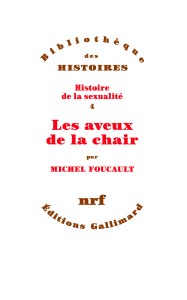
BHI_Foucault_Le_souci_Plat.inddRoger-Pol Droit on Foucault’s Les Aveux de la chair – “Foucault, les mots et les sexes” in Les Echos. There is relatively little about the book itself, and much of this sets the scene through Foucault’s career as a whole. Includes a brief interview with the book’s editor, Frédéric Gros, at the end.

I was at the Paris conference on this book the last few days, which was fascinating and revealing. The book is due for publication on 8 February, though I was able to have a quick look at a copy after the event. I will doubtless say more when it’s actually published.


Posted in Michel Foucault, Uncategorized | Leave a comment

John Lechte’s overview of Kristeva’s work

John Lechte discusses Julia Kristeva’s work in the TLS

Peter Gratton's avatarPHILOSOPHY IN A TIME OF ERROR

At the TLS.

View original post

Posted in Uncategorized | Leave a comment

Launch event for Foucault’s Les Aveux de la chair – Paris, 17 February 2017

Launch event for Foucault’s Les Aveux de la chair – Paris, 17 February 2017 (via Vrin)home_affiche-foucault-site.jpg

Posted in Michel Foucault, Uncategorized | Leave a comment

Frantz Fanon, Alienation and Freedom – translated collection of previously unpublished writings forthcoming from Bloomsbury

9781474250214.jpgFrantz Fanon, Alienation and Freedom – forthcoming from Bloomsbury

Since the publication of The Wretched of the Earth in 1961, Fanon’s work has been deeply significant for generations of intellectuals and activists from the 60s to the present day.

Alienation and Freedom collects together previously unpublished works comprising around half of his entire output – which were previously thought to be lost or inaccessible. This book introduces audiences to a new Fanon, a more personal Fanon and one whose literary and psychiatric works, in particular, take centre stage. These writings provide new depth and complexity to our understanding of Fanon’s entire oeuvre revealing more of his powerful thinking about identity, race and activism which remain remarkably prescient. Shedding new light on the work of a major 20th-century philosopher, this disruptive and moving work will shape how we look at the world.

Posted in Frantz Fanon, Uncategorized | Leave a comment

Subjects of Desire: Foucault’s ‘Aveux de la chair’ and the Roots of Modern Governmentality (2018)

Frustrated that I will miss this…

Clare O'Farrell's avatarFoucault News

Daniele Lorenzini, “Subjects of Desire: Foucault’s ‘Aveux de la chair’ and the Roots of Modern Governmentality”

Research Seminar in Post-Kantian European Philosophy
Tue, Feb 6, 2018 – 5:30pm – 7:30pm (S0.11)
University of Warwick, Department of Philosophy, Social Sciences

View original post

Posted in Uncategorized | Leave a comment

‘Michel Foucault: The Last Interview and Other Conversations’ on ‘indefinite hold’ – anyone know more?

Last year I started seeing notices for a book entitled Michel Foucault: The Last Interview and Other Conversations (for example, see Google Books or Rizzoli Bookstore). Online bookstores list it but do not stock it, and Worldcat suggests no libraries have a copy. It was listed as published by Melville House, but there is nothing on their website.

It always looked a little dubious, likely repacking previously published material in a new form. The publisher has told me that ‘the project is on indefinite hold’, but has provided no other details. Does anyone know the story, or what it was supposed to contain?

Posted in Michel Foucault, Uncategorized | Leave a comment

David Chandler, Ontopolitics in the Anthropocene: An Introduction to Mapping, Sensing and Hacking

9781138570573David Chandler, Ontopolitics in the Anthropocene: An Introduction to Mapping, Sensing and Hacking – now out with Routledge. If you buy direct from Routledge, code FLR40 at checkout will give a 20% discount.

The Anthropocene captures more than a debate over how to address the problems of climate change and global warming. Increasingly, it is seen to signify the end of the modern condition itself and potentially to open up a new era of political possibilities. This is the first book to look at the new forms of governance emerging in the epoch of the Anthropocene. Forms of rule, which seek to govern without the handrails of modernist assumptions of ‘command and control’ from the top-down; taking on board new ontopolitical understandings of the need to govern on the grounds of non-linearity, complexity and entanglement.

The book is divided into three parts, each focusing on a distinct mode or understanding of governance: Mapping, Sensing and Hacking. Mapping looks at attempts to govern through designing adaptive interventions into processes of interaction. Sensing considers ways of developing greater real time sensitivity to changes in relations, often deploying new technologies of Big Data and the Internet of Things. Hacking analyses the development of ways of ‘becoming with’, working to recomposition and reassemble relations in new and creative forms.

This work will be of great interest to students and scholars of international politics, international security and international relations theory and those interested in critical theory and the way this is impacted by contemporary developments.

Posted in Uncategorized | 1 Comment

Alexander Clark and Bailey Sousa, ‘How to be a happy academic’

88807_9781473978805Alexander Clark and Bailey Sousa, How to be a Happy Academic: A Guide to Being Effective in Research, Writing and Teaching. Doubtless some useful advice in here, but what’s with the title? Someone needs to get William Davies to review this…

Want to be an effective, successful and happy academic?  This book helps you hone your skills, showcase your strengths, and manage all the professional aspects of academic life.  With their focus on life-long learning and positive reflection, Alex and Bailey encourage you to focus on your own behaviours and personal challenges and help you to find real world solutions to your problems or concerns.

Weaving inspirational stories, the best of research and theory, along with pragmatic advice from successful academics, this book provides step-by-step guidance and simple tools to help you better meet the demands of modern academia, including:

  • Optimising your effectiveness, priorities & strategy
  • Workflow & managing workload
  • Interpersonal relationships, and how to influence
  • Developing your writing, presenting and teaching skills
  • Getting your work/life balance right.

Clear, practical and refreshingly positive this book inspires you to build the career you want in academia.

Posted in Uncategorized, Universities | Leave a comment

Bernard E. Harcourt, The Counterrevolution: How Our Government Went to War Against Its Own Citizens (out in February with Basic Books)

97815416972871Bernard E. Harcourt, The Counterrevolution: How Our Government Went to War Against Its Own Citizens – out in February with Basic Books.

A distinguished political theorist sounds the alarm about the counterinsurgency strategies used to govern Americans
Militarized police officers with tanks and drones. Pervasive government surveillance and profiling. Social media that distract and track us. All of these, contends Bernard E. Harcourt, are facets of a new and radical governing paradigm in the United States–one rooted in the modes of warfare originally developed to suppress anticolonial revolutions and, more recently, to prosecute the war on terror.
The Counterrevolution is a penetrating and disturbing account of the rise of counterinsurgency, first as a military strategy but increasingly as a way of ruling ordinary Americans. Harcourt shows how counterinsurgency’s principles–bulk intelligence collection, ruthless targeting of minorities, pacifying propaganda–have taken hold domestically despite the absence of any radical uprising. This counterrevolution against phantom enemies, he argues, is the tyranny of our age. Seeing it clearly is the first step to resisting it effectively.

“Bernard Harcourt’s The Counterrevolution offers a masterful look into the deeper logic and long-term consequences of the systemic changes that took place in the United States in the name of the war on terror. Harcourt brilliantly recasts the premises, the terminology, and the consequences of post-9/11 policies of surveillance, detention, torture, and targeted killings in a way that is bound to transform our understanding of our times and to inspire new means of protest and counter-action. The Counterrevolution will no doubt become a must-read for any student of the era.”–Karen J. Greenberg, author of Rogue Justice: The Making of the Security State and editor of The Torture Papers: The Road to Abu Ghraib

“I’m not on board with the premise, and I found something to disagree with on nearly every page, but make no mistake: The Counterrevolution is an important and deeply challenging book. It should be mandatory for anyone who cares about the future of the Republic, especially to challenge those who want to believe, as I do, that we aren’t doomed.”–Noah Feldman, author of The Three Lives of James Madison: Genius, Partisan, President

“As far as I can tell, Bernard Harcourt has never had an uninteresting thought.”–Malcolm Gladwell

“Shattering any notion that the current state of American politics, or today’s uglier practices of exclusion and repression, are either new or temporary, Bernard Harcourt’s The Counterrevolution is searing and indispensable. From this richly researched and powerfully argued account, we come to appreciate the full depth and scope of the crisis we now face in our country. Harcourt’s analysis is brutal and clear: if we don’t fully grasp just how totally our democracy is now compromised, we might never rescue it.”–Heather Ann Thompson, Pulitzer Prize-winning author of Blood in the Water: The Attica Prison Uprising of 1971 and its Legacy

“Bernard Harcourt has written a brilliant and disturbing book, which shows that James Madison was right when he said that ‘no nation could preserve its freedom in the midst of continual warfare.’ The Counterrevolution make a compelling case that the U.S. government is employing the same strategies and weapons that it uses to fight its endless wars abroad to deal with imagined enemies on the home front. This book should be required reading for every American.”–John J. Mearsheimer, University of Chicago


Posted in Bernard E. Harcourt, Politics, Uncategorized | 2 Comments