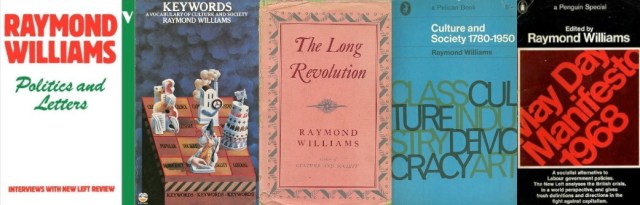
Reflections on Raymond Williams – Part One

Reflections on Raymond Williams, thirty years after his death.

Raymond Williams Society's avatarThe Raymond Williams Society

Welcome to the first of two collected reflections on Raymond Williams to mark 30 years since his death on 26 January 1988. To begin, Patrick Parrinder offers an edited version of a longer diary piece he wrote for the London Review of Books in February 1988. He is the first of six contributors who knew Williams. There are also four contributions from those who didn’t but whose work continues to be shaped and informed by Williams’ modes of critique. Taken together, these reflections offer personal insights into the life of Raymond Williams as an intellectual and teacher as well as marking a point at which, to paraphrase Towards 2000, we can reflect, look forward, and try to see where we are.

rw final

View original post 2,916 more words

Posted in Uncategorized | Leave a comment

Nik Heynen to give the Neil Smith Lecture, 5 February 2018

The Neil Smith Lecture 2018 University of St Andrews, Scotland, UK

Professor Nik Heynen, University of Georgia, USA

Irvine Lecture Theatre, School of Geography & Sustainable Development
3.15-5pm – Monday 5 February 2018,

Followed by a reception 5-6.30pm
All welcome

The Pirates of Racial Capitalism and Abolition Ecology

At a prominent kitchen table on Sapelo Island I was once told that if Edward Teach’s treasure, rumored to be on Blackbeard Island just across a small tidal channel, was recovered it would prevent the remaining Geechee community on Sapelo from further displacement and experiencing cultural genocide. Blackbeard’s treasure was in part generated by his engagement in the Transatlantic slave trade, which matters because Sapelo Island maintains the most in-tact remaining Gullah/Geechee community in the U.S., having been home to eleven generations that directly tie their ancestry to first slaves brought there in 1802. I’ll stretch this kitchen table conversation toward its global implications to show how the last slave ship to illegally unload on U.S. shores did so on Jekyll Island in 1858, just south of Blackbeard and Sapelo Islands. This is the same island that in 1910 JP Morgan, who fashioned himself as a pirate, clandestinely organized a meeting that led to the formation of the U.S. Federal Reserve bank. These historical connections are important because of how robber barons of the gilded age produced a particular kind of nature along the Southeastern U.S. coast through their purchase of land across this distinctly racialized archipelago and their exploitation of “dead labor” invested in the land through slavery. The paper is about the pirates of racial capitalism and the persistent need for abolition ecology amidst their historical wake.
————-
Please address any queries directly to Dan Clayton


Posted in Conferences, Neil Smith, Uncategorized | Leave a comment

editorial posted for first issue of Open Philosophy

Graham Harman’s editorial for the new journal Open Philosophy

doctorzamalek's avatarObject-Oriented Philosophy

You can read my editorial statement HERE.

Calls for papers on various topics will be posted shortly.

View original post

Posted in Uncategorized | Leave a comment

CFP: Foucault and Benjamin (2018)

Call for papers for an issue on Foucault and Benjamin

Clare O'Farrell's avatarFoucault News

CALL FOR PAPERS

materiali foucaultiani journal / Associazione italiana Walter Benjamin

Foucault and Benjamin

Materiali foucaultiani journal and the Italian Association “Walter Benjamin” launch a call for papers dedicated to a comparison between Walter Benjamin and Michel Foucault.

MF journal proposes to open up new research pathways that jointly crisscross the works of Benjamin and Foucault, beyond the philosophical differences between the two authors. Indeed, we contend that despite their different philosophical horizon and conceptual constellations, both Benjamin and Foucault equip us with powerful tools for undertaking a critical analysis of our present time. In both cases, such a critique is carried on through a refusal of the concept of “progress” and of an understanding of history conceived as a linear and incessant process, as an accumulation of events taking place in an empty and heterogeneous time. Although in different ways, Benjamin and Foucault situate their work within a triangulation between…

View original post 267 more words

Posted in Uncategorized | Leave a comment

Jon Tennant, ‘Shit I learned during my PhD’ (via Academia Obscura)

Shit I learned during my PhD‘ (via Academia Obscura)

Some interesting, and at times provocative, advice. Not all relevant to all disciplines, but certainly worth a look. [The original post seems to be unavailable; but can be found here Now fixed]

Jon Tennant just finished his PhD in paleontology. This post originally appeared on Jon’s blog, Fossils and Shit. Follow him on twitter @protohedgehog.

Doing a PhD is one of the greatest trials you will ever experience in your life. It is physically and mentally grueling, you will be challenged and pushed to the limit every single day, and the pressure levels are so high they will bust you right into the sixth dimension if you’re not prepared or strong enough.

So yeah, they are not for the faint of hearted. That is, if you want to succeed by pushing yourself to the limit, excel in everything that you apply yourself to, and grow to become more powerful than you can possibly imagine (compared to the wimpy undergrad you used to be). But I imagine you wouldn’t even be doing a PhD if this wasn’t your mentality anyway.

I’m a strong believer in committing yourself fully to something if you believe in it, and doing everything within your power to achieve your goals. A PhD is basically a 3-4 year long single project that you can, and should, dedicate yourself too. Now that I’m nearing the end of my own challenge, I wanted to share some simple things with you all that might help in some way.


Posted in Uncategorized | 2 Comments

Territory’s Value: An Interdisciplinary Workshop with Charles Maier, Queen Mary, University of London, 14 February 2018

QM Territory14 February 2018, Territory’s Value: An Interdisciplinary Workshop with Charles Maier, Queen Mary, University of London,Francis Bancroft Building, Room 3.26 (see here for a map of the campus).

I’ll be speaking about my forthcoming book Shakespearean Territories.

Registration is free, but required.

A half-day symposium bringing together scholars from across London and the UK to discuss themes of territory and its relationship to political struggle and to the history of the political more broadly. From empire to secessionism to populism, what work does territory do? How is it imagined and reconstructed over time? Professor Maier will respond to the papers presented.

Co-hosted by the Schools of History, Law and Geography and the QMUL Centres for Law and Society in a Global Context (CLGSC) and History of Political Thought(CHPT).

Chaired by Simon Reid-Henry (QMUL)

Participants

Territory and States – Joe Painter (Durham)

Territory beyond Terra – Phil Steinberg (Durham)

Territory and Shakespeare – Stuart Elden (Warwick)

Territory and the International – Benno Teschke (Sussex)

Territory and Contingent Sovereignty – Sara Kendall (Kent)

Territory and Colonialism – Gerry Kearns (Maynooth)

Territory and Borders – Henry Jones (Durham)

Response – Charles Maier (Harvard)

Posted in Boundaries, Conferences, Philip Steinberg, Shakespearean Territories, Territory, Uncategorized | 2 Comments

Advice from Writing Manuals by famous authors

A roundup of advice from Writing Manuals by famous authors. Mainly fiction, but I think academic writing can learn a lot from the process.

There are countless books that purport to teach you how to write. Many of them are good. Some of them are not quite as good. This is the usual way of things. However, I am always most excited to come across a book about writing by an author whose work I already admire. That is, it’s one thing to get advice from a professor or a critic or an editor, but quite another to hear it from someone who has been in the mines and come up with gold—those who can teach and do. To that end, I’ve put together a list of 25 writing manuals and book-length musings on craft from famous authors, along with a bit of advice drawn from each book. An amuse-bouche, you might say. NB that I have excluded anthologies of essays from multiple authors, even if one or more of them (and/or the book’s editor) are famous writers, as well as how-to books by famous authors who are primarily known for their how-to books, like Natalie Goldberg and John Gardner. This list, of course, is ever expanding and incomplete (I see that Dean Koontz published a book on how to write best-sellers, but it’s out of print!), so add on as you see fit below.

Posted in Publishing, Uncategorized, Writing | Leave a comment

Cornell Open – open access out of print Cornell University Press books

Cornell Open – open access out of print Cornell University Press books

Cornell Open is the new global open access portal for classic out-of-print titles from the distinguished catalog of  Cornell University Press. Funded by the newly created Humanities Open Book Program, a collaborative effort between the National Endowment for the Humanities (NEH) and The Andrew W. Mellon Foundation, Cornell Open offers for the first time open access to key titles in literary criticism and theory, German studies, and Slavic studies.

“As America’s first university press we are extremely honored to receive this generous grant from the NEH and Mellon, and expand our role as a leader in open access scholarship through our new Cornell Open initiative,” said Cornell University Press Director Dean Smith. “Our close collaboration with the Cornell University Library and noted scholars in the field has ensured that the Cornell books chosen for this project are ones that will truly make a significant global impact in each of their respective fields.”

“These first open books from Cornell University Press reflect a long-standing legacy of publishing classic scholarship in German Studies and Slavic Studies,” said Brett Bobley, Director of the NEH’s Office of Digital Humanities. “We are pleased that the titles are accessible and open for the next generation of scholars.”

Slated to feature twenty ebooks in its first year, available from both Cornell as well as collaborative partners JSTOR and Project MUSE, Cornell Open aims to expand this list to 150 titles for the Press’s 150th anniversary in 2019.

“Project MUSE is delighted to provide a stable, long-term, and highly functional platform for the digital open access versions of these influential works of scholarship, “ said Wendy Queen, Director of Project MUSE. “The titles enhance our offerings in core humanities and area studies disciplines and our global user base will benefit from unrestricted access to these classic scholarly books.”

Cornell University Library and Press staff began the process of selecting the first twenty books to be digitized with the NEH grant by examining over two decades of the library’s circulation statistics for influential Press titles which are currently out-of-print. Scholars and subject specialists in selected fields were then asked to evaluate the list of prospective titles using both this quantitative data and their own knowledge of research and teaching needs in their specialty areas, to choose those books of greatest continuing interest and relevance.

“As an advocate for open access and sustainable publishing, Cornell University Library is thrilled to see the digital versions of Cornell University Press titles made openly accessible to all readers,” said Anne R. Kenney, Carl A. Kroch University Librarian for the Cornell University Libraries. “Previously available in print form only, the titles selected were not only well received when initially published but remain relevant to scholars and students today.”

“I’m particularly pleased that this initial round of Cornell Open books includes titles that will be important complements to books in our Signale series in Modern German Letters, Cultures, and Thought,” added Kizer Walker, Director of Collections for Cornell University Library, and Managing Editor of the Signale series. “The program will acquaint new readers with three seminal works in criticism, theory, and literary history by Signale’s editor, Peter Uwe Hohendahl, originally published with Cornell Press in the 1980s and ‘90s.”

Posted in Uncategorized | 3 Comments

Readings on Urbicide

A very useful reading list on Urbicide from Ian Shaw at Understanding Empire

understandingempire's avatarUnderstanding Empire: Technology, Power, Politics

Readings on Urbicide

Abujidi, N. (2014). Urbicide in Palestine: Spaces of Oppression and Resilience. Oxon: Routledge.

Adams, N. (1993). Architecture as the target. Journal of the Society of Architectural Historians, 52(4): 389-390.

Berman, M. (1987). Among the ruins. new internationalist, available at https://newint.org/features/1987/12/05/among

Berman, M. (1996). Falling towers: city life after urbicide. In: Crow, D. (ed.) Geography and Identity: Exploring and Living Geopolitics of Identity. Washington: Maisonneuve, pp. 172–192.

Bevan, R. (2005). The Destruction of Memory: Architecture at War. London: Reaktion Books.

Bogdanovic, B. (1993) ‘Murder of the City.’ The New York Review of Books, 40:10. Available: http://www.nybooks.com/articles/1993/05/27/murder-of-the-city/

Campbell, D., Graham, S. and Monk, D. B. (2007). Introduction to urbicide: the killing of cities? Theory and Event 10(2), https://muse.jhu.edu/article/218080

Coward, M. (2006). Against anthropocentrism: the destruction of the built environment as a distinct form of political violence. Review of International Studies 32: 419-437

Coward, M…

View original post 495 more words

Posted in Uncategorized | 1 Comment

Foucault and Nietzsche A Critical Encounter edited by Joseph Westfall and Alan Rosenberg

9781474247399Foucault and Nietzsche A Critical Encounter edited by Joseph Westfall and Alan Rosenberg, due out with Bloomsbury in February 2018. Looks great, but what a shame about the prohibitive price.

Foucault’s intellectual indebtedness to Nietzsche is apparent in his writing, yet the precise nature, extent, and nuances of that debt are seldom explored. Foucault himself seems sometimes to claim that his approach is essentially Nietzschean, and sometimes to insist that he amounts to a radical break with Nietzsche. This volume is the first of its kind, presenting the relationship between these two thinkers on elements of contemporary culture that they shared interests in, including the nature of life in the modern world, philosophy as a way of life, and the ways in which we ought to read and write about other philosophers.

The contributing authors are leading figures in Foucault and Nietzsche studies, and their contributions reflect the diversity of approaches possible in coming to terms with the Foucault-Nietzsche relationship. Specific points of comparison include Foucault and Nietzsche’s differing understandings of the Death of God; art and aesthetics; power; writing and authorship; politics and society; the history of ideas; genealogy and archaeology; and the evolution of knowledge.

Table of contents
AcknowledgmentsIntroduction
Alan Rosenberg (Queens College) and Joseph Westfall (University of Houston-Downtown)

1 ‘Foucault, Nietzsche and the History of Truth’
Paul Patton (UNSW Australia)

2 ‘Nietzsche and Foucault’s “Will to Know”’
Alan D. Schrift (Grinnell College)

3 ‘“We are Experiments”: Nietzsche, Foucault’
Keith Ansell-Pearson (University of Warwick)

4 ‘Nietzsche and Foucault: Modalities of Appropriating the World for an Art of Living’
Alan Rosenberg and Alan Milchman (Queens College)

5 ‘Foucault and Nietzsche: Sisyphus and Dionysus’
Michael Ureand Federico Testa (Monash University)

6 ‘Truth and Becoming Beyond the Liberal Regime’
Jill E. Hargis (California State Polytechnic University, Pomona)

7 ‘Twice Removed: Foucault’s Critique of Nietzsche’s Genealogical Method’
Brian Lightbody (Brock University)

8 ‘The Religion of Power: Between Nietzsche and Foucault’
James Urpeth (University of Greenwich)

9 ‘Nietzsche and Foucault on Power: From Honneth’s Critique to a New Model of Recognition’
João Constâncio and Marta Faustino (Universidade NOVA de Lisboa)

Posted in Uncategorized | 1 Comment