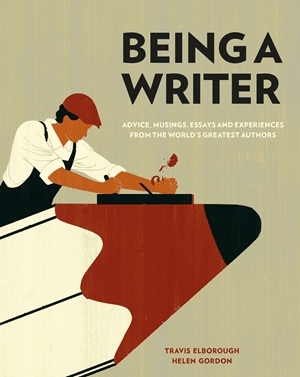
‘Buy a cat, stay up late, don’t drink: top 10 writers’ tips on writing’ in The Guardian

untitled.png‘Buy a cat, stay up late, don’t drink: top 10 writers’ tips on writing‘ in The Guardian from Travis Elborough. Mainly about novels, but much applies to any kind of writing. It comes from their book Being a Writer, published late last year.

Over the past year, Helen Gordon and I have been putting together Being a Writer, a collection of musings, tips and essays from some of our favourite authors about the business of writing, ranging from the time of Samuel Johnson and Grub Street, to the age of Silicon Roundabout and Lorrie Moore.

Researching the book, it quickly became obvious that there isn’t a correct way to set about writing creatively, which is a liberating thought. For every novelist who needs to isolate themselves in a quiet office (Jonathan Franzen), there’s another who works best at the local coffee shop (Rivka Galchen) or who struggles to snatch an hour between chores and children (a young Alice Munro). [continues here]
Posted in Uncategorized, Writing | 1 Comment

Why has submitting a manuscript to a journal become so difficult? A call to simplify an overly complicated process

Why has submitting a manuscript to a journal become so difficult? A call to simplify an overly complicated process – interesting piece at the LSE Impact blog.

It is widely acknowledged that submitting a paper to a journal is a fraught activity for authors. But why should this still be the case? James Hartley and Guillaume Cabanac argue that the process has always been complicated but can, with a few improvements, be less so. By adopting standardised templates and no longer insisting on articles being reformatted, the submission process can quickly be simplified.

The first scientific journal, the Journal des Scavans, was published in Paris in January 1665, hotly pursued by Philosophical Transactions in London in March of the same year. We have come a long way since then – from handwriting to typewriting to electronic submissions.

But some things seem to remain the same. Each submission system creates its own difficulties for authors. And each has its critics. Take, for example, the case of submitting papers to publications of the American Psychological Association. Their “instructions for authors” were first published in six and a half pages in the Psychological Bulletin in 1929. This article was revised in 1944 and 1952 and then book-length revisions were published in 1967, 1974, 1983, 1994, 2001 and 2010. The largest of these editions (2001) contained 29 preliminary pages and 439 pages of instructions. The current 2010 edition initially had to be withdrawn and reprinted because it contained so many errors and confusions. [continues]

Posted in Uncategorized | 1 Comment

15(!) Interdisciplinary Arctic PhD Opportunities at DurhamARCTIC

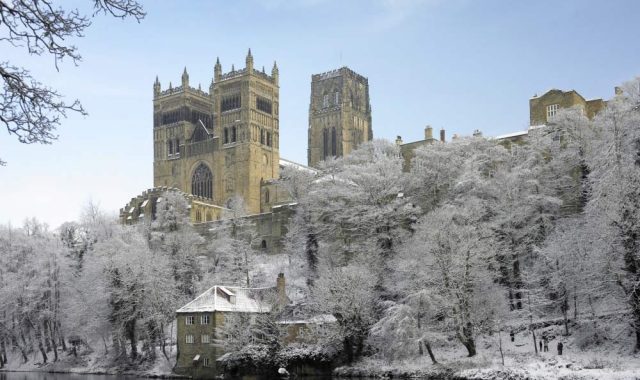
cropped-durham-snow1.jpgExciting news from Phil Steinberg at Durham: 15(!) Interdisciplinary Arctic PhD Opportunities at DurhamARCTIC
I am happy to announce Durham University’s success with a £1.05 million, five-year bid to the Leverhulme Trust to fund 15 PhD students in Interdisciplinary Understanding for a Changing Arctic. Although I took the lead with the grant proposal and will be directing the interdisciplinary training programme, I am indebted to input from colleagues from across the university.

To host the programme, and carry on its legacy after the grant ends in 2023, I am presently establishing a new Doctoral Training Centre at Durham: The Durham Arctic Research Centre for Training and Interdisciplinary Collaboration (DurhamARCTIC). While waiting for the bureaucratic wheels at Durham to (slowly) turn, I’ve established a provisional “unofficial” website for the programme at http://durhamarctic.wordpress.com.

Students in the programme enrol in standard, department-based doctoral programmes, but DurhamARCTIC then provides a number of “extras” including interdisciplinary supervision, colloquia, summer schools, etc., as well as dedicated funds for Arctic placements and research. The application deadline for the first cohort, to enter in Autumn 2018, is 2 February 2018. If you’re interested in applying (or if you know someone who might be interested) please see the programme website for more details regarding DurhamARCTIC’s focus, the extra elements it will provide for students, and the application process.

Flyer with more details – DurhamARCTIC 1-page.

Posted in Uncategorized | Leave a comment

2017 in review: round-up of LSE Impact blog top posts on academic writing

2017 in review: round-up of LSE Impact blog top posts on academic writing

I linked to some of these, but this is a useful summary. Lots more links and discussion on writing and publishing here.

Posted in Uncategorized | Leave a comment

AHR Conversation: Walls, Borders, and Boundaries in World History (open access)

AHR Conversation: Walls, Borders, and Boundaries in World History with Suzanne Conklin Akbari, Tamar Herzog, Daniel Jütte, Carl Nightingale, William Rankin and Keren Weitzberg.

Since 2006, the AHR has published nine “Conversations,” each on a subject of interest to a wide range of historians.1 For each the process has been the same: the Editor convenes a group of scholars with an interest in the topic, who, via e-mail over the course of several months, conduct a conversation, which is then lightly edited and footnoted, finally appearing (with one exception) in the December issue. The goal has been to provide readers with a wide-ranging consideration of a topic at a high level of expertise, in which the participants are recruited across several fields and periods. It is the sort of publishing project that this journal is uniquely positioned to undertake.

This year’s topic, “Walls, Borders, and Boundaries in World History,” has an obvious contemporary relevance, most dramatically in the calls to “Build That Wall” that were a shrill trope in the recent U.S. presidential campaign. Beyond this, the specter of building walls, defending borders, and reasserting boundaries haunts political life in many parts of the world, from the wall separating Israel and the Palestinian territories; to the potential redrawing of the boundaries of several nation-states, as regions—Kurdistan in Afghanistan, Catalonia in Spain—attempt to assert their independence; to the oft-heard pleas for borders to be policed or even closed in the face of what seems to be a worldwide refugee crisis. Contemporary public discourse on this subject is usually cast in moral terms: walls are seen as either good or bad; boundaries and borders are viewed either as regrettable obstacles to the virtues of openness and cosmopolitanism or as necessary to keep out things and people deemed undesirable. Our conversation will certainly attend to the contemporary aspects of our topic, but we want to add a historical perspective to thinking about “walls, borders, and boundaries,” while also remaining alert to the methodological and theoretical problems encountered in attempting to make sense of the many different phenomena and experiences evoked by our topic.

Posted in Boundaries, Territory, Uncategorized | Leave a comment

Top posts on Progressive Geographies in 2017


  1. Walter Benjamin’s thirteen rules for writing
  2. Foucault also struggled to get his students to do the reading…
  3. Delete your academia.edu account… (there are other ways to share your work)
  4. Michel Foucault’s acid trip in Death Valley: Interview with Simeon Wade with great archival photos (updated)
  5. The adjunct crisis – an infographic (2013)
  6. Foucault and Neoliberalism – a few thoughts in response to the Zamora piece in Jacobin (2014)
  7. Why I prioritise writing books over articles, even in an era of research assessment
  8. Foucault, History of Sexuality Vol IV, Les Aveux de la Chair scheduled for January 2018
  9. Where to start with reading Henri Lefebvre? (updated)
  10. My favourite academic books of 2017

I’d also point to some of the pages on the site, rather than just the posts. Notably the resources pages on things like Writing and Publishing, Foucault and so on, which collect a lot of posts by theme.

Posted in Uncategorized | Leave a comment

Cycling Tenerife – a ride from Caletillas to the Mount Teide observatories at Izaña

Over the Christmas and New Year period I was in Tenerife, for a holiday and some cycling. Unfortunately in the second half of the time there I was unwell, and had dizziness and balance problems, so did no further cycling. But in the first half of the time I did a few shorter rides and the big climb I’d been planning to do. This was to ride to the Mount Teide observatories at Izaña. The road reaches 2330 metres above sea level, which is the highest I’ve been on a bike, and the climb began from Caletillas on the north-east coast. It was tough.

This slideshow requires JavaScript.

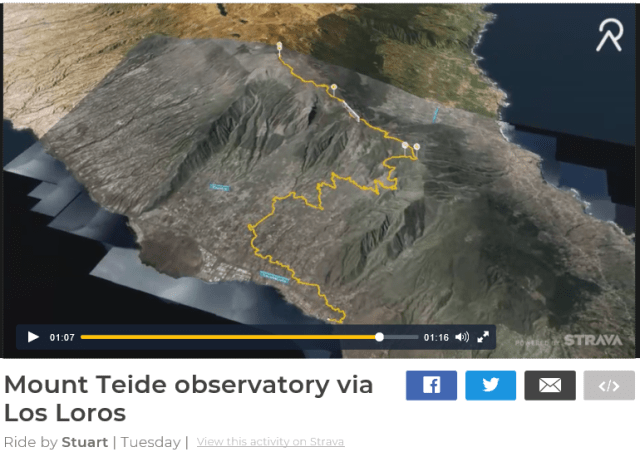
On a previous trip I’d cycled up to the Teide plateau from the southwest of the island. That was very hard, but I think this was tougher. There is a ridge running roughly south-west to north-east from the plateau, and the first part of the challenge was to get onto that. The climb from Afaro to Los Loros is itself an ‘hors catégorie’ climb, and it’s only 11 miles of the total. From there it was about 8 miles to the observatory, marginally easier, but with some drops that you have to reclimb. It was 55 mile ride in total, and I came down the way I went up. If you’re interested, there is a animated map video from relive.cc

relive.png

The Mount Teide volcano itself is much higher, but there is a cable car to the top. The highest point on the paved road can only be reached by descending from where I was into the crater, and then climbing again. But I think it’s only 20 metres higher than the point I reached, and would have added about 20 miles onto the ride. Another time, perhaps.

Posted in Cycling, Travel, Uncategorized | Leave a comment

Derek Gregory’s tribute to Peter Meusburger

187096_1_org_image_ed7b512c0eacd027afa3a5c22da6d207Derek Gregory has a very nice tribute to Peter Meusburger, who died in December.

Posted in Uncategorized | Leave a comment

William V. Spanos (1925-2017)

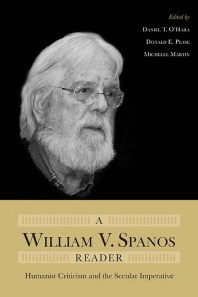
william-v.-spanos-readerLiterary critic and theorist William V. Spanos died on 29th December. His boundary 2 colleague Paul Bové has a brief report here. Although I never met him or heard him speak, I really liked his books Heidegger and CriticismThe Errant Art of Moby-Dick: The Cold War, the Canon, and the Struggle for American Literary Studies and America’s Shadow: An Anatomy of Empire.

Posted in Uncategorized | Leave a comment

Novels and biographies read in 2017

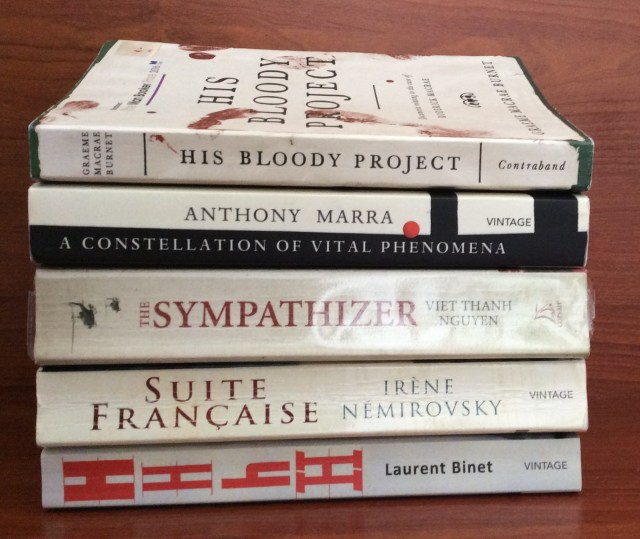
A list of the novels and biographies I read in 2017. For the most part these are the reading I do which is not related to work, though some of the biographies blur that line. A mixed bag, of which a couple of the biographies made my list of favourite academic books. Ones I particularly liked were Still Time, Eight Months on Ghazzah Street, HHhH (though The 7th Function of Language was disappointing), and His Bloody Project. I enjoyed Sher’s diaries, and am looking forward to his King Lear diary this year. I’m starting the new year with Alex Danchev’s biography of Georges Braque, having liked his Cézanne this year. For lists from previous years see here, and for some responses to questions asked about my novel reading see here.

holiday reading

Holiday reading

  1. Haruki Murakami, Pinball, 1973
  2. Salman Rushdie, Two Years, Eight Months and Twenty-Eight Nights
  3. Ben Marcus, Leaving the Sea: Stories
  4. Alexandre Koyré, The Astronomical Revolution: Copernicus, Kepler, Borelli (non-fiction)
  5. Cecilia Ekbäck, Wolf Winter
  6. Francis Hardinge, The Lie Tree
  7. Robert E. Lerner, Ernst Kantorowicz: A Life (biography)
  8. A.D. Miller, Snowdrops
  9. Paul Griffiths, The Sea on Fire: Jean Barraqué (biography)
  10. Alena Graedon, The Word Exchange
  11. Stuart Jeffries, Grand Hotel Abyss: The Lives of the Frankfurt School (biography)
  12. Brian Friel, Translations (play – a gift)
  13. Eric Hazan, A People’s History of the French Revolution (non-fiction)
  14. Tom Rob Smith, Child 44
  15. Lisa McInerney, The Glorious Heresies
  16. Mario Reading, The Nostradamus Prophecies
  17. Graeme Simsion, The Rosie Project
  18. Susanna Jones, The Earthquake Bird
  19. Tess Gerritson, Bloodstream
  20. Andrew Smith, Moon Dust: In Search of the Men who Fell to Earth (non-fiction)
  21. Gabriella Coleman, Hacker, Hoaxer, Whistleblower, Spy: The Many Faces of Anonymous (non-fiction)
  22. Jean Hegland, Still Time
  23. Linda Herrara, Revolution in the Age of Social Media: The Egyptian Popular Insurrection and the Internet (non-fiction)
  24. Jonas Jonasson, The Girl who Saved the King of Sweden
  25. Jon Krakauer, Into the Wild (non-fiction)
  26. Dot Hutchinson, The Butterfly Garden
  27. S.J. Watson, Before I go to Sleep
  28. David Downing, Masaryk Station
  29. Sarah Lotz, The Three
  30. Celeste Ng, Everything I Never Told You
  31. Hilary Mantel, Eight Months on Ghazzah Street
  32. Catherine McKenzie, Hidden
  33. Jan Rothuizen, The Soft Atlas of Amsterdam (non fiction)
  34. Isabel Allende, The Japanese Lover
  35. Ray Monk, Wittgenstein: The Duty of Genius (biography)
  36. Gabrielle Ferrières, Jean Cavaillès: A Philosopher in Time of War, 1903-1944 (biography)
  37. Francoise Gilet, Life with Picasso (autobiography)
  38. Jeannette Winterson, Gut Symmetries
  39. Val McDermid, Splinter the Silence
  40. Anne Holt, 1222
  41. Julian Young, Friedrich Nietzsche: A Philosophical Biography
  42. Vena Cork, The Lost Ones
  43. Saskia de Bodt, Children of Holland::The Image of the Netherlands in American Children’s Books (non-fiction – a gift)
  44. Aoife Clifford, All These Perfect Strangers
  45. Shari Lapena, The Couple Next Door
  46. Emily St John Mandel, Station Eleven
  47. Alex Danchev, Cézanne: A Life (biography)
  48. Trevor Noah, Born a Crime: Stories from a South African Childhood (autobiography – a gift)
  49. Deborah Levy, Hot Milk
  50. Ali Smith, How to be Both
  51. David Lagercrantz, The Girl in the Spider’s Web
  52. Iris Murdoch, The Bell
  53. Gillian Flynn, Gone Girl
  54. Sam Baker, The Woman who Ran
  55. Laurent Binet, The 7th Function of Language
  56. Sibylle Lacan, Un père: Puzzle (memoir)
  57. Claire Mackintosh, I See You
  58. Anna Castle, Murder by Misrule
  59. Antony Sher, Year of the Fat Knight: The Falstaff Diaries (non-fiction)
  60. Graeme Mcrae Burnet, The Disappearance of Adèle Bedeau
  61. Antony Sher, Year of the King: An Actor’s Diary and Sketchbook (non-fiction)
  62. Andy Weir, The Martian
  63. Alison Lurie, The War Between the Tates
  64. China Mièville, October: The Story of the Russian Revolution (non-fiction)
  65. Fiona Barton, The Child
  66. Elisabeth Roudinesco, Freud in His Time and Ours (biography)
  67. David Szalay, All That Man Is
  68. Julian Barnes, The Noise of Time
  69. John le Carré, Call for the Dead
  70. Laurent Binet, HHhH
  71. Irène Némirovsky, Suite française
  72. Viet Thanh Nguyen, The Sympathiser
  73. Graeme Macrae Burnet, His Bloody Project: Documents relating to the case of Roderick Macrae
  74. John le Carré, The Spy who Came in from the Cold
  75. Anthony Mara, A Constellation of Vital Phenomena
Posted in Novels read, Uncategorized | Leave a comment