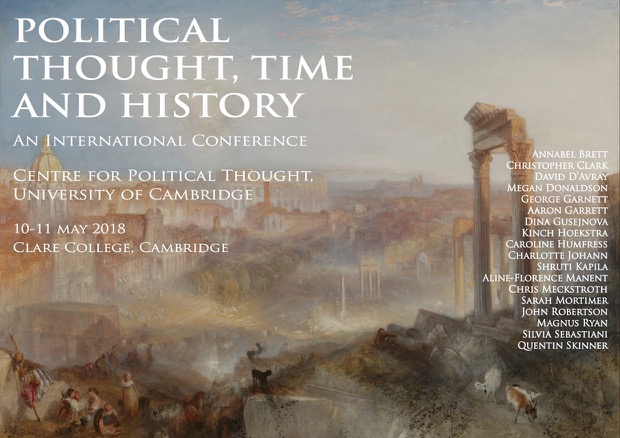
Political Thought, Time and History: An International Conference – Cambridge, 10-11 May 2018

Conference Poster -Final- copy 2

Full details and programme heherere.

It is easy to assume that political thought is bound up with time and history.  To most historians, time and history are obvious dimensions of politics; politics occur in contexts which are temporal and historical, and must be studied by reference to the evidence provided by those contexts.  Periodically historians have questioned whether temporality should be regarded as uniform; recently, there has been much interest in the thesis that ‘modernity’ entailed a new understanding of time.  But whether that understanding, and the understandings of time in pre-modern eras, are thought of as belonging to contemporaries and shared by all those who thought about politics, or are conceived rather as heuristic models, is often unclear.  The debate hovers uncertainly between intellectual history and historical methodology.

Political philosophers, however, have never taken time and history for granted.  Whether temporality is a necessary or normative foundation for the concept of the civitas, the state, whether political concepts require to be inserted into a historical narrative to be effective are questions to which they have returned very different answers.  A Machiavelli might hold politics governed by an inherently temporal ‘necessity’, and insist that political agency be assessed in its specific historical outcomes.  But a Hobbes or a Rousseau would create a foundation for the state which deliberately limited the scope for time to make a difference, and which would be valid independent of historical circumstance.  A similar division may be found among the jurists.  Exponents of customary law argued from prescription, while Roman jurists explored the adaptability of concepts codified for the inhabitants of the Roman Empire to the post-Roman world of multiple kingdoms and city-states.  But other jurists set aside time by preferring first principles to prescription, or by making historical examples support accounts of natural law as the universal, supratemporal embodiment of civilised sociability.  Viewed as the study of ‘languages’, the history of political thought has found itself studying many languages to which time and history are essential – but many too which diminish or exclude them.

The aim of this conference will be to explore the variety of engagements with time and history found in political thinkers, the better to understand (and, perhaps, to explain) why political philosophy has been unable to take these concepts for granted.  Themes of individual sessions will include Time and the State, the temporal and historical perspectives available to political thinkers following the fall of the Roman Empire, time in customary and Roman legal traditions, the temporalities of civil and sacred history in the early modern period, the conceptual status of Enlightenment ‘stadial history’ and what it contributed to the understanding of society and government, the time of ‘modern’ politics, in the nineteenth and again in the twentieth centuries, and whether a political thought ‘global’ in time and history is conceivable.  It will end with a reassessment of time in the history of political thought itself: what understandings of time should govern our engagement with the political and legal thought of the past, whether remote or still close at hand?  Must they be adapted if the history of political thought is, as many of its foremost practitioners have hoped, to enhance political philosophy itself?  The conference is organised under the aegis of the Cambridge Centre for Political Thought and the University’s Faculty of History.


Posted in Conferences, Quentin Skinnner, Uncategorized | Leave a comment

When did Foucault translate Leo Spitzer?

Reposting this query as it still doesn’t make sense. Either Foucault did his one translation from English when he was already famous, and of a text he doesn’t seem to be much in sympathy with, AND Macey, Bernauer, Lagrange, and Clark are all wrong. Or there really is a 1962 version of the Spitzer text, which I’ve been unable to find, despite extensive searching.

stuartelden's avatarProgressive Geographies

Spitzer.jpgOne of the few translations made by Michel Foucault, and perhaps the most unusual, was an essay by literary theorist Leo Spitzer.
It was published as “Arts du langage et linguistique”, in Leo Spitzer,Etudes de style, Paris: Gallimard, 1970, pp. 45-78. (There are several other pieces in there, translated by others. The text has since been reissued in the Tel series.) Daniel Defert’s ‘Chronology’ dates the publication to 21 January 1970.

The original text was “Linguistics and Literary History”, in Leo Spitzer, Linguistics and Literary History: Essays in Stylistics, Princeton: Princeton University Press, 1948, pp. 1-39.

The original was written in English, even though Spitzer had written most of his earlier work in German. All of the other translations by Foucault were from German to French, so this is unusual in being from English to French.

The other issue which I think is interesting is the date of the translation. The 1970…

View original post 420 more words

Posted in Uncategorized | Leave a comment

Drone Imaginaries and Society, Odense, June 5-6 2018

Drone Imaginaries and Society – full details here (via Geographical Imaginations)

University of Southern Denmark, June 5-6, 2018
Room Sky (Odense Campus College)

Organizer:
  • Kathrin Maurer (Phd, Dr. Phil)
    Associate Professor of German Studies
    kamau@sdu.dk
Keynote Speaker:
  • Derek Gregory: Peter Wall Distinguished Professor of Geography at the University of British Columbia and author of Violent Geographies: Fear, Terror, and Political Violence (Routledge)

Drones are in the air. The production of civilian drones for rescue, transport, and leisure activity is booming. The Danish government, for example, proclaimed civilian drones a national strategy in 2016. Accordingly, many research institutions as well as the industry focus on the development, usage, and promotion of drone technology. These efforts often prioritize commercialization and engineering as well as setting-up UAV (Unmanned Arial Vehicle) test centers. As a result, urgent questions regarding how drone technology impacts our identity as humans as well as their effects on how we envision the human society are frequently underexposed in these initiatives.

Our conference aims to change this perspective. By investigating cultural representations of civilian and military drones in visual arts, film, and literature, we intend to shed light on drone technology from a humanities’ point of view. This aesthetic “drone imaginary” forms not only the empirical material of our discussions but also a prism of knowledge which provides new insights into the meaning of drone technology for society today.

Several artists, authors, film makers, and thinkers have already engaged in this drone imaginary. While some of these inquiries provide critical reflection on contemporary and future drone technologies – for instance issues such as privacy, surveillance, automation, and security – others allow for alternative ways of seeing and communicating as well as creative re-imagination of new ways of organizing human communities. The goal of the conference is to bring together these different aesthetic imaginaries to better understand the role of drone technologies in contemporary and future societies.

Posted in Conferences, Derek Gregory, Uncategorized | Leave a comment

E-IR introductory textbook on International Relations Theory (open access)


timthumbInternational Relations Theory

Available now on Amazon (USA, UK, Ca, Fra, Ger), in all good book stores, and via a free PDF download. Kindle, iBook and other e-reader versions are available via the relevant stores/apps.
This book is designed as a foundational entry point to International Relations theory. The first half covers the established theories that are most commonly taught in undergraduate programmes. The book then expands to present emerging approaches and offer wider perspectives. Each chapter sets out the basics of a theory whilst also applying it to a real-world event or issue. This format creates a lively, readable and relevant guide that will help students to see not only what theories are, but why they matter.

Edited by: Stephen McGlinchey, Rosie Walters and Christian Scheinpflug.

Contributors: Victor Adetula, Amitav Acharya, Sandrina Antunes, Lina Benabdallah, Isabel Camisão, Irena Leisbet Ceridwen Connon, Jeff Corntassel, Alix Dietzel, Hugh C. Dyer, Clara Eroukhmanoff, Marcos Farias Ferreira, Dana Gold, Richard Ned Lebow, Aishling Mc Morrow, Jeffrey W. Meiser, Carlos Murillo-Zamora, Sheila Nair, Maïa Pal, Alex Prichard, Felix Rösch, Archie W. Simpson, Sarah Smith, Yannis A. Stivachtis, Sarina Theys, Markus Thiel, Marc Woons and Pichamon Yeophantong.E-R

Posted in Uncategorized | Leave a comment

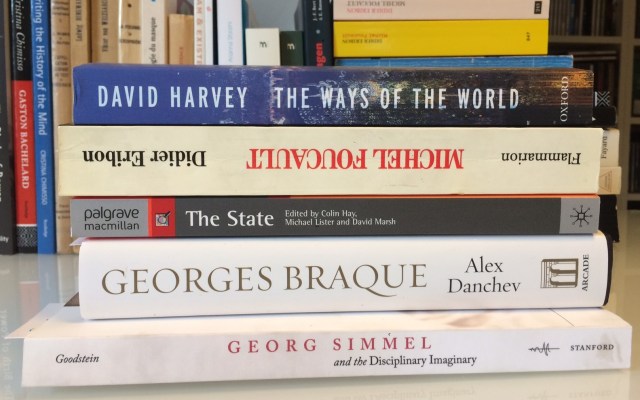
Books received – Harvey, Eribon, Hay, Lister & Marsh, Danchev, Goodstein

David Harvey’s The Ways of the World; the first edition of Didier Eribon’s biography of Foucault; Colin Hay, Michael Lister and David Marsh (eds.) The State: Theories and Issues; Alex Danchev’s biography of Georges Braque; and Elizabeth Goodstein’s Georg Simmel and the Disciplinary ImaginationIMG_3001

Posted in David Harvey, Uncategorized | 2 Comments

Foucault’s Last Decade reviewed at Manchester Review of Books

I’ve been rather preoccupied the last few days with hosting the second Territory workshop of the ICE-LAW project, of which more later. But I’ve just se9780745683911en this very nice review of my 2016 book Foucault’s Last Decade in Manchester Review of Books.

Stuart Elden – Foucault’s Last Decade (Polity).
Stuart Elden is an outstanding academic and a great writer, combining a high degree of scrupulousness in research with an accessible and assured style. Foucault always seems to arrive obscured by a fog of sensation, stories of saunas and acid trips, self-mutilation and other ‘excesses’.

But this holds a mirror up to everything else, rather than telling us much about Foucault. It tells us that we live in an age in which information will fly with spectacle and sensation or it will dive below the altitude of detection.

There is gladly none of this here and you can read The Passion of Michel Foucault by James Miller if you want that.

Elden begins with one brief paragraph of relevant biography before moving on to The Work. He tells us that in 1974 Foucault finished Discipline and Punish and on the very same day he began the History of Sexuality, Volume One. In 1984 he was dead.

In those ten years there was a huge shift, a large amount of new beginnings and, because of Foucault’s death, a lot of loose ends. Elden works meticulously and fascinatingly through these. His ability to keep such arcana within a highly engaging narrative is at times quite miraculous. [continues here]

Posted in Foucault's Last Decade, Michel Foucault, Uncategorized | Leave a comment

Special issue on “Power and Space in the Drone Age”

Open access special issue on “Power and Space in the Drone Age” in Geographica Helvetica

Jeremy's avatarOpen Geography

graphic_gh_cover_homepage

A special issue on “Power and Space in the Drone Age” is available (open access) from the journal Geographica Helvetica.

The list of contents is below and includes my own paper “Assemblage of the vertical: commercial drones and algorithmic life.” The papers were assembled following an amazing workshop organized and hosted by Francis Klauser and Silvana Pedrozo. Thanks to them and my fellow workshoppers for a productive and memorable event!

Special issue

Power and space in the drone age. Editor(s): B. Korf and F. Klauser | Theme issue coordinator: F. Klauser and S. Pedrozo
F. Klauser and S. Pedrozo
Geogr. Helv., 70, 285-293, https://doi.org/10.5194/gh-70-285-2015, 2015
Francisco Klauser and Silvana Pedrozo
Geogr. Helv., 72, 231-239, https://doi.org/10.5194/gh-72-231-2017, 2017

View original post 174 more words

Posted in Uncategorized | Leave a comment

ScholarlyHub – Scholars launch crowdfunding campaign for non-profit academic platform


ScholarlyHub has launched a crowdfunding campaign to build a new, multi-disciplinary open-access platform for scholarly communications. It aims to boost interaction among scholars and enhance their ability to share their work with the public at large, free from the constraints placed by publishing conglomerates and myopic government policies. ScholarlyHub will be an inclusive but critical space where curiosity and creativity can flourish and where scholars’ independence is protected for their own benefit and that of society at large.This non-profit platform will redefine social networks for scholars. The major academic social networking sites have been backed by venture capitalists, whose primary goal to profit from scraping and selling scholars’ data. ScholarlyHub, by contrast, is committed to scholarship, not profit. It aims to repair an unjust academic system and a global disparity in access to research, which is often publicly funded. By creating a member-run social network, ScholarlyHub will become a sustainable alternative for bringing scholars closer together in an increasingly fragmented academic landscape.

ScholarlyHub is an Amsterdam-based foundation supported by a diverse network of people from a wide range of backgrounds and experiences. Once fully developed, the site will offer a broad range of services, including personal pages, an open-access repository, data storage, job and conference wikis, mentorship programs, teaching aids and access to a variety of review and publishing protocols. ScholarlyHub will never sell users’ data and will always be run for and by its community.

Guy Geltner, founder and community director of the platform, says: “It’s time to create a truly inclusive space; one that lets scholars define quality research without being enslaved by irrelevant metrics, ends the absurdity of conglomerate publishers earning billions on the back of free labor, and prevents data merchants from turning human curiosity into yet another product.”

To know more about ScholarlyHub please visit: www.scholarlyhub.org

Contact
Mail: open@scholarlyhub.org
Phone: 0031205254662
Site: www.scholarlyhub.org
Social media: https://twitter.com/ScholarlyHub https://www.facebook.com/ScholarlyHub/

ScholarlyHub in the media:
https://www.timeshighereducation.com/news/scholars-form-non-profit-rival-to-researchgate
https://www.insidehighered.com/news/2017/11/09/scholars-plan-nonprofit-alternative-researchgate
http://www.researchresearch.com/news/article/?articleId=1371337

Posted in Publishing, Uncategorized | Leave a comment

Books received – Wilson, Beer, Park and Kaplan, Sullivan, Roudinesco, Mattern

untitled

A pile of recent books – Matthew Wilson, New Lines: Critical GIS and the Trouble of the Map; David Beer, Metric Power; Lisa Parks and Caren Kaplan (eds.), Life in the Age of Drone Warfare; Rob Sullivan, The Geography of the Everyday; Elizabeth Roudinesco, Freud: In His Time and Ours and Shannon Mattern,  Code and Clay, Data and Dirt. Metric Power was recompense for review work and I bought the Roudinesco. The others were sent by their publishers.

Posted in Caren Kaplan, Sigmund Freud, Uncategorized | Leave a comment

David Harvey, The Ways of the World – now published (and in paperback), and open access extract

Now available in paperback – UK and US

stuartelden's avatarProgressive Geographies

9781781255315_26David Harvey, The Ways of the World is now published, and an open access extract is available here.

This book presents a sequence of landmark works in David Harvey’s intellectual journey over five decades. It shows how experiencing the riots, despair and injustice of 1970s Baltimore led him to seek an explanation of capitalist inequalities via Marx and to a sustained intellectual engagement that has made him the world’s leading exponent of Marx’s work. The book takes the reader through the development of his unique synthesis of Marxist method and geographical understanding that has allowed him to develop a series of powerful insights into the ways of the world, from the new mechanics of imperialism, crises in financial markets and the effectiveness of car strikers in Oxford, to the links between nature and change, why Sacré Coeur was built in Paris, and the meaning of the postmodern condition. David…

View original post 17 more words

Posted in Uncategorized | Leave a comment