Jo van Every on ‘using all three types of writing time’, and some thoughts

The always interesting and useful Jo van Every has a post on using all three types of writing time. These range from ‘full days’, to ‘longish periods’, to ‘short snatches of time’.

I think this is helpful – too many people seem to get into a habit of only thinking they can write if a whole day or more stretches ahead of them (and then sometimes feel so daunted by it they get little done). I think Jo is right to say that four hours in a full day is probably about right, with six as a maximum. Few people seem to be able to sustain the intensity of writing for that long – though it of course depends on what you mean by writing. I will frequently work for far longer than six hours on a full writing day, and on that project alone, but it’s not always what everyone would see as writing in a narrow sense.

The ‘longish periods’ are also important. Jo describes these as ‘meetings’ with your writing – perhaps of one or two hours, in a day filled with other things. Last academic year I tried to write for two hours before I went into work each day – not always successful, but more often than not it was, and it did pay off. With term fast approaching I’m going to try to do the same thing again. Blocking this into a calendar/diary is, I think, important. Last year I tried hard to protect the early morning; other times I’ve needed to be more flexible. I’ve said before how at my busiest, when someone else could schedule meetings in my diary, I insisted that while these writing slots could move around to accommodate other things, they could not be deleted.

Perhaps most important in the post is the suggestion that you can do something useful in even short bursts – 10 to 30 minutes. As with the ‘longish periods’, it’s a lot easier to get back into a project quickly if it is only a day or two since you last worked on it. If it’s a week or more, waiting for that ‘clear day’, then it can take a while to get going again, and the time slot may have gone. Jo insists on the idea of ‘moving your writing and research projects forward in tiny increments’, and remaining engaged with it. I’d really stress her point about how writing a note on what to do next at the end of one session can be a useful spur at the beginning of the next.

If you believe that anything that moves the writing forward counts, then when not feeling so inspired you can fill these little periods of time with mechanical tasks – references, checking style guides, downloading articles, sourcing books, etc. See also her good post asking ‘Is tidying your desk procrastination?

Jo has another good recent post on ‘Maintaining your writing practice when things get busy‘ which is also helpful, there is loads of other good advice on her site and I should recommend, again, her little book The Scholarly Writing Process.


There are lots of other posts and links on writing and publishing from Progressive Geographies archived here. Some of these link to other people’s advice or suggestions; some to my own.

Posted in Uncategorized, Writing | 1 Comment

Foucault’s inaugural lecture at the Collège de France – audio re-recording

738_foucaultokLeçon inaugurale de Michel Foucault – L’ordre du discours

Quelle est cette volonté de vérité dans nos discours, qui a traversé tant de siècles de notre histoire ? demande Michel Foucault dans sa leçon inaugurale. Qu’est ce qui est en jeu, sinon le désir et le pouvoir? Quelles sont les procédures de contrôles et de délimitation du discours?

https://www.franceculture.fr/player/export-reecouter?content=23619276-1b2b-43d1-93ba-5e3ca08ac882 [update: the audio is no longer available; see here]

This isn’t nearly as interesting as I’d imagined when I found the link. Foucault’s inaugural lecture at the Collège de France from 2 December 1970 has been re-recorded by Léon Bonnaffé. As far as I am aware, there are no recordings of the original lecture, which is a shame for two reasons – first, obviously it would be nice to be able to hear Foucault give the talk; but also because the version published as L’ordre du discours is not the text as actually delivered, as it includes some additional passages.

However, at the beginning of this recording, there is a short snippet of Foucault himself speaking, talking about the role of professors at the Collège de France .

There are many audio and video recordings of Foucault found in various places online. I’ve tried to compile all these and put them in chronological order on a page on this site.

Posted in Michel Foucault, Uncategorized | 2 Comments

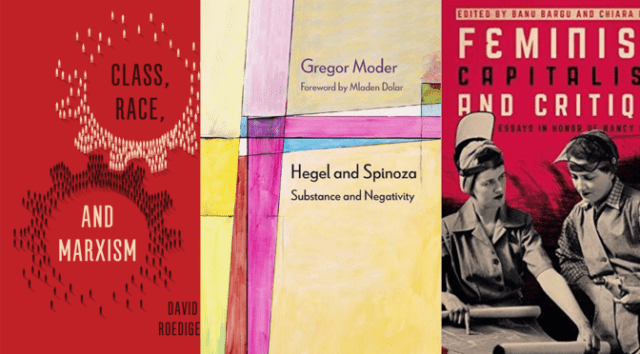
5 Critical Theory books that came out in July 2017

A useful roundup of some recently-published books

Posted in Uncategorized | 2 Comments

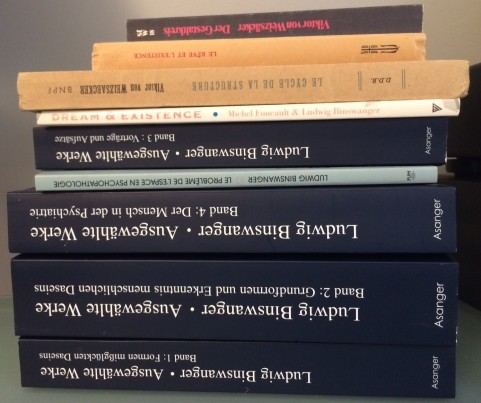
Books received – Eribon, von Weizsäcker, Althusser, Žižek, Wyrsch, Foucault, Funnell & Dodds, Bier

Some recently received books – Eribon, von Weizsäcker, Wyrsch, Bochner & Halpern, and The Cambridge Companion for the research on the early Foucault, plus Althusser, Žižek and Lisa Funnell & Klaus Dodds’s Geographies, Genders and Geopolitics of James Bond in recompense for review work, and Jess Bier’s Mapping Israel, Mapping Palestine sent by the publisher.

Posted in Michel Foucault, The Early Foucault, Uncategorized | Leave a comment

Gary Shapiro, Nietzsche’s Earth: Great Events, Great Politics reviewed at NDPR

9780226394459Gary Shapiro, Nietzsche’s Earth: Great Events, Great Politics is reviewed at NDPR by Gabriel Zamosc.

This book offers a valuable and provocative contribution to the growing literature on Nietzsche’s political philosophy. It invites us to understand Nietzsche’s politics as consisting mainly in a kind of political programcalling for a radical transformation of our earthly habitation. On Shapiro’s reading, this program principally requires reconceiving our relation to temporality, and, in particular, to the future, by cultivating a kind of openness that can make us receptive to those rare opportunities for radical change Nietzsche called “great events”. Nietzsche’s politics of futurity, however, requires displacing the way of thinking prevalent in the petty politics of nation-states. In each chapter, Shapiro investigates different aspects of Nietzsche’s critiques of this way of thinking, trying to articulate, at the same time, its positive alternative.

Posted in Friedrich Nietzsche, Uncategorized | Leave a comment

Recent book reviews in Antipode – open access

Recent book reviews in Antipode – all open access

Sophie Gonick (New York University) on Matt Hern’s What a City Is For: Remaking the Politics of Displacement;

Simone Tulumello (Universidade de Lisboa) on Marco Allegra, Ariel Handel and Erez Maggor’s Normalizing Occupation: The Politics of Everyday Life in the West Bank Settlements;

Miriam Williams (Macquarie University) on Ana Cecilia Dinerstein’s Social Sciences for an Other Politics: Women Theorizing Without Parachutes;

Amy Starecheski (Columbia University) on three books about gentrification: D.W. Gibson’s The Edge Becomes the Center; Peter Moskowitz’s How to Kill a City; and John Joe Schlichtman, Jason Patch and Marc Lamont Hill’s Gentrifier;

Posted in Uncategorized | Leave a comment

A week of cycling in Provence, including Mont Ventoux

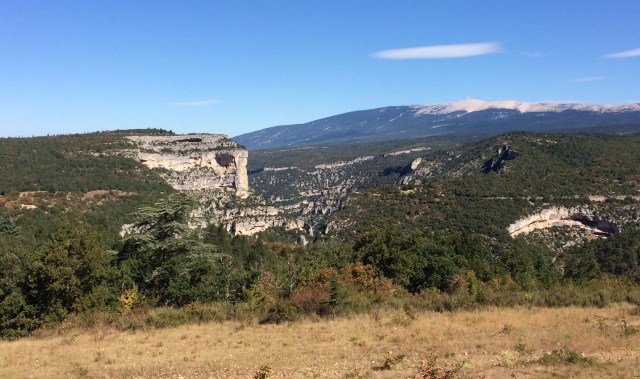
Back from a great week of cycling in Provence, including an ascent of Mont Ventoux, and a 100km ride doing a complete circuit of it. Sunny and warm, although the Mistral made the first few days quite windy. It’s also a great region for wine. Now back to rain and a return to the early Foucault work

gorges-and-ventoux1.jpeg

looking toward Mont Ventoux from Saint Hubert, with the Gorges de la Nesque in between

Posted in Cycling, Travel | Leave a comment

Umberto Eco intervista Michel Foucault (video)

Archive footage of a 1968 discussion between Foucault, Umberto Eco and Enzo Melandri. Although Foucault responds in French, he is dubbed into Italian and it’s hard to hear what he says. As the comment included in the post notes, it would be interesting to know if there is a longer version of this video anywhere – especially if the original French is audible.

I’ve added this to the list of Foucault audio and video recordings available online – https://progressivegeographies.com/resources/foucault-resources/foucault-audio-and-video-recordings/

The video was removed, but is now available here. Thanks to Philippe Theophanidis for this link.

https://www.youtube.com/watch?v=I_WQzNGbG9U

Clare O'Farrell's avatarFoucault News

From one of the comments
L’incontro è avvenuto a Milano nel 1968, organizzato da Eco e da Enzo Melandri, che è il primo degli intervistatori in questo breve video. Una foto dell’incontro è stata inserita nella riedizione Quodlibet di “La linea e il circolo” di Enzo Melandri. Eco e Melandri scommisero una birra su come Foucault avrebbe pronunciato “episteme”: alla francese, secondo Melandri, o alla greca, secondo Eco (vinse Melandri). L’incontro non fu organizzato per caso: Melandri, assieme a Celati, Calvino, Carlo Ginzburg, e altri, lavoravano al progetto di una rivista incentrata sul concetto di “archeologia”, che purtroppo non andò in porto (sia Celati che Calvino hanno scritto un saggio che ruota attorno all’archeologia: si tratta dei materiali di discussione del progetto). Inoltre, Melandri stava scrivendo “La linea e il circolo”, nel quale si confronta anche con Foucault.
Sarebbe interessante sapere da dove proviene questo video, e se è disponibile…

View original post 4 more words

Posted in Uncategorized | Leave a comment

The Early Foucault update 9: from Shakespeare back to Foucault and Canguilhem

IMG_2710.JPGI’ve spent most of the first half of the summer revising my Shakespeare manuscript, which is now resubmitted. But I have been doing a little work on the early Foucault in the meantime, and on Canguilhem. With the latter, much of the work has been reference checking from the extensive notes I took on his work while I was in Amsterdam. Canguilhem references a lot of historical texts in biology and medicine, and I wanted to check all of his quotations at a minimum. I discussed some of the reasons why this was important, and challenging, here. Some of this work was done in Paris, and also at various libraries in London – the British Library, Senate House and the Wellcome Trust.

The reason I was in Paris was for another short visit to the Bibliothèque Nationale, where I worked through some more boxes of Foucault material. These concerned some thematically organized boxes of lectures and manuscripts on art, literature, criminology and madness. Some of the texts here have been published in the last several years; others are planned for the future. Only a few relate to the period I’m currently working on, but it’s clear that Foucault wrote quite a lot which he didn’t publish, and not all of this was delivered as a lecture. There are carefully written, and sometimes typed, texts, which it seems just were left to gather dust.

On the final day of this trip I made an initial survey of a box of materials relating to his early lecture courses at Lille. There are plans to publish at least one course from this period. Jacques Lagrange’s student notes are archived at IMEC, and there are some discussions of this material in works by Elisabetta Basso and Philippe Sabot, among others. Some of these courses were repeated at the ENS in Paris. I’ll need more time with this material, though I’m also hoping that a schedule for the publication of the pre-Collège de France courses will become available soon.

While I still have a lot of research to do, and expect this to go on for more than a year, I have spent some time beginning to write up some sections. So I have the draft of a chapter on Foucault’s teachers, a section on his time in Uppsala, a bit on the intellectual side of his relationship with Barraqué, and about half a chapter on his work translating Binswanger and von Weizsäcker. Each of these will need much more work, but little bits of the book are beginning to take shape. Now for a holiday, and then when I return I hope to make a bit more progress before the summer ends.


The previous updates on this project are here; and Foucault’s Last Decade and Foucault: The Birth of Power are now both available from Polity. Several Foucault research resources such as bibliographies, short translations, textual comparisons and so on are available here. On the Canguilhem project, see this page.

Posted in Canguilhem (book), Georges Canguilhem, Ludwig Binswanger, Michel Foucault, Shakespearean Territories, The Early Foucault, Uncategorized, William Shakespeare | 2 Comments

Phoebe Moore’s new book: The Quantified Self in Precarity: Work, Technology and What Counts

More information on Phoebe Moore’s forthcoming book.

Quantified Worker's avatarPhoebe V Moore

My next book is about to come out. Published by Routledge, this is the summation of about four years of work I have been doing on the quantified self at work. The Quantified Self in Precarity: Work, Technology and What Counts is the state of the art text on how technology and the use of technology for management and self-management changes the ‘quantified’, precarious workplace today.

Humans are accustomed to being tool bearers, but what happens when machines become tool bearers, where the tool is seemingly ever more precise in its calculation about human labour via the use of big data and people analytics by managements? Data, as quantified output, is treated as a neutral arbiter and judge, and is being prioritised over qualitative judgements in ‘agile’ key performance indicator management systems and digitalised client based relationships. From insecure ‘gig’ work to workplace health and wellness initiatives in office work…

View original post 1,335 more words

Posted in Uncategorized | 2 Comments