Publishing Strategies as an ECR @ PhD Publishing workshop 5th July 2016

Charlotte Mathieson with some very useful advice for early-career researchers.

Charlotte Mathieson's avatarDr Charlotte Mathieson

This workshop hosted by Newcastle University’s International Centre for Cultural & Heritage Studies focused on publishing and peer-reviewing for early career researchers. I presented on publishing strategies – how you can make best use of your time to get the most out of your research in the hectic post-PhD years. My slides from the event are here and below are my notes from the session.

“From publish or perish, to publish and thrive”: developing a publication strategy as an ECR 

This talk aims to you thinking about how you create a publishing strategy in the later and post-PhD stages in order to make the most of your time, get the best out of your publications, and make yourself employable as you do so.

“Publish or perish” is an oft-cited phrase in academia; you need to publish to get ahead. But there’s a sense of negativity implicit in this phrase, and talk of publishing often…

View original post 2,089 more words

Posted in Uncategorized | 6 Comments

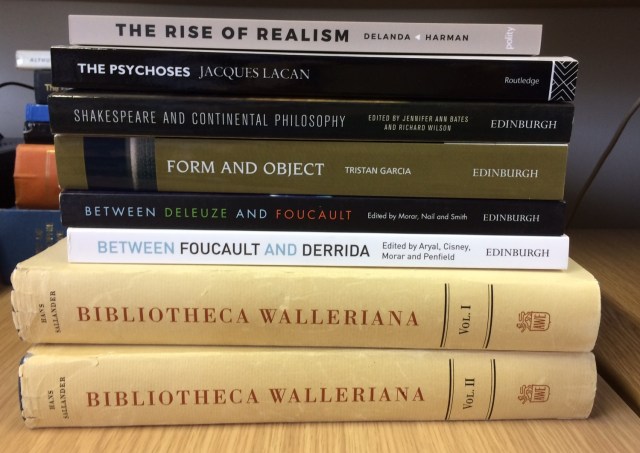
Books received – Bibliotheca Walleriana, Foucault, Derrida, Deleuze, Garcia, Shakespeare, Lacan, Delanda and Harman

IMG_2652

Mainly sent in recompense for review work, but also a copy of the Bibliotheca Walleriana – the guide to the library of Erik Waller housed at Uppsala University. Foucault used this extensively in his work on the History of Madness. For more details, see my last update on my research on his early work.

Posted in Gilles Deleuze, Graham Harman, Jacques Lacan, Manuel deLanda, Michel Foucault, Tristan Garcia, Uncategorized, William Shakespeare | 1 Comment

Visiting Boko Haram territory – an excerpt from Helon Habila’s new book, The Chibok Girls (plus links to my article and bibliography)

cover.jpg.rendition.460.707.pngVisiting Boko Haram territory – an excerpt from Helon Habila’s new book, The Chibok Girls at African Arguments.

Here’s the book description:

An urgent Penguin Special investigating the 2014 mass-kidnapping of 276 schoolgirls by the world’s deadliest terrorists

On 14th April 2014, 276 girls disappeared from a secondary school in northern Nigeria, kidnapped by the world’s deadliest terror group. A tiny number have escaped back to their families but over 200 remain missing.

Reporting from inside the traumatised and blockaded community of Chibok, Helon Habila tracks down the survivors and the bereaved. Two years after the attack, he bears witness to their stories and to their grief. And moving from the personal to the political, he presents a comprehensive indictment of Boko Haram, tracing the circumstances of their ascent and the terrible fallout of their ongoing presence in Nigeria.

While writing a paper entitled “The Geopolitics of Boko Haram and Nigeria’s ‘War on Terror’” (open access), I produced a detailed bibliography of academic writings on Boko Haram. At the time (between 2012 and 2014) there was a manageable amount of literature – things have developed substantially since, and as a consequence the bibliography is out of date. But it may still be of some use. You can download the bibliography here (pdf).

Posted in Territory, Uncategorized | 1 Comment

David Scott (ed.), Understanding Foucault, Understanding Modernism reviewed at NDPR

9781628927702.jpgDavid Scott (ed.), Understanding Foucault, Understanding Modernism is reviewed at NDPR by Corey McCall. This sounds an interesting collection – what a shame about the grotesque price. Even with the 10% discount, both physical book and e-book are over £80.

Michel Foucault continues to be regarded as one of the most essential thinkers of the twentieth century. A brilliantly evocative writer and conceptual creator, his influence is clearly discernible today across nearly every discipline-philosophy and history, certainly, as well as literary and critical theory, religious and social studies, and the arts. This volume exploits Foucault’s insistent blurring of the self-imposed limits formed by the disciplines, with each author in this volume discovering in Foucault’s work a model useful for challenging not only these divisions but developing a more fundamental interrogation of modernism. Foucault himself saw the calling into question of modernism to be the permanent task of his life’s work, thereby opening a path for rethinking the social.

Understanding Foucault, Understanding Modernism shows, on the one hand, that literature and the arts play a fundamental structural role in Foucault’s works, while, on the other hand, it shifts to the foreground what it presumes to be motivating Foucault: the interrogation of the problem of modernism. To that end, even his most explicitly historical or strictly epistemological and methodological enquiries directly engage the problem of modernism through the works of writers and artists from de Sade, Mallarmé, Baudelaire to Artaud, Manet, Borges, Roussel, and Bataille. This volume, therefore, adopts a transdisciplinary approach, as a way to establish connections between Foucault’s thought and the aesthetic problems that emerge out of those specific literary and artistic works, methods, and styles designated “modern.” The aim of this volume is to provide a resource for students and scholars not only in the fields of literature and philosophy, but as well those interested in the intersections of art and intellectual history, religious studies, and critical theory.

Posted in Michel Foucault, Publishing, Uncategorized | Leave a comment

Mark Kelly, For Foucault: Against Normative Political Theory

63676_cov.jpgI shared Mark Kelly’s review of Althusser et al’s Reading Capital: The Complete Edition at the Progress in Political Economy site yesterday.
Mark’s next book,  For Foucault: Against Normative Political Theory is forthcoming in early 2018 from SUNY Press:

Calls for a Foucauldian approach to political thought that is intrinsically resistant to power and subordination to public policy.

This book comprises a series of staged confrontations between the thought of Michel Foucault and a cast of other figures in European and Anglophone political philosophy, including Marx, Lenin, Althusser, Deleuze, Rorty, Honneth, and Geuss. Focusing on the status of normativity in their thought, Mark G. E. Kelly explains how Foucault’s position in relation to political theory is different, and, over the course of the book, describes a distinctive Foucauldian stance in political thought that is maximally anti-normative, anti-theoretical, and anti-political. For Foucault aims to undermine attempts to discern the appropriate form of political action, instead putting forward a rigorously critical program for a political theory that lacks any moralizing or totalizing dimension, and serves only to side with resistance against power, and never with power itself. Looking at attempts to think radically about politics from Marx to the present day, Kelly traces a novel history of political thought as a trend of attempts to overcome the constraints of normativity, theoreticism, and subordination to public policy. He concludes by assessing and rejecting recent attempts to reclaim Foucault for a form of normative politics by associating him with neoliberalism.

“This original and insightful book makes a significant contribution to political philosophy.” — Stuart Elden, author of Foucault: The Birth of Power

Mark G. E. Kelly is Associate Professor and ARC Future Fellow in the School of Humanities and Communication Arts at Western Sydney University in Australia. His books include Foucault and Politics: A Critical Introduction; Biopolitical Imperalism; and The Political Philosophy of Michel Foucault.


Posted in Michel Foucault, Uncategorized | 1 Comment

Mark Kelly on Althusser et al, Reading Capital: The Complete Edition

Reading-Capital-angle-1050st-57bb375caaf6210c8f6916d87dfff76a.jpgMark Kelly discusses Louis Althusser, Étienne Balibar, Roger Establet, Pierre Macherey, and Jacques Rancière, Reading Capital: The Complete Edition at the Progress in Political Economy site.
The book is part of Verso’s summer sale – 50% off until July 9th. Lots of other books in the sale, including Lefebvre’s Metaphilosophy. Most come with the bundled e-book.

Posted in Etienne Balibar, Jacques Rancière, Louis Althusser, Pierre Macherey, Uncategorized | Leave a comment

David Harvey, Visualizing Capital – video of New School lecture

David Harvey, Visualizing Capital – video of New School lecture, June 12, 2017

Posted in David Harvey, Uncategorized | Leave a comment

Colin Koopman reviews Penelope Deutscher, Foucault’s Futures at NDPR

9780231176415.jpgColin Koopman reviews Penelope Deutscher, Foucault’s Futures: A Critique of Reproductive Reason at NDPR.

In Foucault’s Futures, Penelope Deutscher reconsiders the role of procreation in Foucault’s thought, especially its proximity to risk, mortality, and death. She brings together his work on sexuality and biopolitics to challenge our understanding of the politicization of reproduction. By analyzing Foucault’s contribution to the politics of maternity and its influence on the work of thinkers such as Roberto Esposito, Giorgio Agamben, and Judith Butler, Deutscher provides new insights into the conflicted political status of reproductive conduct and what it means for feminism and critical theory.

Posted in Michel Foucault, Uncategorized | Leave a comment

Preview and discount code for my ‘In the Ruins of the Cold War Bunker’ edited collection which is being published on 30/6/17.

Details and sample material from Luke Bennett’s excellent new edited collection.

lukebennett13's avatarlukebennett13

In the Ruins - final cover

I’m pleased to present below a copy of the publisher’s flyer for my book, and delighted at the reviews featured there.

I’m told the book (hardback and ebook formats) will be available to buy from 30 June 2017, and using the code below on the publisher’s website you’ll be able to get 30% off either format. Please note that all author and editorial royalties are being donated to www.msf.org.uk (Medecins Sans Frontieres).

In the meantime my introductory chapter is available to view for free here:

https://www.rowmaninternational.com/book/in_the_ruins_of_the_cold_war_bunker/3-156-afdcfe7a-b585-4303-82a2-23ee9b64e05d#

and here:

https://www.amazon.co.uk/Ruins-Cold-War-Bunker-Materiality-ebook/dp/B072SSPTXS/ref=sr_1_1?ie=UTF8&qid=1498233592&sr=8-1&keywords=ruins+of+the+cold+war+bunker

Further details of launch events will follow soon.

In the Ruins of the Cold War Bunker flyer-page-001In the Ruins of the Cold War Bunker flyer-page-002

View original post

Posted in Uncategorized | Leave a comment

Foucault also struggled to get his students to do the reading…

2711627497.jpgI’ve previously shared one of Lacan’s comments from his seminar. Here’s Foucault on the same theme:

Has everyone read these texts? Yes? No? Nobody? Well, I will have to punish you, that’s for sure! I’m not going to tell you how… That’s a surprise for the last day!

Dire vrai sur soi-même: Conférences prononcées à l’Université Victoria de Toronto, 1982, edited by Henri-Paul Fruchaud and Daniele Lorenzini, Paris: Vrin, 2017, p. 189

Posted in Michel Foucault, teaching, Uncategorized | 4 Comments