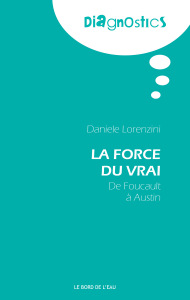
La force du vrai. De Foucault à Austin (2017)

One of Foucault’s most important editors has a new book out on theories of truth.

Clare O'Farrell's avatarFoucault News

Daniele Lorenzini, La force du vrai. De Foucault à Austin
Le bord de l’eau

Format 13×20 cm – 156 p. – 20 €
Isbn 9782356875310
Collection « diagnostics » dirigee par Fabienne brugere & Guillaume le Blanc
En librairies en juillet 2017

PDF of flyer

Cet ouvrage propose une lecture originale du projet foucaldien d’une histoire de la vérité qui vise à en mettre clairement en lumière les enjeux éthiques et politiques, grâce à l’établissement d’une confrontation entre les analyses de Foucault sur la parrêsia antique, les travaux de J.L. Austin sur l’énoncé performatif et l’étude de l’énoncé passionné par Stanley Cavell. Le problème qui est ainsi posé, en lien mais également en décalage avec les réflexions traditionnelles sur le pouvoir des mots, est celui de la force du vrai : est-il possible ou légitime d’affirmer que la vérité est une force qui s’inscrit, de manière toujours « stratégique »…

View original post 92 more words

Posted in Uncategorized | Leave a comment

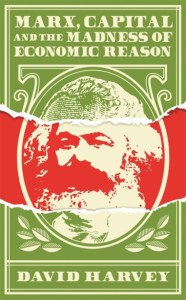
David Harvey, Marx, Capital and the Madness of Economic Reason – forthcoming in August

9781781258743David Harvey, Marx, Capital and the Madness of Economic Reason forthcoming in August

Marx’s Capital is one of the most important texts of the modern era. The three volumes, published between 1867 and 1883, changed the destiny of countries, politics and people across the world – and continue to resonate today. In this book, David Harvey lays out their key arguments.In clear and concise language, Harvey describes the architecture of capital according to Marx, placing his observations in the context of capitalism in the second half of the nineteenth century. He considers the degree to which technological, economic and industrial change during the last 150 years means Marx’s analysis and its application may need to be modified. Marx’s trilogy concerns the circulation of capital: volume I, how labour increases the value of capital, which he called valorisation; volume II, on the realisation of this value, by selling it and turning it into money or credit; volume III, on what happens to the value next in processes of distribution. The three volumes contain the core of Marx’s thinking on the workings and history of capital and capitalism. David Harvey explains and illustrates the profound insights and enormous analytical power they continue to offer in terms that, without compromising their depth and complexity, will appeal to a wide range of readers, including those coming to the work for the first time.

Posted in David Harvey, Karl Marx, Uncategorized | 4 Comments

Work for the summer – Shakespeare, Canguilhem and Foucault

My last talk of the 2016-17 academic year was in Stockholm at the Nordic Geographers Meeting. This academic year, despite saying ‘no’ quite a lot, I gave twenty visiting talks, in seven different countries (UK, Ireland, Germany, Netherlands, Sweden, Norway, USA). Most were on terrain, a couple on Shakespeare, a few on Foucault, and two on Foucault and Shakespeare. I’m really hoping to reduce the number in the next academic year. I do appreciate invitations, but I find the preparation and travelling is exhausting and giving the same paper more than a couple of times is of limited use to me.

Unusually for me, I have no talks lined up over the next academic year. A couple were cancelled for reasons outside of my control, and while I have tentatively agreed to a couple of events, these are some way off with no dates fixed. Not having any specific events to plan for should mean that my summer is wide open. However, it’s not quite that way.

I was external examiner on two PhDs in late June and early July. Both were excellent theses, and led to very interesting discussions. Three of my own PhD students are close to submission, so there are complete drafts to read. The steady stream of review requests continues. I have a few archive visits planned. The first is to the Bibliothèque Nationale next week, and the second is also to Paris in September. That’s the week the BNF is closed, but I hope to use the time to get to another archive. I also have a week’s holiday in Provence, which will include a ride up Mont Ventoux, and a long weekend in the Brecon Beacons. Looking at the diary it’s clear that the time is already more fragmented than I’d like.

The major writing task for the summer is to revise Shakespearean Territories. The revisions I need to make are important, but they are structural and explicative rather than requiring new research or reading. I am hoping that a few consolidated weeks of work in the first half of the summer will take care of this, and the plan is to resubmit the manuscript before I go on holiday.

Once I return, there should be a few weeks to work on The Early Foucault and Canguilhem book projects. I also have a few small writing projects – revision of a book chapter for a new edition of a text; a short piece on Foucault; a book review – and I plan to do those in the last full week of summer before the new term starts. As much as possible I am trying to have entire clear weeks to work on the book projects.

Posted in Canguilhem (book), Cycling, Georges Canguilhem, Michel Foucault, Shakespearean Territories, The Early Foucault, Uncategorized, William Shakespeare | Leave a comment

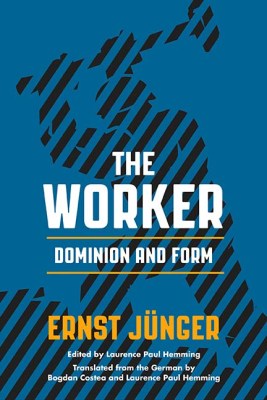
A long overdue translation of Ernst Jünger’s Der Arbeiter – forthcoming in November 2017

workerA long overdue translation of Ernst Jünger’s Der Arbeiter as The Worker: Dominion and Form is forthcoming in November 2017, edited by Laurence Paul Hemming and translated by Hemming and Bogdan Costea.

Written in 1932, just before the fall of the Weimar Republic and on the eve of the Nazi accession to power, Ernst Jünger’s The Worker: Dominion and Form articulates a trenchant critique of bourgeois liberalism and seeks to identify the form characteristic of the modern age. Jünger’s analyses, written in critical dialogue with Marx, are inspired by a profound intuition of the movement of history and an insightful interpretation of Nietzsche’s philosophy.

Martin Heidegger considered Jünger “the only genuine follower of Nietzsche,” singularly providing “an interpretation which took shape in the domain of that metaphysics which already determines our epoch, even against our knowledge; this metaphysics is Nietzsche’s doctrine of the ‘will to power.’” In The Worker, Jünger examines some of the defining questions of that epoch: the nature of individuality, society, and the state; morality, justice, and law; and the relationships between freedom and power and between technology and nature.

This work, appearing in its entirety in English translation for the first time, is an important contribution to debates on work, technology, and politics by one of the most controversial German intellectuals of the twentieth century. Not merely of historical interest, The Worker carries a vital message for contemporary debates about world economy, political stability, and equality in our own age, one marked by unsettling parallels to the 1930s.

Posted in Friedrich Nietzsche, Martin Heidegger, Uncategorized | Tagged | Leave a comment

Rob Kitchin – Balancing and redistributing ‘additional’ academic work

Rob Kitchin has a very good piece on ‘Balancing and redistributing ‘additional’ academic work‘ at his The View from the Blue House blog. Beginning with an absolutely terrifying list of requests to review, examine, interview, contribute etc. (and I thought I was asked frequently), he questions what is an acceptable number to do, and then moves from this to discuss how those making requests should try to diversify those they ask much more. Worth a read – though the solution needs to be collective, and it will be interesting to see what comes of this discussion.

Posted in Publishing, Uncategorized, Universities | Leave a comment

Amitava Kumar and V.S. Naipal – Rules for Writing

Amitava Kumar has an interesting piece on 10 Rules for Writing, which includes V.S. Naipaul’s ‘Rules for Beginners’.

As with any of the things I share on ‘advice’, these are of course only suggestions, and different people work in different ways. Kumar’s final two rules concern working on only one thing at once, for example, which is hardly a rule I follow…


Posted in Uncategorized, Writing | Leave a comment

A copy of Foucault and Rocher’s translation of Viktor von Weizsäcker’s Der Gestaltkreis

IMG_2661I’ve been looking for a copy of Foucault and Daniel Rocher’s translation of Viktor von Weizsäcker’s Der Gestaltkreis as Le Cycle de la Structure for sometime, and now have a copy. While the German text is widely available, the translation was only printed once, in 1958, and relatively few libraries have a copy – even the BnF provided a microfiche instead of the physical book.
This copy is in good condition for a book of its age – the pages are still uncut. This is going to be valuable for my research for The Early Foucault, where I will make the claim that his role as a translator is an important but neglected part of his early career.

Posted in Michel Foucault, The Early Foucault, Uncategorized | 1 Comment

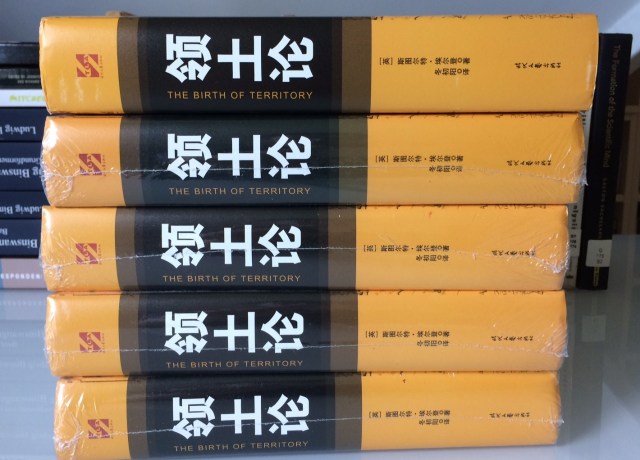
The Birth of Territory – now available in Chinese translation

My 2013 book The Birth of Territory is now available in Chinese translation. It can be ordered here.

IMG_2659.JPG


Posted in My Publications, Publishing, The Birth of Territory, Uncategorized | Leave a comment

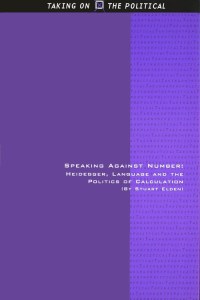
Stuart Elden, Speaking Against Number (EUP 2006) now available at reduced price

9780748619818_2My 2006 book Speaking Against Number: Heidegger, Language and the Politics of Calculation is now available at reduced price from Edinburgh University Press. It was only ever published in hardback, and previously available only at a very high price. It’s now selling for £20. I’m not sure how long this will remain at this price.

I obtained the paperback rights to this book a couple of years ago, with the idea of doing a new edition. As I’ve previously discussed, I got as far as writing a proposal for this, but knew it would require a substantial new introduction taking account of new material, especially the notorious ‘Black Notebooks’. I decided against the idea, so this book remains the last statement I made about Heidegger and politics. Despite his own repugnant views, Heidegger remains a significant thinker to the development of my work, and the ideas explored in this book were central to my future work on territory.


Posted in Martin Heidegger, Politics, Speaking Against Number, Territory, Terror and Territory, The Birth of Territory, Uncategorized | Leave a comment

5 Critical Theory Books That Came Out in June, 2017

5 Critical Theory Books That Came Out in June, 2017 at Critical Theory

june-2017-critical-theory-books-672x372.png

Posted in Uncategorized | 1 Comment