Can you have too much writing time? – some discussion at Explorations of Style

Can You Have Too Much Writing Time?

A few weeks ago, I received an email from a former student, asking for some advice about managing a summer of writing. With her permission, I am sharing her email and my reflections on our conversation.

Some good advice and discussion at the Explorations of Style blog, which continues into the comments. I shared ‘my sabbatical rules for writing‘ back in September 2015, and they worked quite well for me then. Of course, more time and less time are relative, and small amounts of time can add up to something larger. With any amount of time, the questions are what could be achieved realistically, and how could it be achieved.

The key line for me in this piece is “A generous block of writing time is an opportunity, not a solution.” Of course, it’s a great opportunity, but without some thought, planning and discipline, it may not be what you expect it to be. Much to think about here.


Posted in Publishing, Uncategorized, Writing | Leave a comment

Todd S. Mei, Land and the Given Economy: The Hermeneutics and Phenomenology of Dwelling

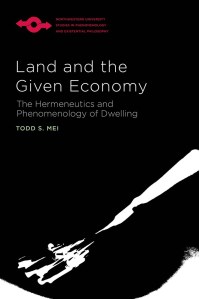
land-and-the-given-economyTodd S. Mei, Land and the Given Economy: The Hermeneutics and Phenomenology of Dwelling. Here’s the publisher description:

Alarming environmental degradation makes ever more urgent the reconciliation of political economy and sustainability. Land and the Given Economy examines how the landed basis of human existence converges with economics, and it offers a persuasive new conception of land that transcends the flawed and inadequate accounts in classical and neoclassical economics.

Todd S. Mei grounds this work in a rigorous review of problematic economic conceptions of land in the work of John Locke, Adam Smith, David Ricardo, John Stuart Mill, Karl Marx, Henry George, Alfred Marshall, and Thorstein Veblen.

Mei then draws on the thought of Martin Heidegger to posit a philosophical clarification of the meaning of land—its ontological nature. He argues that central to rethinking land is recognizing its unique manner of being, described as its “givenness.” Concluding with a discussion of ground rent, Mei reflects on specific strategies for incorporating the philosophical account of land into contemporary economic policies.

Revivifying economic frameworks that fail to resolve the impasse between economic development and sustainability, Land and the Given Economy offers much of interest to scholars and readers of philosophy, environmentalism, and the full spectrum of political economy.

The book is reviewed at NDPR by Casey Rentmeester.

Posted in Uncategorized | Leave a comment

Simon Reid-Henry on Arturo Escobar in The Guardian

MDG--Arturo-Escobar-009.jpgSimon Reid-Henry discusses the work of and influences on Arturo Escobar in The Guardian


Posted in Uncategorized | Leave a comment

Social Morphogenesis: Five Years of Inquiring Into Social Change – British Library, May 30 2017

Social Morphogenesis: Five Years of Inquiring Into Social Change

Postmodernity. Second modernity. Network Society. Late modernity. Liquid modernity. Such concepts have dominated social thought in recent decades, with a bewildering array of claims about social change and its implications. But what do we mean by ‘social change’? How do we establish that such change is taking place? What does it mean to say that it is intensifying? These are some of the questions which the Social Morphogenesis project has sought to answer in the last five years, through an inquiry orientated around the speculative notion of ‘morphogenic society’.

In this launch event, contributors to the project discuss their work over the last five years and the questions it has addressed concerning social change. The day begins with an introductory lecture by the convenor of the project, Margaret S. Archer, before a series of thematic panels presenting different stands of the project. It concludes with a closing session in which participants share three issues the project raised for them, as well as a general discussion.

At the end of the day, there will be a wine reception to which all participants are invited. There will also be an opportunity to purchase discounted copies of the books from Springer.

Participants:
Ismael Al-Amoudi
Margaret S. Archer
Mark Carrigan
Pierpaolo Donati
Emmanuel Lazega
Andrea M. Maccarini
Jamie Morgan
Graham Scambler (Chair)

More speakers to be confirmed.

Posted in Uncategorized | Leave a comment

Chronicle Vitae – The Art of ‘No’

This is some good advice on the need to, and how to, say ‘no’ to some of the requests that come your way.

Early in my career, I struggled to say no. I was asked to serve on committee after committee, to evaluate fistfuls of manuscripts and grants, and to perform dozens of other tasks, large and small. I said yes willy-nilly — often because of genuine interest, but other times out of a sense of guilt or obligation, and sometimes out of fear of reprisal if I refused. But as I advanced in my career, the requests snowballed. Agreeing to do all of them — or even half of them — became impossible. I needed to figure out when to say no, and how to do it artfully. Five principles have helped me learn what to say, and what not to say.

The article is worth reading, but the five key points, which apply in different situations are:

  • Volunteer someone else — strategically
  • Don’t explain
  • Do explain
  • Set your own policies
  • Just hit ‘delete’

I’ve written on this topic before – The challenge of saying ‘no’ to academic requests There is some good advice in this post. But to pre-empt the comments on avoiding work, or transferring to others, here’s the conclusion:

Academe could not function if every scholar refused to serve on committees, evaluate manuscripts and grants, write recommendations, and perform many other uncompensated and often undervalued tasks. We need to say yes — and to do so often. Ultimately, that’s why saying no is so important. Saying no to some requests enables us to say yes to others. Each productive yes depends on many an artful no.

Posted in Uncategorized | Leave a comment

Christopher Watkin’s research hacks on conference presentations

Research hacks #14: 15 tips on planning and writing a conference paper

Research hacks #15: Tips on delivering a conference paper

Research hacks #16: 20 tips on timekeeping and technology for your conference presentation

Research hacks #17: 15 tips on fielding questions after a conference paper

Research hacks #18:20 further tips on fielding questions after a conference paper

The rest of this useful series can be found here.

Posted in Conferences, Uncategorized | 1 Comment

Hubert Dreyfus (1929-2017)

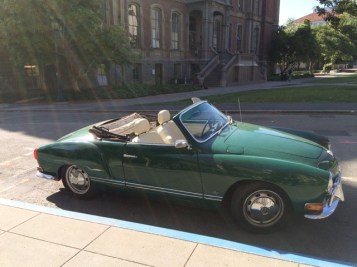
dreyfus_car.jpgI heard the news yesterday that Hubert Dreyfus had died at the age of 87. While it was shared on social media, it took a while for an official notification. Dreyfus’s Twitter account simply said ‘Reports of my demise are not exaggerated’.

Dreyfus was a Professor of Philosophy at University of California, Berkeley, and was still teaching a class a semester. He is known for his work on Husserl, Merleau-Ponty, Heidegger and Foucault, and on artificial intelligence, among other themes. His lectures on Heidegger were very influential, and led to the book Being-in-the-World, and his co-authored book on Foucault with Paul Rabinow was very important. Neither of these books were uncontroversial, of course, but his role in introducing continental theorists to the US and Anglophone world was considerable.

I met him only once, almost twenty years ago, at a conference at the University of Essex when I was a PhD student. I gave a talk on Heidegger and Hölderlin, which became my first journal publication (read it here). I don’t think he was in the audience for that session, but we had a talk about Heidegger, Foucault and space in one of the breaks, and he was very generous with his time. In particular he suggested that I talk more to Béatrice Han-Pile, whom I met at that conference, and to get in contact with Jeff Malpas. Both were excellent people to talk to, and I am still in touch with both, and I’m extremely grateful for that. He kindly answered some questions by email following this event. I’d hoped to speak to him when I visited Berkeley in 2015 to do work on the Foucault papers archived there, but it didn’t work out. I did spot his beautiful car parked on campus though – immortalised in the covers of the collections on Dreyfus’s work edited by Malpas and Mark Wrathall.

The interview below gives a sense of the breadth of his interests.

Posted in Jeff Malpas, Martin Heidegger, Uncategorized | Tagged , | Leave a comment

The ICE LAW Project comes out from the cold

Phil Steinberg with an update on activities in the ICE-LAW project, including the workshop I’m organising next month in Amsterdam –

philsteinberg's avatar

logo copyThe ICE LAW Project is close to concluding its first full year of funding and we’re in the midst of a particularly active few months. We’ve been providing regular updates on the ICE LAW Project’s website and Twitter feed. However, with so much happening in April-May-June, I’m taking this opportunity to highlight events to followers of this blog who are not ICE LAW regulars.

View original post 494 more words

Posted in terrain, Territory, Uncategorized | Leave a comment

Last week’s to do list

IMG_2326 copy.jpg

Just back from a good week’s holiday, cycling in Lanzarote. The hire bike was great fun – a BH G6 Pro. I borrowed one of these for a weekend in Australia a couple of years ago, in a slightly earlier model but with a better set of components. I was sorry to have to give both back. This was a really good bike to ride, light for climbing and fast, though I did get buffeted with the crosswinds. Lanzarote isn’t nearly as high as Tenerife or Gran Canaria, but there are some nasty gradients in places. Apart from the far northeast we covered nearly all of the island, including the climb to its highest point, Peñas del Chache.

It was a week without thinking about work, or writing, and a good break. Now back for just a couple of days before I head to Amsterdam, with a plan to have some good writing time while there.

Posted in Cycling, Travel, Uncategorized | Leave a comment

The Early Foucault update 6: Foucault’s teachers, and returning to his work on Binswanger

Update 6.JPG

I’ve largely been able to continue the focus of the last update, with a series of fairly uninterrupted days’ research and writing. Aside from continuing work on Lacan, I’ve also been looking at the people who taught Foucault. Merleau-Ponty is the key figure, as I’ve mentioned before, and I’ve done a bit more work on him, but Jean Wahl, Jean Hyppolite, Jean Beaufret, Henri Gouhier, and Daniel Lagache are all important. It’s taken a bit of digging around, but quite a lot of the lectures Foucault attended have been published. So, where possible, I’ve been tracking these down and doing some selective reading. Warwick has a pretty good collection, often in French and English. I was back in London for a couple of days, so did some work in the British Library, though my list of things to do there, and in Paris, is still quite extensive. I have the references I made when working on Foucault’s notes in Paris, which has helped guide this work a bit. I knew a bit about Hyppolite before, and had read Beaufret’s Dialogues avec Heidegger some time back, but others were less known to me. There were also some figures about whom I knew nothing before – Julian de Ajuriaguerra on psychiatric science, or Jean-Toussaint Desanti on philosophy of science (he was a student of Jean Cavaillès). The tight intellectual circles of France are ever more apparent – Desanti directed Derrida’s doctorate; Gouhier supervised Bourdieu’s dissertation, which was on Leibniz; and there seems to have been a common route between the Sorbonne, ENS and the Collège de France. And many of Foucault’s teachers reappear in his story about a decade later, as members of his thesis jury. Later still Gouhier and Wahl chair important lectures Foucault gave at the Société française de philosophie.

As a side-note, in the English translation of Lacan’s second seminar (p. 294), there is a list of the people who gave special lectures to the Société Française de Psychanalyse between November 1954 and June 1955, usually the day before Lacan’s seminar. The SFP was formed in 1953 as a breakaway from the main Paris body, led by Lagache and supported by Lacan. Lacan regularly refers to the most-recent lecture in the seminar. The list of speakers reads like an entirely male who’s who of French intellectual life at the time: Jean Delay, Alexandre Koyré, Claude Lévi-Strauss, Jean Hyppolite, Maurice Merleau-Ponty, Étienne de Greeff, Marcel Griaule, Medard Boss, Émile Benveniste, Daniel Lagache, Jacques Lacan. The external person is Medard Boss from Zurich – who organized the Zollikon seminars with Heidegger. The only one I’d not heard of before was Étienne de Greeff, but he too looks interesting.

Following some of the connections between Foucault and these figures has taken me outside of the time period I’m currently working on (essentially up to 1961), but it’s been interesting to track the intersections. Hyppolite, for example, was Foucault’s predecessor in the chair at the Collège de France, and Foucault and Canguilhem organized a tribute session at the ENS in 1969 after he died in 1968. Their two speeches were published at the time, and then they were among those who contributed to a small volume Hommage à Jean Hyppolite in 1971. Foucault’s text in that volume is his famous ‘Nietzsche, Genealogy, History’ essay. In between the ENS session and the book Foucault was elected to the Collège de France chair, and paid fulsome tribute to Hyppolite in his inaugural lecture ‘The Order of Discourse’. (There is a new, and likely definitive translation of that important text coming out soon, a text which is long overdue an overhaul.) In the mid-1950s Hyppolite was a regular attender at the early sessions of Lacan’s seminar, and contributes a text to the discussion which is reprinted and commented upon in Lacan’s Écrits. Jacques-Alain Miller has commented that Hyppolite “was quite open-minded at a time when other French philosophers found Lacan too difficult to understand”. I shared Lacan’s acerbic remark that Hyppolite had found time to do the reading, and that he was at least as busy as the other students, earlier this week.

I also spent some time on the ‘What is an Author?’ lecture, partly because there are some interesting points in the introduction and the subsequent discussion – which are not in the translations of the lecture. For more on this, see my post here.

In the last couple of days I’ve begun sketching out the section on Foucault’s work on Ludwig Binswanger. I’m talking not just about his introduction to the translation of ‘Dream and Existence’, but the translation itself. This will then lead into a discussion of the co-translation of the book by Viktor von Weizsäcker. I hope to pick up on that when in Amsterdam. But now for a holiday.

The previous updates on this project are here; and Foucault’s Last Decade and Foucault: The Birth of Power are both now available from Polity worldwide. Several Foucault research resources such as bibliographies, short translations, textual comparisons and so on are available here.
Posted in Emile Benveniste, Jacques Lacan, Jean Hyppolite, Ludwig Binswanger, Maurice Merleau-Ponty, Michel Foucault, The Early Foucault, Uncategorized | 1 Comment