Isabel K. Köster, Stealing from the Gods: Temple Robbery in the Roman Imagination – University of Michigan Press, January 2026

Isabel K. Köster, Stealing from the Gods: Temple Robbery in the Roman Imagination – University of Michigan Press, January 2026
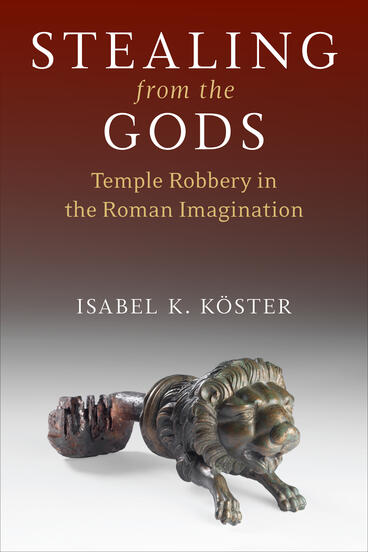
Stealing from the Gods investigates how authors writing between the first century BCE and second century CE addressed the issue of temple robbery or sacrilegium. As a self-proclaimed empire of pious people, the Romans viewed temple robbery as deeply un-Roman and among the worst of offenses. On the other hand, given the constant financial pressures of warfare and administration, it was inevitable that the Romans would make use of the riches stored in sanctuaries. In order to resolve this dilemma, the Romans distinguished sharply between acceptable and unacceptable removals of sacred property. When those who conducted themselves as proper Romans plundered the property of the gods, their actions were for the good of the state. In contrast, the temple robber was viewed as a stranger to the norms of Roman society and an enemy of the state.

Roman authors including Cicero, Caesar, Livy, Appian, and Pausanias present isolated, grotesque individuals whose actions have no bearing on the conduct of Romans as a whole, rendering temple robbery not a matter of collective responsibility, but of individual moral failure. By revealing how narratives of temple robbery are constructed from a literary perspective and how they inform discourses about military conquest and imperial rule, Isabel K. Köster shines a new light on how the Romans coped with the more pernicious aspects of their empire.
Posted in Uncategorized | 1 Comment

How Literary Agents Made Italian Publishing Transnational: An Interview with Anna Ferrando

How Literary Agents Made Italian Publishing Transnational: An Interview with Anna Ferrando – Journal of the History of Ideas blog with Rose Facchini

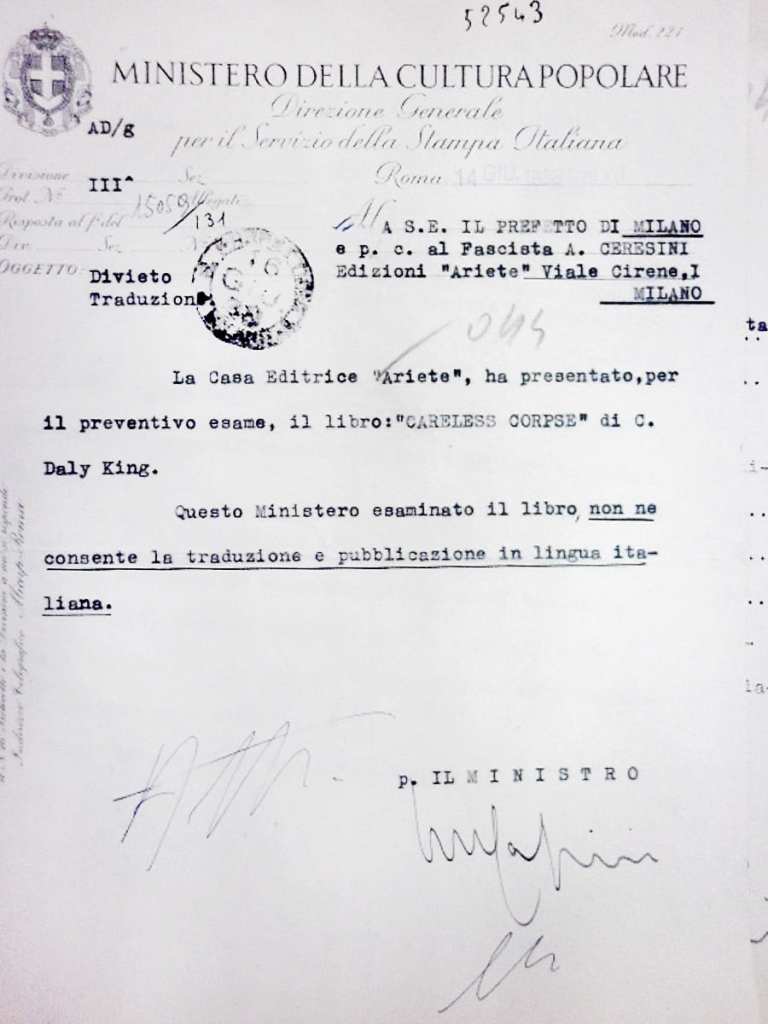
Anna Ferrando is a researcher in Contemporary History at the Department of Political and Social Sciences at the University of Pavia, Italy. Her work explores the relationship between publishing and politics from a transnational perspective, focusing chiefly on twentieth-century cultural mediators. She edited a volume on translations under Fascism, Stranieri all’ombra del Duce. Le traduzioni durante il fascismo [Foreigners in the Shadow of the Duce: Translations During Fascism] (FrancoAngeli, 2019). She recently published a history of the Adelphi publishing house, titled Adelphi. Le origini di una casa editrice (1938–1994) [Adelphi: The Origins of a Publishing House, 1938–1994] (Carocci, 2023). Her interview with Rose Facchini explores all of these themes, centering on Ferrando’s Cacciatori di libri. Gli agenti letterari durante il fascismo [Book Hunters: Literary Agents under Fascism] (FrancoAngeli, 2019), which was awarded the SISSCO Prize for “Best Debut Book” by the Italian Society for the Study of Contemporary History.

The use of archives of literary agents is really interesting – later this month I’ll share what I found out about Foucault’s early English translations in the archives of the Georges Borchardt literary agency. [Update: now available here.]

Posted in Michel Foucault, Publishing, Sunday Histories, Uncategorized | Leave a comment

Bettina Brandt & Daniel L. Purdy eds. Colonialism and Enlightenment: The Legacy of German Race Theories – Oxford University Press, November 2025

Bettina Brandt & Daniel L. Purdy eds. Colonialism and Enlightenment: The Legacy of German Race Theories – Oxford University Press, November 2025

For the last 30 years, scholars have treated Enlightenment race theory and nineteenth-century German colonialism as two distinct events. In Colonialism and Enlightenment, editors Bettina Brandt and Daniel L. Purdy present perspectives from scholars across the fields of philosophy, postcolonialism, literature, and German and African American studies, who challenge this view, providing a critical examination of the historical connection between “scientific” racial theory in late-Enlightenment Germany and the forces of colonialism and Nazism over a hundred years later.
From its first formulations in the eighteenth century and well into the twentieth century, German race theory was implicated in colonialism. Philosophers and biologists drew their arguments about race from information that was generated by the slave trade and plantation economies in the Americas. Their reliance on colonial data was applied to so-called “internal colonization” within Eastern Europe and Central Asia, as well as to seaborn European competition in South Asia. Most strikingly, some of the sites of German race theorization, such as East Prussia and the Baltic states, were themselves long-established colonies with ethnic separations between ruling and laboring populations. Race theory depended not only on the exploration of distant islands in the Pacific, but on the long-term exploitation and breeding of forcefully transported populations across the Atlantic. Without the involuntary migration of Africans, nineteenth century racial scientists would not have been able to engage in arguments about crossbreeding, skull size, and skin color. 
The chapters in this volume explore how eighteenth-century German theories about race reinforced discourses on colonial settlements, both within and outside Europe. Given the multiple, often contradictory positions developed in the Enlightenment, Brandt and Purdy explore how later race thinkers responded to earlier concepts. How did Enlightenment-era debates figure into later forms of racism? How did nationalist and Nazi racisms view Enlightenment anthropology? What Enlightenment concepts and configurations persisted into the twentieth century? Taking a broad view, the scholars in this volume offer a variety of positions on these and other questions as they take stock of the debates about race and the Enlightenment held over the last 20 years.

Posted in Uncategorized | 1 Comment

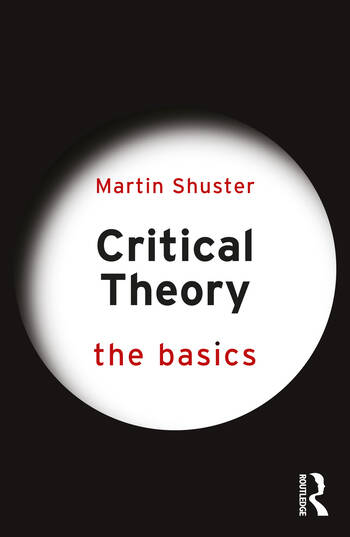
Martin Shuster, Critical Theory: The Basics – Routledge, 2024 and New Books discussion

Martin Shuster, Critical Theory: The Basics – Routledge, 2024

New Books discussion with Dave O’Brien

Critical Theory: The Basics brings clarity to a topic that is confusingly bandied about with various meanings today in popular and academic culture.

First defined by Max Horkheimer in the 1930s, “critical theory” now extends far beyond its original German context around the Frankfurt School and the emergence of Nazism. We now often speak of critical theories of race, gender, anti-colonialism, and so forth. This book introduces especially the core program of the first-generation of the Frankfurt School (including Horkheimer, Theodor W. Adorno, Erich Fromm, and Herbert Marcuse), and shows how this program remains crucial to understanding the problems, ideologies, and systems of the modern world, including capitalism, racism, sexism, and the enduring problems of colonialism. It explores basic questions like:

  • What is critical theory?
  • What can critical theory be? What should it be?
  • Why and how does critical theory remain vital to understanding the contemporary world, including notions of self, society, politics, art, religion, culture, race, gender, and class?

With suggestions for further reading, this book is an ideal starting point for anyone seeking an accessible but robust introduction to the richness and complexity of this tradition and to its continuing importance today.

Posted in Uncategorized | Leave a comment

Todd McGowan, The Cambridge Introduction to Jacques Lacan – Cambridge University Press, July 2025

Todd McGowan, The Cambridge Introduction to Jacques Lacan – Cambridge University Press, July 2025

The difficulty of Jacques Lacan’s thought is notorious. The Cambridge Introduction to Jacques Lacan cuts through this difficulty to provide a clear, jargon-free approach to understanding it. The book describes Lacan’s life, the context from which he emerged, and the reception of his theory. Readers will come away with an understanding of concepts such as jouissance, the objet a, and the big Other. The book frames Lacan’s thought in the history of philosophy and explains it through jokes, films, and popular culture. In this light, Lacan becomes a thinker of philosophical importance in his own right, on a par with Jean-Paul Sartre and Simone de Beauvoir. Lacan’s great contribution is the introduction of the unconscious into subjectivity, which results in a challenge to both the psychoanalytic establishment and to philosophers. The Cambridge Introduction to Jacques Lacan provides readers with a way of understanding the nature of Lacan’s contribution.

  • Allows the reader to learn about Jacques Lacan’s theory in an enjoyable manner
  • Presents Lacan in relation to the history of philosophy
  • Introduces all of Lacan’s key concepts separately in a clear and detailed way

Update September 2025: New Books discussion with Helena Vissing. Thanks to dmf for this link.

Posted in Jacques Lacan | Leave a comment

Michel Foucault, Histoire de la vérité – Cours à l’Université d’État de New York à Buffalo, mars et avril 1972 – eds. Henri-Paul Fruchaud and Orazio Irrera, Vrin, October 2025

Michel Foucault, Histoire de la vérité – Cours à l’Université d’État de New York à Buffalo, mars et avril 1972 – eds. Henri-Paul Fruchaud and Orazio Irrera, Vrin, October 2025

Comment s’est constituée, à travers le temps, la conception de la vérité qui est aujourd’hui celle de la civilisation occidentale? Tel est le thème de ce cours inédit prononcé par Foucault au printemps 1972 à l’Université d’État de New York à Buffalo. En prolongeant ses deux premiers cours au Collège de France, il étudie dans deux périodes, l’Antiquité grecque et le Moyen Âge occidental, l’histoire de la façon dont s’est opéré, à travers l’évolution des pratiques judiciaires et des relations de pouvoir qui les sous-tendent, le partage du vrai et du faux qui est à l’origine du discours scientifique occidental.
Ainsi, l’Histoire de la vérité est l’un des tout premiers travaux où Foucault met en oeuvre l’approche généalogique qui caractérise sa pensée à partir du début des années 1970.
Ce cours est aussi l’occasion, pour Foucault, de préciser sa propre démarche, dans laquelle la relation entre pouvoir et savoir occupe une place centrale, en la distinguant soigneusement de celle d’un certain marxisme, notamment par la critique des notions d’idéologie et de conception du monde.

The next issue of Foucault Studies has an essay on this course by Leonhard Riep, alongside my discussion of what else the Buffalo archives reveal about Foucault’s two visiting posts there in 1970 and 1972. A much shorter version of my piece is here.

Posted in Michel Foucault, Uncategorized | Leave a comment

Ryan L. Allen, Adventures in the Archaic: Primitivism, Degrowth, and the French Social Sciences, 1945-1975 – University of Chicago Press, January 2026

Ryan L. Allen, Adventures in the Archaic: Primitivism, Degrowth, and the French Social Sciences, 1945-1975 – University of Chicago Press, January 2026

Examines how four intellectuals with ties to the French social sciences articulated a new primitivist sensibility between 1945 and 1975.
 
We tend to associate primitivism with the nostalgic idealization of origins, often aimed at parts of the world that are viewed as closer to that idealized past than modern post-industrial society. Primitivist impulses still exist in popular culture, whether in paleo diets or returns to foraging, and they can also be seen in intellectual and political circles in debates around the possibility of degrowth. In this book, historian Ryan L. Allen examines primitivism anew through four fascinating figures: Georges Bataille, Henri Lefebvre, Georges Devereux, and Mircea Eliade.
 
In the postwar period, Allen shows, the French social sciences reappraised the primitive and archaic from anthropological, sociological, psychiatric, or religious angles. These thinkers sought past alternatives to midcentury hyper-modernization and capitalist excess. They put forth trenchant critiques of contemporary society and sought in the archaic past a way to imagine a more sustainable future. Adventures in the Archaic rehabilitates these thinkers, showing how their critique of growth and consumerism was nourished by an engagement with primitive cultures as potential sources of cultural and ecological wisdom. As we confront ecological crisis, Allen suggests that there is still something to learn from these iconoclastic approaches.

Thanks to Alin Constantine for the link.

Posted in Georges Bataille, Henri Lefebvre, Mircea Eliade | Leave a comment

“Models of Ideological Analysis” and “Ideology: Marx and Lukacs” by Fredric Jameson, Opening Lectures of 1977 Institute on Culture & Society (audio)

Models of Ideological Analysis” by Fredric Jameson, Opening Lecture of 1977 Institute on Culture & Society (audio recording)

Remastered audio of Fredric Jamesons opening lecture at the 1977 Institute On Culture & Society sponsored by the Marxist Literary Group and hosted by St. Cloud State University. 

For further context, see “The Jameson Tapes, Side A.”

The second lecture is Ideology: Marx and Lukacs and is contextualised in “The Jameson Tapes, Side B”. The contributors to the Jameson Tapes include Anna Kornbluh, Isabel Bartholomew, Caleb Smith and Robert T. Tally, Jr.

thanks to dmf for the link

Posted in Fredric Jameson, Uncategorized | Leave a comment

Books received – Braudel, Wolff, Bourke, Bataille, Felsch

Some second-hand copies of Fernand Braudel, and Etienne Wolff’s Les chemins de la vie, and copies of Richard Bourke, Hegel’s World Revolutions, Georges Bataille, Critical Essays 2, and Philipp Felsch, The Summer of Theory: History of a Rebellion, 1960-1990.

Wolff will be the subject of one of my ‘Sunday Histories’ posts – he was administrator of the Collège de France and a biologist with interesting links to philosophy. The Bataille essays translated in this volume have been added to my list of translations of his work.

Posted in Étienne Wolff, Bradley Garrett, Georg Wilhelm Friedrich Hegel, Georges Bataille | Leave a comment

Thomas M. Wilson ed. Border Studies: A Multidisciplinary Approach – Edward Elgar, August 2025

Thomas M. Wilson ed. Border Studies: A Multidisciplinary Approach – Edward Elgar, August 2025

Very expensive hardback only, unfortunately, but e-book also available.

This multidisciplinary book provides a diverse overview of social science approaches to geopolitical borders, social boundaries and cultural frontiers. It discusses the multiplicity of borders with a view to addressing the question: how far have we come?

Chapters present narratives on statecraft, law and violence relating to geopolitical borders, adopting cultural and historical perspectives. An array of esteemed specialists examine political imaginaries of border security and identify methodological innovations that will enhance future scholarly work in the field. They highlight regional and global problems tied to borders, looking at issues such as sovereignty, citizenship, security, migration and social justice. Ultimately, it illustrates that metaphorical borders delineating identity and culture are as real as any political, economic or social boundary.

Border Studies: A Multidisciplinary Approach draws on perspectives from geography, political science, international relations, history, social anthropology, law and economics, making this an invigorating read for scholars in these fields. Practitioners in politics, government, international relations and law will also greatly benefit from its unique insights.

Posted in Uncategorized | Leave a comment