
Peter Johnson, Philosophy for a Time of Crisis: Michel Serres and Climate Change – independently published, January 2026
Update: the ebook is free on Amazon from 18 May to 22 May 2026
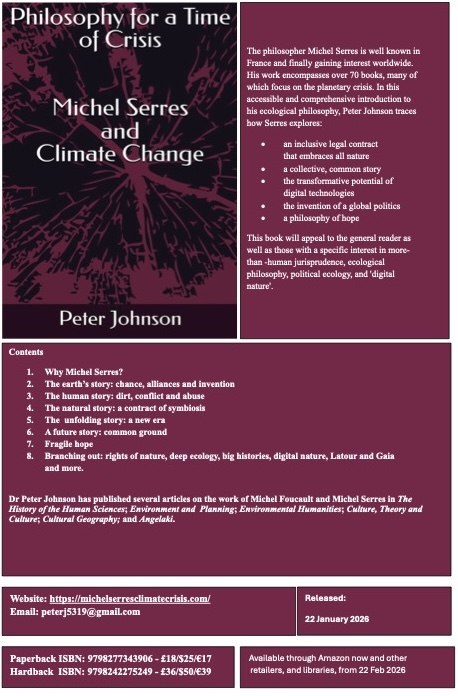
Peter Johnson, Philosophy for a Time of Crisis: Michel Serres and Climate Change – independently published, January 2026
Update: the ebook is free on Amazon from 18 May to 22 May 2026
Roy Scranton, Impasse: Climate Change and the Limits of Progress – Stanford University Press, August 2025
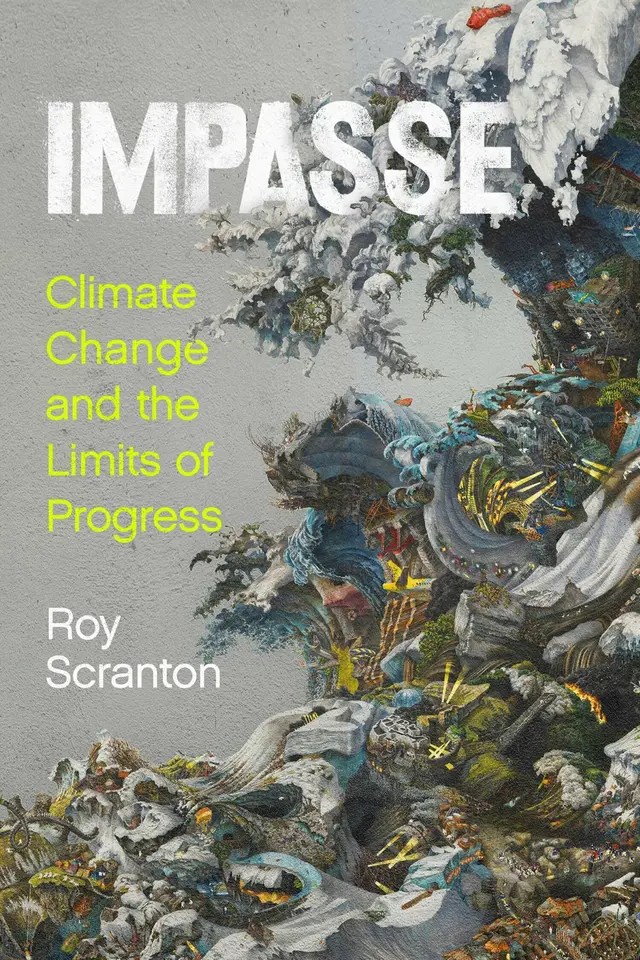
We need a new realism in the face of global climate catastrophe.
Extreme heat, fires, floods, and storms are transforming our planet. Yet instead of serious responses from world leaders, we get increasing emissions, divisive politics, and ersatz solutions that offer more of the same: more capitalism, more complexity, more “progress.”
The impasse we face is not only political and institutional, but cognitive, existential, and narrative. We’re incapable of grasping the scale, speed, and impact of global warming. Our brains can’t make sense of how radically our world is changing. And we optimistically cling to a civilizational narrative that promises a better tomorrow if we just keep doing what we’re doing.
It’s well past time, Roy Scranton argues, to free ourselves from our dangerous and dogmatic faith in progress. Such unwarranted optimism will only accelerate our collective disintegration. If we want to have any hope at all for the future, it must be grounded in a recognition of human limits—a view Scranton calls ethical pessimism.
Drawing from psychology, philosophy, history, and politics, as well as film, literature, and personal experience, Scranton describes the challenges we face in making sense of our predicament, from problems in communication to questions of justice, from the inherent biases in human perception to the difficulties of empirical knowledge. What emerges is a challenging but ultimately hopeful proposition: if we have the courage to accept our limits, we may find a way to embrace our unknowable future.
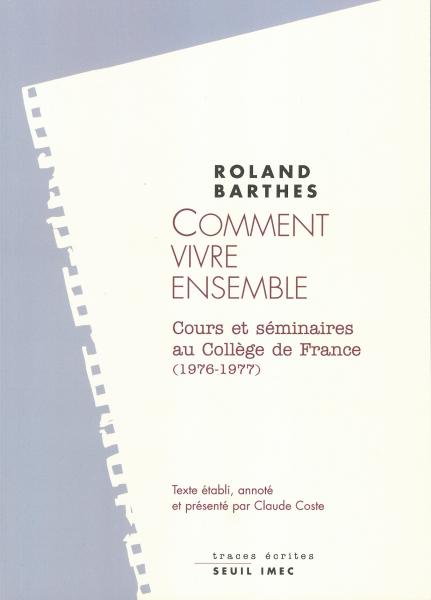

Roland Barthes only taught at the Collège de France for a short period, from the 1976-77 academic year until shortly before his premature death in early 1980. I was drawn to his lecture courses there for my current work because he sometimes used Émile Benveniste as an important resource. I will be discussing his broader engagement with Benveniste in detail elsewhere, but here I want to talk briefly about his 1976-77 Collège de France course, Comment Vivre Ensemble, How to Live Together, where he briefly uses Benveniste’s work in the Vocabulaire to think about the question of territory, as a shared space of a people (Comment Vivre Ensemble, 161-62; How to Live Together, 116-17).
Territory had been a theme earlier in the course, mainly in the sense of animal ethology (Comment Vivre Ensemble, 71, 93-95, 117, see 168-69; How to Live Together, 37, 57-59, 79, see 122). Barthes makes use of the article “Territoire (ethologie)” from the Encyclopaedia Universalis by the zoologist Jean-Claude Ruwet (editor note to Comment Vivre Ensemble, 71 n. 21; How to Live Together, 183 n. 23), but also the work of the archaeologist and palaeontologist André Leroi-Gourhan. Barthes makes the claim that:
Leroi-Gourhan: man = a territorial animal, like the stag and the robin. The idea of territory incorporates the public/private opposition. There are some historical, ideological aspects to that opposition (legislation, legal right to ‘privacy’), but its basis is anthropological. Private [space] is territory. It’s possible to have concentric (concentrated) spheres of the private, or in other words a territory within a territory: domain (large rural estate) -> house (servants, agriculture workers excluded) -> room (not all the inhabitants of the house are admitted) -> bed (Comment Vivre Ensemble, 93; How to Live Together, 57).
Barthes’s gloss of domaine, domain or estate, as “large rural estate [grand domaine rural]” came in his oral presentation rather than the preparatory notes (see editor note to Comment Vivre Ensemble, 93 n. 4; How to Live Together, 187 n. 4).
Claude Coste’s editor note to the course indicates that Barthes’s notecards for the lecture attributes the deer and robin example to Leroi-Gourhan, Le Geste et la Parole, but that there is no passage which directly corresponds to this claim (Comment Vivre Ensemble, 93 n. 2; How to Live Together, 187 n.2). The note suggests that one passage from Le Geste et la Parole is close to Barthes’s point: “At the technoeconomic level the nature of human integration is no different from that of animals having territorial organisation and shelters [Au plan techno-économique, l’intégration humaine n’est pas différente, en nature de celle des animaux à organisation territorial et à refuge]” (Le Geste et la Parole II: La Mémoire et les Rythmes, 185 [2022 edition, Vol II, 233; Gesture and Speech, 349]). Ruwet, “Territoire (Éthologie)”, 955 mentions the robin as one of his examples. In his book length study of animal behaviour, he defines territoriality this way:
Territoriality exists when an individual [sujet], a pair, or a group establish themselves in a particular place [endroit] and deny other members of the same species access to it (Ruwet, Éthologie, 200; Introduction to Ethology, 176).
The most sustained discussion of territory by Leroi-Gourhan comes in an earlier passage of the book (Le Geste et la Parole I: Technique et langage, 2022 edition, Vol I, 258-62; Gesture and Speech, 150-53). There he is concerned with the territorial behaviours of people, from prehistoric groups to “the primitive peoples of today”. The relation between people, density, food and territory is one in which “the variables are correlated” (Le Geste et la Parole, 2022 edition, Vol I, 258-59; Gesture and Speech, 150). Whether animal territoriality can shed light on this is one question; whether this is a useful approach to think about territory at larger scales is another.
The nested model of territory, of spaces within spaces, is also mentioned when Barthes indicates the territory of an apartment building: “This shared territory (the building) defines the community’s mode of being: bourgeois respectability. Inside this shared territory, smaller territories (just as rigorously delimited): apartments [which] define the fundamental [canonique] being of the family. The (bourgeois) staircase with all the closed doors therefore functions as a no-man’s land [le hors-limite]” (Comment Vivre Ensemble, 95; How to Live Together, 59).
Ethology: not only is territory defended, it is also marked [signalé] (the hippopotamus marks out [jalonne] its territory with its excrement). From this comes two functions of enclosure (in its original relation to territory): that of protection, that of definition (Comment Vivre Ensemble, 94; How to Live Together, 57-58).
Jacques Lacan also uses the example of the hippopotamus using excrement to mark out its territory in his 1958-1959 seminar (Le Désir et son interpretation, 161-62; Desire and its Interpretation, 106). The idea of definition is crucial for Barthes here. “The very meaning of ‘to define’: to mark out borders [limites], frontiers. Enclosure = defines a territory, and by extension the identity of its occupants” (Comment Vivre Ensemble, 94; How to Live Together, 58). In other words, there is a conceptual fencing and exclusion as well as a material, spatial one.
Elsewhere in the course, Barthes recognises that while animals can mark territory by scent, with humans it can be marked by sight – “everything the eye can see”, or touch – “everything within touching range, everything within my gestural range, within an arm’s reach”, or sound – “a polyphonic network of familiar sounds” (Comment Vivre Ensemble, 117; How to Live Together, 79).
On territory, there is also the discussion in the 1977 essay “Listening”, written in collaboration with Roland Havas, and contemporaneous with the course:
It is doubtless by this notion of territory (or of appropriated, familiar, domestic space – household [espace approprié, familier, aménagé – ménager]) that we can best grasp the function of listening, insofar as territory can be essentially defined as the space of security (and as such, as space to be defended): listening is that preliminary attentions which permits intercepting whatever might disturb the territorial system; it is a mode of defence against surprise; its object (what it is orientated toward) is menace or, conversely, need; the raw material of listening is the index, because it either reveals danger or promises the satisfaction of need (Roland Barthes with Roland Havas, “Ecoute”, 341-42; “Listening”, 247).
These are not especially innovative claims, not advancing beyond the work on animal ethology that uses a human notion of territory to think about animal behaviour, and the subsequent work on human territoriality which unproblematically took that animal notion to think about territory. I have criticised that approach to territory before (especially in “Land, Terrain, Territory”). The most famous French theory engagement with literature on animal territoriality is, I think, by Deleuze and Guattari in A Thousand Plateaus. I discuss this a bit in “The State of Territory Under Globalization”. But the point which Barthes takes from Benveniste is more interesting:
Benveniste (Vocabulaire des institutions indo-européennes, II, beginning) demonstrates: Rex, not a chief [chef], but someone who determines consecrated spaces (cities, territories), someone who marks out [trace]. Rego < Greek orégō = expand in a straight line (≠ expand outward, pétannumi). From the point one occupies, to mark a straight-line out ahead – to move forward in a straight-line. Horses (Homer): stretching out to their full length as they bound ahead. -> Regio: the point reached by following a straight line. Regula: the instrument used to draw a straight line. That etymological process authorises what I consider to be an enlightening link between rule [in the monastic sense] and territory (territory can be linked to ‘Enclosure’, as I did, but it may have an even closer relation to ‘Rule’ (Barthes, Comment Vivre Ensemble, 161; How to Live Together, 116).
I’ve written about how Benveniste’s analyses in the Vocabulaire are potentially useful for the analysis of territory in two earlier pieces in this series (here and here). Barthes describes a territory as “an appropriated space, protected from intruders (man, robins, deer), where each individual rules over his own domain. But also: a space associated with certain recurrent functions or—in human terms—habits” (Comment Vivre Ensemble, 161-62; How to Live Together, 116-17).
He goes on to reiterate the key points of the ethological sense of territory, and add details of when animals might do this, and the examples also come from literature with Daniel Defoe’s Robinson Crusoe and Thomas Mann’s The Magic Mountain(Comment Vivre Ensemble, 162; How to Live Together, 116-17). But this leads him to a more interesting claim.
The territory’s generic function (it’s worth reminding ourselves of this). It is not only a matter of security but also a constraint of distance: the spacing of subjects between one territory and another + a certain regulated distance between one subject and another within the territory itself. Intra-territorial spacing is reduced in the case of danger (schools of fish, flocks of starlings) but, once the danger has passed, the subjects re-establish their distance from one another. Notion of critical distance governing the relations between individuals. -> One function of the rule will be simply to instate (to stage) that critical distance.
Indeed, it would be possible to consider every system of rules as, metonymically, a territory: either temporal (timing), or gestural (behaviors) (Comment Vivre Ensemble, 162; How to Live Together, 117).
The spatial aspects of Barthes’s late work have not gone unnoticed. As Lucy O’Meara indicates in her study of his teaching at the Collège de France.
Spatialisation is the pre-eminent metaphor linking all the lecture courses, but especially Comment vivre ensemble and Le Neutre. Space is dispersive and freeing. In line with the ‘impure’ ideals of Leçon, these lecture series are set up as broad, open areas of investigation, constituting an idiorrythmic space: ‘l’idiorrythmique ne protège pas une “pureté”, c’est- à-dire une identité. Son mode d’implantation dans l’espace: non la concentration, mais la dispersion’ (CVE, 94, 2 March). Rhythm itself is spatial for Barthes, who has learned from Émile Benveniste’s article on rhythm that rhuthmos originally referred to a distinctive, individualised form. According to Benveniste, it was after Plato that rhythm came to be conceived of as an established order imposed upon the individual from the outside. Barthes seeks a return to rhythm as a ‘forme improvisée, modifiable […]; configuration sans fixité ni nécessité naturelle’ (CVE, 38, 12 January) (Roland Barthes at the Collège de France, 94).
The Benveniste essay is “The Notion of ‘Rhythm’ in its Linguistic Expression”, included in the first volume of his Problems in General Linguistics. The two passages quoted by O’Meara in the English translation, How to Live Together, are: “The function of idiorrhythmy is not to protect a ‘purity’, that is to say an identity. Its arrangement in spatial terms: not concentration, but dispersion, spacing… ” (p. 58) and “an improvised, changeable form… configuration without fixity or natural necessity” (p. 7).
I have not found a definitive source to confirm this, but I think that Jean-Claude Ruwet (1938-2007), the Belgian zoologist cited above, is the younger brother of the linguist Nicolas Ruwet (1932-2001). Born in Belgium but educated in France, Nicolas Ruwet studied with Benveniste, Lévi-Strauss and others, before going to the USA to work with Jakobson and Noam Chomsky (see the obituary by Jean-Louis Aroui and Anne Zribi-Hertz; and my brief mention in relation to Jakobson, here). He was the translator of the two-volume collection of Jakobson’s Essais de linguistique générale, is best-known for his An Introduction to Generative Grammar, and along with Kristeva and Jean-Claude Milner edited the Langue, discours, société: Pour Émile Benveniste collection. Barthes has an essay on Robert Schumann’s Kreisleriana, opus 16, in that collection. There, he draws on Benveniste’s work to think about music and meaning:
In a famous text [“Sémiologie de la langue”], Benveniste sets in opposition two realms of signification: the semiotic, an order of articulated signs each of which has a meaning (such as natural language), and the semantic, an order of discourse no unit of which signifies in itself, although the ensemble is given a capacity for signifying. Music, Benveniste says, belongs to semantics (and not to semiotics), since sounds are not signs (no sound, in itself, has meaning); hence, Benveniste continues, music is a language which has a syntax, but no semiotics.
What Benveniste does not say, but what perhaps he would not contradict, is that musical signifying, in a much clearer fashion than linguistic signification, is steeped in desire. Hence, we change logics. In Schumann’s case, for instance, the order of beats is rhapsodic (there is weaving, patchwork of intermezzi): the syntax of the Kreislerianais that of a quilt [patchwork]: the body, one might say, accumulates its expenditure—signifying takes on the frenzy but also the sovereignty of an economy which destroys itself as it develops; it therefore relates to a semanalysis, or one might say to a second semiology, that of the body in a state of music; let the first semiology manage, if it can, with the system of notes, scales, tones, chords, and rhythms; what we want to perceive and to follow is the effervescence of the beats.
By music, we better understand the Text as signifying [signifiance] (“Rasch”, 837-38; The Responsibility of Forms, 311-12.
Nicolas Ruwet also worked on the semiotics of music, with most of his writings on this collected in Langage, musique, poésie in 1972. The links between linguistics, semiology and ethology might be worth further exploration – Jean-Claude Ruwet co-authored a synthesis of research on communication and language in animals with P. Poncin and M.C. Huynen in 2002.
I plan to write about Roland Barthes’s 1978-79 seminar on “The Metaphor of the Labyrinth” as another spatial theme of his late work in a future piece in this series. [Update 1 February 2026 – now available here.]
References
Jean-Louis Aroui and Anne Zribi-Hertz, “In Memoriam: Nicolas Ruwet 1933-2001”, Le français moderne 70 (1), 2002, 109–111.
Roland Barthes, “Rasch”, in Julia Kristeva, Jean-Claude Milner and Nicolas Ruwet eds., Langue, discours, société: Pour Émile Benveniste, Paris: Seuil, 1975, 217-28; reprinted in Œuvres complètes, ed. Eric Marty, Paris: Seuil, five volumes, 2002, Vol IV, 827-38; “Rasch”, The Responsibility of Forms: Critical Essays on Music, Art, and Representation, trans. Richard Howard, Berkeley and Los Angeles: University of California Press, 1991 [1985], 299-312.
Roland Barthes, Comment Vivre Ensemble: Simulations Romanesques de quelques espaces quotidiens: Notes de cours et de séminaires au Collège de France, 1976-1977, ed. Claude Coste, Paris: Seuil/IMEC, 2002; How to Live Together: Novelistic Simulations of Some Everyday Spaces, trans. Kate Briggs, New York: Columbia University Press, 2013.
Roland Barthes with Roland Havas, “Ecoute”, in Œuvres complètes, ed. Eric Marty, Paris: Seuil, five volumes, 2002, Vol V, 340-52; “Listening”, The Responsibility of Forms: Critical Essays on Music, Art, and Representation, trans. Richard Howard, Berkeley and Los Angeles, 1991, 245-60.
Émile Benveniste, “La notion de ‘rythme’ dans son expression linguistique”, Problèmes de linguistique générale 1, Paris: Gallimard, 1966, 327-35; “The Notion of ‘Rhythm’ in its Linguistic Expression”, Problems in General Linguistics, trans. Mary Elizabeth Meek, Coral Gables: University of Miami Press, 1971, 281-88.
Émile Benveniste, Le Vocabulaire des institutions indo-européennes, 2 volumes, Paris: Éditions de Minuit, 1969; Dictionary of Indo-European Concepts and Society, trans. Elizabeth Palmer, Chicago: Hau Books, 2016 (originally published as Indo-European Language and Society, Coral Gables: University of Miami Press, 1973).
Émile Benveniste, “Sémiologie de la langue”, Problèmes de linguistique générale 2, Paris: Gallimard, 1974, 43-66; “The Semiology of Language”, trans. Genette Ashby and Adelaide Russo, Semiotica (supplement), 1981, 5-23.
Gilles Deleuze and Félix Guattari, Mille Plateaux: Capitalisme et schizophrénie 2, Paris: Minuit, 1980; A Thousand Plateaus: Capitalism and Schizophrenia, trans. Brian Massumi, London: Athlone, 1988.
Stuart Elden, “Land, Terrain, Territory”, Progress in Human Geography 34 (6), 2010, 799-817.
Stuart Elden, “The State of Territory Under Globalization: Empire and the Politics of Reterritorialization” (2005), reprinted with new afterword in Mattias Kärrholm and Andrea Mubi Brighenti (eds.) Territories, Environments, Governance: Explorations in Territoriology, London: Routledge, 2022, 15-36.
Roman Jakobson, Essais de linguistique générale, trans. Nicolas Ruwet, Paris: Minuit, two volumes, 1963–1973.
Julia Kristeva, Jean-Claude Milner and Nicolas Ruwet eds., Langue, discours, société: Pour Émile Benveniste, Paris: Seuil, 1975.
Jacques Lacan, Le Séminaire de Jacques Lacan Livre VI: Le Désir et son interpretation 1958-1959, ed. Jacques-Alain Miller, Paris: Seuil Points, 2022; Desire and its Interpretation: The Seminar of Jacques Lacan Book VI, trans. Bruce Fink, Cambridge: Polity, 2019.
André Leroi-Gourhan, Le Geste et la Parole, Paris: Albin Michel, two volumes, 2022 [1964-65]; Gesture and Speech, trans. Anna Bostock Berger, Cambridge, MA: The MIT Press, 1993.
Lucy O’Meara, Roland Barthes at the Collège de France, Liverpool: Liverpool University Press, 2012.
P. Poncin, M.C. Huynen & J.C. Ruwet, “Communication et langage chez les animaux”, Bulletin de la Société Royale des Sciences de Liège 71 (4), 2002, 213-28, https://popups.uliege.be/0037-9565/index.php?id=1968
Jean-Claude Ruwet, “Territoire (Éthologie)”, Encyclopædia Universalis Corpus 17: Soutine-Thoreau, Paris: Encyclopædia Universalis, 1985, 955-56.
Jean-Claude Ruwet, Éthologie: Biologie du comportement, Bruxelles: C. Dessart, 1969; Introduction to Ethology: The Biology of Behaviour, New York: International Universities Press, 1973.
Nicolas Ruwet, Introduction à la grammaire générative, Paris: Plon, 1967, second edition 1970; Introduction to Generative Grammar, trans. Norval S.H. Smith, Amsterdam: North-Holland Publishing Company, 1973.
Nicolas Ruwet, Langage, musique, poésie, Paris: Seuil, 1972.
This is the 56th post of a weekly series, posted every Sunday throughout 2025, and now entering a second year. The posts are short essays with indications of further reading and sources. They are not as formal as something I’d try to publish more conventionally, but are hopefully worthwhile as short sketches of histories and ideas. They are usually tangential to my main writing focus, a home for spare parts, asides, dead-ends and possible futures. I hope there is some interest in them. They are provisional and suggestions are welcome. A few, usually shorter, pieces in a similar style have been posted mid-week. I’m not sure I’ll keep to a weekly rhythm in 2026, but there will be at least a few more pieces.
The full chronological list of ‘Sunday histories’ is here, with a thematic ordering here.
Isabel Feichtner, Susanne Heeg, Anne Klingenmeier, Gesine Langlotz and Katja Schubel eds., Stadt – Land – Boden: Verbindende Bodenpolitik zwischen Stadt und Land – transcript, August 2025, open access
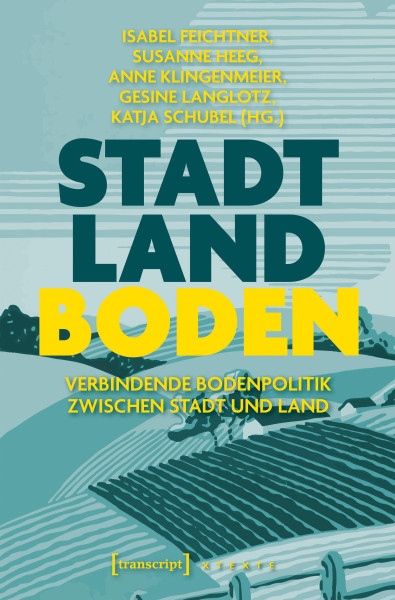
Bodenpolitische Fragen sind zukunftsweisend, denn sie entscheiden über Erhalt oder Zerstörung unserer Lebensgrundlagen. In den Debatten um Zugang, Verteilung und Nutzung von Boden wird heute die Eigentumsfrage neu gestellt: Wo sollte Boden Gegenstand von Privateigentum sein, wo als Gemeineigentum verwaltet werden? Und wie kann Recht Eigentumskonzentration verhindern und die gemeinwohlorientierte Nutzung von Grundeigentum sichern? Die Beiträge antworten mit einer Stadt und Land verbindenden Bodenpolitik und präsentieren Initiativen sowie Instrumente aus sozialen Bewegungen, Wissenschaft und Verwaltung, die eine gerechtere Verteilung, eine demokratischere und selbstbestimmte Verwaltung und eine nachhaltige Nutzung von Boden ermöglichen.
Chris O’Kane, Social Constitution and Fetishistic Social Domination in Marx, Lukács, Adorno, and Lefebvre – Brill, March 2026
The Marxian theory of fetishism is usually interpreted as a theory of false consciousness, alienation, or reification pertaining to commodities or culture. This book reconstructs how Marx, Lukács, Adorno, and Lefebvre interpret and use the theory of the fetish to explain how capitalist social relations create a supra-individual, autonomous, and inverted form of social domination. These relations transform individuals into bearers of domination, thereby perpetuating capitalist society. The resulting reinterpretations of their respective social theories, and of the theory of the fetish, are crucial for a critical theory of capitalism today.
Part of the Historical Materialism series, where books are published in paperback 12 months later with Haymarket.
Christophe Bouton, Sur les traces du temps – Minuit, 2026
thanks to John Raimo for the link
Qu’est-ce que le temps ? Constitue-t-il une réalité autonome ou une simple relation entre les êtres ? Un élément irréductible du monde ou une forme de la conscience, voire une illusion subjective ? S’écoule-t-il vers le passé ou vers l’avenir ? Est-il réversible ou irréversible ? Peut-il même être défini ? Ce livre se propose d’instruire ces questions à nouveaux frais, en s’appuyant sur plusieurs apports récents de la philosophie et des sciences de la nature. Son point de départ est la conviction qu’il faut libérer la pensée du temps du primat ontologique du présent, qui consiste soit à affirmer que seul le présent existe, en reléguant le passé et l’avenir dans le néant, soit à concevoir ceux-ci sur le modèle du présent, dont ils ne seraient que des formes dérivées ou dégradées. L’avenir, le présent et le passé existent tout autant, mais selon des modalités différentes que cette enquête se donne pour tâche d’analyser selon trois catégories principales, unies comme les volets d’un triptyque : la puissance, la présence et la trace. Si ces trois concepts s’appliquent en premier lieu au monde des choses et des événements, la dernière étape de cet ouvrage examine la forme spécifique qu’ils revêtent pour les êtres humains.
Duncan Kelly, Worlds of Wartime: The First World War and the Reconstruction of Modern Politics – Oxford University Press, November 2025
I’ve shared news of this major study, of a massive topic – 784 pages! – before. There is now a New Books Network discussion with Ryan Trip. Thanks to JC on bluesky for the link.
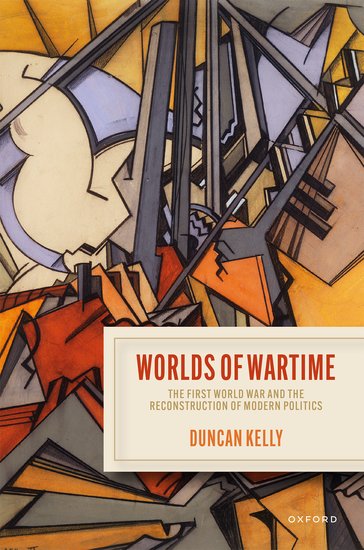
The First World War hardly ended with the formal Armistice in Europe on November 11, 1918, amid the continuing violence of blockades and epidemics, amid numerous forms of reconstruction and revolution. Its legacies, in fact, resonate deeply in our present. Nor is it obvious that it only began on July 28, 1914, just a month after the assassination of the Archduke Franz Ferdinand, in Sarajevo. Rather than these formal legal openings and closings, the beginnings and endings of wartime are many, depending upon the questions we ask, and the frames of reference we provide. For many at the time, the outbreak of what would become the First World War was an inevitability, the result of rising tensions over decades, whether due to the dynamics and systems of international politics within Europe, or a result of the competitive logic of imperial politics as practised by Europe outside its borders, rebounding back upon it. This resulted in equally persistent ideas down to our own time, about the inevitability that followed from victory; namely, that to be successful and realistic, modern politics and economics must necessarily be fixed in the form of a democratic nation-state. But this new world of democracy, forged in war, could easily become its own sort of intellectual prison-house, curating and limiting political and economic possibilities just as securely as any form of tyranny. That the tyranny of victory was a danger recognized by many of the leading analysts of the First World War at the time, helped to foster a continued search for ideas that might keep the worlds of politics and economics open to alternative futures, rather than being closed by the force of a few great powers or the presentational fiat of democracy. Those hopes paved the way for the wide variety of anti-imperial, federal, diasporic, and revolutionary forms of political and economic arrangements, which were designed to challenge the seemingly inevitable rise of the nation-state.
Worlds of Wartime: The First World War and the Reconstruction of Modern Politics provides a new intellectual history of the many and varied ideas about politics and economics that were made, and remade, through wartime and revolution, by political and economic thinkers working across the globe, from the 1880s to the 1930s. Spanning continents, connecting networks of people, power, and possibilities, in new and often experimental ways, the worlds of wartime saw histories of modern politics and economics revised and updated, used as well as abused, in myriad attempts to interpret, explain, understand, explore, and indeed to win, the war. This book takes the measure of a great many of these overlapping visions, and it does so by trying to learn some of the lessons that literary and artistic modernism can teach us about the complexities of political and economic ideas, their contingency and uncertainty, and how they are fixed into focus only at very particular moments. Moving from the stylised narratives of European and American political theory and intellectual history, through to the futurist politics of revolutionaries in Ireland, India, Ottoman-Turkey, and Russia, this book also tracks arguments and strategies for Pan-African diasporic federation, alongside German and American debates about federal pasts and federal futures. From the invention of the world economy, to the reality of multiple war economies, from revolutionary conjunctures to ideas of democracy and climate catastrophe in the Anthropocene today, Worlds of Wartime tells the story of just how strongly modern politics in general, and modern ideas about political and economic possibility, were fixed by the intellectual turbulence wrought during the First World War.
Anne O. Law, Migration and the Origins of American Citizenship: African Americans, Native Americans, and Immigrants – Oxford University Press, March 2026
Update June 2026: New Books network discussion with Lilly Goren
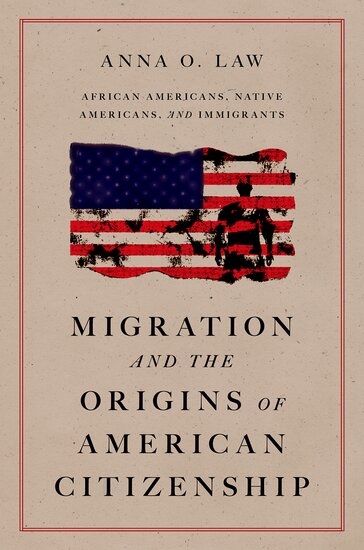
Since the late nineteenth century, the US federal government has enjoyed exclusive authority to decide whether someone has the ability to enter and stay in US territory. But freedom of movement was not guaranteed in the British colonies or early US. By contrast, voluntary migrants were met with strict laws and policies created by colonies and states, which denied free mobility and settlement in their territories to unwanted populations.
Migration and the Origins of American Citizenship presents a story of constitutional development that traces the confluence of the logics of slavery and settler colonialism in early legal rulings and public policy about migration and citizenship. The book examines the division of labor between the national and state governments that endured for over a century, reasons why that arrangement changed in the late nineteenth century, and what the transformation meant for people subject to those regimes of control. Drawing into one study the migration policy histories of groups of people that are usually studied separately, and combining the methodologies of political science, history, and law, Anna O. Law reveals the unmistakable effects of slavery and Native American dispossession in modern US immigration policy.
Gautham Rao, White Power: Policing American Slavery – University of North Carolina Press, May 2026

Beginning in the colonial era and growing through the American Revolution and the Southern plantation system, slaveholders’ violent police regime continued after Emancipation, through Reconstruction, to today. Moving across time, space, and place, White Power uncovers how slaveholders created their own white supremacist police and government to deny Black people rights, power, and humanity.
Legal historian Gautham Rao introduces us to laws that empowered white people to forcibly exercise their desired racial superiority over Black people, shows how they spread from the South throughout the nation, and traces the rebellions, fugitivity, activism, and legal systems that challenged them. Rao’s narrative includes slaveholders, lawmakers, and the Ku Klux Klan, dramatic escapes by runaway enslaved people, abolitionist activism in courtroom showdowns, and pitched battles between white paramilitaries and enslaved rebels. He offers a new interpretation of the history of policing in the US, centering the institution and legacy of slavery and speaking to the origins of today’s persistence of white vigilance, white supremacist militia groups, and white racist cops determined to maintain power over Black people by force. Equally determined, however, was Black Americans’ refusal to accept it.
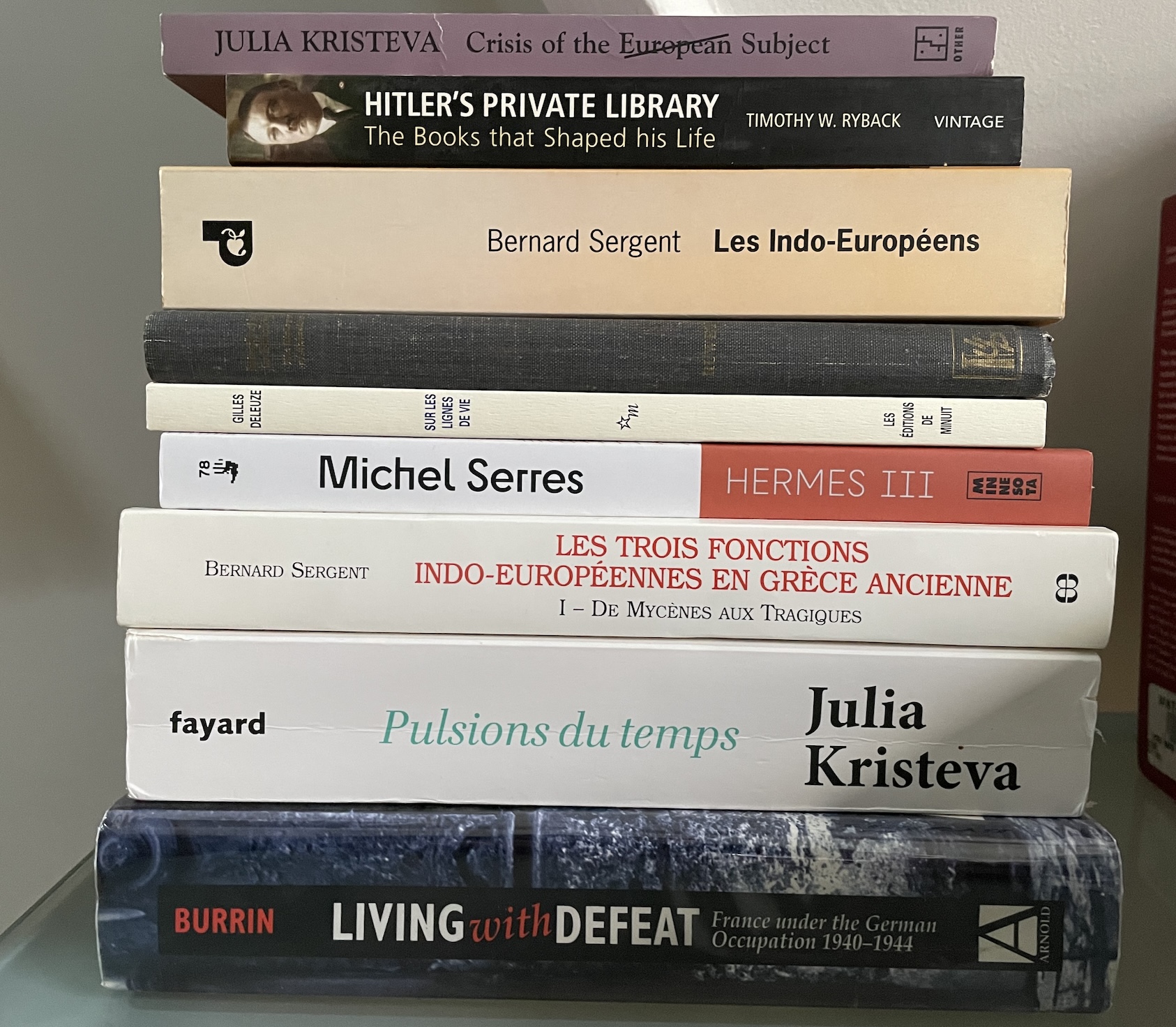
Mostly bought second-hand, but including Michel Serres, Hermes III, sent by University of Minnesota Press, and Gilles Deleuze, Sur les lignes de vie. The one without a clear title on the spine is Jean-Claude Ruwet, Introduction to Ethology: The Biology of Behaviour. Ruwet’s work on territoriality was important for some of the French theorists I’m interested in. The others generally relate to my current Indo-European thought project.

