Ludwig Binswanger – a bibliography of major German works and available French or English translations

As part of my work on the early Foucault, I’ve been doing some work on Ludwig Binswanger, including finding several of his works. For my own purposes I compiled a bibliography of his major German works, and all the work translated into French and English. I was getting confused by different references to the same essays, and making a bibliography was the best way I could find to keep track of things. There is a major collection in German, Ausgewählte Werke in 4 Bänden (Roland Asanger, Heidelberg, 1992–1994), which collects many, but not all, of his writings. There are two earlier collections of essays and lectures in German. There are several books translated into French, as well as three collections of essays – Analyse existentielle, psychiatrie clinique et psychanalyse: Discours, parcours, et Freud, translated by Roger Lewinter, Introduction à l’analyse existentielle, translated by Jacqueline Verdeaux, and the more recent Phénomenologie, psychologie, psychiatrie. There is much less in English, with the key collection Being-In-The-World: Selected Papers of Ludwig Binswanger, though that is long out of print and it was hard to find. The first of the French collections has a good bibliography, and the definitive one is Germaine Sneessens, “Bibliographie de Ludwig Binswanger” from 1966, but both are very out-of-date concerning translations.

The bibliography is available here, and will be updated as and when I find other sources. I am quite sure that it is incomplete, and I would welcome additions or corrections – though I don’t need to be told of additional German essays which are untranslated, unless they do not appear in Snessens. I hope someone finds it useful.

Posted in Ludwig Binswanger, Michel Foucault, The Early Foucault, Uncategorized | Leave a comment

By Heart: A Year in Writing Advice – The Atlantic

Writing advice from The Atlantic.

Peter Gratton's avatarPHILOSOPHY IN A TIME OF ERROR

Highlights from 12 months of interviews with writers about their craft and the authors they love

Source: By Heart: A Year in Writing Advice – The Atlantic

View original post

Posted in Uncategorized | Leave a comment

Antipode 2017 – a new look for the new year

An update on changes at Antipode, including a brief mention of two interesting new projects – a book on the writings and thought of Neil Smith (2017) and a special issue on keywords of/in radical geography (2019).

Antipode Editorial Office's avatarAntipodeFoundation.org

Here we are at the start of 2017 with a new look for the journal’s 49th volume (issue 1 is freely available online). Antipode has had a number of facelifts since 1969 as radical geography has become an integral part of the discipline. We’ve expanded and multiplied in content and membership, as an increasingly diverse set of Left geographers have gained legitimacy and positions of power in universities, and as the range of “valid” approaches has become ever wider. Antipode has always welcomed the infusion of new ideas and the shaking-up of old positions through dialogue and debate, never being committed to just one view of diagnosis or critique. We might say, borrowing Linda Peake and Eric Sheppard’s words, that the journal’s pages have been “bound together by a shared no – rejection of the…status quo – and diverse yeses”.

As Antipode approaches it’s 50th anniversary, we…

View original post 386 more words

Posted in Uncategorized | Leave a comment

One or Two King Lears? – review at Berfrois (open access)

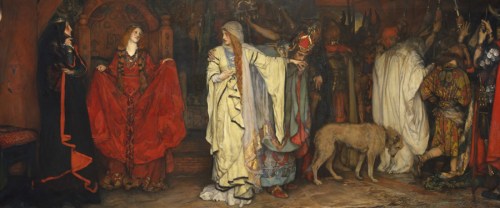
Edwin_Austin_Abbey_King_Lear_Act_I_Scene_I_The_Metropolitan_Museum_of_Art.jpg

Update September 2025: the Berfrois site is now closed and the archive has been removed. My piece can now be found here.

I have a long review of Brian Vickers’s The One King Lear, at the Berfrois website. It was one of the biggest review challenges I’ve ever faced – a difficult, technical and contentious book…

Anyone who has seen more than one production of a Shakespeare play in a theatre, or watched a film version, will know that the words said by the actors can change. Speeches are cut in whole or part, some lines reassigned, scenes switched around or dropped entirely. Sometimes lines from other plays, or the director or their colleague’s own, are introduced. These decisions are made for a range of artistic or logistical reasons – to reduce the running time, to speed the action, to give a contemporary spin, to streamline a subplot, to merge minor roles, and so on. It is of course highly likely that such practices accompanied these plays from their first performances in Shakespeare’s lifetime.

It is also reasonably well known that several Shakespeare plays exist in more than one printed version. [continues here]

Posted in Shakespearean Territories, Uncategorized, William Shakespeare | Leave a comment

Books received – Foucault, Binswanger, Lacan

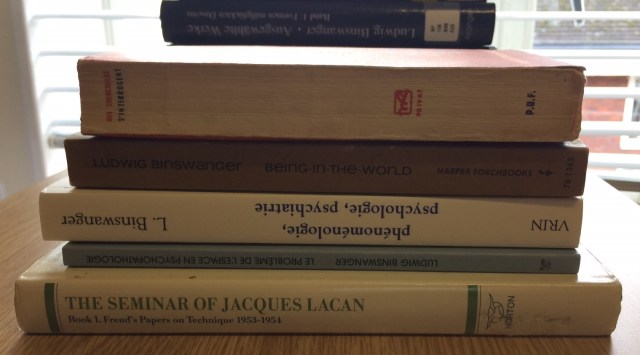
IMG_2136.JPG

Some recently bought books for the project on the early Foucault – a seminar by Lacan which he likely attended, some works by Binswanger and the original source of one of his first publications.

Posted in Jacques Lacan, Ludwig Binswanger, Michel Foucault, The Early Foucault, Uncategorized | 1 Comment

Books received – author copies of Foucault: The Birth of Power

IMG_2138.jpgThe remaining author copies of Foucault: The Birth of Power – which means that the book is now shipping if you order direct. Amazon etc. might take a bit longer to have stocks…


Posted in Foucault: The Birth of Power, Michel Foucault, My Publications, Uncategorized | Leave a comment

Gastón Gordillo on Terrain

terrain-blogOne of the key people I am in dialogue with for my work on terrain is UBC Anthropology Professor, Gaston Gordillo. He provides a preview of a forthcoming essay on terrain at his Space and Politics blog. It will appear in Lexicon for an Anthropocene Yet Unseen, edited by Anand Pandian and Cymene Howe (2017, Punctum).
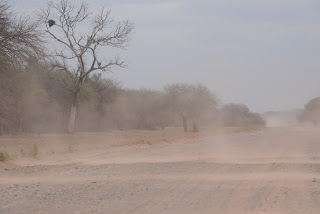
The piece begins with the rich ethnographic description familiar to readers of his books  Landscapes of Devils: Tensions of Place and Memory in the Argentinean Chaco and  Rubble: The Afterlife of Destruction. But it shifts into a powerful emphasis on the concept of terrain:

Global warming challenges human-centered views of places, landscapes, and territories as socially configured spatial fields for a simple reason: it confronts us with the vast, uncontrollable physicality of terrain. I propose “terrain” for our lexicon of the future because only this term admits that all actually-existing places have volumes, forms, and textures that are irreducible and indifferent to human practice, and whose dynamism becomes most apparent in the elusive physicality of the wind. And the air moves because we live in a planet in motion that rhythmically exposes the ocean and the atmosphere to the heat of the sun, creating temperature imbalances, flows, and currents in a state of flux.

You can learn more about his remarkable work in an interview I conducted with him for the Society and Space open site a couple of years ago.

Posted in Uncategorized | 1 Comment

6 Critical Theory Books That Came Out in December, 2016

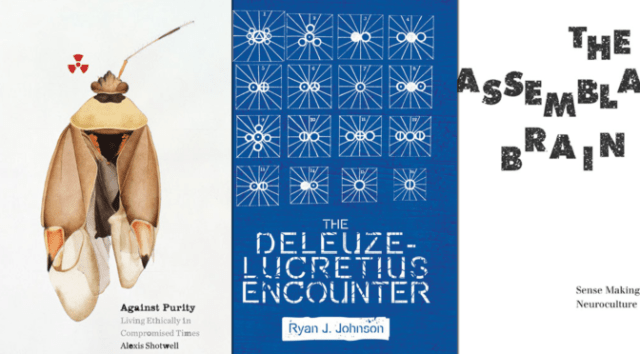
December-2016-critical-theory-books-672x372.pngAs ever, a very useful roundup here.

Posted in Uncategorized | Leave a comment

Peter Adamson’s 20 rules or “suggestions of best practice” for doing the history of philosophy

Peter Adamson, professor of philosophy at Ludwig-Maximilians-Universität in Munich and creator of the podcast History Of Philosophy Without Any Gaps, has put together a list of 20 rules or “suggestions of best practice” for doing the history of philosophy.

The rules were culled from various podcasts and posts over the past couple of years. Some of them, he admits, are obvious, and others he says he ought not have to say but must owing to common violations of it.

Read more at the Daily Nous (summary), or History of Philosophy (original version). Lots of good advice here, and I think this is useful for more general work in the history of thought or intellectual history too. Many of these are principles I try to follow (but don’t necessarily or always succeed in doing…)


Posted in Uncategorized | Leave a comment

Achille Mbembe, The age of humanism is ending

Achille Mbembe, ‘The age of humanism is ending‘, Mail and Guardian, 22 December 2016

There is no sign that 2017 will be much different from 2016.

Under Israeli occupation for decades, Gaza will still be the biggest open prison on Earth.

In the United States, the killing of black people at the hands of the police will proceed unabated and hundreds of thousands more will join those already housed in the prison-industrial complex that came on the heels of plantation slavery and Jim Crow laws.

Europe will continue its slow descent into liberal authoritarianism or what cultural theorist Stuart Hall called authoritarian populism. Despite complex agreements reached at international forums, the ecological destruction of the Earth will continue and the war on terror will increasingly morph into a war of extermination between various forms of nihilism.

Posted in Uncategorized | 3 Comments