
Society and Space book series – first two volumes by Bulley and Klauser out soon

Over the past several years I’ve been working with Sage on a Society and Space book series, which is linked to the Environment and Planning D: Society and Space journal (now published by Sage). There are several books under contract or in discussion, with the first two volumes due to be published very soon. The series description is as follows:

The Society and Space series explores the fascinating relationship between the spatial and the social. Each title draws on a range of modern and historical theories to offer important insights into the key cultural and political topics of our times, including migration, globalisation, race, gender, sexuality and technology. These stimulating and provocative books combine high intellectual standards with contemporary appeal for students of politics, international relations, sociology, philosophy, and human geography.
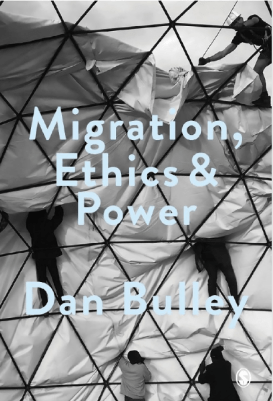
Bulley.pngThe first book to be published will be Dan Bulley’s  Migration, Ethics and Power: Spaces Of Hospitality In International Politics. The book’s description is:

In 2014, the ethics and politics of hospitality were brought into stark relief. Three years into the Syrian conflict, which had already created nearly 2.5 million refugees and internally displaced 6.5 million, the UN called on industrialised countries to share the burden of offering hospitality through a fixed quota system. The UK opted out of the system whilst hailing their acceptance of a moral responsibility by welcoming only 500 of the ‘most vulnerable’ Syrians. Given the state’s exclusionary character, what opportunities do other spaces in international politics offer by way of hospitality to migrants and refugees?

Hospitality can take many different forms and have many diverse purposes. But wherever it occurs, the boundaries that enable it and make it possible are both created and unsettled via exercises of power and their resistance. Through modern examples including refugee camps, global cities, postcolonial states and Europe, as well as analysis of Derridean and Foucauldian concepts, Migration, Ethics and Power explores:

  • The process and practice of hospitality
  • The spaces that hospitality produces
  • The intimate relationship between ethics and power

This is a brilliantly contemporary text for students of politics, international relations and political geography.

Klauser.jpgDan’s book will be closely followed by Francisco Klauser’s Surveillance and Space:

The digital age is also a surveillance age. Today, computerized systems protect and manage our everyday life; the increasing number of surveillance cameras in public places, the computerized loyalty systems of the retail sector, geo-localized smart-phone applications, or smart traffic and navigation systems. Surveillance is nothing fundamentally new, and yet more and more questions are being asked:

Who monitors whom, and how and why?

How do surveillance techniques affect socio-spatial practices and relationships?

How do they shape the fabrics of our cities, our mobilities, the spaces of the everyday?

And what are the implications in terms of border control and the exercise of political power?

Surveillance and Space responds to these modern questions by exploring the complex and varied interactions between surveillance and space.  In doing so, the book also advances a programmatic reflection on the very possibility of a ‘political geography of surveillance’.

Other books under contract include Marcus Doel’s Violent Geographies, Shiloh Krupar and Greig Crysler’s The Waste Complex and Ross Exo Adams’s Circulation and Urbanization. Plenty more in development and discussion. If you’d like to talk to me about the series, please email me.
Posted in Books, Publishing, Society and Space, Uncategorized | 4 Comments

Volumetric Urbanism: Charting New Urban Divisions, Sheffield, 24-25 May 2017

VOLUMETRIC URBANISM: Charting new urban divisions [pdf]

An International Workshop
University of Sheffield and University of Western Sydney Sheffield, United Kingdom, 24-26th May 2017.

Organisers: Simon Marvin, Urban Institute, Rowland Atkinson, Inclusive Societies at the University of Sheffield and Donald McNeill Institute for Culture and Society, University of Western Sydney.

In major cities around the world, councils and governments are faced with the problem and possibilities of ‘volume’: the stacking and moving of more and more people and things above, across and below tiny, interlocking sites within booming central business districts. Three trends are particularly notable here: first, the growth of improved mass public transport provision that now funnels many more people in and out of city centres than before, often underground; second, there has been a marked increase in tall building construction in cities, between 2010 and 2016 fifty ‘supertall’, or 300 metres plus skyscrapers were built; third, building and city management systems have now improved to a point where ‘utopian’ building projects based around new forms of enclosure and autonomous infrastructures are now being realized thanks to advanced materials and engineering technology.

This workshop has been organized to respond to what we see as the reinterpretation of the limits, porosity and nature of building ‘envelopes’ – the boundary between the notions of the interior and exterior and the placing and management of different kinds of atmospheres in city plans. These are being reworked according to a number of new technological, design and financial logics: architects, engineers, developers, bankers and other specialist service providers act variously to, quite literally, ‘push theenvelope’reconfiguringthenatureofthesebuiltspaces.

The core aim of the workshop is to understand through empirical analysis and theoretical frameworks how urban space is being made more malleable, with surface, airspace, and underground constantly subject to new logics of development. The workshop welcomes papers that address one or more of the following three objectives:

1. Genealogies of architectural and engineering approaches to the production of volumetric spaces, identifying key cities, prototypes, models, and movements, and their geographical spread and influence, including glasshouses, atria, skyscrapers, and underground/elevated walkways as they shift from experimental status to standardized, commercialized design solutions in various urban forms.

2. Identification of how global private and public actors and institutions are working with tools, procedures and products to operationalize vertical and horizontal movement, exclusion and security in volumetric spaces, including new property development and investment practices also the use of tunneling, elevators and escalators, and devices used to maximize safety and comfort, from fire escapes to air quality control, and their accompanying metrics.

3. Examinations of the socio-spatial consequences of volumetric urbanism, new forms of inequality and differential forms of (in)security. Many critics have noted the potential for ‘secession’ for affluent city users, through volumetric responses – enclosure, bubbles of security, depth and height, creation of microclimates, internalising energy and food production, conditioned air. How can we understand these new scales and forms and the encompassing of multiple functions that may become urban ‘assets’ in terms of threats like ecological and economic turbulence while engendering new and novels modes of social exclusion.

Please send 250 words abstracts to Simon Marvin and Donald McNeill by December 19th 2016.Theorganisers may be able to provide supportfor some subsistence and travel costs for the workshop.

Posted in Uncategorized | Leave a comment

A response to the publishing advice from yesterday from David Enoch

A few people didn’t like the publishing advice I linked to yesterday, so here’s a response from the same blog, the Daily Nous, from David Enoch. But do look at the comments to the original post, where Jason Brennan responds to all the criticisms made of his advice.

I should add the standard disclaimer: there is no correct way to do things, just ways that work for different people. But I see so many people, at different career stages, stuck in patterns that don’t work for them, that it seems good to share advice that may be useful to some. If you don’t like it, that’s fine.

Posted in Publishing, Uncategorized, Writing | Leave a comment

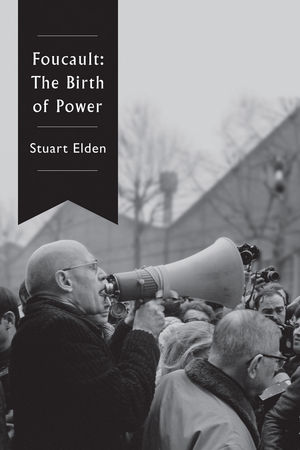
Endorsements for Foucault: The Birth of Power from Caren Kaplan and Bernard Harcourt

1509507256Two very generous endorsements for my next book Foucault: The Birth of Power, due out in early 2017.

‘Foucault: The Birth of Power opens an illuminating window into the process of political awakening and philosophical transformation as intellectual history. Drawing on lectures, talks and unpublished as well as published material, Stuart Elden has marshalled the contents of a massive archive to substantiate this pivotal period in the development of one of the most influential thinkers of the twentieth century.’
Caren Kaplan, University of California, Davis

‘This is a brilliant prequel to Elden’s masterful book, Foucault’s Last Decade. Here, Elden offers a meticulous, erudite reading of the thinker’s early years at the Collège de France – a critical time in the arc of his research, which included seminars and conferences on disciplinary power, with deep political engagement and activism on behalf of prisoners. With his unmatched knowledge of Foucault, Elden unearths key intellectual moments and carefully traces Foucault’s intellectual journey to the mid-1970s, the publication of Discipline and Punish and the lectures on psychiatric power. Foucault: The Birth of Power is the perfect reading companion to Foucault’s “power-knowledge” period.’
Bernard Harcourt, Columbia University

Posted in Caren Kaplan, Foucault: The Birth of Power, Michel Foucault, Uncategorized | 2 Comments

New Historical Materialism website

New Historical Materialism website – looks good.

Posted in Uncategorized | Leave a comment

A great comment from a university press editor on publishing

A great comment to Productive in Publishing (guest post by Jason Brennan) at the Daily Nous.

Matt McAdam ·November 10, 2016 at 1:39 pm

I think this is all very good advice, and I also think those who find it off-putting or impossible to put into practice should really ask themselves whether academia is for them. As a university press editor, I work with lots of authors, and it’s clear to me that the most successful ones do some version of what Brennan describes. Perhaps more importantly, the _happiest_ authors I know follow some version of Brennan’s plan. In particular, productive and happy academics, in my experience, write everyday, vigorously guard and prioritize their writing time, write shitty first drafts that they edit later, and read the secondary literature only after they’ve written something. Sure, there are other ways of making it as an academic, perhaps most commonly being just productive enough by squeaking out work under intense pressure, but these often involve near constant anxiety. This is why I say that Brennan’s suggestions here are a good prompt for the question of whether one really wants to go into academia.

See also my posts – You can’t polish a turd, but you can edit one – the importance of early drafting and My sabbatical rules for writing which make similar points.

Posted in Publishing, Uncategorized, Writing | 3 Comments

Some of the best advice I’ve read on being productive in publishing

Productive in Publishing (guest post by Jason Brennan) at the Daily Nous.

Read the whole thing – it’s an outline, not a full article. But here are some especially good points:

1b: Publishing is not the price of being an academic. It’s the point.

2. Don’t let the urgent take precedence over the important
a. Write first; prep second; answer emails third
b. Prep less. Don’t let teaching be your excuse
c. Never sacrifice research to get other things done

3. Write every weekday, 20 hours/week
a. Keep a log

8. Always have multiple projects at different stages
a. When you get stuck on one, move on to the next
b. Come back with a clear head in a few weeks

18. Read your papers out loud. Rewrite until they sound good.

Worth reading the comments below the post too, which provide some clarifications. 2b is open to misinterpretation, but I’d see it less as say under-prepare your teaching, than don’t over-prepare. It is entirely possible to take teaching seriously, without taking it too seriously. And reading others’ work, while essential, should not be the barrier to writing.


Posted in Publishing, Uncategorized | Leave a comment

When did Foucault translate Leo Spitzer?

Spitzer.jpgOne of the few translations made by Michel Foucault, and perhaps the most unusual, was an essay by literary theorist Leo Spitzer.
It was published as “Arts du langage et linguistique”, in Leo Spitzer, Etudes de style, Paris: Gallimard, 1970, pp. 45-78. (There are several other pieces in there, translated by others. The text has since been reissued in the Tel series.) Daniel Defert’s ‘Chronology’ dates the publication to 21 January 1970.

The original text was “Linguistics and Literary History”, in Leo Spitzer, Linguistics and Literary History: Essays in Stylistics, Princeton: Princeton University Press, 1948, pp. 1-39.

The original was written in English, even though Spitzer had written most of his earlier work in German. All of the other translations by Foucault were from German to French, so this is unusual in being from English to French.

The other issue which I think is interesting is the date of the translation. The 1970 date of the collection Etudes de style is well after Foucault had an international reputation. All of his other translation work dates from over a decade before – he edited the translation of Ludwig Binswanger, Le rêve et l’existence, which was published in 1954; co-translated Viktor von Weizsäcker, Le cycle de la structure for publication in 1958, and in 1959-60 translated Kant’s Anthropologie, which was submitted as his secondary thesis in 1961 and published in 1964. The Spitzer essay was the last translation with which he was involved.

It’s of course possible that Foucault did indeed translate the text for a 1970 edition, perhaps a year or two before. But it seems unlikely. One of the only essays I know on this text (Geertjan de Vugt, ‘Art du langage et linguistique: on Foucault’s Spitzer’) makes quite a bit of the date, and how unusual it was for Foucault to turn to this text after what he had written on linguistics in The Order of Things.

But several sources suggest that the date might have been earlier. In David Macey’s The Lives of Michel Foucault, pp. 120, 497 n. 2, the date of the Gallimard text is given as 1962. The same date is given in James Bernauer’s Michel Foucault’s Force of Flight, pp. 232-3 (and the bibliography of The Final Foucault, p. 121), and in Jacques Lagrange’s Complèment Bibliographique in Dits et écrits, vol IV, p. 829. There is of course the risk that bibliographies are copying each other, rather than independently checked, though this seems unlikely given the sources. Richard Lynch’s bibliographic tools also indicate that it is listed in Michael Clark’s Annotated Bibliography (ref B031), and Lynch lists the 1962 date (though here I am fairly sure that is a product of following his sources).

A 1962 date would make much more sense – it could have been done c. 1961 around the time of the thesis, or perhaps a little earlier. But I can find no indication, beyond the ones cited above, that this date is accurate. The Gallimard text is clearly dated as 1970, which is confirmed by Gallimard’s website, Worldcat and other library sources.

Where, then, did anybody get the 1962 date? The most plausible explanation I can think of is that a reedition of the American text was from that year. But unless the bibliographies are copying each other, this seems unlikely to be a slip more than one person could have made. Anybody shed any further light on this?

Update 7 December 2017: To clarify, the pagination in the two Gallimard editions is the same – both in the NRF/Bibliothèque des Idées and Tel versions, the essay is on pp. 45-78. The NRF edition is dated to 1970 – with 1er trimester 1970 as its copyright date – and the Tel edition to October 1980, with subsequent reprints. According to the Gallimard site, the NRF edition was printed 21 January 1970, and published 4 February 1970 (which would fit with Defert’s dates, noted above); the Tel edition was published 14 November 1980.

The book also appears in the bibliography of Clare O’Farrell’s Foucault: Historian or Philosopher? There it is dated to 1962, with a reprint in 1970 (p. 156). It also appears in Sheridan’s Michel Foucault: The Will to Truth, 1980, p. 228 as 1962.

In summary: indications of the 1962 date come from Sheridan, Macey, Bernauer, Lagrange, Clark (Lynch), O’Farrell; the 1970 date comes from Defert, de Vugt, Gallimard, Worldcat and the actual Spitzer booksI’ve seen.

Update 11 December 2017: The bibliographies of Power, Truth, Strategy, 1979, p. 94 and Power/Knowledge, 1980, p. 263 both give the 1962 date.

Posted in Michel Foucault, The Early Foucault, Uncategorized | 6 Comments

Foucault and the Making of Subjects – book launch at Goldsmiths,28 Nov 2016, 6pm

Foucault and the Making of Subjects – book launch at Goldsmiths,28 Nov 2016, 6pm

9781786601049Michel Foucault’s account of the subject has a double meaning: it relates to both being a “subject of” and being “subject to” political forces.
This book interrogates the philosophical and political consequences of such a dual definition of the subject, by exploring the processes of subjectivation and objectivation through which subjects are produced.

Drawing together well-known scholars of Foucaultian thought and critical theory, alongside a newly translated interview with Foucault himself, the book will engage in a serious reconsideration of the notion of “autonomy” beyond the liberal tradition, connecting it to processes of subjectivation.

In the face of the ongoing proliferation of analyses using the notion of subjectivation, this book will retrace Foucault’s reflections on it and interrogate the current theoretical and political implications of a series of approaches that mobilize the Foucaultian understanding of the subject in relation to truth and power.

Full details here.

Posted in Michel Foucault, Uncategorized | 1 Comment

Foucault and Shakespeare: Ceremony, Theatre, Politics – audio recording of Cambridge talk

Foucault and Shakespeare (Cambridge).jpg

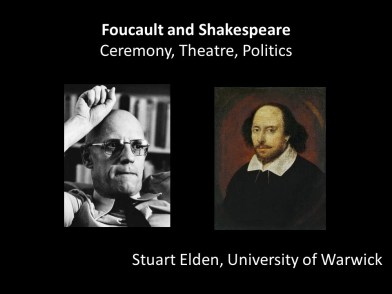
On 7 November 2016 I gave a talk to the Political Thought and Intellectual History seminar, University of Cambridge, entitled “Foucault and Shakespeare: Ceremony, Theatre, Politics”.

An audio recording is available here.

Posted in Michel Foucault, Shakespearean Territories, Uncategorized, William Shakespeare | Leave a comment