There are many things on which to reflect from yesterday’s events in the USA. One side of my extended family is in Ohio, Michigan and Alabama, so this is personally as well as generally political. But I was supposed to be spending today working on a grant proposal, which brings my own research back to more contemporary geopolitical concerns. Yesterday’s events make it particularly difficult.
I’ve said before that the 2004 US election was the real spur to my writing on topics that eventually became the book Terror and Territory: The Spatial Extent of Sovereignty – not so much the election of Bush, but his re-election, where the ‘war on terror’ became legitimised by a popular vote. Since that book came out in 2009, I’ve only turned to contemporary political and geopolitical events on occasion – most of my work has been historical or conceptual. In contrast, my teaching has often been engaged with contemporary events – I teach an MA course at Warwick called ‘Burning Issues: Geopolitics Today’, and at Durham taught on ‘Territory and Geopolitics’. Some of the PhD students I supervise are working on very contemporary issues. I’ve spoken about Boko Haram, Ebola, Islamic State and so on at conferences, but not published very much on this, with the exception of one piece on Boko Haram and a couple of short pieces on the EU referendum.
Today I’m torn between a retreat back into the archive, into more work on Foucault and a continuation of themes from my work on Shakespeare; or a reengagement much more explicitly with contemporary politics. As well as the continuation of work on the early Foucault, I’ve been debating whether there might be more to be done with the theme of political ceremony. Of course, as with my work on territory, even the historical relates to the present moment. The other main project, which will at least be a paper or two, is on terrain, the materiality of territory, with conceptual as well as political overtones. I’ve been struggling recently with trying to work out how I can possibly do both or all these different things, both in terms of time and focus.
Of course, the situation is much more serious than my own research trajectory. But the election of Donald Trump has put my personal tension in very stark focus. Now that Trump has been elected, as with the vote to leave the EU, I dearly hope that the worst fears are not realised. But I sense that the themes of geopolitics, global disorder, territorial struggles and so on are going to be crucial topics for the foreseeable future.


 Just in time for anyone still wondering what they should pack to read by the beach this summer, here is a short paper by me entitled Towards a Geography of Injustice, available open access at the Finnish journal Alue & Ympäristö (Region and Environment – my paper is not in Finnish, just to be clear), which I’m told is “unofficially” the “critical geography journal of Finland”. This is pretty much the tidied up script of the Keynote Lecture I presented at the Annual Meeting of Finnish Geographers in Tampere back in October last year. I learnt lots and met nice people at the meeting, and thanks to Kirsi Pauliina Kallio for asking me to write the talk up properly.
 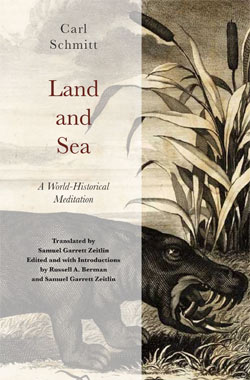 Originally published in 1942, at the height of the Second World War, Land and Sea: A World-Historical Meditation recounts Carl Schmitt’s view of world history “as a history of the battle of sea powers against land powers and of land powers against sea powers.” Schmitt here unfolds his view of world history from the Peloponnesian War to European colonial expansion to the birth pangs of capitalism, while polemically setting Nazi Germany as a continental land power against Britain and the United States as its maritime enemies. In Land and Sea, Schmitt offers his interpretations of the rise of Venice, piracy, “corsair capitalism,” the spatial revolution of European colonial expansion, the rise of the British empire, and his readings of thinkers as diverse as Seneca, Shakespeare, Herman Melville, and Benjamin Disraeli.
 Leading academics came together at the Academy on 4 November for a one day seminar examining some of the most crucial questions facing the UK in the wake of the EU referendum. ‘European Union and Disunion: What Has Held Europeans Together and What Has Divided Them?’ included sessions exploring historic al legacies and ideas of Europe, challenges and tensions within the UK and Ireland, migration and refugee patterns, and the roles played by politics and the media. The proceedings have been recorded and highlights can now be viewed on the Academy’s website.

 A few books and journals received. The final issue of
  I mentioned
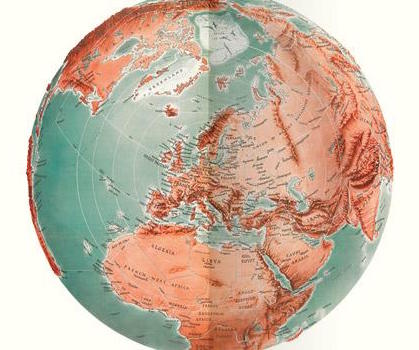 Last night I attended the opening of the British Library exhibition ‘