Forthcoming publications and some open access pre-prints

I’ve updated the list of my forthcoming publications and added a few pre-prints which are available to download. These include my article on Foucault and Shakespeare, an encyclopaedia entry on the relation between territory and the urban, and some older pieces on terricide, Shakespeare, and Foucault and geometrics.

For already published work, much of which is available to download on this site, there are separate pages for articles and chapters, booksinterviewsaudio and video, and reading lists.

Posted in Uncategorized | Leave a comment

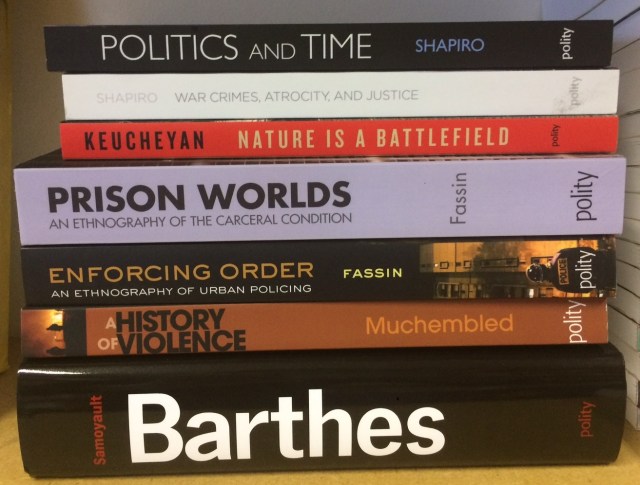
Books received – Shapiro, Keycheyan, Fassin, Muchembled, Samoyault

IMG_1904.jpg

A number of mainly recently published books from Polity, in recompense for review work.

Posted in Uncategorized | 1 Comment

Thomas Parker, Tasting French Terroir: The History of an Idea reviewed

9780520277519.jpgThomas Parker, Tasting French Terroir: The History of an Idea reviewed at H-France Review by Rod Philips. Thanks to Mike Heffernan for bringing this to my attention.

This book explores the origins and significance of the French concept of terroir, demonstrating that the way the French eat their food and drink their wine today derives from a cultural mythology that developed between the Renaissance and the Revolution. Through close readings and an examination of little-known texts from diverse disciplines, Thomas Parker traces terroir’s evolution, providing insight into how gastronomic mores were linked to aesthetics in language, horticulture, and painting and how the French used the power of place to define the natural world, explain comportment, and frame France as a nation.
Posted in Uncategorized | Leave a comment

Eugen Fink, Play as Symbol of the World and Other Writings review at NDPR

9780253021052_medMy review of Eugen Fink, Play as Symbol of the World and Other Writings has been published at Notre Dame Philosophical Reviews.

Eugen Fink (1905-1975) is not sufficiently well known in the Anglophone world, in part because of the lack of translations of his work. He is perhaps generally understood through two texts which have been translated — his continuation of Edmund Husserl’s work in the Sixth Cartesian Meditation and his co-taught Heraclitus Seminar with Martin Heidegger. As one of Husserl’s assistants, his work was initially seen as a continuation of his ideas; and towards the end of his career the Heidegger relation tends to dominate readings. Ronald Bruzina’s Edmund Husserl & Eugen Fink: Beginnings and Ends in Phenomenology 1928-1938 (Yale University Press, 2004) is an excellent guide to his philosophical apprenticeship. Yet Fink was a significant thinker in his own right, with a number of important works on phenomenology, metaphysics, Nietzsche, the world, death and education published in his lifetime. Of these, only the Nietzsche book was previously available in English. Since his death a number of other volumes have appeared, some based on his lecture courses. His Gesamtausgabe or collected edition, under the general editorship of Stephan Grätzel, Cathrin Nielsen and Hans Rainer Sepp, has been underway since 2006, with five volumes published to date.

One of those volumes is the text translated here… [more]

Posted in Edmund Husserl, Eugen Fink, Martin Heidegger, Uncategorized | Leave a comment

Hot off the press – Dan Bulley’s Migration, Ethics and Power – the first book in the Society and Space book series

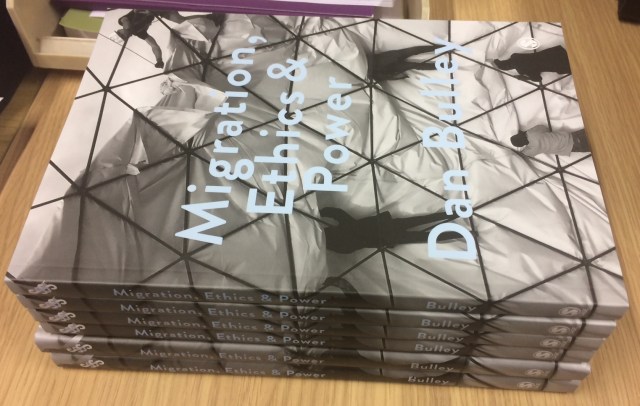
IMG_1905.JPGThe first book in the Society and Space book series is Dan Bulley’s  Migration, Ethics and Power: Spaces Of Hospitality In International Politics. I posted about the series as a whole earlier this week, and now the editor copies of this book have arrived. It looks terrific. The book’s description is:

In 2014, the ethics and politics of hospitality were brought into stark relief. Three years into the Syrian conflict, which had already created nearly 2.5 million refugees and internally displaced 6.5 million, the UN called on industrialised countries to share the burden of offering hospitality through a fixed quota system. The UK opted out of the system whilst hailing their acceptance of a moral responsibility by welcoming only 500 of the ‘most vulnerable’ Syrians. Given the state’s exclusionary character, what opportunities do other spaces in international politics offer by way of hospitality to migrants and refugees?

Hospitality can take many different forms and have many diverse purposes. But wherever it occurs, the boundaries that enable it and make it possible are both created and unsettled via exercises of power and their resistance. Through modern examples including refugee camps, global cities, postcolonial states and Europe, as well as analysis of Derridean and Foucauldian concepts, Migration, Ethics and Power explores:

  • The process and practice of hospitality
  • The spaces that hospitality produces
  • The intimate relationship between ethics and power

This is a brilliantly contemporary text for students of politics, international relations and political geography.

Posted in Uncategorized | Leave a comment

Evgeny Morozov & David Harvey on post-neoliberalism, Trump, infrastructure, sharing economy, smart city

Evgeny Morozov and David Harvey on post-neoliberalism, Trump, infrastructure, sharing economy, smart city.

dmf's avatarDeterritorial Investigations

View original post

Posted in Uncategorized | 2 Comments

Books received – Sullivan, Rogers, Foucault companion, journals

IMG_1902.JPG.
A copy of Garrett Sullivan Jr’s classic The Drama of Landscape, kindly sent by Garrett. I use this extensively in my work on Shakespeare. Dallas Rogers also sent a copy of his new book The Geopolitics of Real Estate, which is the first volume in a new series on Geopolitical Bodies, Material Worlds with Rowman International. Michel Foucault: A Research Companion was sent by the publisher – I was one of the readers of the manuscript and provided an endorsement.

Posted in Michel Foucault, Shakespearean Territories, terrain, Uncategorized, William Shakespeare | 1 Comment

Promoted from doctor to professor: what changes?

Promoted from doctor to professor: what changes? – various people, including my ex-Durham colleague Harriet Bulkeley, give their take on this in The Times Higher Education.

Posted in Uncategorized, Universities | Leave a comment

Society and Space book series – first two volumes by Bulley and Klauser out soon

Over the past several years I’ve been working with Sage on a Society and Space book series, which is linked to the Environment and Planning D: Society and Space journal (now published by Sage). There are several books under contract or in discussion, with the first two volumes due to be published very soon. The series description is as follows:

The Society and Space series explores the fascinating relationship between the spatial and the social. Each title draws on a range of modern and historical theories to offer important insights into the key cultural and political topics of our times, including migration, globalisation, race, gender, sexuality and technology. These stimulating and provocative books combine high intellectual standards with contemporary appeal for students of politics, international relations, sociology, philosophy, and human geography.

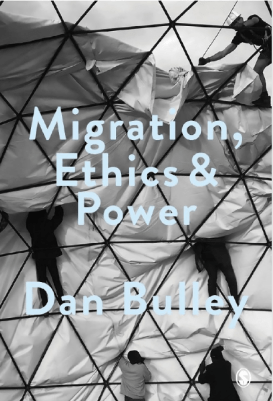
Bulley.pngThe first book to be published will be Dan Bulley’s  Migration, Ethics and Power: Spaces Of Hospitality In International Politics. The book’s description is:

In 2014, the ethics and politics of hospitality were brought into stark relief. Three years into the Syrian conflict, which had already created nearly 2.5 million refugees and internally displaced 6.5 million, the UN called on industrialised countries to share the burden of offering hospitality through a fixed quota system. The UK opted out of the system whilst hailing their acceptance of a moral responsibility by welcoming only 500 of the ‘most vulnerable’ Syrians. Given the state’s exclusionary character, what opportunities do other spaces in international politics offer by way of hospitality to migrants and refugees?

Hospitality can take many different forms and have many diverse purposes. But wherever it occurs, the boundaries that enable it and make it possible are both created and unsettled via exercises of power and their resistance. Through modern examples including refugee camps, global cities, postcolonial states and Europe, as well as analysis of Derridean and Foucauldian concepts, Migration, Ethics and Power explores:

  • The process and practice of hospitality
  • The spaces that hospitality produces
  • The intimate relationship between ethics and power

This is a brilliantly contemporary text for students of politics, international relations and political geography.

Klauser.jpgDan’s book will be closely followed by Francisco Klauser’s Surveillance and Space:

The digital age is also a surveillance age. Today, computerized systems protect and manage our everyday life; the increasing number of surveillance cameras in public places, the computerized loyalty systems of the retail sector, geo-localized smart-phone applications, or smart traffic and navigation systems. Surveillance is nothing fundamentally new, and yet more and more questions are being asked:

Who monitors whom, and how and why?

How do surveillance techniques affect socio-spatial practices and relationships?

How do they shape the fabrics of our cities, our mobilities, the spaces of the everyday?

And what are the implications in terms of border control and the exercise of political power?

Surveillance and Space responds to these modern questions by exploring the complex and varied interactions between surveillance and space.  In doing so, the book also advances a programmatic reflection on the very possibility of a ‘political geography of surveillance’.

Other books under contract include Marcus Doel’s Violent Geographies, Shiloh Krupar and Greig Crysler’s The Waste Complex and Ross Exo Adams’s Circulation and Urbanization. Plenty more in development and discussion. If you’d like to talk to me about the series, please email me.

Posted in Books, Publishing, Society and Space, Uncategorized | 4 Comments

Volumetric Urbanism: Charting New Urban Divisions, Sheffield, 24-25 May 2017

VOLUMETRIC URBANISM: Charting new urban divisions [pdf]

An International Workshop
University of Sheffield and University of Western Sydney Sheffield, United Kingdom, 24-26th May 2017.

Organisers: Simon Marvin, Urban Institute, Rowland Atkinson, Inclusive Societies at the University of Sheffield and Donald McNeill Institute for Culture and Society, University of Western Sydney.

In major cities around the world, councils and governments are faced with the problem and possibilities of ‘volume’: the stacking and moving of more and more people and things above, across and below tiny, interlocking sites within booming central business districts. Three trends are particularly notable here: first, the growth of improved mass public transport provision that now funnels many more people in and out of city centres than before, often underground; second, there has been a marked increase in tall building construction in cities, between 2010 and 2016 fifty ‘supertall’, or 300 metres plus skyscrapers were built; third, building and city management systems have now improved to a point where ‘utopian’ building projects based around new forms of enclosure and autonomous infrastructures are now being realized thanks to advanced materials and engineering technology.

This workshop has been organized to respond to what we see as the reinterpretation of the limits, porosity and nature of building ‘envelopes’ – the boundary between the notions of the interior and exterior and the placing and management of different kinds of atmospheres in city plans. These are being reworked according to a number of new technological, design and financial logics: architects, engineers, developers, bankers and other specialist service providers act variously to, quite literally, ‘push theenvelope’reconfiguringthenatureofthesebuiltspaces.

The core aim of the workshop is to understand through empirical analysis and theoretical frameworks how urban space is being made more malleable, with surface, airspace, and underground constantly subject to new logics of development. The workshop welcomes papers that address one or more of the following three objectives:

1. Genealogies of architectural and engineering approaches to the production of volumetric spaces, identifying key cities, prototypes, models, and movements, and their geographical spread and influence, including glasshouses, atria, skyscrapers, and underground/elevated walkways as they shift from experimental status to standardized, commercialized design solutions in various urban forms.

2. Identification of how global private and public actors and institutions are working with tools, procedures and products to operationalize vertical and horizontal movement, exclusion and security in volumetric spaces, including new property development and investment practices also the use of tunneling, elevators and escalators, and devices used to maximize safety and comfort, from fire escapes to air quality control, and their accompanying metrics.

3. Examinations of the socio-spatial consequences of volumetric urbanism, new forms of inequality and differential forms of (in)security. Many critics have noted the potential for ‘secession’ for affluent city users, through volumetric responses – enclosure, bubbles of security, depth and height, creation of microclimates, internalising energy and food production, conditioned air. How can we understand these new scales and forms and the encompassing of multiple functions that may become urban ‘assets’ in terms of threats like ecological and economic turbulence while engendering new and novels modes of social exclusion.

Please send 250 words abstracts to Simon Marvin and Donald McNeill by December 19th 2016.Theorganisers may be able to provide supportfor some subsistence and travel costs for the workshop.

Posted in Uncategorized | Leave a comment