Early Modern Literary Geographies – 14-15 October 2016

Early Modern Literary Geographies, Huntington library, San Marino, CA, 14-15 October 2016 –  details here or download the programme brochure

The conference is organised around the themes of Body, House, Neighbourhood, and Region. I’ll be speaking in the last of these on “Denmark, Norway, Poland: Regional Geopolitics in Hamlet”. This is part of what I hope will be chapter 2 of my Shakespeare book.

Huntington EMLG Conference Brochure.jpg


Posted in Conferences, Shakespearean Territories, Uncategorized, William Shakespeare | 2 Comments

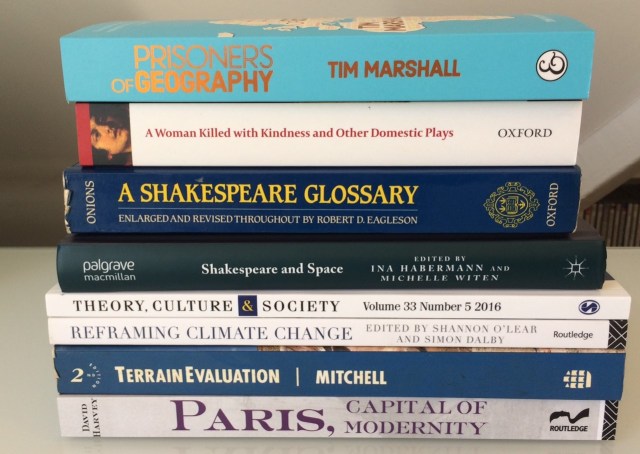
Books received – Marshall, Shakespeare, O’Lear & Dalby, Mitchell, Harvey

IMG_1747

Back from holiday, a mix of recently received books. The Routledge ones are in recompense for review work, as is Shakespeare and Space. The others were picked up second-hand for various projects.

Posted in David Harvey, Shakespearean Territories, Uncategorized, William Shakespeare | Leave a comment

Repo, Jemima 2016 The Biopolitics of Gender, reviewed by Martina Tazzioli

Posted in Uncategorized | 1 Comment

Angharad Closs Stephens – National Atmospheres and the ‘Brexit’ Revolt

Posted in Uncategorized | Leave a comment

Seminar: Tool-boxes and rolling marbles: The far-flung applications of Michel Foucault’s work (2016)

Clare O'Farrell's avatarFoucault News

Clare O’Farrell, Tool-boxes and rolling marbles: The far-flung applications of Michel Foucault’s work (2016)

Date: Tuesday, 30th August 2016, 11:30am-1:00pm
Location:
A Block, Level 3, Conference Room 330
QUT, Kelvin Grove Campus
Brisbane, Queensland, Australia

Entry is free but please register with Eventbrite by Monday, 29th August 5:00pm

PDF Flyer

This paper was originally delivered as a keynote presentation to the Foucault @ 90 conference at Ayr in Scotland in June 2016.

Foucault famously said he was writing for users, not readers. He wanted his books to function as tooI-boxes to be deployed in the most applied of areas – he specifically names educators, magistrates, wardens, and conscientious objectors for instance. He also imagined his books as ‘rolling marbles’ that could be picked up and then sent elsewhere. Some 40 years after Foucault expressed these sentiments about his work, he has become the most cited theorist in the social sciences…
View original post 282 more words

Posted in Uncategorized | Leave a comment

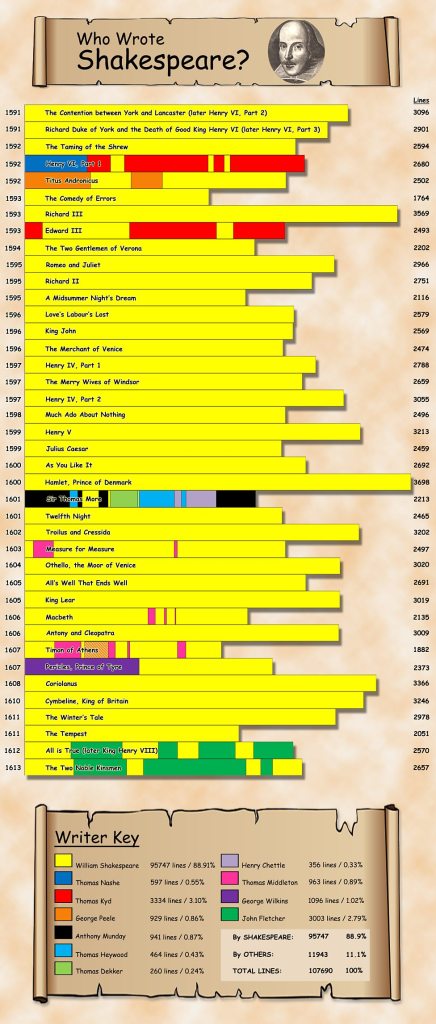
Who Wrote Shakespeare? – Martin Wiggins on collaboration at the BBC website

p0451wyzWho Wrote Shakespeare? – Martin Wiggins at the BBC website. The discussion is not of the para-academic debate about whether William Shakespeare wrote the plays that bear his name, but rather about the collaborative nature of some of them – some of which are canonical, and some of which are disputed. Some good introductory discussion, a handy image of the plays and likely authors, and some good video clips of passages from some plays.

I’m well aware that much of this is contested, having worked on several of the plays which are thought to be collaborative for my Shakespeare project. But for a wide audience, this is a clear and useful summary.

The ‘Hand D’ manuscript of a addition to Sir Thomas More, believed to be by Shakespeare is currently on display at the British Library, in their superb ‘Shakespeare in Ten Acts‘ exhibition. There is much else of interest in that exhibition, but for me the manuscript was worth it alone. It’s open for about a week more.

Posted in Uncategorized, William Shakespeare | Leave a comment

Finishing with Foucault, working on Shakespeare and now a holiday

I’ve now finished work on Foucault: The Birth of Power – the corrections to the proofs have been sent off. In the past several weeks I’ve been working hard on Shakespeare, and have got several chapters into draft state. I’m going to have to take a break from this work in the autumn-winter, with teaching and several talks on different topics, so I’d like to get this manuscript to a point where I can leave it without too many loose ends. This doesn’t mean it’s nearly finished, indeed far from it, but I want it to be at a point where I can put it aside and return, at some point, with fresh eyes and hopefully new energy and ideas.

I’ve put a new page on this site with more information on the Shakespeare project. This supersedes the older page, and more accurately reflects the current shape of it.

Foucault: The Birth of Power is now available to pre-order from Polity’s distributor, Wiley, as well as online bookstores. It is currently projected for February publication. The cover isn’t yet up, but the book’s description is.

Now for a holiday.

Posted in Books, Foucault: The Birth of Power, Michel Foucault, Shakespearean Territories, William Shakespeare | 4 Comments

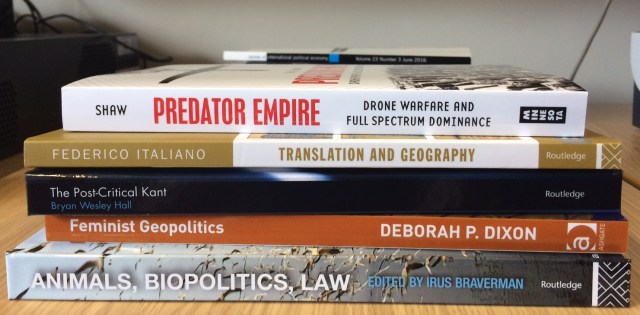
Books and journals received – Shaw, Italiano, Hall, Dixon, Braverman

A pile each of books and journals, recently received. The books are mainly the second instalment of ones in recompense for review work, along with Ian Shaw’s Predator Empire, sent by the publisher.

books

journals

Posted in Uncategorized | 2 Comments

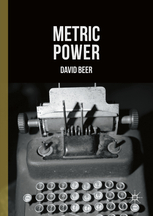
David Beer, Metric Power

9781137556486David Beer’s Metric Power is now out. A great shame about Palgrave’s prohibitive price for this – hopefully a paperback will appear at some point, but there is no justification for a £50 e-book.

This book examines the powerful and intensifying role that metrics play in ordering and shaping our everyday lives. Focusing upon the interconnections between measurement, circulation and possibility, the author explores the interwoven relations between power and metrics. He draws upon a wide-range of interdisciplinary resources to place these metrics within their broader historical, political and social contexts. More specifically, he illuminates the various ways that metrics implicate our lives – from our work, to our consumption and our leisure, through to our bodily routines and the financial and organisational structures that surround us. Unravelling the power dynamics that underpin and reside within the so-called big data revolution, he develops the central concept of Metric Power along with a set of conceptual resources for thinking critically about the powerful role played by metrics in the social world today.

Posted in Uncategorized | Leave a comment

Louise Amoore on ‘Cloud geographies: Computing, data, sovereignty’ in Progress in Human Geography

Louise Amoore on ‘Cloud geographies: Computing, data, sovereignty’ in Progress in Human Geography (requires subscription).

The architecture of cloud computing is becoming ever more closely intertwined with geopolitics – from the sharing of intelligence data, to border controls, immigration decisions, and drone strikes. Developing an analogy with the cloud chamber of early twentieth century particle physics, this paper explores the geography of the cloud in cloud computing. It addresses the geographical character of cloud computing across two distinct paradigms. The first, ‘Cloud I’ or a geography of cloud forms, is concerned with the identification and spatial location of data centres where the cloud is thought to materialize. Here the cloud is understood within a particular history of observation, one where the apparently abstract and obscure world can be brought into vision and rendered intelligible. In the second variant, ‘Cloud II’ or the geography of a cloud analytic, the cloud is a bundle of experimental algorithmic techniques acting upon the threshold of perception itself. Like the cloud chamber of the twentieth century, contemporary cloud computing is concerned with rendering perceptible and actionable that which would otherwise be beyond the threshold of human observation. The paper proposes three elements of correlative cloud reasoning, suggesting their significance for our geopolitical present: condensing traces; discovering patterns; and archiving the future.

Posted in Louise Amoore | Leave a comment