Thomas Nail, Theory of the Border

9780190618650Thomas Nail, Theory of the Border, forthcoming in October 2016.

Despite — and perhaps because of — increasing global mobility, there are more types of borders today than ever before in history. Borders of all kinds define every aspect of social life in the twenty-first century. From the biometric data that divides the smallest aspects of our bodies to the aerial drones that patrol the immense expanse of our domestic and international airspace, we are defined by borders. They can no longer simply be understood as the geographical divisions between nation-states. Today, their form and function has become too complex, too hybrid. What we need now is a theory of the border that can make sense of this hybridity across multiple domains of social life.
Rather than viewing borders as the result or outcome of pre-established social entities like states, Thomas Nail reinterprets social history from the perspective of the continual and constitutive movement of the borders that organize and divide society in the first place. Societies and states are the products of bordering, Nail argues, not the other way around. Applying his original movement-oriented theoretical framework “kinopolitics” to several major historical border regimes (fences, walls, cells, and checkpoints), Theory of the Border pioneers a new methodology of “critical limology,” that provides fresh tools for the analysis of contemporary border politics.

Posted in Boundaries, Politics, Uncategorized | 1 Comment

Behrooz Ghamari-Tabrizi, Foucault in Iran: Islamic Revolution after the Enlightenment

imageOut shortly is Behrooz Ghamari-Tabrizi, Foucault in Iran: Islamic Revolution after the Enlightenment. Thanks to Chathan Vemuri for the link.

Foucault in Iran centers on the significance of Foucault’s writings on the Iranian Revolution and the profound mark it left on his lectures on ethics, spirituality, and fearless speech. This interdisciplinary work will spark a lively debate in its insistence that what informed Foucault’s writing was his conviction that Enlightenment rationality has not closed the gate of unknown possibilities for human societies.

Foucault in Iran is a courageous and thought-provoking invitation to understand the Iranian revolution, and Foucault’s reaction to it, in an original way. A splendid work that goes beyond simple binaries, it has no sympathy for the clichéd vocabulary used by Progressivists to describe these events—or to criticize Foucault for his alleged romanticisation of the Iranian revolution.

Talal Asad, City University of New York

Posted in Michel Foucault, Uncategorized | 1 Comment

Genius of the Modern World – BBC documentaries on Marx and Nietzsche

Genius of the Modern World – BBC documentaries on Marx and Nietzsche, presented by Bettany Hughes.


Posted in Friedrich Nietzsche, Karl Marx, Uncategorized | Leave a comment

Three linked posts on peer review delays – the role of editors, of reviewers, and authors

Three linked posts on peer review delays – the role of editors, of reviewers, and authors. If you read one, read them all – they all begin with the same problem, but this is a system. There is some good advice here. I wrote a lot about the review process and editing work on this site when I was a journal editor, but as an ex-editor, the first of these stages is something I’m now (or, at least currently) free from.

Posted in Publishing, Uncategorized, Writing | Leave a comment

Derrida’s early lecture course on Heidegger reviewed at LARB

derridaheideggerDerrida’s 1964-65 lecture course Heidegger: The Question of Being and History is reviewed at LARB by Richard Polt (thanks to Peter Gratton for the link).

Posted in Jacques Derrida, Martin Heidegger, Uncategorized | Leave a comment

Echoes of Cologne [Forum], Introduction by Angela Last

The first few pieces of a Society and Space open site forum on the Cologne assaults of New Year’s Eve are now available.

Posted in Uncategorized | Leave a comment

Michel Foucault, Prisons and the future of abolition – an interview at Critical Theory

sarte-foucault-deleuze-672x372.jpgAt Critical-Theory.com, there is an interesting interview with Andrew Dilts and Perry Zurn about Foucault, the Prisons Information Group and the future of prisons and abolition. It builds on the work of their edited book Active Intolerance: Michel Foucault, the Prisons Information Group, and the Future of Abolition.

Posted in Michel Foucault, Politics, Uncategorized | 5 Comments

Books received – three Marxist classics from Verso: Lefebvre, Althusser et. al. and Goldmann

Books received – three Marxist classics from Verso. Henri Lefebvre’s Metaphilosophy, the first complete English translation of Althusser, Balibar, Establet, Macherey and Rancière’s Reading Capital and Lucien Goldmann’s The Hidden God.

Metaphilosophy is a book I’ve wanted to get translated into English for a long time. It is one of Lefebvre’s most important works, and provides a basis for the arguments he would develop in many of his more concrete works on the city, space, everyday life and so on. David Fernbach did a great job translating this difficult text. I edited the translation, provided most of the notes, and wrote the introduction.IMG_1592 copy.jpg


Posted in Etienne Balibar, Henri Lefebvre, Jacques Rancière, Louis Althusser, Pierre Macherey, Uncategorized | 1 Comment

A dark day for the UK – my early thoughts on the EU referendum

Yet again I find myself in a minority in a national vote. It was hard to take in the past – 1992, 2010, 2015 – but with those there was always the hope for the future. Now it is hard to see where. This is a backward step that cannot be reversed. This vote was always about more than EU membership. It was a vote about what kind of UK the people wanted. An open, inclusive, tolerant nation that saw itself as part of a wider world; or a closed one which saw divisions and barriers which it wanted hardened. 17.5 million people have voted for the latter. Some of those people may claim that they saw the vote as means of achieving the former, and I look forward to hearing from the left-exit voters and leaders how they will go about that. It seems clear, as it always appeared, that this has simply handed further power to the right.

For the past year I’ve had a divided life between home in Coventry – near University of Warwick – and a rented flat in London, in the borough of Lambeth, which is close to where my wife works. Coventry voted to leave; Lambeth had one of the strongest remain votes.  When the votes came in for Newcastle and Sunderland it was clear which way things were going. As someone who used to live in the northeast when I taught at Durham University it is devastating to see that the huge problems of that region are blamed on the EU and migration rather than domestic politics. Other places I’ve previously lived such as York and Bath voted to remain. The town I was born in, Ipswich, and the town where I grew up, Colchester, voted to leave. It is a divided country, by class, geography, age and other factors which may take some time to disentangle. 16 million people voted to remain. That at least gives some hope. But this was a one-off vote, the process begun cannot be reversed. Worse is to come. While the parties may have short term joy, the UK Independence Party and the bulk of the Conservative and Unionist party may have destroyed both the UK and the Union.

As an English European, an identity I saw as mutually reinforcing, rather than as an either/or, I feel that a part of that is being taken away. The EU was far from perfect, and there were serious problems with its democracy, its economic policies, its migration attitude and more. But it was a shared project to say that Europe in the second half of the twentieth century and beyond could be better, not just compared to the first half of the twentieth century but the centuries that came before. As a historian, a political theorist, a political geographer, those issues are very much in my mind. I have worked on two main topics in my research and teaching career – European thought and the question of territory. I will doubtless find ways to engage with the future politics and geography of the European continent, a continent of which the UK is and will remain a part, even though its future lies outside of the EU.

I worry for my non-British European PhD students, my European colleagues and friends who have made a life in the UK. I worry for my nieces and nephews, and the country they will grow up in. I worry for the future life of migrants, and the welcome they will, or will not, receive. I am married to a migrant, a US citizen who came here when we got married, took jobs in the UK, took citizenship and now works for the UK government on international development. What will be the future of that part of the UK’s role in the world? I worry for the future of the European project, which both includes and exceeds the EU. This is a dark day. Perhaps something good will come of this, but at the moment it is hard to see quite how.

Posted in Politics, Uncategorized | 5 Comments

“Sur les Toits”: An open-access Antipode Symposium on the Prison Protests in Early 1970s France

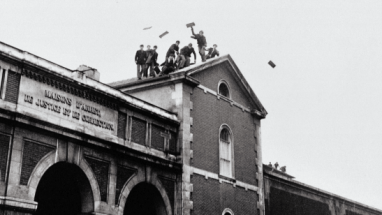
the-nancy-prison-revolt-gc3a9rard-drolc“Sur les Toits”: An open-access Antipode Symposium on the Prison Protests in Early 1970s France

This symposium contains a rich collection of contributions based on the screening of the French documentary film Sur les Toits (“On the Roofs”). On a Wednesday in May 2016 I invited the film’s independent maker, Nicolas Drolc, and a number of academics from across Warwick’s humanities and social sciences to the screening of the movie. The result was a friendly and productive discussion on an important, but sometimes forgotten, episode in the history of incarceration (see, however, Zurn and Dilts 2016). The essays presented here comprise an interview with the director and a series of original reflections (from Dominique MoranSophie FuggleAnastasia ChamberlenOliver Davis and Stuart Elden) on both the film and its subject of investigation.

My contribution discusses the riots in relation to the GIP and Foucault and other intellectuals, while praising the film for providing oral histories of key, non-elite voices, while other contributions look at the film, images, contemporary politics and related questions. Thanks to Marijn Nieuwenhuis for coordinating this symposium, and the director, Nicolas Drolc, for coming to Warwick to show the film and discuss it with us. Continue reading in Antipode online.

Posted in Foucault: The Birth of Power, Michel Foucault, Politics, Uncategorized | 1 Comment