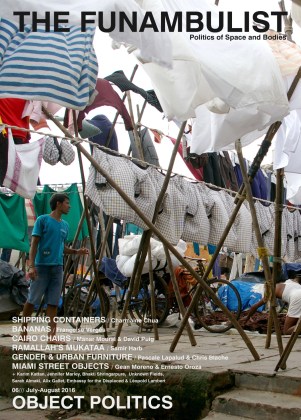
Object Politics – the Sixth Issue of The Funambulist Magazine Now Published

Cover Design & RacismObject Politics – the Sixth Issue of The Funambulist Magazine Now Published

The issue includes guest columns about Native resistance in New Mexico by Jennifer Marley, and about the most recent Palestinian Festival of Literature by Bhakti Shringarpure. The articles of the main dossier are written by Charmaine Chua about the shipping container, Françoise Vergès about the banana, Manar Moursi & David Puig about Cairo’s street chairs, and Pascale Lapalud & Chris Blache (Genre & Ville) about gender and urban furniture in French cities. It also includes a short graphic essay about Ramallah’s Mukataa by Samir Harb and a text about the New Palestinian Museum “without objects” by Karim Kattan. The transcript of a 2014 Archipelago conversation with Miami artists/writers Gean Moreno & Ernesto Oroza examines the systems in which generic objects take place, while the photographic section is a partial report of the most recent Unknown Fields‘ expedition in Rajasthan’s garment factories. The three student projects invent a passport and a backpack for the refugees in Lesvos (Embassy for the Displaced), a kit of facial prosthetics to “trick biometrics” (Alix Gallet) and a bridge countering the segregating effects of the concrete walls of Baghdad (Sarah Almaki).

Posted in Uncategorized | Leave a comment

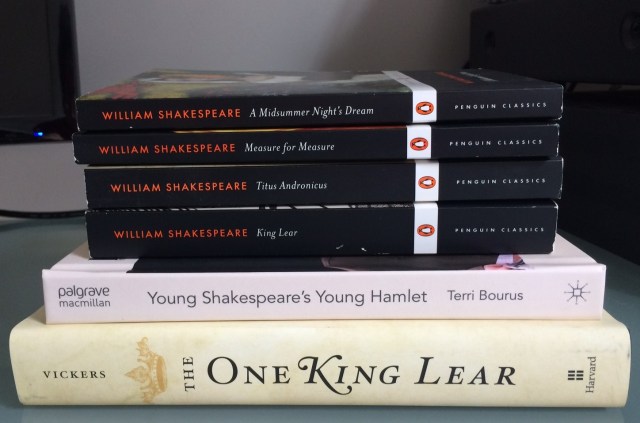
Books received – Shakespeare, Bourus, Vickers

IMG_1594.JPG

A pile of books for the Shakespeare work – including Terri Bourus’s Young Shakespeare’s Young Hamlet in recompense for review work, and Brian Vickers’s The One King Lear to review.

Posted in Shakespearean Territories, Uncategorized, William Shakespeare | 1 Comment

Thomas Nail, Theory of the Border

9780190618650Thomas Nail, Theory of the Border, forthcoming in October 2016.

Despite — and perhaps because of — increasing global mobility, there are more types of borders today than ever before in history. Borders of all kinds define every aspect of social life in the twenty-first century. From the biometric data that divides the smallest aspects of our bodies to the aerial drones that patrol the immense expanse of our domestic and international airspace, we are defined by borders. They can no longer simply be understood as the geographical divisions between nation-states. Today, their form and function has become too complex, too hybrid. What we need now is a theory of the border that can make sense of this hybridity across multiple domains of social life.
Rather than viewing borders as the result or outcome of pre-established social entities like states, Thomas Nail reinterprets social history from the perspective of the continual and constitutive movement of the borders that organize and divide society in the first place. Societies and states are the products of bordering, Nail argues, not the other way around. Applying his original movement-oriented theoretical framework “kinopolitics” to several major historical border regimes (fences, walls, cells, and checkpoints), Theory of the Border pioneers a new methodology of “critical limology,” that provides fresh tools for the analysis of contemporary border politics.

Posted in Boundaries, Politics, Uncategorized | 1 Comment

Behrooz Ghamari-Tabrizi, Foucault in Iran: Islamic Revolution after the Enlightenment

imageOut shortly is Behrooz Ghamari-Tabrizi, Foucault in Iran: Islamic Revolution after the Enlightenment. Thanks to Chathan Vemuri for the link.

Foucault in Iran centers on the significance of Foucault’s writings on the Iranian Revolution and the profound mark it left on his lectures on ethics, spirituality, and fearless speech. This interdisciplinary work will spark a lively debate in its insistence that what informed Foucault’s writing was his conviction that Enlightenment rationality has not closed the gate of unknown possibilities for human societies.

Foucault in Iran is a courageous and thought-provoking invitation to understand the Iranian revolution, and Foucault’s reaction to it, in an original way. A splendid work that goes beyond simple binaries, it has no sympathy for the clichéd vocabulary used by Progressivists to describe these events—or to criticize Foucault for his alleged romanticisation of the Iranian revolution.

Talal Asad, City University of New York

Posted in Michel Foucault, Uncategorized | 1 Comment

Genius of the Modern World – BBC documentaries on Marx and Nietzsche

Genius of the Modern World – BBC documentaries on Marx and Nietzsche, presented by Bettany Hughes.


Posted in Friedrich Nietzsche, Karl Marx, Uncategorized | Leave a comment

Three linked posts on peer review delays – the role of editors, of reviewers, and authors

Three linked posts on peer review delays – the role of editors, of reviewers, and authors. If you read one, read them all – they all begin with the same problem, but this is a system. There is some good advice here. I wrote a lot about the review process and editing work on this site when I was a journal editor, but as an ex-editor, the first of these stages is something I’m now (or, at least currently) free from.

Posted in Publishing, Uncategorized, Writing | Leave a comment

Derrida’s early lecture course on Heidegger reviewed at LARB

derridaheideggerDerrida’s 1964-65 lecture course Heidegger: The Question of Being and History is reviewed at LARB by Richard Polt (thanks to Peter Gratton for the link).

Posted in Jacques Derrida, Martin Heidegger, Uncategorized | Leave a comment

Echoes of Cologne [Forum], Introduction by Angela Last

The first few pieces of a Society and Space open site forum on the Cologne assaults of New Year’s Eve are now available.

Posted in Uncategorized | Leave a comment

Michel Foucault, Prisons and the future of abolition – an interview at Critical Theory

sarte-foucault-deleuze-672x372.jpgAt Critical-Theory.com, there is an interesting interview with Andrew Dilts and Perry Zurn about Foucault, the Prisons Information Group and the future of prisons and abolition. It builds on the work of their edited book Active Intolerance: Michel Foucault, the Prisons Information Group, and the Future of Abolition.

Posted in Michel Foucault, Politics, Uncategorized | 5 Comments

Books received – three Marxist classics from Verso: Lefebvre, Althusser et. al. and Goldmann

Books received – three Marxist classics from Verso. Henri Lefebvre’s Metaphilosophy, the first complete English translation of Althusser, Balibar, Establet, Macherey and Rancière’s Reading Capital and Lucien Goldmann’s The Hidden God.

Metaphilosophy is a book I’ve wanted to get translated into English for a long time. It is one of Lefebvre’s most important works, and provides a basis for the arguments he would develop in many of his more concrete works on the city, space, everyday life and so on. David Fernbach did a great job translating this difficult text. I edited the translation, provided most of the notes, and wrote the introduction.IMG_1592 copy.jpg


Posted in Etienne Balibar, Henri Lefebvre, Jacques Rancière, Louis Althusser, Pierre Macherey, Uncategorized | 1 Comment