
There was a lot I learned, and much I liked, about Jason Ānanda Josephson Storm’s recently published The Genealogy of Genealogy: Nietzsche, Foucault, and the Coils of Critical History (University of Chicago Press, 2026). There was also a great deal which has made me pause, slow down and reconsider. What follows isn’t a traditional review, which I’ve not been asked to write, and not an outline of what I liked and learned from the book. Rather, it uses the book’s arguments to add a bit of detail and some other considerations.
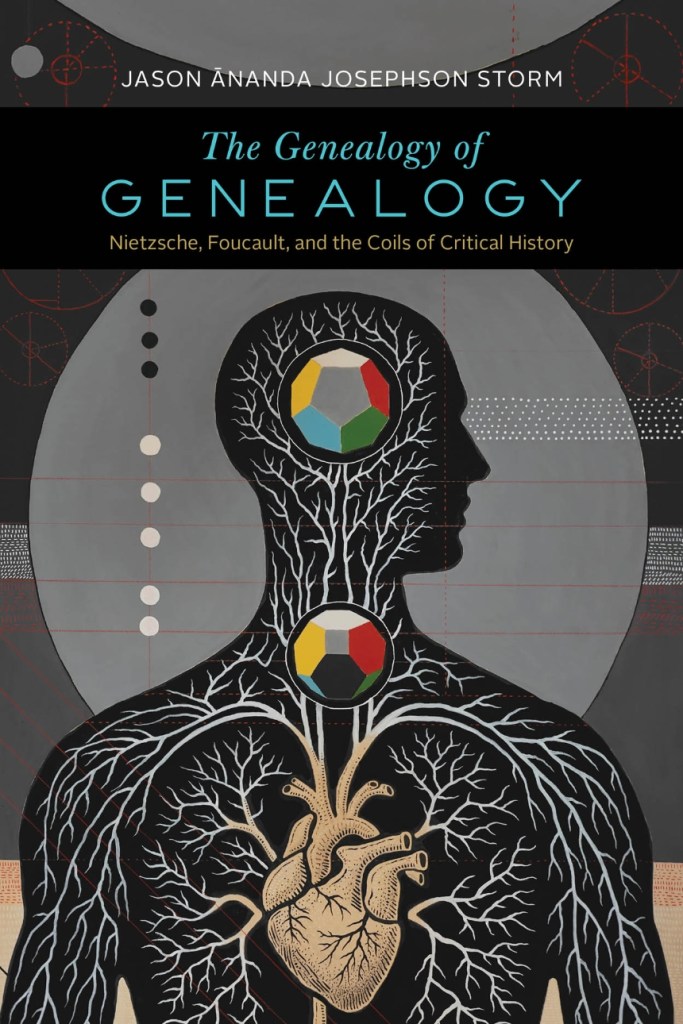
Essentially Storm’s argument is that the term ‘genealogy’, used so much in the contemporary humanities and social sciences to describe a particular style of historical work, is much more complicated and contested than usually acknowledged. The term’s popularity is largely due to Foucault’s use, and in particular his reading of Nietzsche’s work, notably in the 1971 essay “Nietzsche, Genealogy, History”. Storm argues, though, that Nietzsche does not use the term to designate his own work, and that his On the Genealogy of Morality takes genealogy as the object of his critique, the target of his polemic. Storm argues Foucault’s reading is tendentious, but has been powerful and effective. Storm shows that genealogy as a mode of historical inquiry is tangled up with genealogy in its more common usage – heritage, lineage, race, and so on.
In part, Storm’s project is very similar to Jacqueline Stevens’s 2003 essay “On the Morals of Genealogy”, which also questions Foucault’s reading. But Storm’s book is much more than a critical examination of this essay, and expands the analysis to think of how genealogy is a questionable term and one we should be resistant to using. It has a lot to offer for an intellectual history of Foucault’s career and the way the idea of genealogy has been taken up. It also provides some very interesting discussion of some of the French readings of Nietzsche which preceded and in part anticipated Foucault – Georges Bataille and Gilles Deleuze are well known, but there is some useful discussion of Jean Wahl, whose importance to Foucault is generally neglected. His reading of Heidegger was, I’ve argued, really significant to Foucault; Storm concentrates on what he says about Nietzsche which I think is an important contribution.
Partly because of Stevens’s essay, I think it’s long been known that Foucault’s reading of Nietzsche on genealogy is questionable, that Foucault describes Nietzsche’s approach in a way which he would have rejected. I would be more inclined to think about why Foucault made the reading he did, and the intellectual development of his reading of Nietzsche. The 1971 essay comes after some earlier work by Foucault on Nietzsche, including a course at Vincennes and some lectures in North America. Until recently these were largely unknown, read by a few in the archive, but in 2024 they were edited by Bernard Harcourt. For a reading of Foucault’s development, and how he came to distil his reading of Nietzsche into this single essay – one of only a couple of pieces he wrote on Nietzsche of which he authorised publication – a reading of this volume is really important. I say something about Foucault’s analysis of Nietzsche, and how important his reading of Nietzsche was to his own intellectual development in my books on Foucault, particularly The Early Foucault and The Archaeology of Foucault. Storm discusses the course at Vincennes published in Harcourt’s collection, and has some interesting things to say about the way the essay developed from that. But I think more could and should be done with reading these earlier texts, and it will be interesting to see how that volume generates a renewed interest in Foucault’s long engagement with Nietzsche. Some initial articles on this are in a recent issue of Foucault Studies. I was working with the texts in the archive, since when I was writing they were unpublished; Storm worked both in the archive and with Harcourt’s edition.
What is striking here, I think, is that although Foucault explicitly aligns his project with Nietzsche from quite early – it’s there in the History of Madness in 1961, for example, when he describes it as “beneath the sun of the great Nietzschean quest” – it comes with a serious hesitation to label his own project as genealogy. The 1971 essay is intended to be a text about Nietzsche, and I think it’s interesting that Foucault does not use the term genealogy to describe his own approach for a few more years. Of course, in the 1960s he described what he was doing as archaeology, and the relation or contrast between archaeology and genealogy has been much discussed. Storm’s analysis touches on this, and we have much to consider on this point as a consequence of his reading. In one interview in the 1960s Foucault does say that how he understands archaeology is closer to Nietzschean genealogy than structuralism (quoted by Storm, p. 191), but it’s almost another decade before he claims what he is doing is genealogy explicitly. I don’t intend to go into all the references here. But for a while, Foucault describes a supplementary approach to ‘archaeology’ as ‘dynastics’, and it seems this might the term until it gets supplanted by ‘genealogy’. Storm briefly discusses ‘dynastics’ in this book (pp. 211-12). I trace that shift in detail in an essay which came out in 2025, “Foucault, Dynastics and Power Relations: Between Archaeology and Genealogy”. I was intrigued by the way Foucault only fully opts for the term ‘genealogy’ to describe his own work some years after he has discussed it in relation to Nietzsche.
Storm recognises that Georges Dumézil is significant for Foucault’s intellectual development. He indicates that Didier Eribon has done work on this, particularly in Michel Foucault et ses contemporains, and generously mentions my books on Foucault, reporting that in The Early Foucault I said that Dumézil’s influence was “a topic that requires further investigation” (p. 173, cited in Storm, The Genealogy of Genealogy, p. 311 n. 61). But while Dumézil is someone Foucault discusses through his career, in terms of approach he is most significant for an earlier period of Foucault’s development – Storm traces it in relation to structure and structuralism, but as he indicates it is also there in the use of the term ‘archaeology’.
In his 1949 book L’héritage indo-européen à Rome, Dumézil had said that while material remains of the Indo-European people may be limited, “there is abundant documentation in words, myths, institutions, and so on”. In order to examine their civilisation, he said that we “are therefore obliged to develop, alongside an archaeology of objects and sites, an archaeology of representations and behaviours” (p. 43). Foucault copied this passage in his notebooks and it is clear that it was important in the formulation of his own approach. I discussed this in my books on Foucault; Storm quotes the same passage (p. 170). Troels Krarup has also written about this in his study of “archaeological methodology” in Foucault. Storm adds to this discussion, though it is striking that Krarup, Storm and I have come to this understanding of Foucault’s fundamental debt to Dumézil independently, within a few years of each other.
I’ve tried to discuss something of Dumézil’s importance to Foucault in a few pieces since I completed my series of books on Foucault. One book chapter discussed the way Foucault makes use of Dumézil’s work for his understanding of sovereignty; an article in the Journal of the History of Ideas examined Foucault’s readings of Dumézil’s work in his lectures on antiquity throughout his career. I’ve seen these pieces as something of a bridge between the series of Foucault books and my book manuscript on Benveniste, Dumézil and Indo-European thought in France. I’ve also discussed Foucault’s relation to structuralism in a chapter in Daniele Lorenzini’s The Foucauldian Mind collection. There I make the case that Foucault’s connection to structuralism is really through his relation to Dumézil, not supposed parallels to Lévi-Strauss, Lacan or others. All this is to say that the Foucault-Dumézil connection is in need of investigation beyond Eribon, although that remains an indispensable starting point. Storm’s book is, alongside Krarup (and I hope my pieces), another step forward in that work.
Foucault’s wish to disassociate himself from structuralism, especially around 1970, is well known. One unconvincing point by Storm was his suggestion that because archaeology was indebted to Dumézil, Foucault wanted to distance himself from that approach, in part because of one of flare-ups of the debate about Dumézil’s politics (see, i.e. pp. 186-87; 224-25). The relation of Foucault to Dumézil’s politics is an interesting question, but the chronology seems off to me – Foucault was explicit in referencing Dumézil in lectures from 1957 through to 1984, with particularly important ones in 1970, 1971, 1972, 1976, 1981, 1983, and 1984. I just don’t see a pause in the engagement, or in their personal relations, which would coincide with the political question.
As I said, this piece is not a review, and there is much more in the book I liked, a lot I learned and much that gave me reason to reconsider. These are initial thoughts based on a first reading, but I suspect it is a book I will return to. I thoroughly recommend the book to anyone interested in Foucault and Nietzsche, and I think it will have a lot to say to debates about historical methodology in the humanities and social sciences. These few thoughts and references hopefully add something to a conversation which I hope that the book begins.
(As ever, if any of my articles or chapters are hard to access, just send me an email and I’ll share a pdf.)
References
Georges Dumezil, L’héritage indo-européen à Rome, Paris: Gallimard, 1949.
Stuart Elden, The Early Foucault, Cambridge: Polity, 2021.
Stuart Elden, The Archaeology of Foucault, Cambridge: Polity, 2023.
Stuart Elden, “The Yoke of Law and the Lustre of Glory: Foucault and Dumézil on Sovereignty”, in Martina Tazzioli and William Walters (eds.), Handbook on Governmentality, Cheltenham: Edward Elgar, 2023, 38-53
Stuart Elden, “Foucault and Dumézil on Antiquity”, Journal of the History of Ideas, Vol 85 No 3, July 2024, 571-600, https://muse.jhu.edu/pub/56/article/933859/pdf
Stuart Elden, “Foucault, Dynastics and Power Relations: Between Archaeology and Genealogy”, Philosophy, Politics & Critique, Vol 2 No 1, 2025, 40-57, https://www.euppublishing.com/doi/abs/10.3366/ppc.2025.0064
Stuart Elden, “Foucault and Structuralism”, The Foucauldian Mind, ed. Daniele Lorenzini, London: Routledge, forthcoming 2026, 218-29.
Didier Eribon, Michel Foucault et ses contemporains, Paris: Fayard, 1994.
Michel Foucault, “Nietzsche, la généalogie, l’histoire”, Dits et écrits, eds. Daniel Defert and François Ewald, Paris: Gallimard, four volumes, 1994, Vol II, 136-56; “Nietzsche, Genealogy, History”, trans. Donald F. Bouchard and Sherry Simon, in Donald F. Bouchard ed., Language, Counter-Memory, Practice: Selected Essays and Interviews, Ithaca: Cornell University Press, 1977, 139-64 (and many reprints, including in The Foucault Reader and the second volume of Essential Works).
Michel Foucault, Nietzsche: Cours, conférences et travaux, ed. Bernard Harcourt, Paris: Seuil/Gallimard/EHESS, 2024.
Troels Krarup, “Archaeological Methodology: Foucault and the History of Systems of Thought”, Theory, Culture and Society 38 (5), 2021, 3-24, https://journals.sagepub.com/doi/abs/10.1177/0263276420984528
Jason Ānanda Josephson Storm, The Genealogy of Genealogy: Nietzsche, Foucault, and the Coils of Critical History, Chicago: University of Chicago Press, 2026.
Jacqueline Stevens, “On the Morals of Genealogy”, Political Theory 31 (4), 2003, https://journals.sagepub.com/doi/10.1177/0090591703254383
This is the 77th post of a weekly series, posted every Sunday throughout 2025, and continuing into a second year. The posts are short essays with indications of further reading and sources. They are not as formal as something I’d try to publish more conventionally, but are hopefully worthwhile as short sketches of histories and ideas. They are usually tangential to my main writing focus, a home for spare parts, asides, dead-ends and possible futures. I hope there is some interest in them. They are provisional and suggestions are welcome. A few, usually shorter, pieces in a similar style have been posted mid-week. I’m not sure I’ll keep to a weekly rhythm throughout 2026, but there will be at least a few more pieces.
The full chronological list of ‘Sunday histories’ is here, with a thematic ordering here.
Discover more from Progressive Geographies
Subscribe to get the latest posts sent to your email.


Pingback: Jason Ānanda Josephson Storm, The Genealogy of Genealogy. Nietzsche, Foucault, and the Coils of Critical History (2026) | Foucault News