
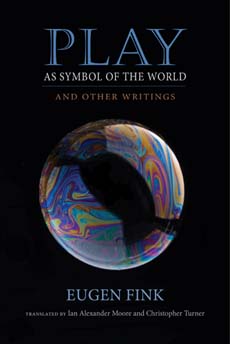
 Eugen Fink, Play as Symbol of the World And Other Writings is forthcoming from Indiana University Press. This is a book I’ve found very helpful in thinking about the ‘world’, and wrote about in an article in 2008 for Parrhesia. Its English translation is long overdue.
Eugen Fink is considered one of the clearest interpreters of phenomenology and was the preferred conversational partner of Edmund Husserl and Martin Heidegger. In Play as Symbol of the World, Fink offers an original phenomenology of play as he attempts to understand the world through the experience of play. He affirms the philosophical significance of play, why it is more than idle amusement, and reflects on the movement from “child’s play” to “cosmic play.” Well-known for its non-technical, literary style, this skillful translation by Ian Alexander Moore and Christopher Turner invites engagement with Fink’s philosophy of play and related writings on sports, festivals, and ancient cult practices.
 Luis Lobo-Guerrero,



 Jonathan was part of a group of Berkeley students who met with Foucault alongside his lecture course on parrēsia (published as Fearless Speech and recently published in a French critical edition). One photograph of this group, with the cowboy hat they gifted Foucault, can be found in Didier Eribon’s biography. Another photo, taken a few moments later, is published for the first time in this article. Jonathan is two to Foucault’s left. I say more about the group and what they did and had planned with Foucault in


