La grande soif de l’etat. Michel Foucault avec les sciences sociales (2016)

News of a recently published book on Foucault and the state.

Clare O'Farrell's avatarFoucault News

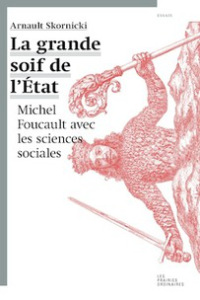
skornickiArnault Skornicki,La grande soif de l’etat. Michel Foucault avec les sciences sociales, Les Prairies Ordinaires, 2016.
288 pages, 20 €
ISBN 978-2-35096-116-3

Michel Foucault n’est pas réputé être un théoricien de l’État, mais un penseur du pouvoir partout où il se trouve (dans l’école, la prison, la caserne, l’usine, l’hôpital). Et pourtant, il apparaît qu’il s’était lancé dans une grande généalogie de l’État moderne. Cet ouvrage se propose de dissiper ce paradoxe en démontrant deux choses.

Oui, il existe bel et bien une théorie foucaldienne de l’État : elle n’est ni systématique ni achevée, mais on peut la reconstituer tant à partir de la fabuleuse richesse des textes de Foucault qu’en le faisant dialoguer avec de grandes entreprises voisines, venues de la philosophie et des sciences sociales : le marxisme, Weber, Elias et Bourdieu, entre autres.

Oui, la généalogie est compatible avec la sociologie. Les concepts de biopolitique…

View original post 100 more words

Posted in Uncategorized | Leave a comment

Foucault’s History of Sexuality Vol I, 40 years on – theme issue of Cultural History

cover.gif‘Revisiting The History of Sexuality: Thinking with Foucault at Forty’, theme issue of Cultural History, guest edited by Howard Chiang. Here’s the abstract of the introduction:


Posted in Michel Foucault, Uncategorized | Leave a comment

International Law and the Territorial Gains and Losses of Non-State Actors, London, 27 October 2016

I’ll be speaking at the launch event of a new project on International Law and The Territorial Gains and Losses of Non-State Actors in London on 27 October 2016, 5pm. The other speaker is Patrick Zahnd, Professor of Humanitarian International Law  at SciencesPo. Full details here.

Posted in Uncategorized | Leave a comment

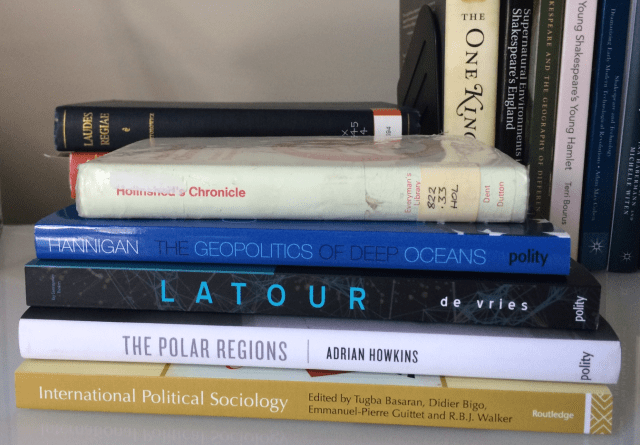
Books received – Holinshed, Hannigan, de Vries on Latour, Howkins, International Political Sociology

books.png

A second-hand copy of Holinshed’s Chronicles – the parts used by Shakespeare; and some books in recompense for review work for Polity and Routledge.

Posted in Uncategorized | 1 Comment

Interview about Foucault’s Last Decade on New Books in Critical Theory (audio)

A few weeks ago I was interviewed by Dave O’Brien of Goldsmiths about Foucault’s Last Decade for the New Books in Critical Theory series. The recording is now available as a podcast: Download (Duration: 47:54 — 21.9MB) or to stream at the series website.

0745683916

Why did Michel Foucault radically recast the project of The History of Sexuality? How did he work collaboratively? What was the influence of Antiquity on his thought? In Foucault’s Last Decade (Polity Press, 2016) Stuart Elden, Professor of Political Theory and Geography at the University of Warwick explores these, and many more, questions about the final years in a rich intellectual life. The book combines detailed studies of Foucault’s recently collected lecture series with archival material and his publications, to give an in depth engagement with the changes and continuities in his thought during the last decade. Addressing questions associated with key terms, such as governmentality, as well as confession, the self, power, truth telling, and many other core ideas and themes, the book will be essential reading for anyone interested in this most important of Western thinkers.

My thanks to Dave for the invitation and for asking the questions.

Posted in Foucault's Last Decade, Foucault: The Birth of Power, Michel Foucault, Uncategorized | 2 Comments

Dallas Rogers, The Geopolitics of Real Estate: Reconfiguring Property, Capital and Rights

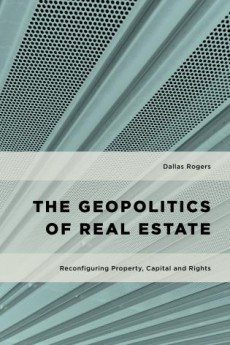
17834833261-230x345Dallas Rogers, The Geopolitics of Real Estate: Reconfiguring Property, Capital and Rights, out in October with Rowman International.

Individual foreign investment in Western nation states is a long-standing geopolitical issue. The expansion of the middle class in BRICS and Asian countries, and their increased activity in Western real estate markets as foreign investors, have introduced new and revived existing cultural and geopolitical sensitivities. In this book, Dallas Rogers develops a new history of foreign real estate investment by mapping the movement of human and financial capital over more than four centuries. The book argues the reconfiguration of Asian geopolitical power has ruptured the conceptual landscape for understanding international land and real estate relations. Drawing on assemblage theories (Latour, Deleuze and Guattari), assemblage analytical tactics (Sassen and Ong) and discursive media theories (Kittler and Foucault) a series of vignettes of land and real estate crisis are presented. The book demonstrates how foreign land claimers and global real estate professionals colonise, subvert and act beyond the governance structures of settler-societies to facilitate new types of capital circulation and accumulation around the world.

This is the first book in the Geopolitical Bodies, Material Worlds series, edited by Jason Dittmer and Ian Klinke – the second will be out later this year.

Posted in Uncategorized | 1 Comment

À propos d’un cours inédit de Michel Foucault sur l’analyse existentielle de Ludwig Binswanger (Lille 1953–54) (2016)

A discussion of a so-far unpublished 1953-54 course by Foucault on Binswanger – though in French there is quite a long summary in English.

Clare O'Farrell's avatarFoucault News

Elisabetta Basso, À propos d’un cours inédit de Michel Foucault sur l’analyse existentielle de Ludwig Binswanger (Lille 1953–54), Revue de Synthèse. December 2016, Volume 137, Issue 1, pp 35–59

First Online: 24 August 2016
DOI: 10.1007/s11873-016-0297-3

Résumé
Cet article examine la manière dont Michel Foucault se rapporte à la psychologie et à la psychopathologie phénoménologiques dans les années 1950, à la lumière des nouvelles sources documentaires que nous avons aujourd’hui à notre disposition. Notre contribution se concentre en particulier sur le manuscrit inédit de l’un des cours donnés par Foucault à l’université de Lille entre 1952 et 1954 : le cours sur « Binswanger et la phénoménologie » (1953-54). L’analyse de ce cours, conçu par Foucault dans le contexte d’une réflexion philosophique sur le problème anthropologique de la psychopathologie, nous permettra enfin de restituer à Foucault la place qui lui revient dans le domaine de la « philosophie de…

View original post 237 more words

Posted in Uncategorized | Leave a comment

Forthcoming in Antipode…

Antipode Editorial Office's avatarAntipodeFoundation.org

As the summer comes to an end and a new semester begins, we’re looking forward to 2017 and the papers forthcoming in Antipode 49(1) in January–all of which are available online now (and will be freely available in the new year).

The Editorial Collective, September 2016

Energy Colonialism and the Role of the Global in Local Responses to New Energy Infrastructures in the UK: A Critical and Exploratory Empirical Analysis

Susana Batel and Patrick Devine-Wright

Susana and Patrick argue that their paper on public responses to large-scale low-carbon energy infrastructures offers lessons for people engaging with other matters of concern, including immigration, contemporary populist politics, and the future of the EU. What role do intergroup relations, collective narratives, and geographical imaginaries play in these phenomena?

Conveyer-Belt Justice: Precarity, Access to Justice, and Uneven Geographies of Legal Aid in UK Asylum Appeals

Andrew Burridge and Nick Gill

Andrew and Nick’s discussion of the frames of “luck”, “uncertainty”, and “dislocation” explores a…

View original post 610 more words

Posted in Uncategorized | 1 Comment

Society and Space 34(5) out now – including free to access forum on area studies and geography

Posted in Uncategorized | Leave a comment

Foucault and Shakespeare, Terrain and forthcoming talks

SpindelI’ve been fairly quiet on this blog recently. That isn’t to say I haven’t been busy – mainly on the Shakespeare project. (More on this project can be found here). Unlike the work for the Foucault books, I haven’t felt I had much to say that didn’t blur the line between writing about the project and sharing writing from the project. While I have regularly written about the process of research and writing, sharing draft material is something I’ve always tended to avoid in the past.

With Foucault, I felt I was genuinely discovering new things in the research – texts, documents, material in the archive, translation issues, comparison of variant texts, dating of material and so on. That was fundamental work – both in the sense of important and preparing the ground for my own interpretative labour. I could write about the project rather than share parts of it. I thought that much of what I was discovering would be useful to other people working on, or using, Foucault. It was for that reason that I put together a number of Foucault Resources. With Shakespeare it feels different: I’m not pretending to have discovered anything new about Shakespeare and I’m much more dependent on the interpretative labour of multiple editors of his texts. What will, I hope, be novel about my reading is much more in terms of the juxtaposition of different texts; reading some passages usually taken as comedy very seriously; textual work on word-meanings and resonances; the interpretative lens of territory; the historical-political context in which I will try to embed the readings, and so on. That, at least, makes sense to me as to why my recent work has not been so conducive to this blog.

In the six-plus years of this blog I’ve felt there are moments when it predominantly becomes a noticeboard for things, a kind of public set of bookmarks, rather than genuinely about my own work. In a sense that’s fine, and I’m well aware the vast majority of visitors come here because they find that useful, rather than because they are interested in my own work. This then has been another moment where the specific nature of the blog – my own work – has again taken something of a backseat.


I’m now on my way to Memphis to present at the ‘Critical Histories of the Present‘ conference. My talk is under the title of ‘Foucault and Shakespeare: Ceremony, Theatre, Politics’, which is substantially developed from a version I gave at King’s College London last year. It will get one more outing at the Political Thought and Intellectual History seminar, University of Cambridge on 7 November 2016. This paper is separate from either the Foucault books or the Shakespeare manuscript, but is a reading of Foucault and Shakespeare together that intersects with some of the books’ themes. I understand that papers from Memphis will be published in the Southern Journal of Philosophy in due course.

When I get back to the UK I’m planning on going into ‘writing lockdown’ mode for about a week, with a view of getting the rough draft of the Shakespeare manuscript to a point where it can be left. I’ll then get ready for the new term, and as time allows over the autumn begin thinking about the question of ‘terrain’, which is shaping up to be the next main project.

I will be talking about terrain in Gießen in December, Durham and London in February, and Maynooth in March. I’m certainly hoping that it won’t be just one paper repeated four times. I’ll also be speaking on Hamlet at the Early Modern Literary Geographies conference in October; at a public event linked to the new British Library exhibition on Maps and the 20th Century: Drawing the Line on 31 January; and on research blogs and social media to Royal Holloway’s Landscape Surgery seminar on 21 February. All the details I have on forthcoming talks can be found here. I’m still deciding what, if anything, I will present at the AAG meeting in Boston. There will also be some events linked to the ICE-LAW project in the spring. I also have a trip to Paris booked for December, to work through a little more of the Foucault archive. So, a lot of things coming up over the next several months. This is the reason why I need to get the Shakespeare material to a point where, although it’s not finished, I can leave it for a while.



Posted in Conferences, Foucault's Last Decade, Foucault: The Birth of Power, Michel Foucault, Shakespearean Territories, Territory, Uncategorized, William Shakespeare | 3 Comments