CFP Third Warwick Graduate Conference on Political Geography 19-20 May 2016

Deadline for abstracts extended until 17 March 2016.

stuartelden's avatarProgressive Geographies

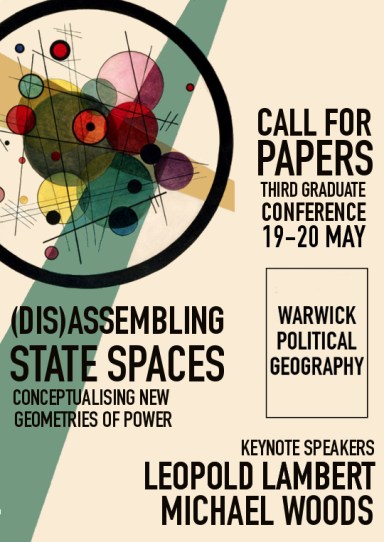
WGPPlease consider submitting a paper for the next Warwick Graduate Conference in Political Geography, held at the University of Warwick on 19-20 May, 2016. The topic of this year’s conference is:
“(Dis)Assembling state spaces: Conceptualising geometries of power” and confirmed speakers are Prof. Michael Woods (Aberystwyth) and Leopold Lambert from The Funambulist.

We invite you to submit your abstracts no later than 8th March 2016. You can find the complete CFP with more details here and please feel free to contact us at politicalgeographywarwick@gmail.com if you have any further queries.

We are looking forward to a great conference and would be delighted to count you in. All potential participants should submit a title, abstract (of no more than 450 words), and evidence of institutional affiliation by March 8th, 2016 to politicalgeographywarwick@gmail.com.

Please note five travel grants of up to £100 each are available to support attendance; preference will…

View original post 40 more words

Posted in Uncategorized | Leave a comment

10 Critical Theory books that came out in February 2016

critical-theory.com has another useful roundup of recent books… Guattari, Reber, Dean, Verso Radical Thinkers Set 12 and more…

feb-2016-critical-theory-releases-672x372.jpg

Posted in Uncategorized | 1 Comment

Henri Lefebvre: Rural Sociology, Ground Rent and the Politics of Land – project funding from the ISRF

39078-1I’m pleased to announce that along with Adam David Morton (Political Economy, University of Sydney) I have been awarded a small grant from the Independent Social Research Foundation for the project ‘Henri Lefebvre’s writings on Rural Sociology, Ground Rent and the Politics of Land’. The grant is to support the translation of essays by Lefebvre on the political economy of ground rent and rural sociology. The plan is that we edit these essays and present them as a book with substantial notes and introduction, on the model of a previous book of Lefebvre’s essays that I co-edited with Neil BrennerState, Space, World, Minnesota: University of Minnesota Press, 2009.

UntitledThe first essay from the project, ‘The Theory of Ground Rent and Rural Sociology” was recently publishing in the journal Antipode, translated by Warwick Philosophy PhD student Matthew Dennis, and edited and with an introduction by Adam and me (both open access). Several more such essays will appear in the edited book – many will come from the first half of Du rural à l’urbain, but there are uncollected texts we intend to include.

When we were first beginning the project we wrote a short piece for the Politics Reconsidered blog answering a key question about this project: Why read a long dead French Marxist to think about land struggles today?


Posted in Adam David Morton, Henri Lefebvre, Uncategorized | 2 Comments

Society and Space Volume 34 Issue 2 now online

New issue of Society and Space now online – requires subscription

Posted in Uncategorized | Leave a comment

The Biopolitics of Birth: Michel Foucault, the Groupe Information Santé and the Abortion Rights Struggle – in Viewpoint Magazine

mdThe Biopolitics of Birth: Michel Foucault, the Groupe Information Santé and the Abortion Rights Struggle” – in Viewpoint Magazine (open access). This is an edited excerpt from the manuscript of my book Foucault: The Birth of Power, Polity Press, forthcoming 2017.

Also see Foucault and the Groupe Information Santé – a bibliography, and for more detail on the book Foucault: The Birth of Power and its companion study, Foucault’s Last Decade (Polity Press, 2016), see this page.

Posted in Michel Foucault, Uncategorized | 3 Comments

Mark Neocleous, The Universal Adversary: Security, Capital and the ‘Enemies of All Mankind’ – now out with Routledge

Mark Neocleous, The Universal Adversary: Security, Capital and the ‘Enemies of All Mankind’ – now out with Routledge.

9781138955165

The history of bourgeois modernity is a history of the Enemy. This book is a radical exploration of an Enemy that has recently emerged from within security documents released by the US state: the Universal Adversary. Neocleous shows how the concept of the Universal Adversary draws on several key figures in the history of ideas, said to pose a threat to state power and capital accumulation. Within the Universal Adversary there lies the problem not just of the ‘terrorist’ but, more generally, of the ‘subversive’, and what the emergency planning documents refer to as the ‘disgruntled worker’. Taking the figure of the disgruntled worker as its starting point, the book introduces some of this worker’s close cousins – figures often regarded not simply as a threat to security and capital but as nothing less than the Enemy of all Mankind: the Zombie, the Devil and the Pirate. In situating these figures of enmity within debates about security and capital, the book engages an extraordinary variety of issues that now comprise a contemporary politics of security, from crowd control to contagion, from the witch-hunt to the apocalypse, from pigs to intellectual property, in a compelling analysis of the ways in which security and capital are organized against nothing less than the ‘Enemies of all Mankind’.

Find out more about the title here: http://bit.ly/1oVqNP0

Posted in Mark Neocleous, Uncategorized | 2 Comments

The Funambulist Magazine issue 4 – Carceral Environments

Cover Carceral EnvironmentsThe fourth issue of The Funambulist Magazine is now published. After examining the politics of space/design and bodies of militarized citiessuburbs, and clothing, it is now the turn of Carceral Environments to be investigated by the talented contributors to the magazine. This issue examines various forms of incarceration spaces in relation to the bodies they imprison. Architecture’s violence is never greater than through its carceral typology, and a bit of this typology lies in all architecture. The issue explore political prisons in Ireland (Fiona McCann), migrant detention centers in the United Kingdom (Tings Chak & Sarah Turnbull), Indigenous boarding schools in Canada (Desirée Valadares), the carceral history of Guantanamo Bay (A. Naomi Paik), labor camps in California (Sabrina Puddu), and prison abolitionism (Nasrin Himada) in additions to the usual photographic and student sections, as well as the opinion columns and blog article re-edition.

Although the issue is already available, it will be formally launched at the Canadian Centre for Architecture in Montreal on Sunday 6th March at 3PM through a presentation of its contents and an introduction to prison abolitionism by Nasrin Himada, contributor to the issue. See the CCA website for more information. There will also be a presentation of this issue in Berlin on March 29 (more information about this event soon).

As usual, the issue is available for purchase in four different offers:
– Printed Version
– Digital Version
– Printed + Digital Combo
– Issues 03 Clothing Politics & 04 Carceral Environments Combo (printed)

You can also subscribe to the magazine and thus support The Funambulist in a longer span of time while benefiting of better prices. A big thanks to the many of you who already subscribed!:
– Printed Subscription per month
– Digital Subscription per month
– Printed + Digital Annual Subscription

Posted in Uncategorized | 3 Comments

Territories of Poverty: Rethinking North and South, edited by Ananya Roy and Emma Shaw Crane

9780820348438Territories of Poverty: Rethinking North and South, edited by Ananya Roy and Emma Shaw Crane, now out with University of Georgia Press.

Territories of Poverty challenges the conventional North-South geographies through which poverty scholarship is organized. Staging theoretical interventions that traverse social histories of the American welfare state and critical ethnographies of international development regimes, these essays confront how poverty is constituted as a problem. In the process, the book analyzes bureaucracies of poverty, poor people’s movements, and global networks of poverty expertise, as well as more intimate modes of poverty action such as volunteerism. From post-Katrina New Orleans to Korean church missions in Africa, this book is fundamentally concerned with how poverty is territorialized.

In contrast to studies concerned with locations of poverty, Territories of Povertyengages with spatial technologies of power, be they community development and counterinsurgency during the American 1960s or the unceasing anticipation of war in Beirut. Within this territorial matrix, contributors uncover dissent, rupture, and mobilization. This book helps us understand the regulation of poverty—whether by globally circulating models of fast policy or vast webs of mobile money or philanthrocapitalist foundations—as multiple terrains of struggle for justice and social transformation.

Posted in Territory, Uncategorized | 1 Comment

Ingo Farin and Jeff Malpas (eds.) Reading Heidegger’s Black Notebooks 1931-1941 – out in late March

9780262034012Also on the ‘Black Notebooks’, Ingo Farin and Jeff Malpas (eds.) Reading Heidegger’s Black Notebooks 1931-1941 will be out in late March.

For more than forty years, the philosopher Martin Heidegger logged ideas and opinions in a series of notebooks, known as the “Black Notebooks” after the black oilcloth booklets into which he first transcribed his thoughts. In 2014, the notebooks from 1931 to 1941 were published, sparking immediate controversy. It has long been acknowledged that Heidegger was an enthusiastic supporter of the Nazi Party in the early 1930s. But the notebooks contain a number of anti-Semitic passages—often referring to the stereotype of “World-Jewry”—written even after Heidegger became disenchanted with the Nazis themselves. Reactions from the scholarly community have ranged from dismissal of the significance of these passages to claims that the anti-Semitism in them contaminates all of Heidegger’s work. This volume offers the first collection of responses by Heidegger scholars to the publication of the notebooks. In essays commissioned especially for the book, the contributors offer a wide range of views, addressing not only the issues of anti-Semitism and Nazism but also the broader questions that the notebooks raise.

Contributors
Babette Babich, Andrew Bowie, Steven Crowell, Fred Dallmayr, Donatella Di Cesare, Michael Fagenblat, Ingo Farin, Gregory Fried, Jean Grondin, Karsten Harries, Laurence Paul Hemming, Jeff Malpas, Thomas Rohkrämer, Tracy B. Strong, Peter Trawny, Daniela Vallega-Neu, Friedrich-Wilhelm von Herrmann, Nancy A. Weston, Holger Zaborowski


Posted in Jeff Malpas, Martin Heidegger, Uncategorized | Leave a comment

Donovan Irven reviews David Farrell Krell’s Ecstasy, Catastrophe: Heidegger from Being and Time to the Black Notebooks

63264_covDonovan Irven reviews David Farrell Krell’s Ecstasy, Catastrophe: Heidegger from Being and Time to the Black Notebooks at Phenomenological Reviews (open access).


Posted in David Farrell Krell, Martin Heidegger, Uncategorized | Leave a comment