
The importance of Jean de Menasce to the life of Émile Benveniste has long been known. A former student of Benveniste in his Iranian courses at the École Pratique des Hautes Études, Menasce later taught at the University of Fribourg, and helped to get Benveniste to Switzerland in the Second World War. The story of his escape is told in various biographical accounts, and I’ll be discussing it detail in my book on Indo-European thought in France, using some previously neglected archival sources.
Like Benveniste, Menasce was Jewish, but he converted to Catholicism and became a priest. He was an important scholar of Zoroastrianism, writing surveys for The Cambridge History of Iran. He translated the Middle Persian text Škand-gumanik Vičār, the doubt-dispelling exposition, in 1945, which was dedicated to Benveniste. The copy in which he wrote an additional dedication is in the Sprachwissenschaft Bibliothek of the Universität Berne, who bought Benveniste’s personal library – I wrote about that here. Menasce gave the Ratanbai Katrak lectures at the Sorbonne in 1946, the same series Benveniste had given twenty-one years before, and his lectures were published as Une encyclopédie mazdéenne: Le Dēnkart in 1958. The Škand-gumanik Vičār was a polemical text, while the Dēnkart was an encyclopaedic compendium of Zoroastrian religious beliefs. Menasce’s major work was a 1973 translation of the third, and by far longest and best preserved, book of the Dēnkart.
Earlier in his life Menasce studied at the Sorbonne, and in Oxford, at Balliol College. There he got to know Graham Greene, Bertrand Russell and T.S. Eliot. Both Anaël Levy and Jean-Michel Roessli say that Greene’s The Power and the Glory is dedicated to Menasce. But the English book is actually dedicated to Gervase, that is Gervase Mathew, an English Dominican.
Menasce translated Russell’s Mysticisme et logique suivi d’autres essais in 1922, and made the first French translation of Eliot’s The Waste Land in the first issue of Esprit in 1926 (available open access on Gallica). This translation was “reviewed and approved by the author” (p. 194). Menasce translated a few other texts by Eliot – some parts of Ash Wednesday and a couple of other pieces. In a 17 May 1944 letter to Kathleen Raine, Eliot said Menasce was “the only really first-rate French translator I have ever had” (quoted in The Letters of T.S. Eliot, Vol 6, 770 n. 1).
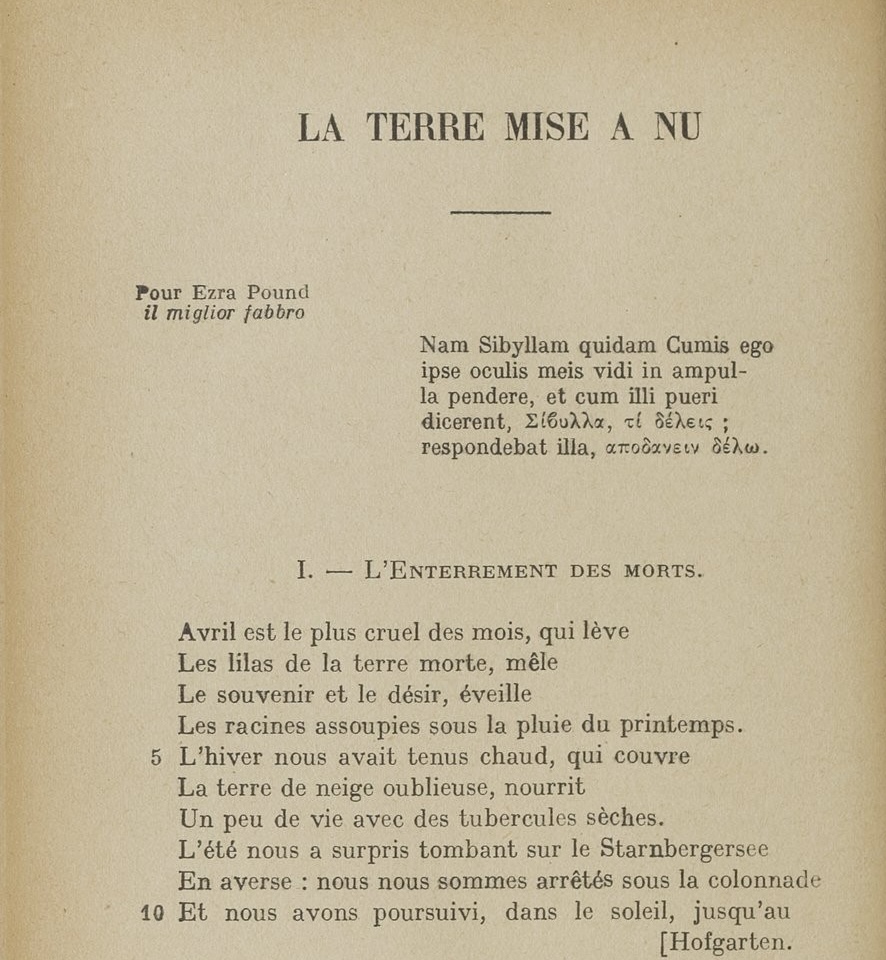
Menasce’s original title for Eliot’s poem was “La Terre mise à nu”, but apparently when the translation was reprinted it was changed to “La Terre Gaste”. The first would be close to “The Earth Laid Bare”. As Teresa Gilbert has noted (“The Waste Land in Spanish Translation (1930-2022)”, 229-30), Eliot thought “La Terre Gaste” was the right translation, since it was a reference to the medieval Grail legend, and the Perceval ou le Conte du Graal of Chrétien de Troyes. Eliot told his Spanish translator Angel Flores that Menasce had discovered this “although alas! too late to use in his version – ‘La Gaste Lande’ [sic]. This is absolutely the exact equivalent as it alludes to the same mediaeval fiction” (Eliot to Flores, 22 February 1928 in The Letters of T.S. Eliot, Vol 4, 63).
Donald Gallup’s T.S. Eliot: A Bibliography says Menasce’s translation was reprinted in the Philosophies journal (1969 edition, p. 278). A note in The Letters of T.S. Eliot, Vol 4, 63 repeats this, saying that there the title was corrected to “La terre gaste”, but neither specify issue number, year or pages. I have not been able to find this reprint, but the connection to the journal is interesting. The reprint is not mentioned in Gallup’s original 1947 edition of his bibliography. But since the translation appeared in L’Esprit in 1926, then I don’t think it can have been reprinted in Philosophies, since that journal ran from 1924-25. It’s not in the six issues I’ve seen. The Philosophies journal was edited by Pierre Morhange, and early work by Henri Lefebvre, Norbert Guterman and others appeared there, including a very early review by Benveniste of Rainer Maria Rilke in the first issue. In the second issue of Philosophies there is a note that Benveniste had gone to India, but that there was a plan he would continue to contribute to the journal, on philosophy, linguistics and literature (“Petites notes”, 230). Benveniste certainly worked for a while in India as a private tutor, but does not seem to have contributed further to the journal. Benveniste, Lefebvre, Guterman and Morhange were among the signatories of the surrealist manifesto “Révolution d’abord et toujours” in 1925. Morhange was also editor of L’Esprit (a different journal to the more famous Esprit), which he founded after Philosophies stopped publication.
Menasce’s cousin, Georges Cattaui also translated a few of Eliot’s poems, included in his Trois poëtes: Hopkins, Yeats, Eliot in 1947. He also wrote the first book on Eliot in French in 1957, dedicated to Menasce as “the first to translate Eliot and introduce him to France”. The relative merits of the different translations, and Eliot’s contact with some of his translators, are discussed in detail in Joan Fillmore Hooker, T.S. Eliot’s Poems in French Translation.
Menasce’s archives are split between the Bibliothèque du Saulchoir and Bibliothèque universitaire des langues et civilisations (BULAC) in Paris, and have been inventoried by Guy Bedouelle and Samra Azarnouche. Both archives include some letters with Benveniste, which are interesting. Balliol College has a small archive of Eliot papers, mostly donated by Menasce. That collection includes copies of Eliot’s books with dedications, some correspondence, publications by Menasce, and also the typescript of Menasce’s translation of “La Terre mise à nu”. I visited this archive in 2023, which I briefly discuss here, and finally went to the Bibliothèque de Saulchoir, where Foucault worked in the last years of his life, in 2024.
A book accompanying an exhibition about Menasce in Fribourg in 1998 is a useful collection. It includes a bibliography, notes on his archive, a list of his Fribourg courses, a lecture, and a reprint of Eliot’s “La Terre mise à nu”, keeping the original French title. There are also several essays about different aspects of Menasce’s work, on Iran, Catholicism and literature, including an essay by Roessli on Menasce and Eliot. Roessli also says that he has been unable to verify the Philosophies reprint mentioned by Gallup (51 n. 15).
Menasce’s translations of Eliot mostly ended in 1929, though a couple of short ones appeared after the war, but they remained in contact. Eliot wrote to Claude André Strauss on 30 June 1944 that though he was grateful for Strauss’s wish to translate his work, the “first opportunity” for a translation of the Four Quartets should be given to Menasce, “who has in the past translated much of my work to my great satisfaction”. (Claude André Strauss changed his name, presumably to avoid confusion with the anthropologist. He is better known under his pen name of Claude Vigée.) In 2006 he was interviewed about the translation, and his correspondence with Eliot.
Interestingly, in the Benveniste archive in the Papiers d’orientalistes at the Bibliothèque nationale de France, there are his translations of Eliot’s Four Quartets (PapOr 36, folder 50). Chloé Laplantine has dated these to 1947. There is no context to the translations in the file. It would be surprising if Benveniste and Menasce had not discussed their shared interest in Eliot. In the last years of his life, Benveniste turned back to his interest in literature, writing a large number of notes on Charles Baudelaire which seem to have been planned for publication on poetic language (PapOr 64, folders 6-23). Laplantine has published these pages, in facsimile and with a transcription as Baudelaire, with a separate book analysing them, Émile Benveniste: l’inconscient et le poème.
Benveniste’s translation of Eliot was never published, and it appears that Menasce never took up Eliot’s suggestion to make a translation of the Four Quartets. The first published French translation was by Pierre Leyris in 1950, following his earlier translation of Poémes 1910-1930 in 1947. (Here, apparently on Eliot’s suggestion, La Terre Vaine was preferred over La Terre Gaste.) Claude Vigée’s translation of the Four Quartets as Quatre Quatuors finally appeared in 1992.
Update August 2026: Irène Fernandez, “À propos de Jean de Menasce traducteur” is a useful brief discussion of his work in this field, focussing on the translations of Eliot.
References
“Petites notes”, Philosophies 2, 1924, 230.
“Revolution d’abord et toujours”, La Révolution surréaliste 5, 1925, 31-32; also in L’Humanité, 21 September 1925, 2 and elsewhere.
Samra Azarnouche, “Fonds Jean de Menasce”, 2014, https://bulac.hypotheses.org/files/2016/06/Fonds-Menasce.pdf
Guy Bedouelle, “Correspondance reçue par le père Jean de Menasce (conservée aux Archives dominicaines de France à Paris)”, Mémoire Dominicaine 20, 2006, 299-324.
Émile Benveniste, “Les Cahiers de Malte Laurids Brigge par Rainer Maria Rilke”, Philosophies 1, 1924, 94-95.
Émile Benveniste, Baudelaire, ed. Chloé Laplantine, Limoges: Lambert-Lucas, 2011.
Georges Cattaui, Trois poëtes: Hopkins, Yeats, Eliot, Paris: Egloff, 1947.
Georges Cattaui, T.S. Eliot, Paris: Éditions Universitaires, 1957; T.S. Eliot, trans. Claire Pace and Jean Stewart, London: Merlin 1966.
Patricia Ceccaroli and Hans Hartje eds. “Correspondance: E.R. Curtius, Jean de Menasce (1945-47: autour de ‘La Littérature latine et le Moyen Age européen’)”, Littérature 81, 1991, 11-24.
Michel Dousse and Jean-Michel Roessli eds., Jean de Menasce: Monographie accompagnant l’Exposition du 9 juillet au 29 août 1998, Fribourg: Bibliothèque cantonale et universitaire, 1998.
T.S. Eliot, “La Terre mise à nu”, trans. Jean de Menasce, L’Esprit 1, 1926, 174-94.
T.S. Eliot, Poèmes 1910-1930, ed. and trans. Pierre Leyris, Paris: Seuil, 1947.
T.S. Eliot, Quatre Quatuors, trans. Pierre Leyris, Paris: Seuil, 1950.
T.S. Eliot, Collected Poems 1909-1962, London: Faber and Faber, 1963.
T.S. Eliot, Quatre Quatuors, trans. Claude Vigée, London: The Menard Press, 1992.
T.S. Eliot, The Letters of T.S. Eliot, ed. Hugh Haughton and Valerie Eliot, London: Faber, ten volumes, 2009-.
Irène Fernandez, “À propos de Jean de Menasce traducteur”, Mémoire Dominicaine 11, 1998, 75-85.
Donald Gallup, T.S. Eliot: A Bibliography Including Contributions to Periodicals and Foreign Translations, Faber & Faber, 1947.
Donald Gallup, T.S. Eliot: A Bibliography – A Revised and Expanded Edition, New York : Harcourt, Brace & World, Inc., 1969.
Philippe Gignoux, “J. P. de Menasce (1902-1973)”, EPHE Annuaire 1973-74, 45-49.
Philippe Gignoux, “À la mémoire de Jean de Menasce pour le dixième anniversaire de son décès” in Études iraniennes, Paris: Association pour l’avancement des études iraniennes, 1985, 11-15.
P. Gignoux and A. Tafazzoli eds., Mémorial Jean de Menasce, Louvain: Imprimerie Orientaliste, 1974.
Teresa Gilbert, “The Waste Land in Spanish Translation (1930-2022)”, Revista Canaria de Estudios Ingleses 85, 2022, 227-40
Graham Greene, The Power and the Glory, London: Heinemann, 1940.
Adrian Hastings, “The Legacy of Pierre Jean de Menasce”, International Bulletin of Mission Research 21 (4), 1997, 168-72.
Joan Fillmore Hooker, T.S. Eliot’s Poems in French Translation: Pierre Leyris and Others, 1983.
Chloé Laplantine, Émile Benveniste: l’inconscient et le poème, Limoges: Lambert-Lucas, 2011.
Chloé Laplantine, “« Si tout temps est éternellement présent » : Émile Benveniste et l’expérience poétique du temps chez T.S. Eliot”, 2022, https://hal.science/hal-04004637/
Gilbert Lazard, “Jean de Menasce (1902-1974)”, Journal Asiatique 262 (3-4), 1974, 265-70.
Anaël Levy, “Jean de Menasce – juif, sioniste, prêtre: De la Renaissance juive au dialogue judéo-chrétien”, https://web.archive.org/web/20140102194053/http://www.fondationshoah.org/FMS/IMG/pdf/15-_Anael_Levy.pdf
Pierre Jean de Menasce ed. and trans. Une apologétique mazdéenne du IXe siècle: Škand gumānīk vičār: La solution décisive des doutes, Fribourg: Librairie de l’Université Fribourg en Suisse, 1945.
Jean de Menasce, Une encyclopédie mazdéenne: Le Dēnkart, Paris: Presses Universitaires de France, 1958.
Le Troisième livre du Dēnkart, trans. J. de Menasce, Paris: Librarie C. Klincksieck, 1973.
Jean de Menasce, “Zoroastrian Literature after the Muslim Conquest” in R.N. Frye ed. The Cambridge History of Iran Volume 4: From the Arab invasion to the Saljuqs, Cambridge: Cambridge University Press, 1975, 543-565.
Jean de Menasce, “Zoroastrian Pahlavi Writings” in Ehsan Yarshater ed., The Cambridge History of Iran Volume 3 (2): The Selucid, Parthian and Sasanian Periods, Cambridge: Cambridge University Press, 1983, 1166-1195
Jean-Michel Roessli, “Jean de Menasce et T.S. Eliot”, in Michel Dousse and Jean-Michel Roessli eds., Jean de Menasce: Monographie accompagnant l’Exposition du 9 juillet au 29 août 1998, Fribourg: Bibliothèque cantonale et universitaire, 1998, 39-53.
Jean-Michel Roessli, “Jean de Menasce (1902-1973), historien des religions, théologien et philosophe: Avec un aperçu de sa correspondance avec Franz Cumont (1868-1947)”, Revue des sciences philosophiques et théologiques 101 (4), 2017, 611-54.
Bertrand Russell, Mysticisme et logique suivi d’autres essais, trans. Jean de Menasce, Paris: Payot, 1922.
Claude Vigée, Anne Mounic and Anthony Rudolf, “Comment traduire les Quatre Quatuors de T.S. Eliot?”, Palimpsestes: Revue de traduction 20, 2007, 201-30, https://journals.openedition.org/palimpsestes/106
Archives
Émile Benveniste library, Sprachwissenschaft Bibliothek, Universität Berne
Papers relating to TS Eliot, Balliol College, University of Oxford, https://archives.balliol.ox.ac.uk/Modern%20Papers/eliot.asp#gsc.tab=0
Fonds Jean de Menasce, Bibliothèque universitaire des langues et civilisations, Paris (inventory)
Fonds Jean de Menasce, Archives de la province dominicaine de France, Bibliothèque du Saulchoir, Paris
Papiers d’orientalistes, Archives et Manuscrits, Bibliothèque Nationale de France
This is the 76th post of a weekly series, posted every Sunday throughout 2025, and continuing into a second year. The posts are short essays with indications of further reading and sources. They are not as formal as something I’d try to publish more conventionally, but are hopefully worthwhile as short sketches of histories and ideas. They are usually tangential to my main writing focus, a home for spare parts, asides, dead-ends and possible futures. I hope there is some interest in them. They are provisional and suggestions are welcome. A few, usually shorter, pieces in a similar style have been posted mid-week. I’m not sure I’ll keep to a weekly rhythm throughout 2026, but there will be at least a few more pieces.
The full chronological list of ‘Sunday histories’ is here, with a thematic ordering here.
Discover more from Progressive Geographies
Subscribe to get the latest posts sent to your email.


Pingback: Did Émile Benveniste try to escape to the USA from Lyon in the Second World War? | Progressive Geographies
Pingback: Forty years since the death of Georges Dumézil and fifty since that of Émile Benveniste | Progressive Geographies