
As part of my research on Georges Dumézil and Émile Benveniste, I’ve been tracing their quite different experiences in the Second World War. Both lost their teaching positions under Vichy, although for very different reasons – Dumézil because he had once been a freemason; Benveniste because he was Jewish. Dumézil got his positions back, and taught through the rest of the war in Paris. Benveniste was a soldier, prisoner, escapee, refugee and eventually a librarian in Switzerland, before returning to Paris after the Liberation. There is a wealth of material in the archives which has shed new light on these stories, especially that of Benveniste. They will be discussed in detail in my book on their parallel lives and careers.
Here’s something which adds a little to Benveniste’s story, which remains speculative and not something I’d publish about in a more formal way, so it perhaps finds a home here.
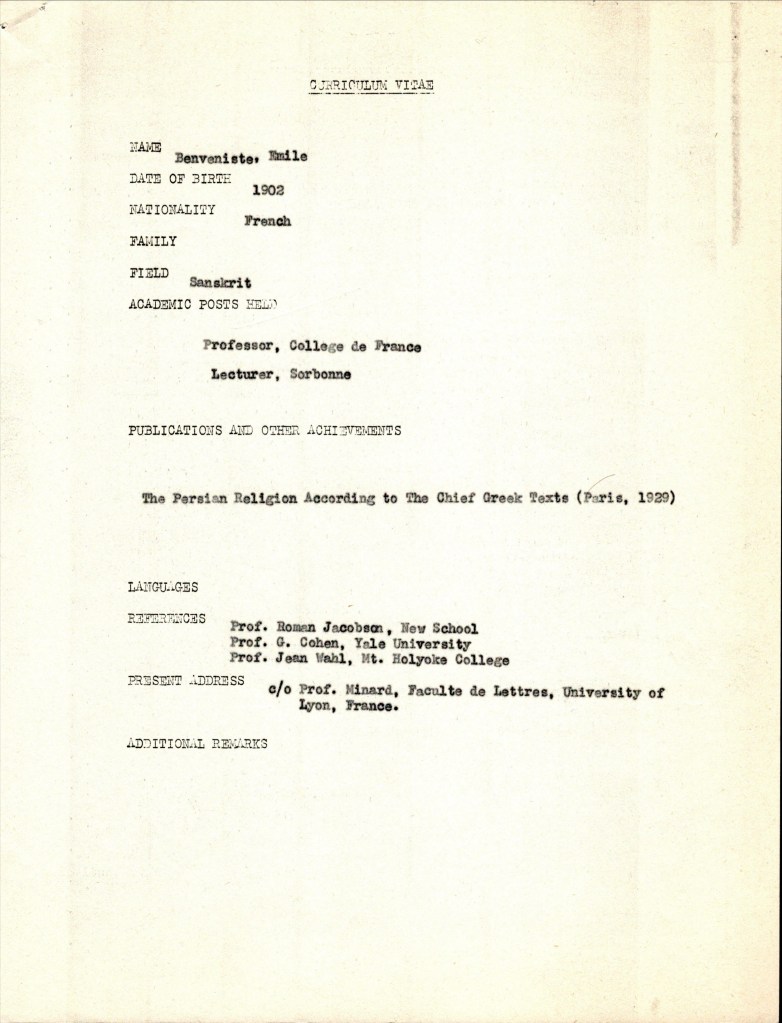
The document is in the papers of German and Jewish Intellectual Émigré Collections, held at the University of Albany, State University of New York. It suggests that Benveniste may have considered a move to the United States, or more likely that friends were exploring this as a possibility for him. The document is in the American Council for Émigrés in the Professions Records, and comes from the papers of Else Staudinger, who helped refugees fleeing Europe. The American Council for Émigrés in the Professions was founded in 1945, by Staudinger and New School director Alvin Johnson, but both of them were important in supporting escaping scholars from Europe much earlier. Johnson was important in the story of the École Libre des Hautes Études, in which many French and Belgian academics in exile taught, alongside other refugees from Europe – I’ve written about some of what Roman Jakobson and Alexandre Koyré taught there in previous pieces in this series.
The document at SUNY Albany is a one-page cv of Benveniste, with the details typed onto a form with existing headings. It lists his posts at the Collège de France and the Sorbonne (i.e. the École Pratique des Hautes Études, which was based at the Sorbonne). It curiously gives his field as Sanskrit, when Iranian and Comparative Grammar were his main fields, and the representative publication as The Persian Religion, perhaps because that was his one book in English at the time. It is undated. It does give the names of some references, and the posts they currently held: Roman Jakobson at the New School; G. Cohen at Yale, and Jean Wahl at Mt. Holyoke. These help with dating the document: Gustave Cohen, formerly of the Sorbonne, was teaching at Yale from 1941; Jakobson arrived in the United States in 1941 and began his École Libre teaching in fall 1942, after doing some work in the New York Public Library; Jean Wahl also began teaching at Mount Holyoke in fall 1942. The institutional affiliations of the referees therefore suggest the document dates from late 1942 or after.
Wahl’s story is fascinating in itself. He was arrested and interned in the Drancy camp north of Paris, as was Benveniste’s brother. Wahl escaped and made it to the United States – a story recently dramatized in W.C. Hackett, Outside the Gates. Benveniste’s brother was sent on a transport to the east, and was murdered in Auschwitz.
Benveniste’s address in this document is given as c/o Prof. Minard, Faculté de Lettres, University of Lyon. This is Armand Minard, a Sanskrit specialist and student of Benveniste’s colleague Louis Renou, and like Benveniste and Renou, of Antoine Meillet. (Georges-Jean Pinault’s work situates Minard well in this French linguistic lineage.) Benveniste had moved to Lyon in the ‘unoccupied zone’ after escaping from a German work camp on 21 November 1941. After the southern parts of France were invaded by the Germans and Italians in late 1942, he decided to leave France. He applied for a Swiss visa in Lyon on 18 December 1942, and left the city the same day. He spent some time in Les Houches near Chamonix in Haute Savoie, then under Italian occupation. He crossed into Switzerland in April 1943, so it again seems likely this document dates from late 1942, or possibly early 1943.
The document is from Staudinger’s files, box 1, folder 122. Staudinger went on to be executive secretary of the American Council for Émigrés in the Professions. Some of the ACEP records are at the New School; some others are at the University of Oregon, mostly a series of annual reports. Unfortunately, neither provides further information on the possibility relating to Benveniste.
It is unlikely the form was completed by Benveniste himself, given the entries on Sanskrit and the Sorbonne, so it was probably completed by someone on his behalf, perhaps one of the people named as a possible reference. By 1942 it would have been exceptionally difficult for someone to get out of Occupied Europe, especially a Jewish escaped prisoner of war. One of the last of the boats out of Marseille, which took Claude Lévi-Strauss, Victor Serge, André Breton and others out of France to Martinique was in Spring 1941. (Eric Jennings is good on these stories.) Jakobson took a different route from Scandinavia – a remarkable story in itself. It certainly makes sense that Benveniste or his friends would have explored options elsewhere.
The prospect of Benveniste entering the United States is an interesting footnote to the story of his evasion of the German forces. By the time the form was completed an Atlantic route would have been closed off. Fortunately, he found another route to safety, and was able to return to Paris after the liberation, taking up his teaching posts at the Collège de France and the EPHE again. After the war, Minard would join Benveniste in teaching comparative grammar at the EPHE.
After a long neglect, Wahl is finally receiving some attention in the anglophone world, and as well as some translations a decade ago – Transcendence and the Concrete and Human Existence and Transcendence – his The Idea of the Instant in Descartes’s Philosophy recently appeared. To connect to another recent post in this series, he was another French reader of T.S. Eliot. Even though he did translate other poetry, including some by Eliot, he was not planning to translate Four Quartets, but to write a refutation. In the end, he seems to have only published a short poem, “On Reading the Four Quartets”.
References
Eric Jennings, “Last Exit from Vichy France: The Martinique Escape Route and the Ambiguities of Emigration”, The Journal of Modern History 74 (2), 2002, 289-324.
Eric T. Jennings, “‘The Best Avenue of Escape’: The French Caribbean Route as Expulsion, Rescue, Trial, and Encounter”, French Politics, Culture & Society 30 (2), 2012, 33-52.
Eric T. Jennings, Escape from Vichy: The Refugee Exodus to the French Caribbean, Cambridge, MA: Harvard University Press, 2018.
W.C. Hackett, Outside the Gates, Brooklyn, NY: Angelico Press, 2021.
Georges-Jean Pinault, “Armand Minard (1906-1998)”, EPHE Section des sciences historiques et philologiques: Livret-Annuaire 13, 1997-98, 31-33.
Georges-Jean Pinault, “Armand Minard (30.12.1906-17.4.1998)”, Bulletin d’Études Indiennes 15, 1997 [1998], 7-18.
Jean Wahl, “On Reading the Four Quartets”, Poetry 73 (6), March 1949, 317.
Jean Wahl, Transcendence and the Concrete: Selected Writings, eds. Alan D. Schrift and Ian Alexander, 2016.
Jean Wahl, Human Existence and Transcendence, trans. William C. Hackett, Notre Dame: University of Notre Dame Press, 2016.
Jean Wahl, The Idea of the Instant in Descartes’s Philosophy, ed. and trans. Alan D. Schrift, Edinburgh: Edinburgh University Press, 2026.
Archives
American Council for Émigrés in the Professions Records, 1930-1974, University of Albany, State University of New York, https://archives.albany.edu/description/catalog/ger017
American Council for Émigrés in the Professions Records, New School Archives and Special Collections, NA-0011-01, https://findingaids.archives.newschool.edu/repositories/3/resources/285
American Council for Emigres in the Professions (ACEP) records, University of Oregon, https://scua.uoregon.edu/repositories/2/resources/1242
This is the 78th post of a weekly series, posted every Sunday throughout 2025, and continuing into a second year. The posts are short essays with indications of further reading and sources. They are not as formal as something I’d try to publish more conventionally, but are hopefully worthwhile as short sketches of histories and ideas. They are usually tangential to my main writing focus, a home for spare parts, asides, dead-ends and possible futures. I hope there is some interest in them. They are provisional and suggestions are welcome. A few, usually shorter, pieces in a similar style have been posted mid-week. I’m not sure I’ll keep to a weekly rhythm throughout 2026, but there will be at least a few more pieces.
The full chronological list of ‘Sunday histories’ is here, with a thematic ordering here.
Discover more from Progressive Geographies
Subscribe to get the latest posts sent to your email.


