Isabelle Stengers’ new book available open access

Isabelle Stengers’ new book, In Catastrophic Times, is available for free download or print-on-demand.

Jeremy Schmidt's avatarJeremy J Schmidt

Isabelle Stengers’ new book, In Catastrophic Times, is available for free as a .pdf download at this site. Here is a description of the book (which you can also buy in hard copy as well following the link above):

There has been an epochal shift: the possibility of a global climate crisis is now upon us. Pollution, the poison of pesticides, the exhaustion of natural resources, falling water tables, growing social inequalities – these are all problems that can no longer be treated separately. The effects of global warming have a cumulative impact, and it is not a matter of a crisis that will “pass” before everything goes back to “normal.”

Our governments are totally incapable of dealing with the situation. Economic warfare obliges them to stick to the goal of irresponsible, even criminal, economic growth, whatever the cost. It is no surprise that people were so struck…

View original post 32 more words
Posted in Uncategorized | 2 Comments

Andy Merrifield: Europe’s New Urban Question

Andy Merrifield: Europe’s New Urban Question – lecture at University of Kentucky.

Posted in Uncategorized | 1 Comment

Books received – Recherches, Foucault, Fourquet, Shakespeare, Vasudevan, Whatmore

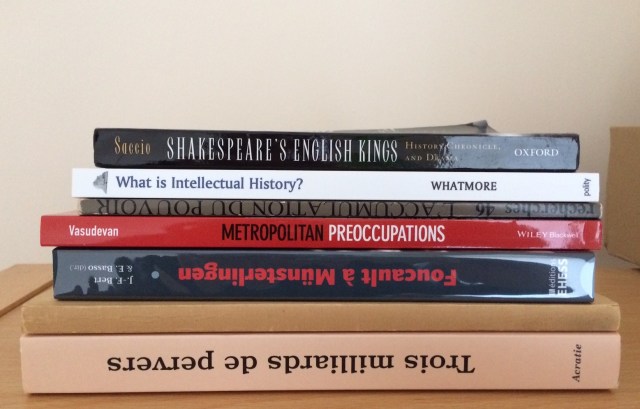
A pile of recent books bought or received. Alex Vasudevan’s Metropolitan Preoccupations: The Spatial Politics of Squatting in Berlin was sent by him; and Richard Whatmore, What is Intellectual History? came from Polity – preordered in recompense for review work. Both look really interesting.

The rest were bought and, except for Saccio, Shakespeare’s English Kings, they are all for the Foucault work. Trois milliards de pervers is a reproduction of an issue of the Recherches journal (no 12) run by Guattari’s CERFI group – it was banned as an obscene publication and original copies are very hard to find. This is a reproduction that appeared earlier this year. Foucault spoke out in defence on the journal and was part of a discussion in the next issue. Also a copy of Recherches no 46 which is François Fourquet’s reflection on the collaborative work done with Guattari, Deleuze, Foucault and others in the early 1970s. The book with no spine marking is the first report from that work, Généalogie des équipements collectifs : première synthèse, which appeared in 1973. These works are all listed in this site’s bibliography of Foucault’s collaborative projects. The final book is the very recent Foucault à Münsterlingen, which is a documentary account of Foucault’s visit to the ‘fête des fous’ in 1954. It includes some reproductions of Foucault’s texts and letters relating the translation work he did on Ludwig Binswanger.

IMG_1169

Posted in Felix Guattari, Foucault: The Birth of Power, Gilles Deleuze, Michel Foucault, Politics, Uncategorized, William Shakespeare | Leave a comment

Extraterritorialities in Occupied Worlds – forthcoming collection from Punctum with essays by Levinas, Bauman, Agamben… and Elden

Amir_Sela_EiOW_Cover_Front_Mockup1

Extraterritorialities in Occupied Worlds – forthcoming collection edited by Maayan Amir and Ruti Sela from Punctum. Includes essays by Levinas, Bauman, Agamben, Harman and many others, including a piece by me entitled ‘Outside Territory’ which is mainly on Shakespeare. Some of the papers, including mine, were first presented at a conference in Paris; some come from a similar conference in New York; others are classic papers reprinted. Should be out in early 2016. Full details here.

The concept of extraterritoriality designates certain relationships between space, law and representation. This collection of essays explores contemporary manifestations of extraterritoriality and the diverse ways in which the concept has been put to use in various disciplines. Some of the essays were written especially for this volume; others are brought here together for the first time. The inquiry into extraterritoriality found in these essays is not confined to the established boundaries of political, conceptual and representational territories or fields of knowledge; rather, it is an invitation to navigate the margins of the legal-juridical and the political, but also the edges of forms of representation and poesies.

Within its accepted legal and political contexts, the concept of extraterritoriality has traditionally been applied to people and to spaces. In the first case, extraterritorial arrangements could either exclude or exempt an individual or a group of people from the territorial jurisdiction in which they were physically located; in the second, such arrangements could exempt or exclude a space from the territorial jurisdiction by which it was surrounded. The special status accorded to people and spaces had political, economic, and juridical implications, ranging from immunity and various privileges to extreme disadvantages. In both cases, a person or a space physically included within a certain territory was removed from the usual system of laws and subjected to another. In other words, the extraterritorial person or space was held at what could be described as a legal distance. (In this respect, the concept of extraterritoriality presupposes the existence of several competing or overlapping legal systems.) It is this notion of being held at a legal distance around which the concept of extraterritoriality may be understood as revolving.


Posted in Politics, Territory, Uncategorized, William Shakespeare | 1 Comment

Foucault’s Last Decade – available to preorder

Foucault's Last Decade coverFoucault’s Last Decade is now available to preorder, either direct from the publisher or at online bookstores. It’s currently scheduled for May 2016, but might be a little earlier. It will be in hardcover and paperback, the latter going for £17.99 or $26.95.

On 26 August 1974, Michel Foucault completed work on Discipline and Punish, and on that very same day began writing the first volume of The History of Sexuality. A little under ten years later, on 25 June 1984, shortly after the second and third volumes were published, he was dead.

This decade is one of the most fascinating of his career. It begins with the initiation of the sexuality project, and ends with its enforced and premature closure. Yet in 1974 he had something very different in mind for The History of Sexuality than the way things were left in 1984. Foucault originally planned a thematically organised series of six volumes, but wrote little of what he promised and published none of them. Instead over the course of the next decade he took his work in very different directions, studying, lecturing and writing about historical periods stretching back to antiquity.

This book offers a detailed intellectual history of both the abandoned thematic project and the more properly historical version left incomplete at his death. It draws on all Foucault s writings in this period, his courses at the Collège de France and lectures elsewhere, as well as material archived in France and California to provide a comprehensive overview and synthetic account of Foucault s last decade.

Posted in Foucault's Last Decade, Michel Foucault | 1 Comment

The Frontiers of Cormac McCarthy – Adam David Morton

Adam David Morton on Cormac McCarthy at the Society and Space open site – links to paper in the journal which is open access for a month.

Posted in Uncategorized | Leave a comment

West, Isaac 2013 Transforming Citizenships: Transgender Articulations of the Law – A Review Forum

Review forum on Isaac West’s Transforming Citizenships: Transgender Articulations of the Law at the Society and Space open site.

Posted in Uncategorized | Leave a comment

Latour on Paris Attacks

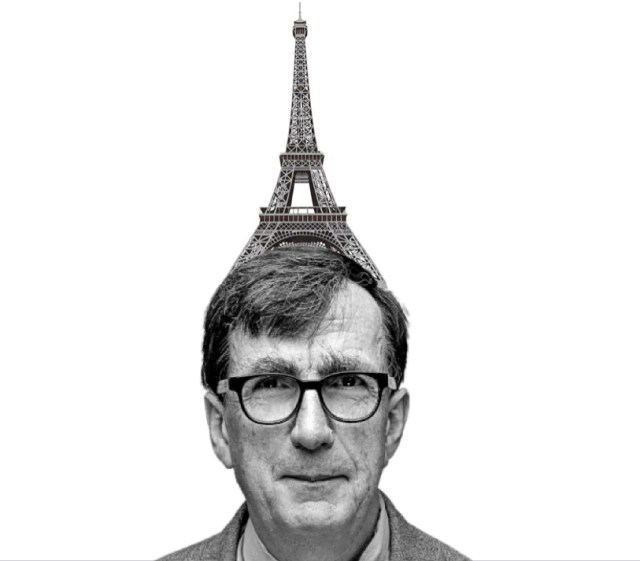
A short commentary by Bruno Latour on the Paris attacks and climate change.

Nicholas's avatarInstalling (Social) Order

LatourLatour on Paris Attacks: 

What is so discouraging about the terrorist acts is that our discussion of what motivated the operations is as insane as the acts themselves. With each attack of this nature, we restage the grand war drama, the nation in peril and the protector-state purporting to rise up against barbarity. This is what states do, we say: we should have a basic expectation of security, and the state should have the means to provide it. End of story.

But what makes the current situation so much more dismaying is that the crimes committed on 13 November have occurred within a few days of another event about to take place that involves tragedies of a different kind, ones that will require that we come up with very different answers to wholly different threats that have nothing to do with ISIS/Daech. I am referring, of course, to the World…

View original post 37 more words

Posted in Uncategorized | 1 Comment

Arlette Farge Remembers Foucault on the Streets of Paris (2015)

Arlette Farge discusses Foucault’s work, and working with him.

Clare O'Farrell's avatarFoucault News

Michel Foucault, Against Himself: Arlette Farge Remembers Foucault on the Streets of Paris, Literary Hub, 16 Nov 2015

The following conversation with French historian Arlette Farge is excerpted from Michel Foucault, Against Himselfa collection of interviews and essays exploring the contradictions and conflicts at the heart of Michel Foucault’s life and work.

You met Foucault after the events of May 1968.

Arlette Farge: I first became acquainted with him through his work in 1975, when Discipline and Punish came out. Back then I was a teacher for young educators who wanted to work in the penitentiary system, so I knew a lot about what Michel Foucault was discussing, and the way, for example, he would go into prisons to read Discipline and Punish out loud to the prisoners. I admired him. Back then, street demonstrations, anything concerning freedom, utopia, the prison system, happiness, life that’s…

View original post 13 more words

Posted in Uncategorized | 1 Comment

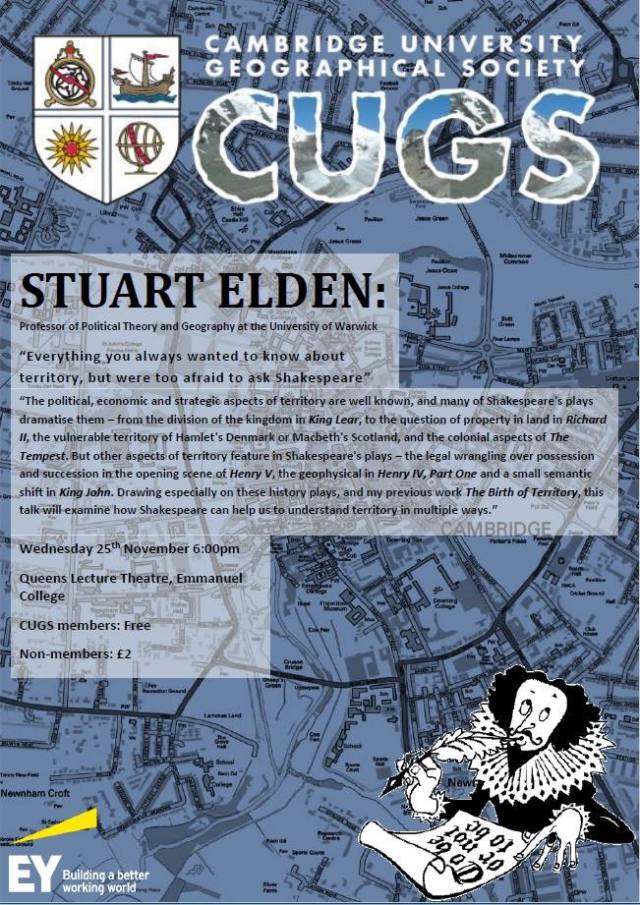
Poster for Shakespeare and territory talk in Cambridge on Wednesday 25 November

CUGS poster

Details at the Cambridge University Geography Society Facebook page.

Posted in Conferences, Shakespearean Territories, Territory, The Birth of Territory, Uncategorized, William Shakespeare | Leave a comment