Since I returned from my last visit to Paris, I had one week back in England where I gave a couple of talks on Shakespeare. One was on ‘The Majesty and Territories of King John’ at UCL’s Institute of Advanced Studies; the other to the Cambridge University Geography Society under the title of ‘Everything you ever wanted to know about territory, but were afraid to ask Shakespeare’. The first was a version of the talk I gave at Warwick a couple of weeks ago, and was a detailed reading of that single play; the second was an overview of the work I’ve been doing much more generally, with examples from King Lear, Hamlet, Henry V and Henry IV, Part One. The thinking with the second was that examples from a range of well-known plays would work best for a largely undergraduate audience, hoping most people would know at least one of the plays. While both talks drew on material I had already, I did some new work on Henry V for the second talk. I also saw the Kenneth Branagh production of The Winter’s Tale as a live-to-cinema broadcast – I’d failed to get a ticket for the theatre itself. This is unlikely to be a play I discuss in the project, but it was a good production and I’m glad I got to see it.
All this meant little time for the Foucault work. But then I was back on the Eurostar on Monday 30th, mainly to visit the Institut mémoires d’editions contemporains (IMEC) in Caen, but because of the archive being closed on Monday and train times I ended up with one and a half days in Paris.
A few hours on Monday were spent in the BNF Richelieu, where Foucault’s papers are housed. There I continued on the roughly chronological way I am working through the material, moving through the first boxes of material labeled as “Pouvoir psychiatrique, Anormaux, etc. (Cours)”. Box 6 has material on responsibility, madness and mental health, box 7 has detailed notes on the campaigns about masturbation, public health, the medical police and hospitals.
Because the Richelieu room closes at 6pm, but the main François Mitterand site stays open until 8pm, I made my way across the city and had a couple of hours there, consulting some published materials relating to Foucault’s work with the Groupe Information Santé (GIS). They have texts that I’ve been unable to find in the UK or in second-hand book stores, including copies of newsletters from the early 1970s, notably Psychiatrie aujourd’hui and Psychiatrisés en lutte, and the GIS report Le Contrôle patronal sur les ouvriers malades. They also had Travailler dans les égouts en 1976, which is a trade-union report that used GIS support. All very useful, and several things ticked off the list.
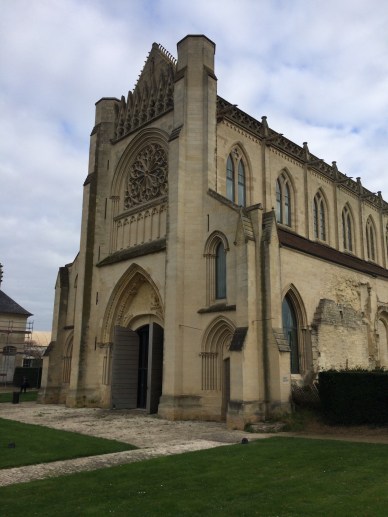
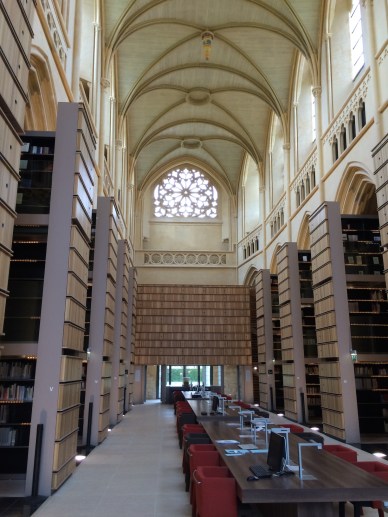
Early Tuesday morning I was on a train to Normandy. I worked through much of the IMEC archive several years ago, when it was still in Paris. For some time it has been housed in the wonderful converted Abbaye d’Ardenne on the outskirts of Caen. I’d only visited the Abbey once before, for a conference on Foucault and medicine in 1999, and back then the main building had not been renovated. The old abbey is now a magnificent reading room. It’s a residential archive and conference centre, with study bedrooms in the old cloisters and communal meals – much like a secular monastery or, indeed, a secularized monastery. They arrange a shuttle with a local taxi firm to meet the early morning train from Paris. The archive of materials relating to Foucault comprises the old collection of the Centre Michel Foucault, initially housed at the Bibliothèque de Saulchoir in Paris, a Dominican library where Foucault worked in the last years of his life. The collection has a lot of material you can find elsewhere though not in the same place. Recordings of his lectures used to be the big draw, it has many typescripts that are also in Berkeley, and a very good collection of secondary literature and other printed material, but also some unpublished material I’ve not found elsewhere. But I was interested in IMEC for two main reasons. One is that it has the material I’d worked through many years ago concerning his collaborative projects with CERFI. The other was what I spent the most time with on this visit – it is the repository of the archives of the Groupe d’information sur les prisons (GIP).
Much of the GIP material has been published in the (now out-of-print) Archives d’une lutte collection, but several things are not in there. If you use the collection here be sure to ask for the ‘Inventaire’ made by Pascal Butel in 2014 – I don’t think this is online. This provides both the old and new catalogue codes for documents, a brief description, but most usefully a reference when pieces have been published somewhere. There is a lot of secondary literature on Foucault and the GIP, so my discussion in Chapter Five will be able to draw on that along with the printed sources, but in with the GIP material are some texts relating to the work of the Groupe Information Santé (GIS). Foucault had a more peripheral involvement with the GIS, and the group quickly took on a regional and autonomous existence, but there is an interesting story to be told, which I recount in Chapter Six. In particular I was pleased to find the text of their founding manifesto, parts of which were published much later, but it was good to find the 1972 original.
Going back to the Foucault papers themselves, there are some unpublished documents unavailable elsewhere. Some of these had a significance that I’d not realized when I went through this material before. These include the full original transcript of an interview from 9th January 1976 between Foucault and K.S. Karol. Part of this was published in Le nouvel observateur, which is the text that forms the basis for an abbreviated English translation, and which is reprinted in Dits et écrits. However there is also an Italian version that doesn’t include all the French but does include some different material. Both were cut from this original, longer version. I discussed this interview back in February 2015, and assumed there must be a longer original: there is, and it is at IMEC.
Another discovery was the original French text of “A propos de la notion d’individu dangereux dans la psychiatrie légale au XIXe siècle”, a lecture given in Toronto in 1977. The English translation is of this original text, but the published French version is slightly cut and some material is rearranged. The full, original French version has not been published. A fuller discussion can be found here – a listing of the variant forms of this text developed through an exchange with Javier Velasquez, where we worked out there must have been an original French version. Again this is validated by the document that can be found at IMEC. The archive also has a transcription of an October 1976 radio interview on “L’Expertise médico-légale”, which has not been published. It’s very interesting and makes some useful connections between medicine and Foucault’s other concerns that I may try to discuss, perhaps in this book’s conclusion. This interview also relates to the question of dangerousness, which had been the topic of Foucault’s 1976 seminar, running alongside the lecture course ‘Society Must be Defended’, and of course the 1977 Toronto lecture.
 The archive also has a transcription of a discussion about the Pierre Rivière case and René Allio’s film of it, held in Tokyo in 1978. As far as I know this has not been published. There is also a copy of another unpublished text, an internal Collège de France document proposing a chair in ‘Sémiologie littéraire’ that was created for Roland Barthes. Foucault was the proposer and wrote the quite detailed proposal.
Perhaps the most interesting material, though not for the current project, was a large folder of notes taken by Jacques Lagrange in Foucault’s courses of the 1950s. These were taught at ENS, Rue d’Ulm, before Foucault left France for posts in Uppsala and Hamburg. These date from 1953 to 1955. Of course, these are notes from an audience member, not Foucault’s own manuscript or even a verbatim record of what he said, though the notes are very detailed. Lagrange also attended Foucault’s Collège de France courses – the tapes used to transcribe the courses were mainly his recordings – and was the editor of the Psychiatric Power course and worked with Defert and Ewald on Dits et écrits. He says a bit about his work here. I may come back to these notes one day – you can understand the Foucault of the Ludwig Binswanger introduction and Maladie mentale et personnalité in their light; and some materials link to his introduction to his translation of Kant’s Anthropology.
IMEC is a splendid place to work. I can’t recommend it highly enough. The cost is very reasonable (50€ per day, full board), food is good, and the people working here are all very interesting. IMEC has a huge range of material – archives of authors, publishers, organisations and journals. The Derrida papers seem to be especially popular – they have 283 boxes of material! For the current project I don’t need to come back, which is a shame because I could get quite used to being here. But I can imagine I will find a reason at some point.
Thursday evening I headed back Paris, and had one more day at the BNF before I headed back to London. This was again split between the Mitterand site and the Richelieu manuscripts. At the Mitterand I was looking again at issues of Psychiatrie aujourd’hui, and some related materials for the GIS and also the Groupe Information Asiles (GIA) – a group which Foucault had much less involvement with, but which is part of an interesting overall story. With the manuscripts I continued with the boxes in the category “Pouvoir psychiatrique, Anormaux, etc. (Cours)”. Boxes 8-10 have a range of notes and a lot of photocopied material on hospitals, mental health, psychiatric expertise and the interconnections of medicine, mental health, crime and sexuality. I wasn’t able to work through everything with the time I had, but I have a decent sense of what is here – at least, what is here and available – now.
Here’s one indication of how Foucault worked. A 1977 text by Arlette Farge in Annales can be found as an offprint in a folder, with the dedication ‘En cordiale et modeste hommage, A. Farge’. Foucault has put an X next to footnotes 2 and 3, and the two texts referenced there appear on a separate page earlier in the folder as one of the frequent reading lists found here. There the two texts are listed under the general title ‘Médicine des pauvres’. The printed text of Farge in this instance helped me to decipher Foucault’s writing. The texts mentioned are “Ph[ilippe] Hecquet, La médicine, la chirurgie, et la pharmacie des pauvres” and “Buchan, Médicine domestique”. Often these reading lists have shelfmarks or order details, most of which seem to be to the BNF’s catalogue. Now these entries to Hecquet and Buchan do not relate to any more detailed notes I’ve found elsewhere, so perhaps Foucault didn’t end up following them up, but many other reading lists in the files relate to detailed notes on the texts listed. Most of these notes are, clearly, just for himself, and can tend towards the illegible. Texts for publication are generally neater.
Foucault put pages into folders – there are photographs of his desk where you can see the piles of these – and many of these are preserved in the BNF archive. The subdivisions of the BNF boxes are in folders, which include one or more of Foucault’s folders. Within the main BNF folders some of the more fragile folders have been enclosed in newer folders. Foucault often folded a page in half to enclose notes on a related theme or photocopies. Sometimes these are blank pages, sometimes scrap paper of various kinds, including his own discarded manuscript pages. Foucault would generally title his folders in the top right, often using abbreviations. He would frequently taken multiple pages of notes on a single book or article, but tended to write these on separate pages, with a short reference to the title and page numbers in the margins, with a short descriptive title of what the notes are on at the top of the page. These were then organized thematically. What that means is that sometimes the full bibliographic reference would be on a page much later in the folder, with earlier ones only having the short title, or perhaps even in a different folder. I can see how errors in references would easily creep in this way. But the advantage is that he could reorganize material quickly, given that notes for a single topic were on separate sheets. Sometimes, but not often, notes from books on separate pages were paper-clipped together. There are traces of rusted paper clip marks on some pages. The BNF archivists have generally replaced these by plastic clips, enclosing a separate tiny slip of paper before Foucault’s paper so that the clips do not touch or damage the archive pages.
I now have a list of some things to work through at the British Library, mainly newspaper reports, but also some pieces Foucault had photocopied that I want to read. I realized that reading them at IMEC or the BNF was not an efficient use of the time I had there, so if I knew I could find them easily in the UK I just made a note to follow-up when back. A couple of decent days at the BL, and perhaps a trip to the LSE should get me to the point where I have everything I need for the next stage of work, either as a physical book, report or journal, as a photocopy or pdf. I’m going to spend quite a bit of the rest of the month back at home in Coventry, working on what I hope will be a complete first draft of the manuscript before the New Year.
Foucault’s Last Decade is now available to pre-order. The index has been submitted and the book is now in the final stages of production. For more information on these two books, see the descriptions here. Audio and video recordings relating to them are here; and a full list of the updates I’ve been posting on the process of writing here. Some translations, bibliographies, scans and links are available at Foucault Resources.

 Graduated Open Access at Punctum Books –
  Michel Foucault’s notion of “biopower” has been a highly fertile concept in recent theory, influencing thinkers worldwide across a variety of disciplines and concerns. In The History of Sexuality: An Introduction, Foucault famously employed the term to describe “a power bent on generating forces, making them grow, and ordering them, rather than one dedicated to impeding them, making them submit, or destroying them.” With this volume, Vernon W. Cisney and Nicolae Morar bring together leading contemporary scholars to explore the many theoretical possibilities that the concept of biopower has enabled while at the same time pinpointing their most important shared resonances.
 My review essay on Foucault’s