Foucault books – reorganisation of webpages

Foucault's Last Decade coverAs Foucault’s Last Decade gets closer to publication, and the writing of Foucault: The Birth of Power continues, I’ve reorganised the web pages on this site relating to the two books.

A main page, with the description of the two books, is here. Audio and video recordings relating to them are here; and the updates I’ve been posting on the process of writing here.

Some translations, scans and links continue to be available at Foucault Resources.


Posted in Uncategorized | Leave a comment

Review of Peter Sloterdijk’s Der Ästhetische Imperativ – Schriften zur Kunst

Peter Sloterdijk’s Der Ästhetische Imperativ – Schriften zur Kunst reviewed at the TCS website.

Peter Gratton's avatarPHILOSOPHY IN A TIME OF ERROR

At Theory Culture and Society (open access). Here is part of what is in that volume:

In order to talk about the future of art after the ‘end of art’, i.e. towards it and from within it, Sloterdijk deems it necessary to firstly talk about the future of the future. It is a question of the ‘world system’ of credit, based on virtualised spaces.,where every ‘reasonable’ person acts ‘as if’ s/he obeyed the “categorical imperative of a Kantian enlightened by a stock market report: act in a way that the maxim of your borrowing could at any time serve as principle of a universal law of the apocalypse” (457). In this highly individualised system, imaginary temporal commonalities have broken into pieces and the only common denominator might be that we are living in a historico-philosophically defined ‘risk society’ (460). However, every synchronisation also creates a-synchronisation – as such, this ‘global’…

View original post 29 more words

Posted in Uncategorized | Leave a comment

Audio recordings of recent talks on Foucault – on Foucault, Porshnev and the Revolt of the Nu-Pieds, and Foucault’s Collaborative Projects

Audio recordings of two recent talks on Foucault, both of which draw on material from the manuscript of Foucault: The Birth of Power, with a little from Foucault’s Last Decade in the second talk.

c9d71a6be7Foucault, Porshnev and the Revolt of the Nu-PiedsHistorical Materialism conference, 7 November 2015 (introduction by Alberto Toscano)

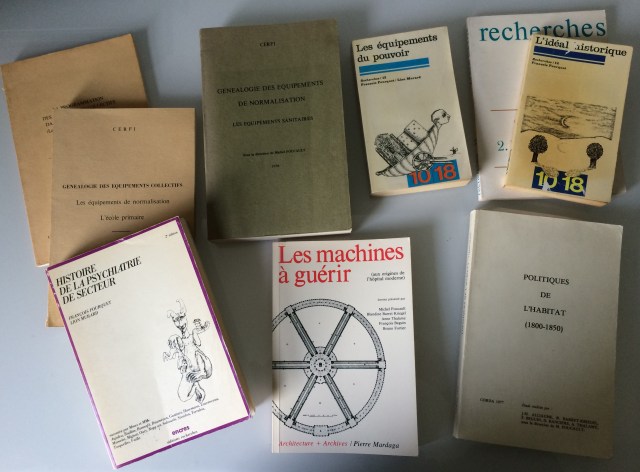
Foucault’s Collaborative Projects: Hospitals, Habitat, Public Infrastructure, Cities, Space and Development seminar, Department of Geography and Environment, London School of Economics, 10 November 2015 (introduction by Murray Low)

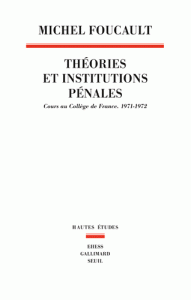
The first talk concentrates on the first half of the Théories et institutions pénales course from 1971-72.

For the second talk, this bibliography of the collaborative projects might be helpful especially as the audio doesn’t have the pictures I showed while talking. The ‘cowboy hat’ photograph I talk about right at the end can be found here.

Collaborative projects

Posted in Foucault's Last Decade, Foucault: The Birth of Power, Michel Foucault | 4 Comments

Romeo and Juliet in Palestine: Teaching Under Occupation

Thanks to dmfant for sharing this news – Tom Sperlinger’s book Romeo and Juliet in Palestine: Teaching Under OccupationIt’s about the experience of teaching at Al-Quds University – which I visited in 2013 (see here) – especially on Shakespeare. There is a discussion of the book here. Definitely on the to-read list…

jhp54ef08e49f548

Is ‘Romeo and Juliet’ really a love story, or is it a play about young people living in dangerous circumstances? How might life under occupation produce a new reading of ‘Julius Caesar’? What choices must a group of Palestinian students make, when putting on a play which has Jewish protagonists? And why might a young Palestinian student refuse to read?
For five months at the start of 2013, Tom Sperlinger taught English literature at the Abu Dis campus of Al-Quds University in the Occupied West Bank. In this account of the semester, Sperlinger explores his students’ encounters with works from ‘Hamlet’ and ‘The Yellow Wallpaper’ to Kafka and Malcolm X. By placing stories from the classroom alongside anecdotes about life in the West Bank, Sperlinger shows how his own ideas about literature and teaching changed during his time in Palestine, and asks what such encounters might reveal about the nature of pedagogy and the role of a university under occupation.

Posted in Politics, William Shakespeare | Leave a comment

What would Shakespeare do about Europe’s migrants?

What would Shakespeare do about Europe’s migrants?” in The Economist.

20150926_bkp502FOR months Sir Ian McKellen has been treating various audiences (including Marc Maron, a comedian and podcast host, and the Savannah Film Festival) to a monologue from a minor Elizabethan play entitled “Sir Thomas More”. It was written in the 1590s by two moderately successful playwrights and later revised by several others. It is notable mainly because one of the revisers (the one scholars refer to as “Hand D” in the original manuscript, in the British Library) is believed to have been William Shakespeare. Presuming the attribution is correct, the folio is the only surviving example of text in Shakespeare’s own handwriting. Sir Ian has been reciting it not just because of who wrote it, but because of what he wrote. Hand D’s contribution to “Sir Thomas More” consists of a powerful scene in which More rebukes a xenophobic London crowd for trying to drive out a group of refugees—a strangely apt 16th-century touchstone for Europe’s current migrant crisis[continues here]

Thanks to various friends for alerting me to this. While exile and banishment are major themes in several Shakespeare plays, they tend to about the treatment of individuals, usually elite ones – for example in Richard II when the feuding noblemen Bolingbroke and Mowbray are exiled by the king: ‘we banish you our territories’. I’ve not focused on groups in that position. One to think about further, perhaps….

Posted in Shakespearean Territories, William Shakespeare | Leave a comment

The Birth of Territory reviewed in The Journal of Territorial and Maritime Studies by Whanyung Kim

There is a a review essay on The Birth of Territory in The Journal of Territorial and Maritime Studies by Whanyung Kim. This a journal of the Northeast Asian History Network, but the review is in English and is open access (Vol 1, No 2, Summer/Fall, 2014, pp. 135-140).

The review is generally very positive, but rightly points out the limits of the book temporally – it ends with the late seventeenth century – and geographically, with its focus on the West. But rather than just highlight or criticise this, the author begins to sketch how the story might be extended to the present, or the comparative work that might be necessary to tell the story for elsewhere.

The Birth of Territory can serve as the basis of a research agenda: a global and comparative history of territory. The book in fact provides a methodological model for writing The Birth of Territory in China and The Birth of Territory in India. The “genealogical account” could be applied to make a narrative about the evolution of territory in China from its rise in ancient China to its perfection in the form of “the-all-under-Heaven” concept before the impact of the West. Similarly, a historical review of the evolution of territory in India will yield interesting insights. For instance, the historical meaning of the ancient term janapada—a compound word composed of janas “people” or “subject” and pada “foot”—could be analyzed. Janapada is particularly intriguing as a concept because it has had a double meaning of “realm, territory” and “subject population.”

There is much more in the piece itself.

Many thanks to Iain Watson for alerting me to this essay.

Posted in The Birth of Territory | 1 Comment

Verso – Space and Power: Celebrating the life of Edward Soja (1940-2015)

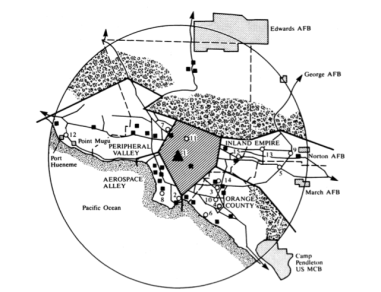
postmodern_geographVerso have published an online extract from Ed Soja’s Postmodern Geographies: the Reassertion of Space in Critical Social Theory, on the production of space and power in Los Angeles.

Posted in Edward Soja | 2 Comments

Michel Foucault, la politique comme guerre continuée. De la guerre des races au racisme d’État, Sur le Cours au Collège de France, “Il faut défendre la société” (2015)

New French book on Foucault’s 1975-76 lecture course.

Clare O'Farrell's avatarFoucault News

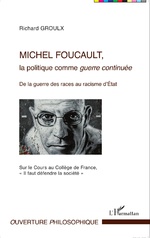
groulxRichard Groulx, Michel Foucault, la politique comme guerre continuée. De la guerre des races au racisme d’État, Sur le Cours au Collège de France, “Il faut défendre la société”, Paris: Editions l’Harmattan, 2015.

La guerre est-elle un accident des sociétés ou appartient-elle à leur constitution même ? Telle est la question posée par Foucault dans son Cours de 1976 « Il faut défendre la société ». Renversant le célèbre aphorisme de Clausewitz sur « la guerre prolongée par la politique », il démontre comment un « dispositif de guerre » s’est introduit dans le discours politique moderne comme « guerre continuée » ou guerre nécessaire à la fois comme guerre des races, lutte des classes, social racisme et racisme d’État.

View original post

Posted in Uncategorized | Leave a comment

Several Essays on Deleuze at LARB

Posted in Uncategorized | Leave a comment

The Political Philosophy of Michel Foucault and Gilles Deleuze conference — final schedule

Final schedule for the Foucault and Deleuze conference in Indiana.

Keith Harris's avatarMy Desiring-Machines

The final schedule for the conference at Purdue this weekend has been posted. Not only am I going, but I’ve found myself moderating a panel on which Marcelo Hoffman and Marco Altamirano will be presenting. Of particular interest is the forthcoming online publication of a transcription, and I presume a translation, of Deleuze’s 1979-80 seminar “Appareils d’Etat et Machines de Guerre” (Apparatuses of State and War Machines). I’ll post details from West Lafayette, Indiana as I learn more.

View original post

Posted in Uncategorized | Leave a comment