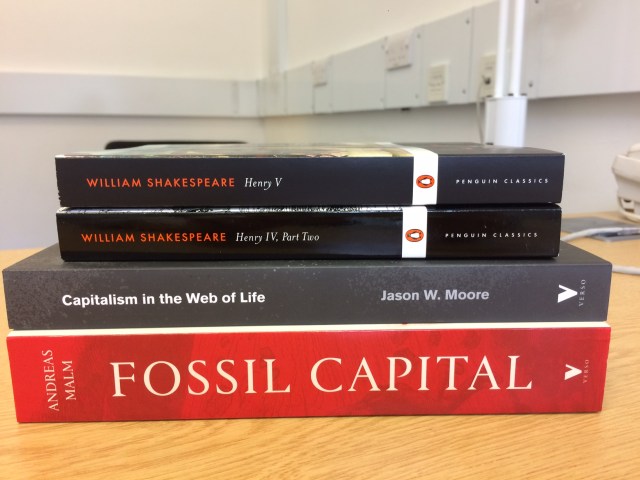
Two re-editions from the Penguin Shakespeare and two books sent by Verso – Jason W. Moore’s Capitalism in the Web of Life and Andreas Malm’s Fossil Capital.
Two re-editions from the Penguin Shakespeare and two books sent by Verso – Jason W. Moore’s Capitalism in the Web of Life and Andreas Malm’s Fossil Capital.
Tomorrow I will be giving a talk entitled “Foucault’s Collaborative Projects: Hospitals, Habitat, and Public Infrastructure” to the Cities, Space and Development seminar series of the Department of Geography & Environment, at the London School of Economics at 4.30pm. It will be held in the New Academic Building, room NAB 1.07. Full details here.
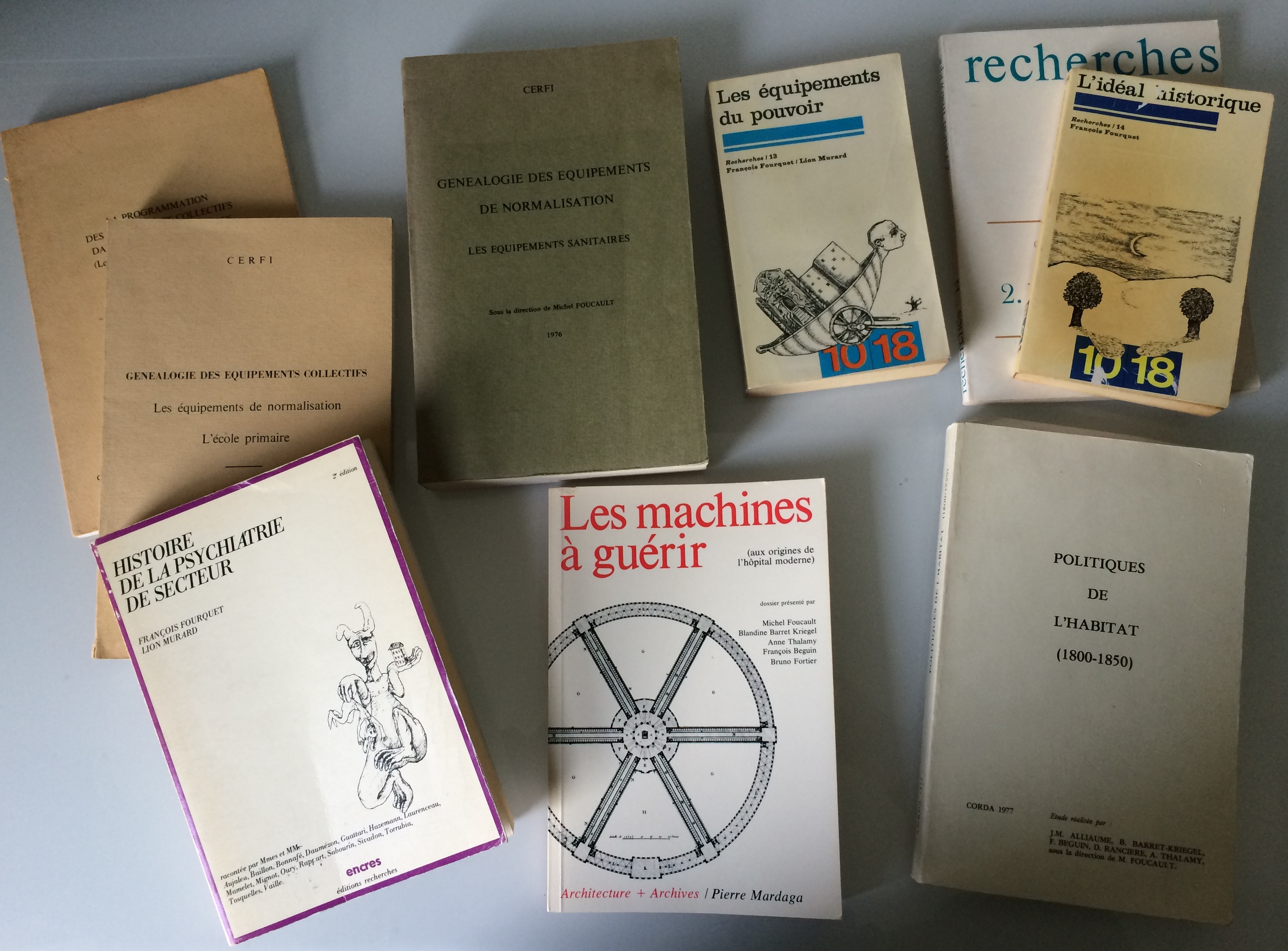
The collaborative projects I have in mind are several of the ones listed here or in the photograph below – works that are not very well-known even in France – and some of the archival traces surrounding them.
Most of the talk draws on the manuscript of Foucault: The Birth of Power, though a few bits are taken from Foucault’s Last Decade.
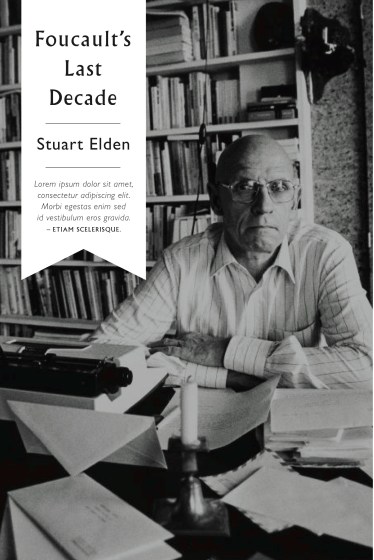 I’ve been waiting to share the cover of Foucault’s Last Decade until the Polity Press webpage was complete, but it is now up on Amazon, so here it is. It will form a pair with Foucault: The Birth of Power – this book with a picture of Foucault the scholar; that book with a picture of Foucault the activist. Much more information on the two books is here.
(The mock-Latin text is just a placeholder until endorsements are in.)
 News of the next translation of the Derrida seminars – 1964-65’s Heidegger: The Question of Being and History, forthcoming in April 2016. After a bit of a delay it seems the seminars are on again – the second volume of La peine de la mort came out in French in October 2015. The listed forthcoming ones are seemingly running at least a year behind the projected schedule.
Durham University seeks to employ a full-time Research Associate to contribute to the work of IBRU, an interdisciplinary training and academic research entity based in Durham University’s Department of Geography. This is a fixed-term appointment which will terminate no later than 31st July 2016.IBRU combines core competencies at the intersection of political geography and comparative and public international law with critical perspectives on borders and bordering. The Research Associate will contribute to ongoing research, conference, and publication projects being undertaken or proposed by IBRU as well as initiating her or his own projects that fall within IBRU’s thematic remit. IBRU is particularly seeking a Research Associate who can contribute to ongoing research on the legal status of sea ice, the political-legal context of seabed mining, and the ways in which maritime spaces and borders are encountered in global refugee and migration flows. The Research Associate will contribute to the development and preparation of research grant applications, journal articles and other academic outputs. Additionally, depending on the Research Associate’s skills and experience, the Research Associate may contribute to IBRU’s training activities in boundary delimitation, demarcation, and dispute resolution.
Closing date 5 December 2015 – full details here
News of Jemima Repo’s book The Biopolitics of Gender
 Jemima Repo (2015) The Biopolitics of Gender. Oxford and New York: Oxford University Press
Description
Michel Foucault identified sexuality as one of the defining biopolitical technologies of the nineteenth and twentieth centuries. As Jemima Repo argues in this book, “gender” has come to be the major sexual signifier of the mid-twentieth and early twenty-first century. In fact, in this historical excavation of the biopolitical significance of the term, she argues that it could not…
View original post 296 more words
Phil Steinberg analyses the territorial and extraterritorial aspects of the recent film The Martian.
A bit belatedly, after getting a number of ‘Does Matt Damon know what he’s talking about?’ emails, I finally got to see The Martian last night. Since it’s not fair that Klaus Dodds and Rachael Squire get to have all the fun analysing this month’s movies, I thought I’d take a stab at parsing the international law beneath The Martian.
View original post 1,652 more words
Review forum of Jenna Loyd’s 2014 Health Rights Are Civil Rights at the Society and Space open site
I’ll be giving the talk I gave at Warwick on Shakespeare’s King John again on the 23rd November at UCL at 6pm (abstract and details here). Then two days later I’ll be giving a talk to the Cambridge University Geography Society, at 6pm in Emmanuel College. They asked me to speak about the Shakespeare project, which I was pleased to do. Rather than a narrow reading of one play, which is how I’ve tended to talk about this work in the past, I’ve decided to draw on a number of plays. Part of the thinking is that most people there will know at least something about one of the plays I discuss, but it’s also a lighter version of the work with a predominantly undergraduate audience in mind – the closest version of this is a talk I gave in a pub in Newfoundland back in 2013.
Everything you always wanted to know about territory, but were afraid to ask Shakespeare
The political, economic and strategic aspects of territory are well known, and many of Shakespeare’s plays dramatise them – from the division of the kingdom in King Lear, to the question of property in land in Richard II, the vulnerable territory of Hamlet’s Denmark or Macbeth’s Scotland, and the colonial aspects of The Tempest. But other aspects of territory feature in Shakespeare’s plays – the legal wrangling over possession and succession in the opening scene of Henry V, the geophysical in Henry IV, Part One and a small semantic shift in King John. Drawing especially on these history plays, and my previous work The Birth of Territory, this talk will examine how Shakespeare can help us to understand territory in multiple ways.


