List of OA journals in my field – geography, political ecology, social science

A very valuable resource on open access journals in Geography and Political Ecology from Simon Batterbury.

simonbatterbury's avatarsimonbatterbury.wordpress.com

 “Full open-access journals are housed on independent or University affiliated websites, freely available to everyone in the world within an internet connection, and provide a free anonymous peer-review service for contributors.” Nathan Coombs here

Academics write most of their work in journals. Journals should publish and curate good quality work, but unfortunately the majority are also used to make money for commercial publishers. Corporate profits are frequently high because companies retain author copyrights, and sell the material to (mainly) scholarly and university libraries. Academics do not rock the boat on this very often, because their  prestige and career is linked too much to the journals they publish in, and most of the high quality ones are commercial and expensive. Our systems of merit and performance measures are not yet geared to rewarding publishing that is ethical, or based on social justice criteria. This is worst at research universities.

To make some contribution to the…

View original post 4,121 more words

Posted in Uncategorized | 3 Comments

CFP “The Politics of Paper in the Early Modern World”, Groningen, 9-10 June 2016

Call for Papers “The Politics of Paper in the Early Modern World” Groningen, The Netherlands, 9-10 June 2016. Full details here.

Paper is today so ubiquitous that we often overlook it. Yet paper was once a brand-new communications technology and political tool that fundamentally influenced early modern political life in myriad ways. The revolutionary effects of paper on European politics and political communications are strikingly visible from the late fifteenth and early sixteenth centuries onwards.

Although scholars of early modern politics and political communications depend upon paper as a building-block of their craft, we still know too little about the paper upon which early modern princes, statesmen, diplomats, secretaries, archivists, informers, spies, smugglers, couriers, postmasters, stationers, or newswriters depended. To paraphrase paperwork ethnologist Ben Kafka, historians have tended to look through paper, at how it can be used to reconstruct events or epistemic processes, but rarely at it, as a material artifact and communications technology around which coherent historical practices developed.

This two-day conference seeks to bring together scholars and paper experts working across a range of disciplines and geographic areas who are interested in the ways in which paper supported, shaped, or otherwise influenced practices of politics and political communications in the period ca.1350-ca.1800. It aims to sketch a more integral picture of the ways in which paper permitted early modern politics and political communications to unfold.

Posted in Uncategorized | Leave a comment

Up to 20 Funded PhD Studentships in Politics and International Studies at University of Warwick

Up to 20 Funded PhD Studentships in Politics and International Studies (PAIS) at University of Warwick – deadlines in January 2016. Full details here.

Applications are invited for up to 20 funded PhD studentships in Politics and International Studies (PAIS) at the University of Warwick. We seek high calibre doctoral candidates with a proven track record of academic excellence – demonstrable via outcomes of assessed work, the quality of the research proposal, and professional and/or academic experience.

PAIS is one of the leading Politics departments in the UK and boasts an ambitious and pluralist research culture as recognised by our strong REF2014 performance (4th on Research Intensity; 1st on Research Environment). PhDs are a fundamental part of our success story.

PAIS is dedicated to the professional development of doctoral students via high quality supervision, a range of professional socialisation courses, and full inclusion in one or more of our four specialist research clusters – Political Theory, Comparative Politics and Democratisation, International Relations and Security, and International Political Economy. Many of our PhD students publish in highly ranked academic journals and several of our students have either been nominated for or won the BISA and PSA thesis prizes. Moreover, PAIS has an enviable track record of supporting students as they transition from doctoral studies to post-doctoral and early career research positions in the UK and globally.

Students interested in applying for funding should first consult our PhD application pages – www2.warwick.ac.uk/fac/soc/pais/study/studyphd – before developing a strong academic proposal in co-ordination with an expert academic supervisor.

Posted in Uncategorized | 2 Comments

Graduated Open Access @punctum Books

DH_Cover_Spread_WEB-e1449539101270Graduated Open Access at Punctum Books – press release. First two paragraphs below.
Today punctum launches a new platform for distributing our titles, which we are calling (for lack of a more elegant phrasing) Graduated Open Access. By way of how this all looks and works, we are also thrilled to announce the publication today of The Digital Humanist: A Critical Inquiry, written by Domenico Fiormonte, Teresa Numerico, and Francesca Tomasi, and translated from the Italian by Desmond Schmidt and Christopher Ferguson (more on which below). Our new platform is inspired by Library Consortium models such as Knowledge Unlatched and Open Library of Humanities, and it has been developed to assist punctum (and any other Open Access publishers who may want to adopt a similar model) in creating sustainable share economies that could be counted upon to better irrigate our growing (yet always threatened) Open Commons — not only with tender feelings, but also with the sort of resources that would give us some hope of more open futures.

More practically speaking, under punctum’s new Graduated Open Access platform, the downloadable PDF of each title published from this date forward will carry a reasonable fee ($5.00) for a temporary period of 6 months, after which period each title will be fully unlocked and made available for free download (all existing titles that are already completely open will remain that way). Each title will still carry a Creative Commons license that will allow it to be shared and distributed and remixed at no cost, with no restrictions (except that all further uses be non-commercial), and the bottom line is that, little by little, and with everyone’s help, the open archive of punctum titles will continue to grow in leaps and bounds. (We want to make clear here as well that punctum allows its authors to devise the copyright license that is right for them.) In addition, we are adding a series of subscription options that will allow readers to pay as little as $10.00 per month to access all punctum titles as soon as they are published, and to also affirm themselves as ongoing patrons of the Open Commons.

Posted in Publishing, Uncategorized | Leave a comment

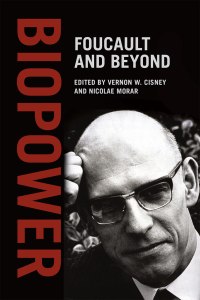
Biopower: Foucault and Beyond – edited by Cisney and Morar

A new collection now out – Biopower: Foucault and Beyond – edited by Vernon W. Cisney and Nicolae Morar. Contains essays by Revel, Negri, Patton, Mills, Hacking, Mendieta, Stoler, Rabinow, Rose, Esposito…

9780226226620Michel Foucault’s notion of “biopower” has been a highly fertile concept in recent theory, influencing thinkers worldwide across a variety of disciplines and concerns. In The History of Sexuality: An Introduction, Foucault famously employed the term to describe “a power bent on generating forces, making them grow, and ordering them, rather than one dedicated to impeding them, making them submit, or destroying them.” With this volume, Vernon W. Cisney and Nicolae Morar bring together leading contemporary scholars to explore the many theoretical possibilities that the concept of biopower has enabled while at the same time pinpointing their most important shared resonances.
Situating biopower as a radical alternative to traditional conceptions of power—what Foucault called “sovereign power”—the contributors examine a host of matters centered on life, the body, and the subject as a living citizen. Altogether, they pay testament to the lasting relevance of biopower in some of our most important contemporary debates on issues ranging from health care rights to immigration laws, HIV prevention discourse, genomics medicine, and many other topics.

Posted in Ann Laura Stoler, Antonio Negri, Eduardo Mendieta, Ian Hacking, Michel Foucault, Roberto Esposito, Uncategorized | 1 Comment

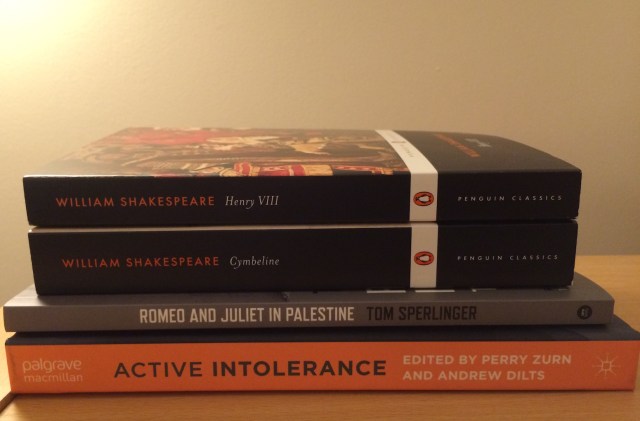
Books received – Shakespeare, Sperlinger, Zurn and Dilts

books received

A couple of volumes of the Penguin Shakespeare series, Tom Sperlinger’s Romeo and Juliet in Palestine: Teaching Under Occupation, and Perry Zurn and Andrew Dilts’s collection Active Intolerance: Michel Foucault, the Prisons Information Group, and the Future of Abolition. I provided an endorsement of Active Intolerance, which is a really interesting collection of essays.

Posted in Michel Foucault, Politics, Uncategorized, William Shakespeare | Leave a comment

Commentary by Sue Ruddick: Reading and writing in a materialist way

Sue Ruddick commentary at the Society and Space open site on reading theory and using secondary literature.

Posted in Uncategorized | 1 Comment

Review essay on Foucault’s The Punitive Society published at Historical Materialism

9782021038033My review essay on Foucault’s La société punitive (now translated as The Punitive Society) has been published at Historical Materialism.

The article requires subscription, but a preprint is here.

Posted in Foucault: The Birth of Power, Michel Foucault, Uncategorized | 2 Comments

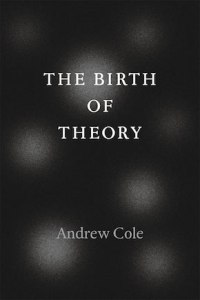
Hegel and The Birth of Theory discussed at PMLA

From the University of Chicago Press blog:

9780226135427

The recently published May 2015 issue of PMLA included a special feature in its “Theories and Methodologies” section devoted to a number of wide-ranging commentaries by contemporary scholars on Andrew Cole’s The Birth of TheoryCole’s book—readily endorsed by Frederic Jameson and Mladen Dolar, among others—situates Hegel’s dialectic as the ur-theory and method of social analysis from which most of the major thinkers of the nineteenth and twentieth centuries would further constitute “theory” as distinct from systematic philosophy. In collaboration with PMLA, we’re pleased to excerpt the opening of Cole’s own piece for the journal, “The Function of Theory at the Present Time,” which follows below. You can read more about the issue in full here, or visit Cole’s page at Princeton University, here.

Posted in Uncategorized | Leave a comment

Giorgio Agamben, The Use of Bodies – available to pre-order

Giorgio Agamben, The Use of Bodies – available to pre-order.pid_24895

Giorgio Agamben’s Homo Sacer was one of the seminal works of political philosophy in recent decades. It was also the beginning of a series of interconnected investigations of staggering ambition and scope, investigating the deepest foundations of Western politics and thought.

The Use of Bodies represents the ninth and final volume in this twenty-year undertaking, breaking considerable new ground while clarifying the stakes and implications of the project as a whole. It comprises three major sections. The first uses Aristotle’s discussion of slavery as a starting point for radically rethinking notions of selfhood; the second calls for a complete reworking of Western ontology; and the third explores the enigmatic concept of “form-of-life,” which is in many ways the motivating force behind the entire Homo Sacer project. Interwoven between these major sections are shorter reflections on individual thinkers (Debord, Foucault, and Heidegger), while the epilogue pushes toward a new approach to political life that breaks with the destructive deadlocks of Western thought. The Use of Bodies represents a true masterwork by one of our greatest living philosophers.


Posted in Giorgio Agamben, Uncategorized | 1 Comment