
 I’ve previously linked to the two reviews in the Global Discourse book award symposium on The Birth of Territory, by Jordan Branch and Jeppe Strandsbjerg.
My response is now online. It requires subscription, but a preprint is here.
I’ve previously linked to the two reviews in the Global Discourse book award symposium on The Birth of Territory, by Jordan Branch and Jeppe Strandsbjerg.
My response is now online. It requires subscription, but a preprint is here.
 The bulk of the recent work has been on Chapter Three. This is mainly a discussion of The Punitive Society, along with related materials. The chapter is based on a long review essay I wrote on the French original for Historical Materialism back in early 2014. It is finally due to be published in the next issue of the journal, though a pre-print is here. In the last update I mentioned that I’d gone through my draft material on this course and checked all my initial translations to Graham Burchell’s official ones, and inserted the double page references. I then did some reorganization work to make it fit a book, rather than a standalone publication. I then read the whole text again, this time in English, reread parts of the French, and added some additional discussion and references and tightened the overall argument. I added some discussion of the ‘Truth and Juridical Forms’ lectures four and five throughout and mainly at the end. In theory this should have been one of the easiest chapters to draft; but there were still some structural issues that took a while to work out.
I also did a bit more work on some of the shorter texts from the early 1970s, including early pieces from Libération, and some other work on newspapers, including some from La cause du people unearthed by Felix de Montety. Foucault briefly discusses the contemporary situation concerning abortion rights in The Punitive Society, so I rewrote the beginning of Chapter Six – on activist and research work on health – using that as the opening example. It then goes into a detailed discussion of his work with the Group d’Information Santé. Also for that chapter I worked through the collection Politiques de l’habitat (1800-1850) one more time and said a bit about it. That collection is also discussed in Foucault’s Last Decade, but there is a detailed discussion of Foucault’s early-mid 1970s collaborative works in this manuscript, and I wanted to say a bit about it here. I think I’ve found a way to complement, rather than repeat, what is in the other book. Politiques de l’habitat is not an easy text to find, but it’s well worth a look.
In early November I gave talks on Foucault’s reading of the Nu-Pieds at the Historical Materialism conference (part of Chapter Two), and on his collaborative work at the LSE (drawing on Chapter Six). Both were useful in terms of sharpening the argument and thinking about the questions. The audio recordings can be found here.
I’ll be speaking about Foucault’s involvement with the Group d’Information Santé (from Chapter Six) in December, to a small closed seminar organized by Colin Gordon, and this may well be the last talk on Foucault before I submit this manuscript.
The proofs for Foucault’s Last Decade have also been corrected and the index should be compiled this week. As Foucault’s Last Decade gets closer to publication, and the writing of Foucault: The Birth of Power continues, I’ve reorganized the web pages on this site relating to the two books. A main page, with the description of the two books, is here. Audio and video recordings relating to them are here; and the updates I’ve been posting on the process of writing here.
Some translations, bibliographies, scans and links continue to be available at Foucault Resources. Developing from that work, earlier this year I compiled a piece on ‘The Uncollected Foucault’ for Foucault Studies – this a bibliography of the short pieces by Foucault that are not in Dits et écrits. Several such pieces can be found here. I’ve just done the proofs for the Foucault Studies piece and it should be out shortly.
Tomorrow I go back to Paris for five days at the Bibliothèque Nationale as I continue to work through Foucault’s reading notes, and I have a trip booked to IMEC in early December for some more archival work, mainly on the GIP. It’s obviously going to be difficult being back in Paris after Friday’s tragic events. Depending on how those visits go I will have a better sense of what work will need to be done in 2016.
A collection examining the relation between Marx and Foucault.
 Christian LAVAL, Luca PALTRINIERI, Ferhat TAYLAN, Marx & Foucault: Lectures, usages, confrontations, Éditions La Découverte, 2015
Marx et Foucault : deux œuvres, deux pensées sans lesquelles on ne peut saisir le sens de notre présent. Pas de théorie critique qui puisse se passer de leurs concepts et de leurs analyses. Et pas de luttes qui ne renvoient à tel moment ou à tel aspect de leur héritage. Pourtant, de l’un à l’autre le passage ne va pas de soi. Les époques, les intentions, les philosophies même ne sont pas superposables. Hétérogènes donc, ces pensées font, l’une et l’autre, obstacle à tout « foucaldo-marxisme ».
L’ouvrage vise à montrer des rapports mobiles et complexes, non des identités profondes ou des incompatibilités d’essence. Rapports de Foucault à Marx : il prend appui sur lui pour le déborder, l’envelopper, et parfois l’opposer à lui-même. Rapports de Foucault aux marxismes, sous leurs variantes…
View original post 76 more words
I’ve not yet found words to say anything about events in Paris, Beirut, Dhaka, the Sinai or other recent events. Derek Gregory has an interesting and thoughtful post on some of these issues here.
 Foucault’s text ‘The rights and duties of international citizenship‘ is translated at Open Democracy.
Also at Open Democracy, see also a new translation of a 1979 text which first appeared on this site: “The refugee problem is a presage of the great migrations of the twenty first century” (earlier translation by Felix de Montety here)
And these commentaries:
Colin Gordon – The drowned and the saved: Foucault’s texts on migration and solidarity
Engin Isin – Michel Foucault as an activist intellectual
Jen Bagelman – Foucault and the ‘current’ refugee crisis
 As Foucault’s Last Decade gets closer to publication, and the writing of Foucault: The Birth of Power continues, I’ve reorganised the web pages on this site relating to the two books.
A main page, with the description of the two books, is here. Audio and video recordings relating to them are here; and the updates I’ve been posting on the process of writing here.
Some translations, scans and links continue to be available at Foucault Resources.
Peter Sloterdijk’s Der Ästhetische Imperativ – Schriften zur Kunst reviewed at the TCS website.
At Theory Culture and Society (open access). Here is part of what is in that volume:
In order to talk about the future of art after the ‘end of art’, i.e. towards it and from within it, Sloterdijk deems it necessary to firstly talk about the future of the future. It is a question of the ‘world system’ of credit, based on virtualised spaces.,where every ‘reasonable’ person acts ‘as if’ s/he obeyed the “categorical imperative of a Kantian enlightened by a stock market report: act in a way that the maxim of your borrowing could at any time serve as principle of a universal law of the apocalypse” (457). In this highly individualised system, imaginary temporal commonalities have broken into pieces and the only common denominator might be that we are living in a historico-philosophically defined ‘risk society’ (460). However, every synchronisation also creates a-synchronisation – as such, this ‘global’…
View original post 29 more words
Audio recordings of two recent talks on Foucault, both of which draw on material from the manuscript of Foucault: The Birth of Power, with a little from Foucault’s Last Decade in the second talk.
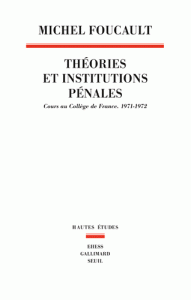 Foucault, Porshnev and the Revolt of the Nu-Pieds, Historical Materialism conference, 7 November 2015 (introduction by Alberto Toscano)
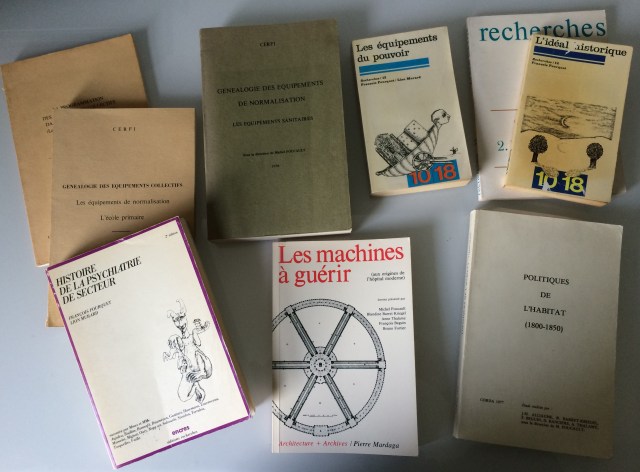
Foucault’s Collaborative Projects: Hospitals, Habitat, Public Infrastructure, Cities, Space and Development seminar, Department of Geography and Environment, London School of Economics, 10 November 2015 (introduction by Murray Low)
The first talk concentrates on the first half of the Théories et institutions pénales course from 1971-72.
For the second talk, this bibliography of the collaborative projects might be helpful especially as the audio doesn’t have the pictures I showed while talking. The ‘cowboy hat’ photograph I talk about right at the end can be found here.
Thanks to dmfant for sharing this news – Tom Sperlinger’s book Romeo and Juliet in Palestine: Teaching Under Occupation. It’s about the experience of teaching at Al-Quds University – which I visited in 2013 (see here) – especially on Shakespeare. There is a discussion of the book here. Definitely on the to-read list…

Is ‘Romeo and Juliet’ really a love story, or is it a play about young people living in dangerous circumstances? How might life under occupation produce a new reading of ‘Julius Caesar’? What choices must a group of Palestinian students make, when putting on a play which has Jewish protagonists? And why might a young Palestinian student refuse to read?
For five months at the start of 2013, Tom Sperlinger taught English literature at the Abu Dis campus of Al-Quds University in the Occupied West Bank. In this account of the semester, Sperlinger explores his students’ encounters with works from ‘Hamlet’ and ‘The Yellow Wallpaper’ to Kafka and Malcolm X. By placing stories from the classroom alongside anecdotes about life in the West Bank, Sperlinger shows how his own ideas about literature and teaching changed during his time in Palestine, and asks what such encounters might reveal about the nature of pedagogy and the role of a university under occupation.
“What would Shakespeare do about Europe’s migrants?” in The Economist.
FOR months Sir Ian McKellen has been treating various audiences (including Marc Maron, a comedian and podcast host, and the Savannah Film Festival) to a monologue from a minor Elizabethan play entitled “Sir Thomas More”. It was written in the 1590s by two moderately successful playwrights and later revised by several others. It is notable mainly because one of the revisers (the one scholars refer to as “Hand D” in the original manuscript, in the British Library) is believed to have been William Shakespeare. Presuming the attribution is correct, the folio is the only surviving example of text in Shakespeare’s own handwriting. Sir Ian has been reciting it not just because of who wrote it, but because of what he wrote. Hand D’s contribution to “Sir Thomas More” consists of a powerful scene in which More rebukes a xenophobic London crowd for trying to drive out a group of refugees—a strangely apt 16th-century touchstone for Europe’s current migrant crisis. [continues here]
Thanks to various friends for alerting me to this. While exile and banishment are major themes in several Shakespeare plays, they tend to about the treatment of individuals, usually elite ones – for example in Richard II when the feuding noblemen Bolingbroke and Mowbray are exiled by the king: ‘we banish you our territories’. I’ve not focused on groups in that position. One to think about further, perhaps….


