Where to start with reading Henri Lefebvre? – updates to the reading guide: Metaphilosophy, Marxist Thought and the City, and two edited collections

9781784782757I’ve made some minor updates to the reading guide ‘Where to start with reading Henri Lefebvre?‘ The updates are a link to the Verso page for the forthcoming translation of Metaphilosophy and links to two recent collections Understanding the City: Henri Lefebvre and Urban Studies and Urban Revolution Now.

In further news, Marxist Thought and the City will appear in late 2016 with University of Minnesota Press. Robert Bonnano is the translator, and I’ll be writing a brief foreword.

Posted in Henri Lefebvre | 1 Comment

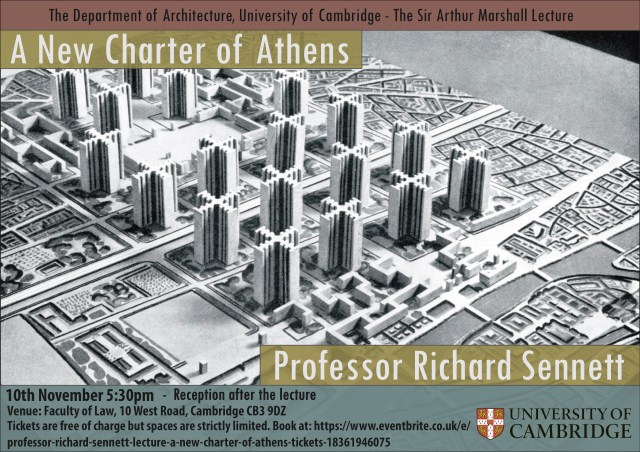
Richard Sennett, ‘A New Charter of Athens’, lecture at Cambridge University, 10 November 2015

Richard_Sennett_final

A NEW CHARTER OF ATHENS, by RICHARD SENNETT, 10 NOVEMBER, 5:30 PM

Sir Arthur Marshall Lecture, hosted by the Department of Architecture at the University of Cambridge where Professor Sennett is Sir Arthur Marshall Visiting Professor in Urban Design. The lecture will be held at the Faculty of Law, West Road, Cambridge. There will be a reception afterwards.

The title of the lecture is ‘A New Charter of Athens’ and Richard has written the following about it:

‘Next year sees the opening of Habitat III, the environmental congress held every twenty years by the United Nations.  For this event, a manifesto is being prepared about the design of cities.  It aims to replace the guidance given by Le Corbusier and others nearly a century ago, in document they called “The Charter of Athens.”  The new Charter of Athens addresses issues emerging in the 21rst Century about environmental crises, the uses of technology and big data, and the challenge of social inclusion.  The lecture serves as an introduction to this modest proposal.’

This promises to be a significant milestone in contemporary urban thinking. There is no charge for tickets, but places must be booked in advance.

Unfortunately for me this clashes with a seminar I am giving at the LSE on Foucault’s collaborative projects.

Posted in Uncategorized | 2 Comments

The geopolitics of international humanitarian law and the kunduz hospital bombing

Alex Jeffrey on the recent Afghan hospital bombing and international humanitarian law.

alexjeffrey38's avatarplacinglaw

Reports are suggesting that on 3rd October a US AC130 gunship fired on an Afghan hospital in the city of Kunduz, killing 12 staff members and 10 patients and wounding many more (while the precise figures are unclear at the moment estimates suggest around 37 people). While NATO, the Afghan Government and the US military have all stated they will launch inquires, the international humanitarian NGO Medecins Sans Frontieres (MSF) that ran the hospital is calling for an independent investigation, claiming the attack is a violation of international humanitarian law (IHL). This desire for independence is perhaps understandable, considering that since the hospital bombing the US military have released four different accounts of the circumstances surrounding the attack, while there is also a long history of the use of inquiries/investigations to delay public scrutiny of military or political decisions (see criticisms of the UK’s Iraq War Inquiry). But the desire for…

View original post 593 more words

Posted in Uncategorized | Leave a comment

Today, 1pm, Architectural Association, London – “Territory – Political Technology, Volume, Terrain”

Today at 1pm I’ll be giving a lecture to the Landscape Urbanism Programme at the Architectural Association, London: “Territory – Political Technology, Volume, Terrain”,  (abstract and details). I understand that the talk will be recorded and made available online. The lecture will range from my work on territory in Terror and Territory and The Birth of Territory, through to the work on volume and terrain I’ve been developing in the last few years. It will be quite visual, with some of my photos from the US-Mexico, Israel-Lebanon, and Swaziland-South Africa borders, as well as several images from the West Bank, Jordan valley and some from the Golan, like the one below. There is also an image of Mont Ventoux, since my interest in terrain is not just geo-strategic, and I may try to find room for a little Shakespeare. It’s the last talk on my previous territory work I’m scheduled to deliver  – future talks, at least for a while, are on Foucault and Shakespeare.

1440505182

Posted in Michel Foucault, Territory, Terror and Territory, The Birth of Territory, William Shakespeare | 2 Comments

The Topographical Imagination of Jameson, Baudrillard, and Foucault (2015)

News of an recently published book on Foucault, Jameson and Baudrillard.

Clare O'Farrell's avatarFoucault News

RizzaMichael James Rizza The Topographical Imagination of Jameson, Baudrillard, and Foucault, Noesis/The Davies Group, 2015

Notice on author’s blog
An interview with the author, Michael James Rizza, in Hyperrhiz 12

This in-depth discussion of several canonical theorists — Fredric Jameson, Jean Baudrillard, and Michel Foucault — traces the trajectory of their ideas from one text to the next. It focuses on how these theorists attempt to avoid the problem of representation, as well as humanist subjectivity, even as they imagine the external situations that shape individual identity. Although the author offers in-depth overviews, he does not simply rehearse the theories, such as many introductions to theory do. Instead, he excavates the topographical imagination that results from seeking to constitute the subject from without, from its external situation. He draws forth the organizing figure of each theorist’s spatial thinking—Jameson’s Marxist dialectical levels, Baudrillard’s double spiral of the symbolic and the…

View original post 236 more words

Posted in Uncategorized | Leave a comment

New issue of ACME now out, including Neil Smith’s last conference presentation

A new issue of ACME is now out, including Neil Smith’s last conference presentation (all open access). Neil Smith’s piece is entitled ‘The Future is Radically Open’, and was presented in Paris in September 2012, shortly before he died. It’s a wide-ranging piece on contemporary universities, neoliberalism, global possibilities and some remarks on Henri Lefebvre. It’s introduced twice, once by Don Mitchell and once by the Paris conference organisers.

Posted in Conferences, Neil Smith, Publishing | Leave a comment

Deleuze and Foucault’s Political Philosophy Conference

Interesting-sounding conference coming up in Indiana in a few weeks.

Keith Harris's avatarMy Desiring-Machines

At Purdue, November 13-14, 2015. The program is here. I’m not sure how I missed earlier announcements about this, but I’m going to do everything I can to get there.

View original post

Posted in Uncategorized | Leave a comment

2015 Millennium Conference, LSE, 17-18 October 2015 – Bruno Latour as keynote

2015 Millennium Conference, “Failure and Denial in World Politics”, LSE, 17-18 October 2015 – more details here.

Programme:  DRAFT 2015 Millennium Conference Programme

Call for Papers:   2015 Millennium Conference: Failure and Denial in World Politics

Conference Theme:   International relations are enmeshed in political failure and denial: from the governing of global climate change, financial collapse, and nuclear proliferation, to liberal statebuilding, development, and the potential for pandemics. Failure and denial reside in the background of world politics. In spite of their ubiquity and global relevance, however, it is paradoxical that these concepts remain under-theorised and under-conceptualised in International Relations scholarship. The 2015 Millennium Conference thus aspires to open new and critical grounds for debate and discussion by examining this paradox. It is a call for IR to theorise what has remained in the background of its thought and theory until now: failure and denial in world politics.

What constitutes failure and denial in world politics? What does the fear and effect of failure do to subjects, states, and international organisations? How does a state of denial affect and govern thought, conduct, politics, and subjectivity? In so far as failure and denial are socio-political categories, who can define a political outcome as a failure; how is the distinction between success and failure governed; how are failure and denial utilised as strategic tools; and how does the exposure of them feed back into political processes? What relations of power produce failures and maintain atmospheres of denial concerning gender, the postcolonial, the environmental, and insecurities of the international? How does the political recognition or denial of failure relate to temporality, memory, critique, and political action?

After a record number of abstract and paper submissions, the 2015 conference promises to offer stimulating theoretical explorations and discussions of this unexplored problematique within IR.  We hope you will join us at the LSE, 17-18 October, 2015!

Posted in Bruno Latour, Conferences | 1 Comment

Slavoj Žižek mini course at Birkbeck – Hegelian Battles

Slavoj Žižek mini course at Birkbeck – Hegelian Battles. December 2-4, 2015. Free for students and Birkbeck staff, £10 per lecture for others. Everyone needs to register in advance.

The battle for Hegel goes on – new interpretations are emerging which perhaps pose an even greater threat to Hegel’s legacy than the usual rejections of Hegel. This series of lectures will provide a cognitive mapping of this twisted terrain, with the aim to redeem Hegel for the radical thought.

  1. Against recognition: a critique of the liberal reading of Hegel (Pippin, Brandom) – 2nd December
  2. What is reconciliation? Hegel against Schiller – 3rd December
  3. Hegel in Athens: what would Hegel have said about our predicament? – 4th December

Literature
G.W.F. Hegel, PHENOMENOLOGY OF SPIRIT, Preface and Introduction (available online)
Slavoj Žižek, ABSOLUTE RECOIL, Verso Books 2014, Chapters 1.1 and 1.3

Posted in Georg Wilhelm Friedrich Hegel, Slavoj Zizek | 1 Comment

The challenge of saying ‘no’ to academic requests

Last year Rob Kitchin had a short post on his blog ‘The View from the Blue House’:

Over the past couple of years I’ve been getting more and more invites to do work that extends beyond my usual day to day work.  This last week has bought it home to me that I really need to try and put a strategy in place to manage how I deal with these requests.  Excluding spam, I was asked to: edit a handbook; write an op ed; review two papers, one grant application, and a set of document for a municipality; present five invited talks; attend six other events; and give six media interviews.  That’s over twenty additional jobs, which collectively would take up more than a working week in time, only one of which provides any recompense.  My inclination is to try and be helpful and do as many as I can, but for the sake of sanity I need to start saying no a lot more.  And since I said yes to 14 of these requests, though not the one that pays, I need to say no a lot, lot more.  I guess I just need to say it, but any strategies for handling this kind of avalanche of requests will be gratefully received.

Well Rob certainly gets more such requests than I do – see his discussion of talks here, for instance – but I can certainly relate to this. When I was recently away, I came back to a lot of requests and I needed to say ‘no’ to most of them. Now I’m on sabbatical and trying to focus on writing, I’m being as focused as I can be (see my self-imposed rules, here). It is a never-ending task to consider all such requests, to work out which I can do and which I can’t, and then to say ‘no’ to some in as nice a way as possible. For me at least, a non-reply is not an option.

As an editor I know how hard it is to get referees; as an author I want my work refereed; and I enjoy speaking and writing. When people are putting together a conference panel or seminar series they are not picking random names from which any will do, they are frequently considering different audiences, balance of speakers, etc. One person saying ‘no’ can upset a whole programme. Somebody has to review work, otherwise the system breaks down. So I want to say ‘yes’, but I realise I need to say ‘no’. I simply cannot do everything I’m asked.

In the past, if I complained about how busy I am, people seemed to think this means that I must be bad at saying ‘no’. But I’m not sure that this is actually true. I say ‘no’ a lot more now than I ever used to do, I just am asked to do a lot more, and so the question is of balancing how many times to say ‘no’ with saying ‘yes’. This features in a lot of registers, but four would be referee requests; requests to comment on other work; requests to write; requests to speak.

Referee requests: I keep lists of referee reports done on a yearly basis – articles, grants, tenure or promotion cases, books or proposals. I keep a tally of things I declined. The count is always higher for the ones I’ve done – I seem to do roughly two of every three I’m asked. Since 2008 it’s been between 30-50 review tasks completed a year. These are on top of the Society and Space editorial work I did from 2006-15, and I don’t count journals of which I am a board member.

Requests to read other stuff: I read work by colleagues, friends, ex-PhD students etc. – these are people I’ve chosen to act as an informal reader for. This means my capacity to read and comment on other stuff is severely curtailed. If I read everything else that was sent to me for comments then I would never get anything else done. So, if you’re a student somewhere else, who maybe vaguely knows my name (less often my work) then this doesn’t mean you have a right to expect comments on your essay, dissertation etc. I now frequently get ‘Dear Professor’ messages that have clearly been sent indiscriminately to many other people. Nor do I have time to offer comments on papers by third parties so that people can then use these comments as their own critique. Unlike many other people, I do actually reply to emails to say ‘no’, rather than not reply and leave the sender to work out the ‘no’ from lack of response. But if I reply, politely declining to comment, don’t come back to me to try to persuade me… By the way, there are two very good discussions of how to write emails that get read and answered, and what not to do, here and here (the first led to me to the second).

Requests to write: These come increasingly regularly. And it’s extremely flattering, but often the kinds of things that I’m asked to write are ones I would not be writing for other reasons, would force me to go back to a research topic I’ve long left behind or where I have exhausted what I have to say on the topic. I’ve been trying to decrease the number of book chapters I write in recent years – it can be a lot of work for something that frequently ends up buried in an expensive hardback, and rarely seen. But there are always exceptions. Sometimes invitations force me to engage with something I know I need to, sometimes they fit conveniently with what I’m doing, sometimes they spark an idea I’d never have had otherwise. And since it is impossible to predict, I value each and every invitation, and try to weigh them up against each other, and other demands.

Requests to speak: I really like to accept these, but it increasingly the decision has to be based on whether it moves forward a project I am currently working on or would like to work on. Speaking about old projects is inherently less appealing – I want feedback on things that are useful to me, hopefully delivered in a way that is interesting to others, rather than talk about something that is already out or forthcoming. I can think of only a handful of the talks I’ve given where I’ve not gained something from the discussion, either the formal bit or later. (Those are often ones where the paper is a repeat of one given too many times, where the genuinely original, challenging questions are harder to get given previous audiences. This doesn’t mean the paper is immune to criticism, of course, just that I’ve probably already heard those criticisms.) Talks are often an opportunity to visit interesting places, meet interesting people, try out ideas, give a definite date to produce something by, etc. They often lead to publishing opportunities, research collaborations, etc. But logistical issues also come up – am I able to be there? Can I reduce the number of trips I take? Do I have the time before the event to prepare something worthwhile? Will I be able to see something of the place I’m visiting, rather than airport-hotel-conference venue/university-hotel-airport?

I know other academics have different strategies for deciding/responding: “What’s the honorarium?” “I only travel business class” – both will lead to several requests disappearing. Or they don’t reply. Or, the bane of editors’ lives, they agree to deliver a report or chapter or something, and then don’t. While some people say, or imply, ‘no’ as a default, others find it hard, even exhausting to do so, but know the alternative is worse. Perhaps we should keep more of a record, that is the list of all the things we could have done, but said ‘no’ to, for various reasons. Maybe this would be our ‘inverse cv’.

Posted in Books, Conferences, Universities | 21 Comments