Books received – Foucault, Brown, Golder, Ashgate, etc.

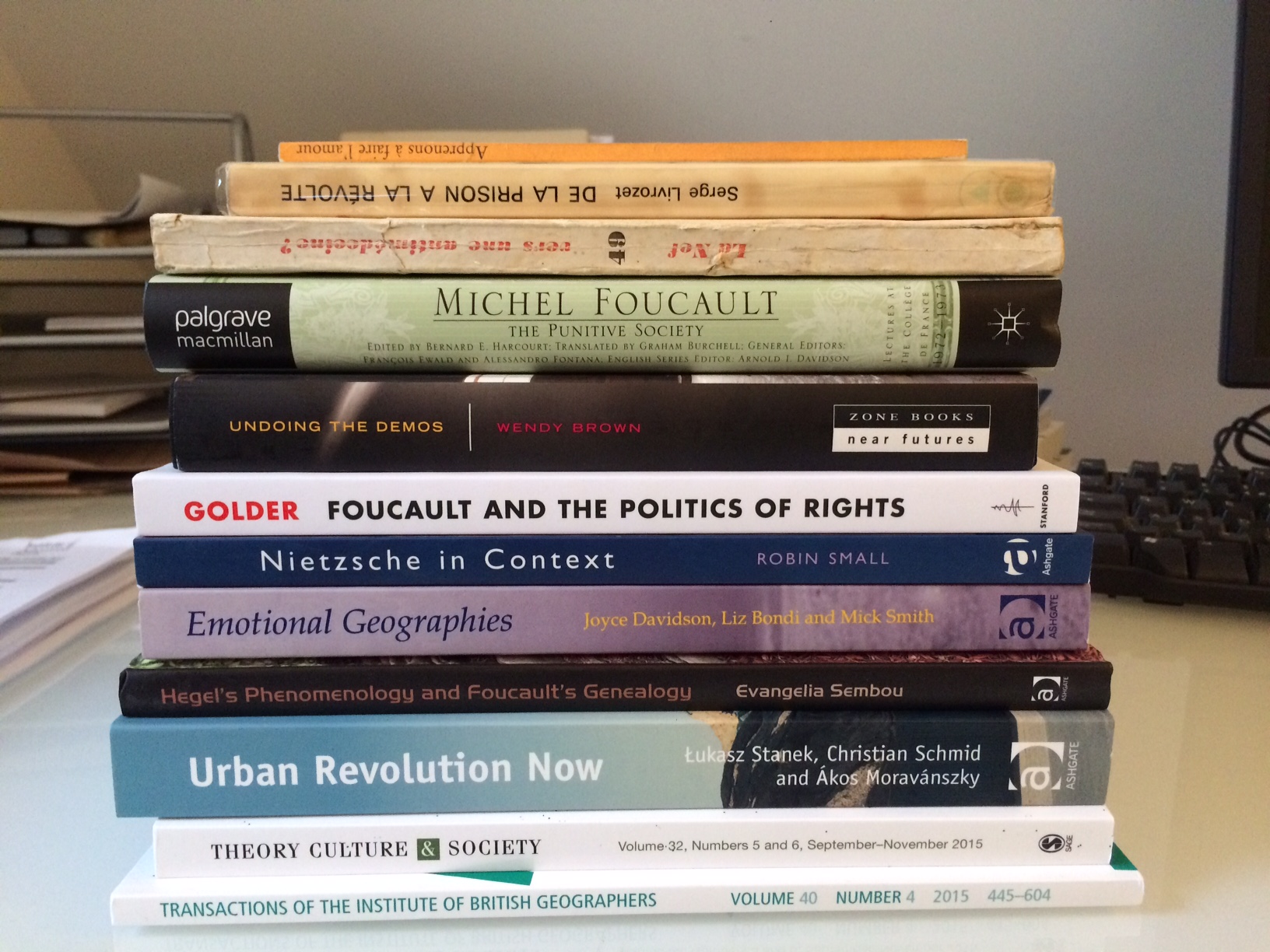
A pile of recently bought, earned or complimentary books: Foucault’s The Punitive Society, Wendy Brown’s Undoing the Demos, Ben Golder’s Foucault and the Politics of Rights, four books in recompense for review work for Ashgate, and recent issues of Theory, Culture & Society and Transactions of the IBG.

The three books at the top are resources for the Foucault work – a copy of the 1973 re-edition of a sexual education manual Apprenons faire l’amour, an issue of La nef, and Serge Livrozet’s De la prison à la révolte. Foucault wrote the preface for the last, co-authored a piece in the second with the Groupe Information Santé, and wrote a short piece defending a doctor, Jean Carpentier, who had been prosecuted for distributing the original version of the first. The first and third of these texts are reprinted in Dits et écrits (texts 116 and 110), but the second was not (see here). I will say a bit about the these texts in chapters five and six of Foucault: The Birth of Power.

Books received

Posted in Friedrich Nietzsche, Henri Lefebvre, Michel Foucault, Wendy Brown | 1 Comment

History and Theory special forum on Foucault and Neoliberalism

History and Theory have a special forum on Foucault and Neoliberalism (requires subscription). Thanks to Timothy Johnson and others for the alert.

Posted in Michel Foucault | 1 Comment

The Question of the Human in Social Theory and Social Research – 25th November 2015, University of Warwick

Posted on behalf of Mark Carrigan:

25th November 2015, 11:00 to 17:00
WT0.05, University of Warwick

This workshop and symposium will explore the, mostly implicit, conceptions of the human, humanity and human nature that underpin various contemporary conceptions of social life. In the context of much-publicised post-human futures, this is an invitation to reconsider the idea that social life itself is predicated on the fact that human beings are capable of such collective existence. Humans are beings who have a continuity of consciousness so that they see themselves as themselves throughout their life; human are beings who negotiate a multiplicity of sometimes contradictory identities and recognise each other as members of the same species, and they are also beings who can create and interpret cultural artefacts. Crucially, humans are beings who can deploy a sense of self-transcendence so that they are able to look at the world from somebody else’s point of view and thus conceive new social institutions.

The main focus throughout the day will be on how questions about the human are encountered in social theory and social research and what are the various implications and challenges of taking these seriously in our work. The day of activities will be divided into two parts. During the morning, we will have a participatory workshop for PhD students and early-career researchers. The goal of the workshop is to help participants negotiate the sometimes abstruse scientific, philosophical, moral, and even theological underpinnings of asking questions about ‘the human’ in the context of their own research projects. Dr Daniel Chernilo (Loughborough University) will offer a general overview of this field of enquiry as well as reflect on its various implications. We will also invite participants to reflect on their own research projects by making a brief (10-minute) presentation of their research projects and how questions about the human have been or are expected to be encountered within them. We’d like to ask all participants to reflect in advance on conceptions of the human and how they pertain to their projects. Uncertainty here is not a problem, in fact it will be a useful contribution to discussions on the day! In the afternoon, we will have a symposium in which Dr Mark Carrigan, Professor Margaret Archer and Daniel Chernilo will engage with questions of the human as they unfold in their own work on digital sociology (Carrigan), the morphogenetic society (Archer), and philosophical sociology (Chernilo).

To register your interest, please contact D.Chernilo@lboro.ac.uk and Mark@Markcarrigan.net with a brief description (500 words or less) of your research and how questions of the human are relevant to it by October 31st, 2015. The event is free but places are limited. Travel bursaries are available for those in need of it, please ask for more details.

Posted in Conferences | 1 Comment

Cahiers marxistes-léninistes

This looks a useful resource.

Keith Harris's avatarMy Desiring-Machines

Selections from the journal (published by Althusser’s students) are available here. (Thanks to Rethinking Marxism‘s Facebook feed for the link)

View original post

Posted in Uncategorized | Leave a comment

Top posts on Progressive Geographies this week

The busiest week on the blog for a while, mainly due to the first two of these posts:

  1. Michel Foucault on refugees – a previously untranslated interview from 1979
  2. Eleven thoughts on reading and citing
  3. 12 Critical Theory books that came out in September
  4. Foucault the mayonnaise maker and card cheat…
  5. CFP: Fiction and the Social Imaginary – 14 March 2016, University of York
  6. Roberto Esposito. ‘Biological Life, Political Life’, Goldsmiths, University of London, 1 Oct 2015 5pm
  7. Henri Lefebvre, Metaphilosophy, forthcoming in February 2016 – Verso page and available to pre-order
  8. Arlette Farge and Michel Foucault, The Disorder of Families – to appear in fall 2016 with University of Minnesota Press
  9. History of the Present – the Berkeley newsletter on Foucault’s work online
  10. Foucault Resources
Posted in Uncategorized | Leave a comment

Foucault: The Birth of Power Update 4 – collaborative work and a complete draft of Chapter One on the Lectures on the Will to Know and related materials

FBP update 4

Since the last update, I’ve been working on various aspects of this project.

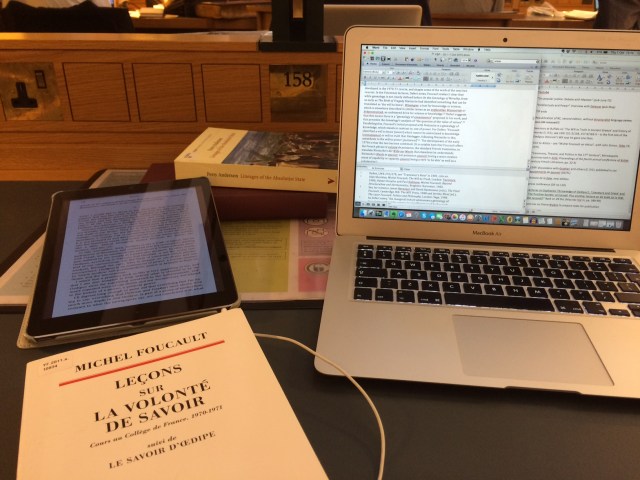
The first was a return to some of Foucault’s collaborative projects around CERFI. Quite late in the drafting of Foucault’s Last Decade I removed most of the discussion of Les équipments du pouvoir, and that is now incorporated into this manuscript. I also reread the Généalogie des équipements de normalisation: Les équipements sanitaires report Foucault edited, and wrote something about that, along with a discussion of the two editions of the Les machines à guérir (aux origines de l’hôpital moderne) volume that developed from it. While these are discussed more fully in Foucault’s Last Decade, I think I’ve found a way to incorporate a discussion in this book that doesn’t simply repeat what I say there. At some point I plan to go back through Politiques de l’habitat (1800-1850) and do something similar. I’ll be talking about this work at the LSE in November, and if you don’t know what these texts are there is a bibliography of all the collaborative projects Foucault led or participated in here. I also added a discussion of the work around the Pierre Rivière case into this part. Then, following more directly the work on activism I talked about last time, I did a bit more work on the Groupe Information Santé, mainly in the British Library following up some of the more obscure sources of information about their work, including newspaper reports, but I also bought a copy of their 1974 report La médecine désordonnée (there don’t appear to be any UK libraries that have it). As well as some valuable statements on the group’s goals it includes a lot of documentary sources. I say a bit more about it here.

I also did some reading of accounts looking at the historical period Foucault was working within, beginning with Keith Reader’s The May 1968 Events in France and his Intellectuals and the Left in France since 1968; and then Julian Bourg’s From Revolution to Ethics: May 1968 and Contemporary French Thought, and Kristin Ross’s May ’68 and its Afterlives. They are quite different: Bourg makes a lot of use of interviews, and so is invaluable for information otherwise unavailable; Ross makes a point of relying only on written sources, but does reference some things in relation to my concerns that I hadn’t come across elsewhere. I also plan to work through Philippe Artières and Michelle Zancarini-Fournel’s collection 1968, une histoire collective (1962-1981), and perhaps some other works on this, though I’m not especially interested in ‘68 itself, more the politics of the period immediately after it.

The next stage was to return to Chapter One, and work on Lectures on the Will to Know again. I’d given a lecture on this at a conference at the University of East London back in 2011, and then again as the George M. Story Lecture in Humanities at Memorial University of Newfoundland in 2013, so some bits were reasonably well-written, or so I thought. Others I knew needed extensive new writing. In particular I completely reworked the section on Nietzsche, and made a little use of Foucault’s notes on this topic at the BNF. Most of the material on Nietzsche is actually missing from the Lectures on the Will to Know manuscript, so the McGill lecture included in that volume is invaluable. The ‘Nietzsche, Genealogy, History’ essay dates from around this time too, though it is striking that there is relatively little overlap of content or, perhaps more accurately, there is a very different approach to some shared concerns. The likely most interesting material by Foucault on Nietzsche remains unpublished – the lecture course on him given at Vincennes – but I understand this is eventually going to see the light of day, though have no further details (and before anyone asks, it’s not currently listed in the BNF catalogue).

I then bit the bullet and worked on the section of Oedipus. I’ve been putting this off because I was struggling to work out what to do with it. It was clearly very important to Foucault, given the number of times he delivered this material. But Oedipus was not discussed in the previous talks I’d given on the course, in part because I found it of little interest, so I had nothing much to work with, aside from some detailed notes on the second of the ‘Truth and Juridical Forms’ lectures. What I’ve done now, as with Nietzsche, is to blend the different sources together in a thematic treatment, instead of treating things more strictly chronologically. I organised Foucault’s Last Decade in a largely chronological way, but this is a different book and I don’t think that is necessarily the best way to approach things here. That said I don’t want to minimize the differences between how Foucault treats things in Paris in 1970-71 and Rio in 1973 though, with the ‘Oedipal Knowledge’ manuscript a mid-way statement, so I’ve tried not to blur these too much. I’m reasonably happy with how this section runs.

After working through those two large sections, I ended up rewriting the section on the Greeks, especially on juridical and political practice. This was in some ways less tricky than the other sections, because there is just one source – the course itself. Yet that also presents challenges because the course is quite fragmented, and the presentation in Rio helped with the other sections because we hear what Foucault said, rather than just see what he wrote. But I’m much happier with the discussion now. Chapter One now exists as a much better draft, which bears only limited comparison to my previous lectures on this course. (I listened back to the Newfoundland lecture, and borrowed a few phrases that were in the oral delivery that were not in the manuscript.) But I’m certainly hoping that this major restructuring and rewriting isn’t needed for the other chapters.

The next work will be on Chapter Two, which mainly looks at the Théories et institutions pénales course. The audio recording of my talk on this course at the ‘Time Served: Discipline and Punish forty years on’ conference, which looked at the second-half and the notion of ‘inquiry’ is available here. I’ll be speaking about the Nu-pieds part of this course in London in November at the Historical Materialism conference, which gives me a good deadline to work towards. So I’ve begun looking again at some of the texts Foucault is in dialogue with, including Boris Porshnev and Roland Mousnier. Chathan Vemuri reminded me there is some use made of Porshnev and Mousnier in Perry Anderson’s Lineages of the Absolutist State, which was useful. Etienne Balibar says a little about the way Porshnev was read by the French left in the early 1970s in his comments for the Columbia seminars on the courses here. I’m hoping that the work required for this chapter will not be much more than the work involved to produce the two talks, since I’m now working with a much clearer sense of this overall project, and a better understanding of how the initial courses fit together.

Incidentally, the English translation of The Punitive Society is now published. I have a copy on pre-order from Palgrave in recompense for some review work, so will be able to compare my initial translations with Graham Burchell’s official ones – that’s for Chapter Three in time.

You can read more about this book and Foucault’s Last Decade, along with links to previous updates, here. And, as a reminder, a lot of Foucault resources are available here. It includes a list of audio files, a bibliography of collaborative projects, a list of short pieces which did not appear in Dits et écrits, comparison of variant forms of texts, a few short translations (including the recent one of a 1979 interview on refugees), and so on.

Posted in Foucault's Last Decade, Foucault: The Birth of Power, Michel Foucault, Publishing, Writing | Tagged , , | Leave a comment

Antipode Foundation Scholar-Activist Project and International Workshop Awards 2016

Antipode announce their latest round of grants.

Antipode Editorial Office's avatarAntipodeFoundation.org

We’re pleased to announce the fourth year of the Antipode Foundation’s Scholar-Activist Project and International Workshop Awards.

Scholar-Activist Project Awards are single-year grants of up to £10,000 intended to support collaborations between academics and students and non-academic activists (from non-governmental organisations, think tanks, social movements, or community/grassroots organisations, among other places), including programmes of action-orientated and participatory research and publicly-focused forms of geographical investigation. They offer opportunities for scholars to relate to civil society and make mutually beneficial connections.

International Workshop Awards are single-year grants of up to £10,000 available to groups of radical/critical geographers staging events (including conferences, workshops, seminar series and summer schools) that involve the exchange of ideas across disciplinary and sectoral boundaries and intra/international borders, and lead to the building of productive, durable relationships. They make capacity-building possible by enabling the development of a community of researchers.

Activists (of all kinds) and students as well as…

View original post 73 more words

Posted in Uncategorized | Leave a comment

Eleven thoughts on reading and citing

  1. At the beginning of reading on a topic, the most useful thing in a paper or book is often its bibliography. As you read more you’ll realise the key texts get cited again and again. You can tell you are getting on top of the literature when bibliographies only contain a few surprises.
  2. The first 5-10 minutes of your time reading a book should be spent deciding how much time you are going to spend reading this book. One of the first things to check is the bibliography.
  3. You should often read a book with questions in mind, which will help you work out how to read it, and certainly what notes to take.
  4. If you think something is worth quoting, then track down its source. ‘X cited in Y’ is lazy, and checking the original is almost always worth doing. You can always, and frequently should, reference Y alongside the reference to X.
  5. If at all possible, find the original language source of a quote that you are using, especially if you want to make a point about the words being used, rather than just the general sense. You cannot provide a ‘close reading’ of a text you are reading in translation. Checking to the original language is nearly always worthwhile. Even if you can only recognise odd words, in time you will improve. (This is the academic version of the advice that if you want to learn a language you shouldn’t read the newspaper. You should read yesterday’s paper.) You’ll also see how the translator ended up with the sentence you originally read. Translation, even at its best, is a continual compromise. The meaning that the translator privileged may not be the one you would highlight; the word you assume is there may not be.
  6. If you do cite works in translation, be sure to credit the translator. If you cite a critical edition, credit the editor. Their work is thankless enough already.
  7. Photocopying an article or downloading a pdf does not mean you have read it.
  8. If you find it hard to get hold of a reference, try inter-library loan, asking friends, repositories or the author’s website, or contact the author direct. Do not email bulk distribution lists – this wastes a lot of collective time.
  9. If you have a choice, use footnotes or endnotes, not ‘author: date’. If the journal requires ‘author: date’ style then try to use notes alongside that. It is often very difficult to make clear the purpose of a reference without explanation. If the journal or publisher insists on notes that include only ‘author: date’ and a separate list of references, refer them to the Congregation for the Doctrine of the Faith.
  10. Fill in your references as you go. It’s much more time-consuming to do it later. Quotes always need a page number. So do paraphrases. In fact, you should almost always give a page number, or at least a chapter. Does the whole book really make that single point?
  11. Citation is not endorsement. Fukuyama and Huntingdon are highly cited, but rarely positively. Bean-counters take note.
Posted in Publishing, Universities, Writing | 11 Comments

The Geographer Royal – and what it means

An interesting piece giving the background to Charles Withers’s recent appointment as Geographer Royal for Scotland.

Posted in Uncategorized | Leave a comment

Think. Check. Submit. (How to Have Trust in Your Publisher.)

A new initiative for academics submitting to journals, directed at saving people and papers from “predatory” publishers.

Posted in Uncategorized | Leave a comment