Foucault 2/13 – recording and materials for Columbia seminar on Penal Theories and Institutions (1971-1972) with Harcourt, Balibar, Ewald and Spivak

Etienne Balibar and François Ewald discuss Foucault’s second annual lectures at the Collège de France, Penal Theories and Institutions (1971-1972)…  Please also read the introductory posts presenting the lectures along with the posts by Etienne Balibar and François Ewald, and the framing essays by Velasco and Harcourt. Readings for the seminar here… Check back later this week for additional essays on these 1972 lectures. Welcome to Foucault 2/13!

The link to the ‘live stream‘ now takes you to a recording of the discussion, held yesterday at Columbia University. Thanks to Clare O’Farrell at Foucault News for the link.

There are lots of other materials on this site, including preparatory notes from some of the participants. The video of the discussion of the first lecture course, Lectures on the Will to Know, is available here.
Posted in Etienne Balibar, Michel Foucault | Tagged | 1 Comment

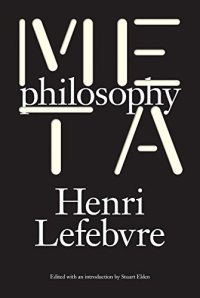
Henri Lefebvre, Metaphilosophy, forthcoming in February [now July] 2016 – Verso page and available to pre-order

Henri Lefebvre, Metaphilosophy, translated by David Fernbach and edited and introduced by Stuart Elden, is forthcoming in February July 2016. Verso’s page for the book is now live and it is available to pre-order.

41lQcLWg6sL.jpgIn Metaphilosophy, Henri Lefebvre works through the implications of Marx’s revolutionary thought for philosophy. Metaphilosophy is conceived of as a transformation of philosophy, developing it into a programme of radical worldwide change. The book demonstrates Lefebvre’s debt to Hegel, Marx and Nietzsche, but it also brings a number of other figures into the conversation including Sartre, Heidegger, and Axelos. Metaphilosophy stands as key text in Lefebvre’s wide-ranging oeuvre, the foundation for his work on everyday life, the city and the production of space. It is also a key moment in contemporary thinking about philosophy’s relation to the world.

Posted in Henri Lefebvre | 1 Comment

Books received – Lefebvre, Nail, Wikileaks, RIS, Leibniz, Groupe Information Santé

Books

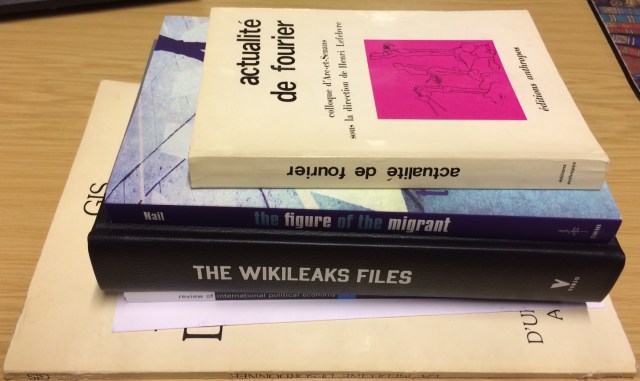
A real mix of stuff – a collection edited by Lefebvre on Fourier, Thomas Nail’s The Figure of the Migrant (which I endorsed and mentioned last week); the new issue of Review of International Studies; Verso’s new book The Wikileaks Files; an offprint of an essay on Leibniz and flooding by Lloyd Strickland and Michael Church; and a text by the Groupe Information Santé, La médecine désordonnée.

GISThe last of these is for the Foucault project. The GIS was set up on the model of the Groupe d’information sur les prisons, and Foucault was involved in early work. This volume dates from 1974, and I’m not sure that it includes anything with which Foucault was directly responsible, but it’s a valuable resource nonetheless. The group was active in projects around industrial medicine, the abortion rights struggle in France, migrant health and the power of the medical profession over patients. A table of contents can be found here. I may say more in a future update on the book.


Posted in Gottfried Leibniz, Henri Lefebvre, Michel Foucault | Tagged , , , | 1 Comment

Chamayou G 2015 “Drone Theory” reviewed by Britain Hopkins

Chamayou’s Drone Theory reviewed at the Society and Space open site.

Posted in Uncategorized | Leave a comment

2016 Symposium CfP: “Spatializing Sovereignty”

Call for papers for a conference in Berkeley in March 2016 from the Society for Radical Geography, Spatial Theory, and Everyday Life.

Society for Radical Geography, Spatial Theory, and Everyday Life's avatarSociety for Radical Geography, Spatial Theory, and Everyday Life

We are pleased to announce the theme of our 2016 symposium, “Spatializing Sovereignty,” which will be held at UC Berkeley on Friday, March 4, 2016 and feature keynote addresses by Dr. Mishuana Goeman, Associate Professor of American Indian Studies and Gender Studies at UCLA, and Gelare Khoshgozaran, writer and multi-disciplinary artist. Please find our call for papers and presentations below!

2016 Symposium CFP: “Spatializing Sovereignty”

Featuring keynote addresses by:
Dr. Mishuana Goeman, Professor of American Indian Studies and Gender Studies, UCLA
and Gelare Khoshgozaran, Writer and Multi-disciplinary Artist

UC Berkeley
March 4, 2016

While sovereignty is often defined in terms of the bounded nation-state, this symposium convenes to examine competing, overlapping, and “nested sovereignties” (Simpson 2014). How is the spatiality of sovereignty felt, practiced, embodied, inhabited, or imposed at various scales? We might consider how the thousands of missing and murdered Indigenous women in Canada and the U.S. lay bare logics of…

View original post 458 more words

Posted in Uncategorized | Leave a comment

Top posts on Progressive Geographies this week

Posted in Uncategorized | Leave a comment

‘Before the Punitive Society: The Inquiry of Théories et institutions pénales’ – audio recording of talk to Time Served: Discipline and Punish Forty Years On conference

SE in NottinghamI recently gave the opening plenary lecture to the ‘Time Served: Discipline and Punish Forty Years On‘ conference, organised by Sophie Fuggle and held at the Galleries of Justice in Nottingham.

My talk was entitled “Before the Punitive Society: The Inquiry of Théories et institutions pénales” (abstract), and the audio recording is now available here. It’s about 45 minutes long.

I spoke about how the analysis of the 1971-72 course Théories et institutions pénales related to the ‘course summary’, to the third ‘Truth and Juridical Forms’ lecture from Rio in 1973, and Foucault’s preparatory notes for these lectures, which I have been working through in Paris. This is part of the draft of Chapter Two of the second book I’ve been writing on Foucault, The Birth of Power, hopefully out in 2017. You can read more about the progress of that book, and about the book that is due out in 2016, Foucault’s Last Decade, here.

Posted in Conferences, Foucault's Last Decade, Foucault: The Birth of Power, Michel Foucault | 1 Comment

Thomas Nail, The Figure of the Migrant – now published from Stanford University Press (and sample to download)

Thomas Nail, The Figure of the Migrant – is now published from Stanford University Press. I provide one of the endorsements. Twenty pages are available to download at academia.edu

pid_23425

This book offers a much-needed new political theory of an old phenomenon. The last decade alone has marked the highest number of migrations in recorded history. Constrained by environmental, economic, and political instability, scores of people are on the move. But other sorts of changes—from global tourism to undocumented labor—have led to the fact that to some extent, we are all becoming migrants. The migrant has become the political figure of our time.

Rather than viewing migration as the exception to the rule of political fixity and citizenship, Thomas Nail reinterprets the history of political power from the perspective of the movement that defines the migrant in the first place. Applying his “kinopolitics” to several major historical conditions (territorial, political, juridical, and economic) and figures of migration (the nomad, the barbarian, the vagabond, and the proletariat), he provides fresh tools for the analysis of contemporary migration.

“In this powerful book, Thomas Nail forces us to think migration from the perspective of movement and so builds both a theoretical argument and a political intervention. A bold and provocative engagement with one of the world’s most pressing contemporary issues.”

—Stuart Elden, University of Warwick

“Hardly a day goes by without some reference in the media to the “problem” of migration. In offering a theoretical account of the figure of the migrant throughout history, Thomas Nail’s book thus performs an important service for the interdisciplinary study of one of the most important subjects of our century. Carefully argued, well informed, hugely ambitious, and analytically precise, it will become a standard reference for years to come.”

—Tim Cresswell, Northeastern University

Posted in Uncategorized | 4 Comments

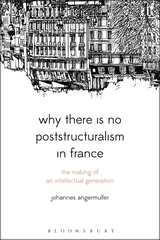
Johannes Angermuller, Why There Is No Poststructuralism in France – now out with Bloomsbury (and free download of introduction)

Johannes Angermuller, Why There Is No Poststructuralism in France – now out with Bloomsbury (and free download of introduction).

9781474226301

French thinkers such as Lacan and Derrida are often labelled as representatives of ‘poststructuralism’ in the Anglophone world. However in France, where their work originated, they use no such category; this group of theorists – ‘the poststructuralists’ – were never perceived as a coherent intellectual group or movement.

Outlining the institutional contexts, affinities, and rivalries of, among others, Althusser, Barthes, Foucault, Irigaray, and Kristeva, Angermuller – drawing from Bourdieu’s concepts of cultural capital and the cademic field – insightfully explores post-structuralism as a phenomenon. By tracing the evolution of the French intellectual field after the war, Why There is No Poststructuralism in France places French Theory both in the specific material conditions of its production and the social and historical contexts of its reception, accounting for a particularly creative moment in French intellectual life which continues to inform the theoretical imaginary of our time.

Posted in Louis Althusser, Michel Foucault, Pierre Bourdieu | Tagged | 1 Comment

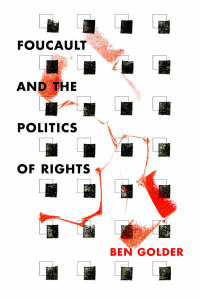
Foucault and the Politics of Rights (2015)

Ben Golder’s book on Foucault and the Politics of Rights is now out.

Clare O'Farrell's avatarFoucault News

golder2Ben Golder, Foucault and the Politics of Rights, Stanford University Press, 2015, Now available.
Publisher’s page

This book focuses on Michel Foucault’s late work on rights in order to address broader questions about the politics of rights in the contemporary era. As several commentators have observed, something quite remarkable happens in this late work. In his early career, Foucault had been a great critic of the liberal discourse of rights. Suddenly, from about 1976 onward, he makes increasing appeals to rights in his philosophical writings, political statements, interviews, and journalism. He not only defends their importance; he argues for rights new and as-yet-unrecognized. Does Foucault simply revise his former positions and endorse a liberal politics of rights? Ben Golder proposes an answer to this puzzle, which is that Foucault approaches rights in a spirit of creative and critical appropriation. He uses rights strategically for a range of political…

View original post 76 more words

Posted in Uncategorized | 1 Comment