Foucault: The Birth of Power Update 3 – Théories et institutions pénales and activist work on health and asylums

FBP update 3Since the last update, I’ve been working on two aspects of this project.

The first was on the 1971-72 course Théories et institutions pénales, for Chapter Two. There are two main parts of the course, on the Nu-Pieds revolts of the mid-seventeenth century and then the birth of the monarchical state and the medieval rebirth of the inquiry. I spoke about the second in Nottingham earlier this month (a few thoughts here); and will be speaking about the first at the Historical Materialism conference in London in November. In working on these I took a look at some of Foucault’s sources, helped by the course’s editorial notes, but also by Foucault’s own reading notes archived in Paris. In particular, for the London event I’ll be talking about Foucault’s use of Boris Porshnev’s work. I say a bit more about the key text here, and appeal for help with his texts on feudalism here.

The second was on some of Foucault’s activism in the early 1970s. Although I will of course discuss the Groupe d’information sur les prisons (GIP), I was already fairly familiar with their material, and the story there is reasonably well-known. I will return to that group at some later stage. Much less clear is the story of Foucault’s contacts with two other groups on the model of the GIP – the Groupe Information Santé (GIS) and the Groupe Information Asiles (GIA). Foucault was actively involved in the former in its early stages, but only attended a single meeting of the latter, apparently leaving without any contribution. Both groups have interesting histories. While the archives of the GIP are in IMEC, and many documents have been published in France (an English translation of a lot of the material is forthcoming), with the GIS and the GIA the traces are harder to find. In his biography of Foucault David Macey suggests that the GIS “has left few documentary traces of its existence”, but that’s not entirely true.

I plan to go back to IMEC at some point, and I think they have some material from the GIS, but a bit of hunting around online bookstores earlier this year helped me find copies of two of the key texts – the GIS’s Oui, nous avortons and the GIA’s Psychiatrie: La peur change de camp, though the latter is also available online. I have a copy of a second GIS report, La médecine desordonnée, on order. Foucault and some doctors in the GIS published a brief manifesto in 1973 – strangely not in Dits et écrits or most English bibliographies. I have a copy, but am trying to get hold of the original journal issue it was printed in so I can take a look at the surrounding texts. The archives of the GIS are deposited at the Centre des Archives du Féminisme at the University of Angers. This archive is catalogued by Lucy Halliday, “Fonds GIS (Groupe Information Santé); Fonds Sylvie Rosenberg-Reiner” – online here. I’m not sure that a special visit to Angers is needed, given Foucault’s involvement was only at the very start, and there may be enough at IMEC, but this remains a possibility.

The GIA still exists, though in quite a different form, and has a website here. An open-access archive of all the issues of its journal Tankonalasanté is available here, and I was able to pick up a copy of a selection of its texts fairly easily, published by Maspero in 1975. The journal is fascinating as an insight into the concerns of the group and a wider network, including the GIS, and the production style and possibilities of activist texts at the time. Foucault’s role in the GIS is not always clear, and I don’t want to put someone else’s words into his mouth, so I am trying to discuss the groups in themselves without over-emphasising his involvement. That’s obviously even more important in terms of the GIA. But all three groups are part of the wider context in which his publications and courses are situated, and the plan at the moment is the activist work on asylums, prisons and health is discussed in the separate chapters on those themes (chapters Four to Six) rather than together, but this might change. I’ve written about 3000 words on the GIS, and can imagine doing that or more for the GIP. I don’t think there is much to say about the GIA, so it may be that I treat that more briefly alongside the GIS.

The next task is to go back and try to complete drafts of Chapters One and Two, which I’m hoping to do over the next few weeks.

You can read more about these books, along with links to previous updates, here. And, as a reminder, a lot of resources I produced while writing Foucault’s Last Decade are available here. It includes a list of audio files, a bibliography of collaborative projects, a list of short pieces which did not appear in Dits et écrits, comparison of variant forms of texts, a few short translations, and so on.

Posted in Foucault: The Birth of Power, Michel Foucault | 2 Comments

The Birth of Territory reviewed in Politička misao by Višeslav Raos (in Croatian)

The Birth of Territory has been reviewed in Politička misao by Višeslav Raos (in Croatian). The review is open access, and is the second review in a Croatian journal (see also the one in Croatian International Relations Review by Daniel Šaric – also open access).

Many thanks to Krešimir Petković for letting me know about the new review, for saying that it is ‘unambiguously positive’, and for providing this translation of some of the conclusion:

A book like this is rare. Elden shows a genuine renaissance spirit, showcasing deep knowledge of ancient, medieval and renaissance political thought, as well as histories of language and theatre, which inevitably follow the conceptual relations between the spatial and the political…

Posted in The Birth of Territory | 1 Comment

How We Write – the open access collection reviewed and highlighted

How-We-Write-cover-E-216x346How We Write – the open access collection edited by Suzanne Conklin Akbari, which includes thirteen short pieces on academic writing – has been getting  a bit of attention already. It was chosen as a highlighted title on open access site Unglue.it and has been reviewed in French at Ludite! Jeffrey Jerome Cohen also talks about his piece here.

As I said when I announced the book’s publication, while free to download, it was not free to produce. It is also available to buy in paperback, or you can leave a donation when you download the book. This is a book that does not seek to give advice, but to show how a range of people do things in a number of different ways. Please share widely…

Posted in Publishing, Writing | 1 Comment

Talk on Foucault’s collaborative projects, 10 November at the LSE

I’ve just agreed to give a talk on Foucault’s collaborative projects in November at the LSE. This is part of the seminar series on ‘Cities, Space & Development’, so I’ll talk about the work on urban infrastructure, hospitals and public health, conducted with CERFI, CORDA and his Collège de France seminar. This leads directly into the plan for Chapter Six of Foucault: The Birth of Power.

“Foucault’s Collaborative Projects: Hospitals, Habitat, Public Infrastructure”, 4.30pm, 10 November 2015, Department of Geography & Environment, London School of Economics.

Details of all forthcoming talks – at present deliberately kept to a specific focus and limited travel – are here.

Posted in Foucault: The Birth of Power, Uncategorized | 1 Comment

Time Served: Discipline and Punish Forty Years On – a few thoughts after the Nottingham conference

SE in NottinghamOn Friday I gave the opening plenary lecture to the ‘Time Served: Discipline and Punish Forty Years On‘ conference, organised by Sophie Fuggle and held at the Galleries of Justice in Nottingham. The room we were in for much of the event was the former courtroom, and was a very appropriate setting for the event.
My talk was entitled “Before the Punitive Society: The Inquiry of Théories et institutions pénales” (abstract). I spoke about how the analysis of Théories et institutions pénales related to the ‘course summary’, to the third ‘Truth and Juridical Forms’ lecture from Rio in 1973, and Foucault’s preparatory notes for these lectures. [Update – the audio recording of my talk is available here]

There were some other very interesting papers, including from Sophie, Azrini Wahidi, Marcelo Hoffman, Colin Gordon and Philippe Artières. I thought it was striking how debates on the text itself have remarked rather static, with many of the same elements highlighted, even in the light in the new materials; but equally that the usefulness of the text for a range of activists remains strong.

On the first evening there was a screening of the Sur les toits film about French prison riots in the early 1970s. Well worth watching if you can locate a copy – the interviews with some of the prisoners and one of the warders involved were fascinating. Daniel Defert is also interviewed.

Posted in Conferences, Foucault: The Birth of Power, Michel Foucault | Tagged , | 2 Comments

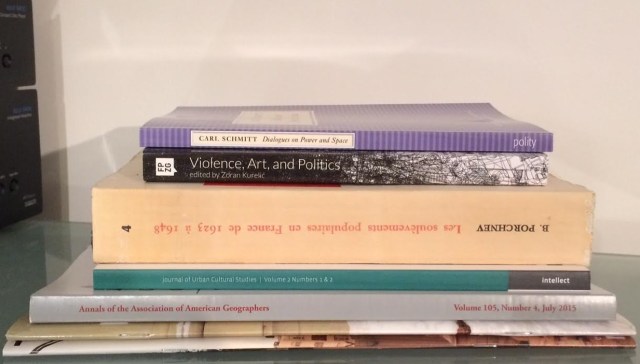
Books received – Schmitt, Kurelić, Porchnev, JUCS, Annals, RP, The Funambulist

booksCarl Schmitt’s Dialogues on Power and SpaceZoran Kurelić (ed.), Violence, Art and Politics (a gift from one of the contributors, Krešimir Petković), Boris Porchnev’s Les soulèvements populaires en France de 1623 à 1648 (see why here), and recent issues of the Journal of Urban Cultural Studies, Annals of the AAGRadical Philosophy, and the launch issue of The Funambulist.

Posted in Carl Schmitt, Michel Foucault | Tagged , , , | 3 Comments

Neil Smith Tribute, tomorrow in Barcelona

News of the Neil Smith tribute to be held in Barcelona tomorrow.

asevillab's avatarmultipliciudades

The Neil Smith tribute organized by Espais Crítics is approaching and I am thrilled to join the event tomorrow, as it will be a great opportunity not only to enjoy the interesting set of selected papers (full program here) and participate in a series of visits exploring the gentrification of Barcelona’s historic center, but also to meet some good old friends and catch up with the group’s research on the spatial challenges of the global crisis. I am going back to some of the keynote speakers’ contributions this weekend, especially by Eric Clark and Tom Slater whom I will interview at some point of the conference for the Espais Crítics project. Both Clark’s and Slater’s interventions on gentrification are inspiring —although very different in their personal approaches, eg see Clark’s pieces here and here, and Slater’s here and here— but the warm up for the event has…

View original post 101 more words

Posted in Uncategorized | Leave a comment

Top posts on Progressive Geographies this week

Posted in Uncategorized | Leave a comment

Update on the Foucault/13 Years at the Collège de France at Columbia University – places closed; live streaming details

via Foucault News

Update on the 13/13 series of seminars from the website

The first seminar will take place  on September 14, 2015.

Thank you very much for your interest in the series Foucault 13/13. The seminar has received an overwhelmingly good response, and we have more applications than available seats. Please accept our apologies. The application process is now officially closed.

However, we will be live streaming the seminars and also arranging to have an overflow room where you could watch the ongoing seminars by audio-visual projection. We are doing everything possible to make this seminar conversation accessible nonetheless.

First, we will be streaming the seminar live on the multimedia page of the new website of the Foucault 13/13 series here: Multimedia.

Second, we will also have an overflow room if you would like to watch the live stream with others in the overflow room while the seminar is going on, and we will try to promote discussion in the overflow room with the help of our teaching assistants.  The overflow room will be located at the Columbia Law School, 435 West 116th Street, NY, and the exact room location will be posted on the blog page of the new website for Foucault 13/13.  The location for the first seminar on September 14, 2015, will be Room 105 at the Columbia Law School, Jerome Greene Hall.

Third, we will also be blogging on issues related to the seminar on the blog page of the new website for Foucault 13/13, and archiving prior recordings of the seminars. Our blog will be open and moderated for comments and you can find it here:http://blogs.law.columbia.edu/foucault1313/ Please do join us in that conversation as well.

We do hope that this will make it possible for you to follow the seminar series closely, even though you will not be able to be in the seminar room in person.  Again, we will do everything possible to make this seminar series accessible to you in overflow and virtually.

Thank you again for your interest.

Please do follow any news and developments regarding the Foucault 13/13 series either on the new website at Microsite or on our FB and/or Twitter pages.

Warm regards,

Bernard E. Harcourt and Jesus R. Velasco

– See more at:http://blogs.law.columbia.edu/foucault1313/2015/09/03/applications-closed-but-live-stream-live/#sthash.diG1j4Df.dpuf

Posted in Conferences, Michel Foucault | Leave a comment

How we Write – open access collection edited by Suzanne Conklin Akbari: thirteen essays on academic writing

How We Write – the open access collection edited by Suzanne Conklin Akbari, which includes thirteen short pieces on academic writing – is now available.

While free to download, it was not free to produce. It is also available to buy in paperback, or you can leave a donation when you download the book.

How-We-Write-cover-E-216x346

This little book arose spontaneously, in the late spring of 2015, when a series of conversations emerged — first in a university roundtable on graduate student dissertation-writing, and then in a rapidly proliferating series of blog posts — on the topic of how we write. One commentary generated another, each one characterized by enormous speed, eloquence, and emotional forthrightness. This collection is not about how TO write, but how WE write: unlike a prescriptive manual that promises to unlock the secret to efficient productivity, the contributors talk about their own writing processes, in all their messy, frustrated, exuberant, and awkward dis/order.

The contributors range from graduate students and recent PhDs to senior scholars working in the fields of medieval studies, art history, English literature, poetics, early modern studies, musicology, and geography. All are engaged in academic writing, but some of the contributors also publish in other genres, includes poetry and fiction. Several contributors maintain a very active online presence, including blogs and websites; all are committed to strengthening the bonds of community, both in person and online, which helps to explain the effervescent sense of collegiality that pervades the volume, creating linkages across essays and extending outward into the wide world of writers and readers.

Contributors include: Michael Collins, Suzanne Conklin Akbari, Alexandra Gillespie, Alice Hutton Sharp, Asa Simon Mittman, Jeffrey Jerome Cohen, Maura Nolan, Richard H. Godden, Bruce Holsinger, Stuart Elden, Derek Gregory, Steve Mentz, and Dan Kline.

As one of the authors, I’m very grateful to Suzanne for the invitation and editing, and Eileen Joy and Chris Piuma for their production work. This is a book that does not seek to give advice, but to show how a range of people do things in a number of different ways. Please share widely…

Posted in Writing | 1 Comment