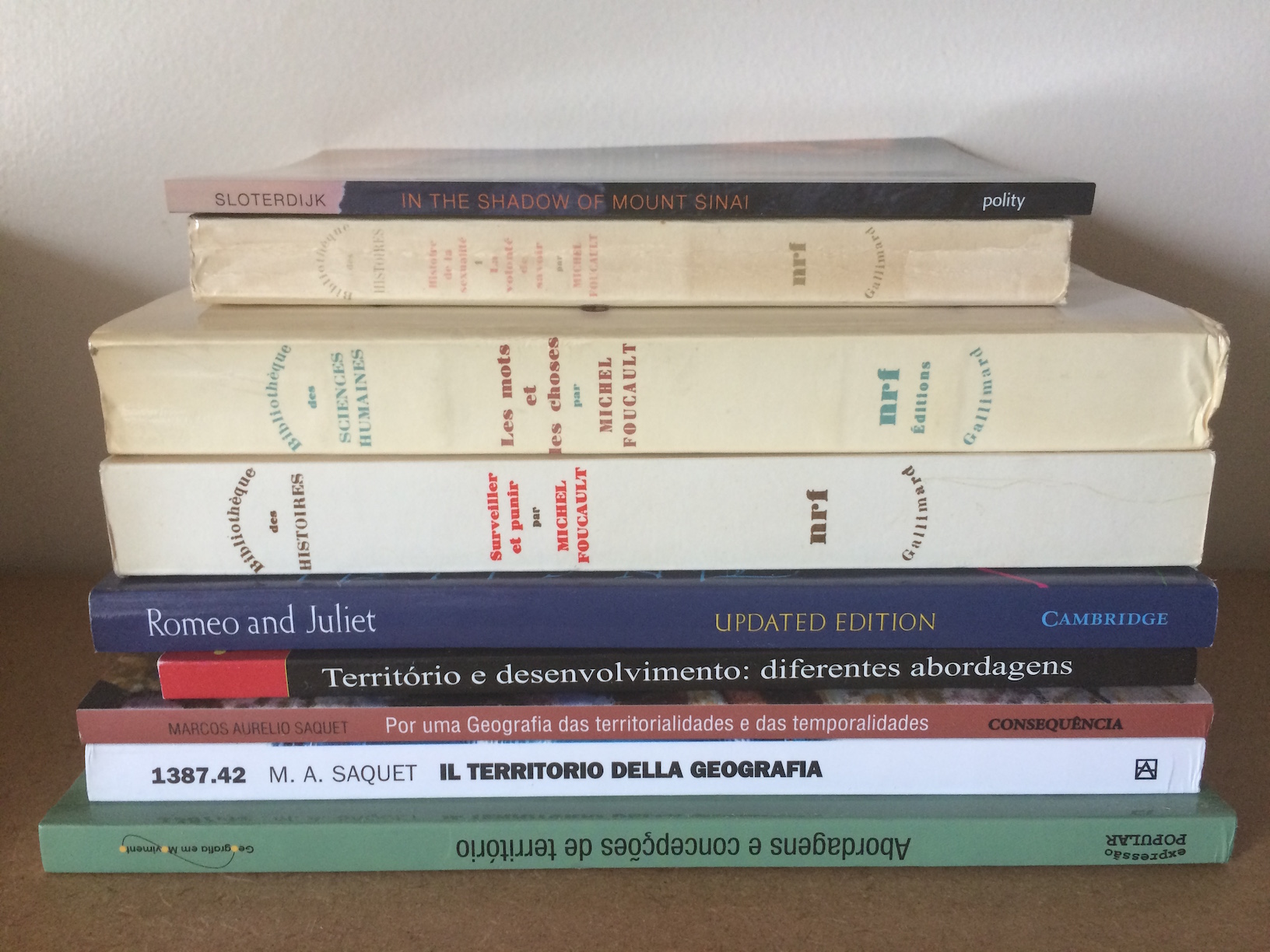
Foucault’s Last Decade is now being copy-edited, with a view to proofs in the autumn and hopefully publication in April. I worked with the same copy-editor for Sloterdijk Now. It’s always good to hear that the text I submitted is seen as ‘well-written and polished’, since it decreases the work for everyone involved.
With the book on the earlier period, I’ve mainly been working on the Introduction and Chapter One over the past couple of weeks, along with another visit to the Bibliothèque Nationale (BnF).
In terms of writing, one of the tasks was developing a longer reading of Foucault’s inaugural lecture, ‘The Order of Discourse’. It’s not clear from this short text what was actually delivered in the lecture on 2 December 1970, and what was added from the manuscript at a later date. But it’s a fascinating text. I also returned to “Titres et travaux”, his 1969 presentation of his previous work and future agenda for the post at the Collège de France. The most recent French edition of Didier Eribon’s biography has some other documents relating to this process. All very interesting, and while the 1970-71 course Lectures on the Will to Know delivers on some of what is promised, from Théories et institutions pénales onwards Foucault took his work in really quite distinct directions.
 I have also spent five days in Paris, again working at the BnF. There is a lot of material now available. Because I am concentrating on the 1969-75 period, this gives me a focus for what material I’m looking at. The manuscripts for some of the Collège de France courses are available, but I’ve decided that, for the moment at least, I will not be comparing the published versions with the manuscripts. In any case, for two of the courses from the period, the published course is based directly on the manuscript, and for one other it is based on a transcript made at the time that Foucault corrected. There are no tapes for any of the first three courses. Unless I thought there were errors of transcription, there would be little to gain, aside from the interest in seeing the manuscript itself. But I’ve now read a few thousand pages of Foucault’s handwriting, and the appeal is wearing off… For Psychiatric Power it might be worth looking at the manuscript, since that text was edited on the basis of transcribed recordings, and quite early in the process – before such extensive quotation from the manuscript became the editorial norm.
What I did instead was spend several days looking at Foucault’s preliminary reading notes for his early Collège de France lecture courses, and at several boxes of notes towards Surveiller et punir. I found some interesting things in all these, and plan to say a bit more about them when I talk on the 1971-72 course in Nottingham in just a couple of weeks. For Surveiller et punir the best way I can describe it is like taking the back off a clock…
I also worked through what are filed as his notes for a 1969 course at Vincennes, with the fascinating title ‘Freud, sexualité, Folie’ but the notes are non-systematic and there is no sign of the manuscript of the course in the available files. Filed here, though not necessary part of the same project, are some quite detailed notes on heredity. This was a potential project mentioned by Foucault several times around 1969-70, but which he abandons, suggesting that François Jacob had already done the work (see my earlier comments on this here). I’d written a bit about this before, but I’m glad I held it back for this book as this new material really helps with how it can be discussed.
The filing system for the materials is unclear: notes for books appear in boxes 1-5, 31, 34-36; for courses in boxes 32, 6-10; and then there are thematic notes in boxes 11-23, 27-28. 17 is missing from the catalogue. Early notes from the 1950s are in boxes 33 and 37-38. Material relating to seminars and related publications is in boxes 24-26. Boxes 40ff are not listed, though I may know what is in box 58. The categories ‘Cours au Collège de France’ and for ‘Correspondence’ appear in the catalogue, but their contents and box numbers are not listed, with the exception of the file for Théories et institutions pénales.
More importantly, the headings for each box are sometimes vague and at times misleading. I found notes from the late 1960s/early 1970s in with notes from the 1950s, and thematic ordering fits better with how Foucault organised his files. It would be difficult to date precisely any single note, since Foucault used roughly the same style of note taking from early to late, though he seems to switch size of paper from A5 to A4 in the early 1970s. We can sometimes be sure of an approximate date from the relation of notes to published materials or datable lectures; but I would ideally like to work the other way round – use the notes to help indicate when the preparatory work for lectures or publications was undertaken.
The notes are sometimes enclosed in a folded sheet of paper, to make thematic subdivisions, and those papers are often recycled from something else. These are generally not marked, but can be interesting – draft pages of his own manuscripts; several pages from a prospectus for a complete works on Bataille, a flyer for a demonstration in support of a student facing disciplinary action, the programme of a cultural event in Sweden, etc. In the notes relating to Surveiller et punir there are some manuscript pages, sometimes double-sided, which appear to be drafts of lectures and in part of the book itself. Given that the book ms. itself does not seemingly exist anymore, these are quite interesting. I’ve said a bit about the way Foucault wrote manuscripts before. There is nothing quite of the quality of a lost Cicero text hidden in an Augustine manuscript, but intriguing nonetheless. I did find an entire early unpublished short text, but it is outside the date range of the planned study and I doubt I will do anything with this. It’s not quite juvenilia, but would fit the description of ‘Foucault before Foucault’. A few pieces of correspondence are in the files, seemingly by chance; occasionally Foucault uses a piece of scrap paper for notes, and once uses a page of Collège de France headed notepaper. That page can at least be given a definite earliest date.
I need to return to work through more materials, so I’ll be planning future visits in the autumn as time allows. It’s quite tiring work, because Foucault’s handwriting is very difficult, and this week I’ve been in the manuscripts room all the time it’s open with only a brief break for lunch for five days straight. When Foucault is writing it can be possible to work out what he means by the context, but proper names can be hard, because it’s difficult to guess their correct spelling. He frequently misses accents, or joins them into the next letter. The bibliography in Discipline and Punish was invaluable in working out what text and which author was meant. Internet searching and online catalogues helped complete most of the rest. He has some shorthand symbols that I’ve worked out – Δ for Dieu; φ for Philosophy, for example – and tends to abbreviate the end of some words by missing some characters and putting the last letters in superscript and underlining it. Usually I get there in the end, but it is time-consuming. And there is a lot of material to work through…
The next thing to work on chronologically would be Lectures on the Will to Know, for which I have detailed notes already, but after the weekend I’m going to have to move to Théories et insitutions pénales, which will be my focus for the lecture in Nottingham in September. I’m only planning on talking about the second part of the course there, rather than the material on the Nu-pieds, and I hope to have a chance to talk about that part at some other point soon.
You can read more about these books, along with links to previous updates, here. And, as a reminder, a lot of resources I produced while writing Foucault’s Last Decade are available here. It includes a list of audio files, a bibliography of collaborative projects, a list of short pieces which did not appear in Dits et écrits, comparison of variant forms of texts, a few short translations, and so on.

 It’s fairly well known that there are various editions of Foucault’s first major work – Histoire de la folie à l’âge classique.
 In 1976, the 1972 version (i.e. with the new preface and without the original one) but without the appendices was reissued in Gallimard’s cheaper Tel series. This is the version that is still in print today. The 1961 preface and the 1972 appendices all appear in Dits et écrits. The book will be included in the forthcoming Oeuvres in the Pléiade series, which is supposed to be a critical edition, so I’d assume both prefaces at least will be in there.