Bradley Garrett on privately owned public spaces (Pops)

Jeremy Crampton links to a new piece by Bradley Garrett and asks some good questions about the vertical dimension.

Jeremy's avatarOpen Geography

Provocative piece by Bradley Garrett on privately owned public spaces, otherwise known as “Pops.” His intro reads in part:

Part of the problem, then, with privately owned public spaces (“Pops”) – open-air squares, gardens and parks that look public but are not – is that the rights of the citizens using them are severely hemmed in. Although this issue might be academic while we’re eating our lunch on a private park bench, the consequences of multiplying and expanding Pops affects everything from our personal psyche to our ability to protest.

His point is well exemplified in the (unusually thoughtful) comments by readers, one of whom asks:

Residential squares (open to the residents of the houses surrounding the square, but not to the general public) were a feature of London architecture up to the beginning of the 20th Century and still remain closed to the public in most cases. Why is…

View original post 304 more words

Posted in Uncategorized | 1 Comment

Public lectures and panels at Antipode’s 5th Institute for the Geographies of Justice – videos now available

Videos of the public lectures from Antipode’s recent Institute for the Geographies of Justice in Johannesburg.

Antipode Editorial Office's avatarAntipodeFoundation.org

The Antipode Foundation’s 5th Institute for the Geographies of Justice took place in Johannesburg, South Africa, in June. A highlight of the week was a series of public lectures and panels:

On Monday 22nd June, Ruth Wilson Gilmore (Professor of Geography, City University of New York) presented “Extraction: Abolition Geography and the Problem of Innocence”, with an introduction from Ruth Hopkins (Senior Journalist, Wits Justice Project);

On Tuesday 23rd, Edgar Pieterse (African Centre for Cities, University of Cape Town) participated in a discussion on “The Contemporary African City: Crises, Potentials, and Limits” with Alex Wafer and Prishani Naidoo (Wits University);

On Wednesday 24th, Gillian Hart (Professor of Geography and Development Studies at UC Berkeley) and Françoise Vergès (Chair in the Global South at the Collège d’études mondiales) participated in a discussion on “Capital, Disposability, Occupations” with Sharad Chari and Melanie Samson (Wits…

View original post 99 more words

Posted in Uncategorized | Leave a comment

Whatever Happened to Academic Freedom?

Thoughts on the relation between academic freedom and academic standards.

lizmorrish's avatarAcademic Irregularities

Paul Greatrix, writing on the Wonkhe blog on July 14th 2015, includes an account of how, as recently as the 1980s in the UK, autonomy, academic freedom and academic standards were thought to be inextricably linked.

In the blog piece, he quotes two key higher education reports: on efficiency (The Jarratt Report 1985), and on degree validation (The Lindop Report 1985). Both contain appeals to academic freedom.

  • “The most reliable safeguard of standards is not external validation or any other outside control; it is the growth of the teaching institution as a self-critical academic community’. (The Lindop Report 1985, p6)
  • “Academic excellence is crucially dependent on academic freedom” (Jarratt Report 1985, p6).

Academic freedom, then, is an issue of academic standards. What has changed, in the 30-year interim, except the infiltration of neoliberalism and managerialism? Why does each new report on governance, standards and ‘quality’ in higher education…

View original post 287 more words

Posted in Uncategorized | 1 Comment

Society and Space Vol 33 No 3 now out – this issue and selected back issues currently open access

From the Society and Space open site

This is the first Society and Space issue with new publisher, SAGE. All contents are currently open access as part of a free trial period.

Situated solidarities and the practice of scholar-activism 391-407 Paul Routledge and Kate Driscoll Derickson
Zapatismo: other geographies circa “the end of the world” 408-424 Alvaro Reyes
After the pop-up games: London’s never-ending regeneration 425-443 Ameeth Vijay
Topologies of vulnerability and the proliferation of camp life 444-459 François Debrix
Contradiction, intervention, and urban low carbon transitions 460-476 Vanesa Castán Broto
On the political nature of cyanobacteria: intra-active collective politics in Loweswater, the English Lake District 477-493 Claire Waterton and Judith Tsouvalis
Securing and scaling resilient futures: neoliberation, infrastructure, and topologies of power 494-511 Daniel Sage, Pete Fussey, and Andrew Dainty
Resilience governance and ecosystemic space: a critical perspective on the EU approach to Internet security 512-527 Mareile Kaufmann
Disrupting migration stories: reading life histories through the lens of mobility and fixity 528-544 Ben Rogaly
Corporate personhood and the corporate body: the case of former energy giant Enron on trial for fraud 545-559 Jayme Walenta
Field recording and the sounding of spaces 560-576 Michael Gallagher

Posted in Uncategorized | Leave a comment

Books received – Shakespeare’s history plays, ‘Shakespeare’? and Yacobi

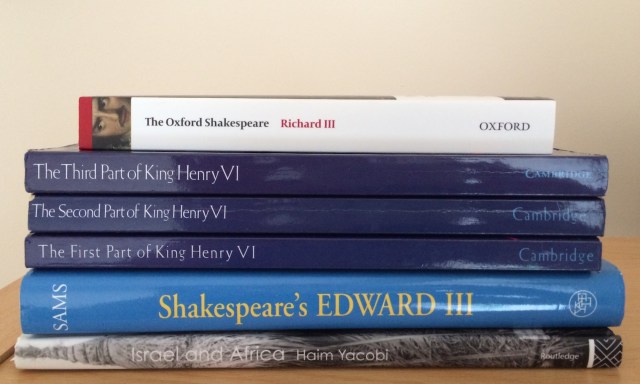
books received

Some books for the Shakespeare project, including the disputed Edward III, and Haim Yacobi’s new book, Israel and Africa: A Genealogy of Moral Geography, sent by the publisher on Haim’s request. I began reading Haim’s book as soon as it arrived – absolutely fascinating research involving interviews and archives to trace Israel’s links to Africa, and vice versa, through migration, arms and agriculture.

The other books are different editions of texts I’ve already worked through at least once, as I try to find a way to structure what I want to say about Shakespeare’s history plays. Aspects of King JohnHenry V, and Henry IV, Part One are definite, and Richard II gets a fuller treatment elsewhere. But the first tetralogy is causing me the most uncertainty. I’m looking forward to the new BBC Hollow Crown: The War of the Roses which is doing the three parts of Henry VI as two films alongside Richard III. I have tickets for Henry V at the RSC in September and Richard II at the Globe later this week, though I’m fairly sure what I’m doing with them.

Posted in Haim Yacobi, Shakespearean Territories, William Shakespeare | Leave a comment

Ashgate acquired by Informa

Another small publisher bought by a larger one…

Michael@Ashgate's avatarAshgate Publishing Blog

ASHGATE ACQUIRED BY INFORMA (Taylor & Francis)

We announce that Ashgate Publishing has been acquired by Informa, owners of the academic publishing group Taylor & Francis. Over the last 48 years Ashgate has grown to become one of the leading publishers of academic monographs and reference works under the Ashgate imprint, and Gower continues to be a highly respected brand name in business and management books. Taylor & Francis, through its Routledge imprint, is a long established publisher with an excellent reputation and a strong commitment to the academic and professional fields in which Ashgate and Gower publish. Together, Taylor & Francis with Ashgate and Gower are now the largest academic book publisher worldwide in the Humanities and Social Sciences.

With its combined resources and expertise we see this as a positive move for all our authors and the academic and professional communities we serve.

Please continue to direct enquiries…

View original post 104 more words

Posted in Uncategorized | 1 Comment

Pip Thornton – ‘The meaning of light: seeing and being on the battlefield’

Thornton - 2015 The meaning of light: seeing and being on the battlefieldPip Thornton’s paper  “The meaning of light: seeing and being on the battlefield” has been published in Cultural Geographies. This paper was part of the sessions on ‘Terrain‘ Gastón Gordillo and I organised at the AAG earlier this year.

Derek Gregory says a little about the paper here; and Pip herself comments here. The paper is based on Pip’s experience of being an Army reservist in Iraq in 2003, and is part of unrelated to her PhD research. It’s also her first article to be published – congratulations Pip!

[updated – this is not part of her PhD research]

Posted in Derek Gregory, Gaston Gordillo | Tagged | Leave a comment

Raul Pacheco-Vega on academic writing, and breaking with usual practices

19576992484_d0dc0a5228_zRaul Pacheco-Vega has several posts on his blog about academic writing. He’s long been an advocate of the model of writing every day, in his case in a carefully-scheduled block, often first thing in the morning. In these posts he reflects on a break in his usual practice, of ‘binge-writing‘, on the practice of ‘Write first, edit later, and edit by hand‘ and then on the idea of slow-scholarship – sparked by ideas in a collaborative paper entitled ‘For Slow Scholarship: A Feminist Politics of Resistance through Collective Action in the Neoliberal University‘. All worth a look, with several links in each.

[Updated to include a link to his earlier post on writing every day]

.

Posted in Writing | 2 Comments

7 Critical Theory books that came out in July 2015

july-2015-critical-theory-books-672x372‘7 Critical Theory books that came out in July 2015’ at critical-theory.com – Agamben, DeLanda, Kelly, Flusser, and books on Badiou, Adorno and Heidegger, Levinas and Lacan.

Posted in Uncategorized | 1 Comment

Top posts on Progressive Geographies this week

Posted in Uncategorized | Leave a comment