Jeffrey Jerome Cohen on ‘Creativity, Routine, Writing Lockdowns, and the Necessity of Ignoring Those Who Offer Themselves as Example’

image_miniJeffrey Jerome Cohen has a draft of his contribution to a collection on writing with which I am also involved: ‘Creativity, Routine, Writing Lockdowns, and the Necessity of Ignoring Those Who Offer Themselves as Example‘. (A little more on my contribution here.)

Jeffrey’s piece is in part an account of how he came to write his remarkable book Stone: An Ecology of the Inhuman, which I have just read. Given how harrowing the account of its writing seems, it’s remarkable how the book bears so little trace of it. The book will be useful as and when I return to my work on earth, terrain, fossils, and related questions.

Posted in Jeffrey Jerome Cohen, Writing | 1 Comment

Deleuze, Guattari, Foucault and Fourquet’s discussions of ‘Les équipements du pouvoir’

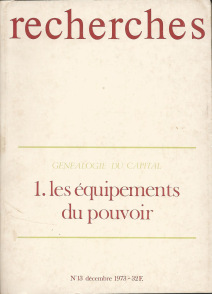
scan0001Keith Harris has been saying a bit about Deleuze, Guattari, Foucault and Fourquet’s discussions of ‘Les équipements du pouvoir’. He first shared his reading notes on Guattari’s contributions to a discussion with Foucault and Fourquet; and has followed up today with a clarification on the initial publication details.

Keith links to my list of Foucault’s collaborative projects, which I think illustrates just how important this model of working was for him. The pieces in question were first published in Généalogie du capital: 1 Les équipements du pouvoir: villes, territoires et équipements collectifs, Recherches, No 13, December 1973; which was then reissued as François Fourquet and Lion Murard, Les équipements du pouvoir, Paris: Union Générales d’Éditions 10/18, 1976. The Recherches issue isn’t that easy to find today, but the 10/18 book is fairly widely available.

Fourquet’s postface to this material was so long it was published as separate volume: Généalogie du capital 2: L’idéal historique, Recherches, No 14, January 1974; reissued as François Fourquet, L’idéal historique, Paris: Union Générales d’Éditions 10/18, 1976.

While the two discussions which involve Foucault were translated in Foucault: Live, to my knowledge none of the other material was. Keith links to a reprint of an essay by Fourquet that the discussion follows. And this work – largely undertaken for Guattari’s CERFI group – led to the volumes on Généalogie des équipements de normalisation with which Foucault was also involved. Fuller details of those here.

I will discuss Les équipements du pouvoir most fully in Foucault: The Birth of Power, but say a bit about it, and a lot about the Généalogie des équipements de normalisation projects in Foucault’s Last Decade. I hope Keith is able to translate some more of this work.

Posted in Felix Guattari, Foucault's Last Decade, Foucault: The Birth of Power, Gilles Deleuze, Michel Foucault | 2 Comments

Draft entry for a Michel Serres Dictionary: Le Système de Leibniz et ses modèles mathématiques (1968)

A very interesting discussion of Michel Serres’s reading of Leibniz.

Christopher Watkin's avatarChristopher Watkin

Le Système de Leibniz was published during the heady anni mirabiles of late 1960s French thought. It appeared in 1968, the same year as Roland Barthes’s short essay ‘The Death of the Author’, one year after Derrida’s Of Grammatology and Deleuze’s Difference and Repetition, and two years after Foucault’s The Order of Things. Like Derrida’s and Deleuze’s volumes Le Système was written as a major doctoral thesis (French doctoral candidates submit a major and a minor thesis), the fruit of research under the supervision of Jean Hyppolite at the Ecole Normale Suprérieure, Rue d’Ulm. Like those other works it stands both as a rich and sinuous study in its own right and also as a radical declaration of philosophical intent from a philosopher elaborating the shapes of thought that will accompany him through his subsequent writings.

The importance of the work can be summarised under three headings. First, it…

View original post 4,649 more words

Posted in Uncategorized | Leave a comment

Top posts on Progressive Geographies this week

A quiet week on the blog, because a busy week at workshops in Florence, Nottingham and London. More on those, hopefully with some audio recordings, early next week.

Posted in Uncategorized | Leave a comment

Leverhulme Trust Network on Project on Indeterminate and Changing Environments: Law, the Anthropocene, and the World (the ICE LAW Project)

Phil Steinberg has the good news that the Leverhulme Trust has funded the Project on Indeterminate and Changing Environments: Law, the Anthropocene, and the World (the ICE LAW Project). I’ll be leading the subproject on territory. Congratulations to Phil and Kate Coddington who led the application. Here’s the full story:

I’m happy to announce that the Leverhulme Trust’s International Networks Programme has agreed fund a series of workshops, conferences and meetings to further the Project on Indeterminate and Changing Environments: Law, the Anthropocene, and the World (the ICE LAW Project), a project being organised by IBRU: Durham University’s Centre for Borders Research with the support of the UArctic Thematic Network on Arctic Law.

To quote from the grant proposal:

The ICE LAW Project will query how human interactions with the geophysical environment of the world’s frozen regions challenge Western normative principles of state power and legal authority that assume an idealized binary between land and water. Six subprojects led by ten scholars (representing seven institutions in six countries) will investigate how normative principles of state territory are challenged by the dynamic nature of geophysics. Subprojects will explore how complex geophysical processes and changes are encountered through regulations and practices of territory, resource use, law, mobility, and migration, including a focus on local and indigenous perspectives.

Over the next three years, beginning in January 2016, each subproject will be a holding a number of workshops, and we’ll also be organising a number of larger conferences, as well as sessions at the 2017 International Congress of Arctic Social Sciences (ICASS) in Umeå, Sweden. The plan of action follows directly from the Workshop on the Ice-Land-Water Interface held in June 2014 in Durham.

I look forward to working with the subproject leaders: Claudio Aporta & Aldo Chircop(Mobilities), Gavin Bridge (Resources), Kate Coddington (Migrations), Stuart Elden(Territory), Timo Koivurova (Law), and Stephanie KaneJessica Shadian, & Anna Stammler-Gossmann (Local & Indigenous Perspectives).

Posted in Uncategorized | 3 Comments

Nick Vaughan-Williams, Europe’s Border Crisis: Biopolitical Security and Beyond – forthcoming from Oxford University Press

Nick Vaughan-Williams, Europe’s Border Crisis: Biopolitical Security and Beyond forthcoming from Oxford University Press [update: published 1 October 2015].

9780198747024_450

Europe’s Border Crisis investigates dynamics in EU border security and migration management and advances a path-breaking framework for thought, judgment, and action in this context. It argues that a crisis point has emerged whereby irregular migrants are treated as both a security threat to the EU and as a life that is threatened and in need of saving. This leads to paradoxical situations such that humanitarian policies and practices often expose irregular migrants to dehumanizing and lethal border security mechanisms. The dominant way of understanding these dynamics, one that blames a gap between policy and practice, fails to address the deeper political issues at stake and ends up perpetuating the terms of the crisis.

Drawing on conceptual resources in biopolitical theory, particularly the work of Roberto Esposito, the book offers an alternative diagnosis of the problem in order to move beyond the present impasse. It argues that both negative and positive dimensions of EU border security are symptomatic of tensions within biopolitical techniques of government. While bordering practices are designed to play a defensive role they contain the potential for excessive security mechanisms that threaten the very values and lives they purport to protect. Each chapter draws on a different biopolitical key to both interrogate diverse technologies of power at a range of border sites and explore the insights and limits of the biopolitical paradigm. Must border security always result in dehumanization and death? Is a more affirmative approach to border politics possible? Europe’s Border Crisis sets out a new horizon for addressing these and related questions.


Posted in Boundaries, Territory | 3 Comments

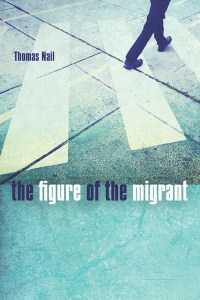
Thomas Nail, The Figure of the Migrant – forthcoming from Stanford University Press

Thomas Nail, The Figure of the Migrant – forthcoming from Stanford University Press. I provide one of the endorsements. The book is due out in September. In the meantime, a short interview on migrant politics related to the themes of the book that can be viewed/downloaded here.

pid_23425

This book offers a much-needed new political theory of an old phenomenon. The last decade alone has marked the highest number of migrations in recorded history. Constrained by environmental, economic, and political instability, scores of people are on the move. But other sorts of changes—from global tourism to undocumented labor—have led to the fact that to some extent, we are all becoming migrants. The migrant has become the political figure of our time.

Rather than viewing migration as the exception to the rule of political fixity and citizenship, Thomas Nail reinterprets the history of political power from the perspective of the movement that defines the migrant in the first place. Applying his “kinopolitics” to several major historical conditions (territorial, political, juridical, and economic) and figures of migration (the nomad, the barbarian, the vagabond, and the proletariat), he provides fresh tools for the analysis of contemporary migration.

Posted in Uncategorized | Tagged | 3 Comments

ANTI-CRISIS REVIEWED

A new review at the Society and Space open site.

Posted in Uncategorized | Leave a comment

New book from Anna Tsing: The Mushroom at the End of the World: on the possibility of life in capitalist ruins

News of a curious and fascinating-sounding book forthcoming from Anna Tsing.

Jeremy Schmidt's avatarJeremy J Schmidt

k10581The Mushroom at the End of the World: On the Possibility of Life in Capitalist Ruins, coming from Princeton this September, details here.

Matsutake is the most valuable mushroom in the world—and a weed that grows in human-disturbed forests across the northern hemisphere. Through its ability to nurture trees, matsutake helps forests to grow in daunting places. It is also an edible delicacy in Japan, where it sometimes commands astronomical prices. In all its contradictions, matsutake offers insights into areas far beyond just mushrooms and addresses a crucial question: what manages to live in the ruins we have made?

A tale of diversity within our damaged landscapes, The Mushroom at the End of the World follows one of the strangest commodity chains of our times to explore the unexpected corners of capitalism. Here, we witness the varied and peculiar worlds of matsutake commerce: the worlds of Japanese gourmets, capitalist…

View original post 407 more words

Posted in Uncategorized | 1 Comment

Judith Butler Parting Ways – A Jewish Philosophy Symposium

Thanks to dmfant for this link to a symposium on Judith Butler’s Parting Ways.

zjb's avatarjewish philosophy place

judith butler

This symposium on Parting Ways is just out in the print version of the journal Political Theology. It includes contributions by Sarah Hammerschlag, Larisa Reznik, Martin Kavka, Vincent Lloyd, and myself with a response by the author, Judith Butler.

There is something uncomfortable about the entire exchange. At points frustrated by the political polemics roused by her book, Butler would clearly have preferred to have focused the discussion around purely philosophical problems raised by Levinas, Benjamin, Arendt, Darwish, and her readings of them. But there seems to have been no way to get past the problem of Jewish identity, given the polemical contexts that stage her readings. It has been suggested to me by a dear friend that Butler did not seem to want to theorize Jewish identity, i.e. her own Jewish identity, which she takes as a given matter of biographical fact.

What I would suggest is that…

View original post 197 more words

Posted in Uncategorized | 1 Comment