Marcelo Hoffman reviews Foucault’s La société punitive in Political Theory (subscription required)

Now up online first, Marcelo Hoffman reviews Foucault’s La société punitive in Political Theory (subscription required).
Posted in Uncategorized | Leave a comment

Editing Henri Lefebvre’s Metaphilosophy – doing his endnotes properly

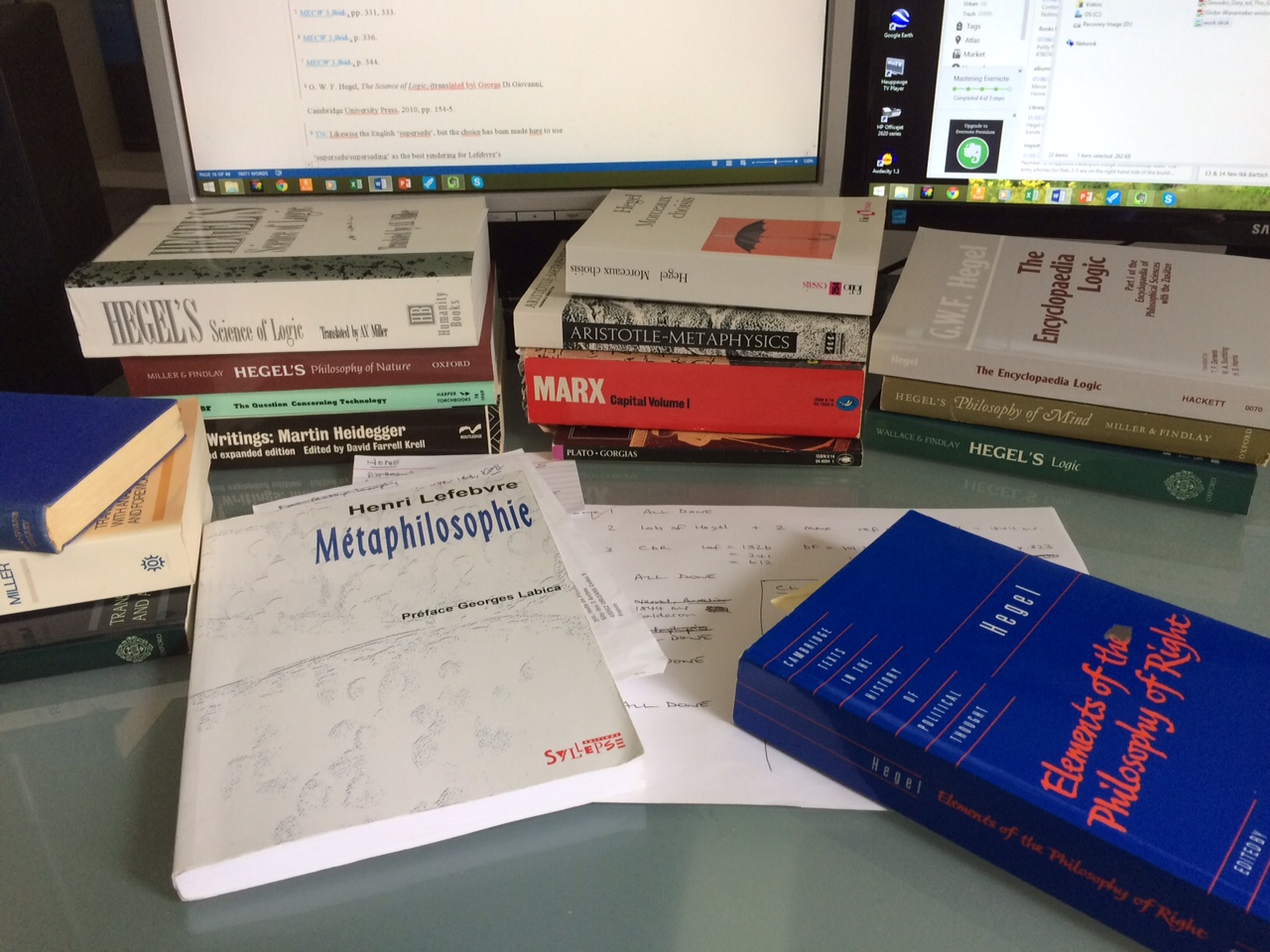
Home desk

Over the last few weeks I’ve been editing the translation of Lefebvre’s Metaphilosophy for Verso. Despite a very fine translation by David Fernbach, this has still taken some work. First there are the linguistic complications of a three-way language dialogue – Lefebvre wrote in French about German writers such as Hegel, Marx, Nietzsche and Heidegger, and we’re trying to render this into English. There are are also some Lefebvre-specific terminological issues, but the key work has been, as ever, with the notes. I said something about this before – here and here – when editing the Axelos translation last year. And having done the notes for Lefebvre’s Key WritingsRhythmanalysis (with the help of Gerald Moore), State, Space, World (with Neil Brenner) and the rural essay with Adam David Morton for Antipode, I knew what was to be done, but that doesn’t make it any easier.

With this text, there are a lot of references. It’s one of Lefebvre’s most fully referenced book. Several are notes; some are in text – at the moment we’ve moved them all to notes. If Lefebvre provided consistent references to texts, either original language or in French translation, then it would be a straight-forward, though time-consuming, task of finding the original, comparing to an English translation and noting the corresponding page. But it’s never that simple.

Lefebvre uses lots of old editions of texts, many of which are hard to find. He frequently references texts, but omits the page, or just says the part such as the ‘Introduction’. He doesn’t always specify the edition. He seems to make up a different journal referencing style every chapter. Some of the passages are just not referenced at all. A few references are to things he heard – lectures at societies, for example. But these were usually published subsequently, so references to those go in. He sometimes puts things that are not quotations in quotation marks, and vice versa. One was from Pedro Calderón de la Barca’s, La Vida es sueño [Life is a dream], but despite quite a bit of time searching and reading I’m now convinced the passage in quotation marks is more of a summary of the sentiment of the play than a specific quotation. Another was a characterisation of Weber’s question in The Protestant Ethic, but I don’t think that’s a quotation either.

In addition, many quotes from German sources are in his own, sometimes idiosyncratic translations. He was an important editor and translator of Hegel and Marx in France, along with Norbert Guterman – Guterman did the bulk of the translating; Lefebvre most of the introductions – but doesn’t always even provide a reference to his own editions (all of which I have copies of, and so could use to locate the quotation). He uses Axelos’s French translation of Heraclitus, which matches English translations poorly, but the specific words used are important to his argument. One quotation from Anaximander is a Heideggerian-Axelos inspired version which has important differences from existing English ones.

David did the vast majority of the notes to Marx, turning Lefebvre’s references to ones that consistently referenced the English Collected Works. There were relatively few to add. Some of those Lefebvre is quoting are authors I know quite well, such as Nietzsche or Heidegger. Those took little time – it helps enormously with Heidegger that when Lefebvre was writing (1963-64) there was very little of his work published, even in German, so it substantially narrows the options, especially compared to now. (David had already done a lot of the work here too.) But other authors referenced were ones I’ve read, but don’t know in depth, such as Hegel. And there is a lot of discussion of Hegel in this book – the Science of Logic and the Encyclopedia LogicElements of the Philosophy of RightThe Phenomenology of Spirit, and Philosophy of Nature. Tracking all of these down took quite some time. David did many, but I still had a lot to do. One reference to the Lectures on the History of Philosophy seems to really be a reference to Lectures on the Philosophy of Religion. Only one defeated me – despite Lefebvre’s reference that it is in the 1827 Preface to the Encyclopedia, I cannot find it there.

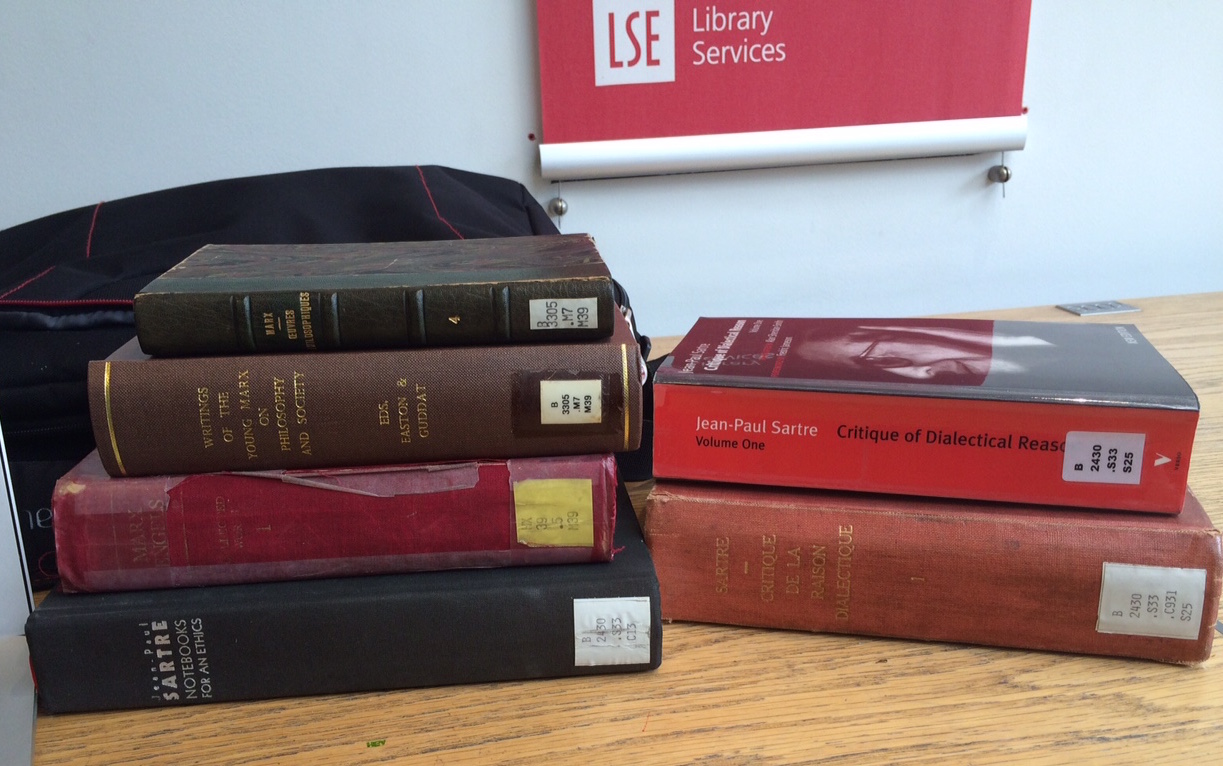
He also has an extended discussion of Sartre’s Critique of Dialectical Reason, which was generally referenced correctly to the French 1960 edition. But the English translation breaks paragraphs in different places, and changes the headings and sections, so finding passages could take a while. David already did the majority of these, but a few raised some questions – one was to Vol 1, p. 1326, but that text only runs to 755 pages. There is a passage in the second volume which corresponds exactly, so did Lefebvre use a preliminary page proof before things were cut? Yet the second volume wasn’t published until after Sartre’s death – some twenty years after Lefebvre’s book. We know Sartre and Lefebvre had a long correspondence – one of my book-buying regrets is not paying what for a PhD student was a huge amount of money for a book signed by Lefebvre with a dedication to Sartre – but Lefebvre doesn’t say something like ‘reference to unpublished ms.’ I guessed it might be a typo, and checking the original 1965 edition, instead of the 2001 second edition used as the basis for this translation, proved it: it should be a reference to p. 136. Another page reference to 741 should have been 744 – another error introduced in the second French edition. Checking the original edition of Sartre was also helpful – the 1960 edition doesn’t match the edition used as the basis for the English translation. So the 1960 one helped to fix a reference where the page in the later French text has nothing to do with the topic. But not all the challenges can be put down to editions: at one point Lefebvre makes up a tautology purportedly from Sartre, sticks it in quote marks, and then criticises it.

Most of his references to classical writers used standard conventions, though one reference to Aristotle’s Metaphysics was to the wrong book, but fortunately the right Bekker number. There was one to Augustine with no reference that took a little bit of work. All the other references to Augustine were to the Confessions, so I started and ended there. Another which missed part of the reference was easy to find because he quoted the Latin, which leads to an easy Google search. Google comes in handy for this work, but often only to indicate where to look in an actual copy of a text, and searching for a phrase in French, or in an English translation of that French, for a text originally written in a different language, is of limited use. Worldcat was helpful in completing his frequently incomplete or inaccurate bibliographical references.  He quite often mentions people by surname alone, sometimes misspelt, so working out who he meant can take some time.

Much of this was most efficient for me to do at home, where I have copies of most of the relevant works by Marx, Hegel. Sartre and all of the ones by Lefebvre, Nietzsche and Heidegger. I had to make trips to Warwick library for lots of the French literary references, and because I don’t own Critique de la raison dialectique in French, though even looking at that made me realise I needed to check the 1960 original edition rather than the reprint. I only own a copy of the 2001 edition of the Lefebvre text, so for the 1965 edition, and the 1960 edition of Sartre, I needed to go to the British Library. The BL though doesn’t have the later French edition of Sartre, so I couldn’t compare side-by-side. I had to make some notes and then go to the LSE library to compare. There is definitely a sense of achievement in finding one of the more intractable references, and the detective type approach can be interesting. This kind of work feels finished in a way that writing never does, but seriously, someone really should have sorted these sorts of things out for the 2001 re-edition of the text. (And not introduce other errors!) While it might have been bad, but relatively standard, practice in the mid 1960s, it is intolerable in a book today. And that is why, despite the huge amounts of labour it takes, I feel it is necessary for a translation with which I am associated.

LSE library

Posted in Adam David Morton, Georg Wilhelm Friedrich Hegel, Henri Lefebvre, Jean-Paul Sartre, Martin Heidegger, Neil Brenner | 4 Comments

Étienne Balibar, Citizenship – now out with Polity

Étienne Balibar, Citizenship – now out with Polity.

0745682413

If fundamental political categories were represented as geometric shapes, citizenship would be one of those rotating polyhedrons with reflective surfaces that together create effects of light and shade. With extraordinarily acute discernment, the leading philosopher Étienne Balibar examines one by one the various faces of this object, more numerous – and far more fissured – than one would imagine. The question of what it means to be a citizen has, from the dawn of Western politics, been anything but clear and straightforward; and modernity has shown it to be even more enigmatic and contested.

Inseparable from democracy, and the demands for equality and liberty from which democracy draws its origins, citizenship is constantly being redefined within the unresolved contradiction between universal principles and the discriminatory mechanisms that regulate membership of a political community.

Not everyone is a citizen, even within one nation-state. It has been said that ‘certain persons are in society without being of society’. The dynamics of inclusion and exclusion continue to generate dramatic asymmetries and create openings and closures, especially today in a time of particular fragility and when national sovereignty is in flux. So are there too many antinomies within citizenship? Balibar does not shy away from these antimonies, but he knows that to renounce citizenship would be to abandon the chance to create new modes of collective autonomy, in short, to democratize democracy.

Posted in Etienne Balibar, Politics | Tagged | 1 Comment

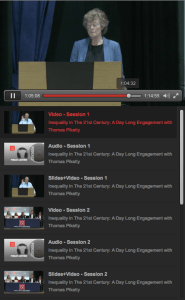
Inequality in The 21st Century: A Day Long Engagement with Thomas Piketty – video recordings available

Via The Sociological Imagination – video recordings of an LSE event in May 2015 – Inequality in The 21st Century: A Day Long Engagement with Thomas Piketty.

Screen Shot 2015-06-11 at 09.11.23Speakers include: Professor Sir Tony Atkinson, Professor Wendy Carlin,  Professor Sir John Hills, Professor Naila Kabeer, Professor Thomas Piketty, Professor Stephanie Seguino, Professor David Soskice

A day-long conference with Thomas Piketty, whose Capital in the Twenty-First Centuryhas been of global significance in shaping debates about inequality across the globe. The workshop will be hosted by LSE’s new International Inequalities Institute with the Department of Sociology at LSE and the British Journal of Sociology, which ran a special issue of reviews on Piketty’s book, several of the contributors to which will be involved in these discussions.

Thomas Piketty is a professor of economics at the Paris School of Economics, an alumnus of the London School of Economics and Political Science (LSE) and author of Capital in the Twenty-First Century.

Posted in Uncategorized | Leave a comment

Foucault’s 1983 seminar at Berkeley – tracing the people in the ‘cowboy hat’ photograph

The missing name has been provided by Richard Dienst – the man second left is Eric Johnson.

stuartelden's avatarProgressive Geographies

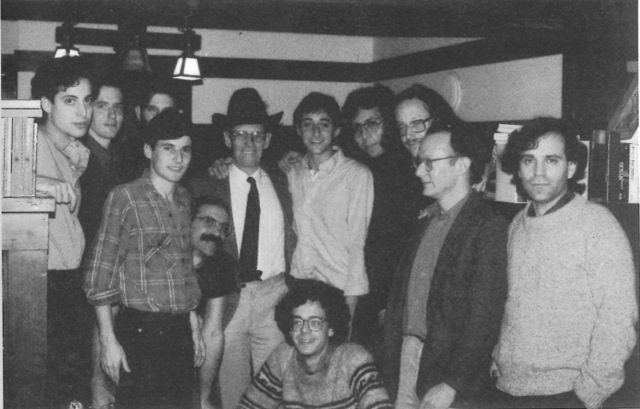
In Didier Eribon’s biography of Foucault, there is a picture of Foucault in a cowboy hat, together with Paul Rabinow and some students at Berkeley. The hat was a gift from the students. This group met in parallel with the seminar on parrēsia that produced the book Fearless Speech.

Eribon book photos - Berkeley2left to right – Mark Maslan; Eric Johnson; Thomas Zummer (part-hidden); Stephen Kotkin; Kent Gerard (crouching); Michel Foucault; David Levin (seated); Keith Gandal; Jonathan Simon; Arturo Escobar; Paul Rabinow; Jerome (Jerry) Wakefield.

If anyone can identify the unknown person, who was apparently an undergraduate, perhaps in history, please contact me.

The photograph was taken by David Horn, at the house of Kotkin and Gandal. This is a black and white reproduction of a picture originally in colour, though I have yet to see that. A second unpublished colour photo which I have…

View original post 350 more words

Posted in Uncategorized | Leave a comment

Simon Springer and David Harvey debate Marxism, anarchism and Geography

Simon Springer – “Why a radical geography must be anarchist“, Dialogues in Human Geography 4: 249-270 (needs subscription or available at academia.edu)

David Harvey – “Listen, Anarchist!” A personal response to Simon Springer’s “Why a radical geography must be anarchist” website or pdf

Simon Springer – “The limits to Marx: David Harvey and the condition of post fraternity” (available at academia.edu)

Posted in David Harvey | 11 Comments

Aleppo and ISIS’s State Ambitions: World Heritage on the Territorial Horizon (June 10, 2015)

An interesting piece on the territorial aspects of ISIS. I’ve been thinking a bit about this question, of a shift from ‘terrorist’ strategies to ‘territorial’ ones in relation to Boko Haram, and at a talk at Harvard in 2014 drew some parallels with ISIS/Islamic State. As yet I’ve not developed these further, but the Boko Haram article is available here and a short piece which hints at the parallels is here.

Randy P. Schiff's avatarTerri-Stories

As others have noted, perhaps the most striking thing about the rise of ISIS (aka the Islamic State) is that it is fundamentally motivated by territorial, rather than merely terrorist ambitions. While Islamist groups such as Al-Qaeda have, as Stuart Elden has shown in his indispensable Terror and Territory: The Spatial Extent of Sovereignty,  always demonstrated sophisticated territorial strategies in linking specific operations with a larger thematics of an aggressive Caliphate (see especially chapter two), the Islamic State is remarkable in being singularly devoted to explicit state-construction in a militarily expanding zone. ISIS seems to me to be combining the expansive energies of conquest that we normally associate with empire with the efforts to stabilize and legitimize a territory that we associate with nation-building.

ISIS’s original name, as I have discussed here before,  strikingly reveals its territorial ambitions by localizing its proto-state in a space that defies the boundaries of…

View original post 507 more words

Posted in Uncategorized | Leave a comment

Peter Kirwan on the Shakespeare Apocrypha at Warwick’s Sidelights on Shakespeare

Fascinating talk at Warwick today by Peter Kirwan on “The Incomplete Works of William Shakespeare: Handling the Apocrypha“, as part of the Sidelights on Shakespeare lecture programme. The talk related to his just published book Shakespeare and the Idea of Apocrypha: Negotiating the Boundaries of the Dramatic Canon.

9781107096172 (1)

In addition to the thirty-six plays of the First Folio, some eighty plays have been attributed in whole or part to William Shakespeare, yet most are rarely read, performed or discussed. This book, the first to confront the implications of the ‘Shakespeare Apocrypha’, asks how and why these plays have historically been excluded from the canon. Innovatively combining approaches from book history, theatre history, attribution studies and canon theory, Peter Kirwan unveils the historical assumptions and principles that shaped the construction of the Shakespeare canon. Case studies treat plays such as Sir Thomas More, Edward III, Arden of Faversham, Mucedorus, Double Falsehood and A Yorkshire Tragedy, showing how the plays’ contested ‘Shakespearean’ status has shaped their fortunes. Kirwan’s book rethinks the impact of authorial canons on the treatment of anonymous and disputed plays.

The talk largely focused on The London Prodigal, but what I found really interesting was the bringing in of perspectives from repertoire studies – Shakespeare as the house dramatist of the King’s Men, which may have meant he worked with texts for productions – and debates about authorship and Biblical apocrypha. Kirwan was also part of the team involved in the recent RSC collection of Collaborative Plays, which includes several texts from the apocrypha. Much to think about, though as yet, the only such play I’m intending on discussing in my planned book on Shakespeare is Edward III, which is being largely accepted as part written by Shakespeare – an Arden third series edition is being prepared, for example.


Posted in Books, William Shakespeare | Leave a comment

Books received – Free Will, Shakespeare’s Storms and Discourse Theory and Political Analysis

IMG_0806

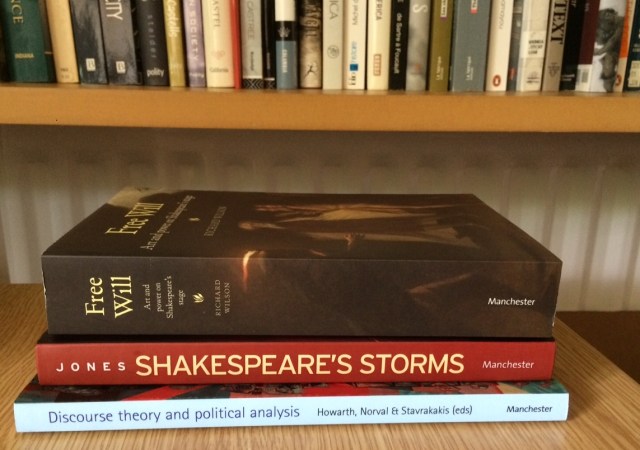
In recompense for review work for Manchester University Press – Richard Wilson, Free Will: Art and power on Shakespeare’s stage; Gwilym Jones, Shakespeare’s Storms and Discourse Theory and Political Analysis.

Posted in William Shakespeare | 1 Comment

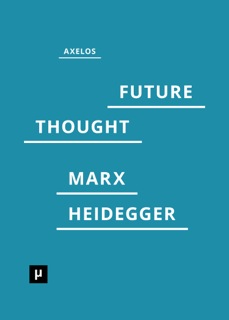
Kostas Axelos, Introduction to a Future Way of Thought: On Marx and Heidegger – out in June 2015 from Meson Press

Kostas Axelos, Introduction to a Future Way of Thought: On Marx and Heidegger – out in June 2015 from Meson Press.

The book was translated by Kenneth Mills, and edited and introduced by me. It will be open access online and print-on-demand. I’ve just received the proofs.

“Technologists only change the world in various ways in generalized indifference; the point is to think the world and interpret the changes in its unfathomability, to perceive and experience the difference binding being to the nothing.”

Axelos - Cover U1

Anticipating the age of planetary technology Kostas Axelos, a Greek-French philosopher, approaches the technological question in this book, first published in 1966, by connecting the thought of Karl Marx and Martin Heidegger. Marx famously declared that philosophers had only interpreted the world, but the point was to change it. Heidegger on his part stressed that our modern malaise was due to the forgetting of being, for which he thought technological questions were central. Following from his study of Marx as a thinker of technology, and foreseeing debates about globalization, Axelos recognizes that technology now determines the world. Providing an introduction to some of his major themes, including the play of the world, Axelos asks if planetary technology requires a new, a future way of thought which in itself is planetary.

Meson Press will be officially launched at ‘The Terms of Media‘ conference in Lüne­burg later this month. Hopefully the first physical copies of the Axelos book will be available for that.

Posted in Karl Marx, Kostas Axelos, Martin Heidegger | 2 Comments