Sam Kinsley has compiled a list of Geographers that blog, and followed this with a post questioning their focus, an excerpt of which was:
It was a surprise to me how quite a few of those blogs, with some honourable exceptions, are tightly focussed conduits for personal research and are not participating in wider online/offline conversations. One of the big claims made for blogging in the noughties was, of course, that ‘social’ media precisely enable broader conversations. While the majority of those active geography bloggers I found use wordpress.com for their blogs they do not seem to use the ‘social’ functions such as ‘reblog’ and other conversation tools on the platform.
Jeremy Crampton and Clive Barnett have engaged with this question on their own blogs. Jeremy talks more about the sharing question, including that of platforms; while Clive offers some very interesting reflections about why his blog, Pop Theory, began and what he uses it for. I’ve had all the above links sitting waiting for me to put them together in a post here. But I’m not sure I have much to add to what has already been said. And it reminded me that we’ve been here before. A bit of searching on this blog – another thing that it’s useful for – turned up this post from March 2011, which I’ll reproduce in full.
A recent discussion on crit-geog-forum, which began with a request for other blogs by geographers, had the question raised as to why anyone bothered with blogs? The commentator said that “it seems to add nothing, but gears and joys itself on self-serving romance”. I sent this reply, slightly edited, to the list.
As a notebook, as previous respondent David Murakami Wood suggested; as a noticeboard (I post/link to quite a lot of stuff that I think might be of interest); as a place where I can say things that I probably wouldn’t work up into publications, but which I think are interesting nonetheless; to publicise my own work, talks, etc.; as place that I can try out ideas and sometimes get feedback… the reasons go on.
Yes, much of it is personal (though there is much I don’t write about); and might be seen as self-serving – but then so are personal websites. Nobody forces you to read them. But it’s my blog, was set up for my own reasons, and the readership comes as an additional and pleasant second to that. I never expected to get regular readers, and have been quite surprised at the readership, both in terms of numbers, but also from where in the world – over 100 countries on the last count. Nothing I’ve written in more conventional media has come close to that.
My own blog aside, I completely disagree that they ‘add nothing’. I have a long list of blogs in google reader (now that bloglines is defunct), and find them invaluable as a source of information, provocation and inspiration. I now find them far more useful than email discussion lists.
Some things have changed – Google Reader is now also long gone, so I use Feedly; the readership of the blog is much larger than it was back in 2011; and I have less time now for the kind of substantive posts I’d like to write. So much of the blog is a noticeboard, for myself and for others, but it’s also – as Clive noted – still a place where I blog about my work, rather than blog parts of my work.
Some of the best discussions I’ve seen on blogs have been about how we work, rather than about our work. The key one, perhaps aside from the ‘why blog?’ question, is about writing. There were some good recent discussions on writing, many of which I linked to. There is also a discussion at An und Für Sich. This has long been a topic of interest to me, and has regularly come up in interviews, and some of the most popular pieces on this site have been about this topic – I’ve also been on a panel discussion on the topic. The focus has generally been about different strategies, and advice or suggestions, rather than instruction or direction. And so it’s nice that a discussion that began on a blog, and to which I linked, has led to an invitation to write about writing for a small book of multiple voices. The theme, fittingly, is not how to write, but how we write. I’m looking forward to contributing.

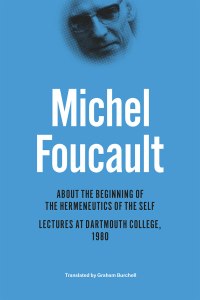 A few more details about Michel Foucault, About the Beginning of the Hermeneutics of the Self: Lectures at Dartmouth College, 1980, translated by Graham Burchell, are available at the University of Chicago Press site.