Thanks to ‘Sig Laser’ for sending me details of an interesting site-specific production of Shakespeare’s Antony in Cleopatra. The production is “a story of occupation, set on the pre-confederation plains of Manitoba during the fur trade”. From the accounts inThe Winnipeg Free Press comes this description of director Sarah Kitz’s vision:
Her idea — which will debut at SIR’s outdoor home in St. Norbert tonight — was to bring the story to the Red River in pre-Confederation times; Cleopatra and her Egyptians would be represented by indigenous Canadians, while Antony and the Romans would be portrayed as European fur traders.
“It shows us how relevant the play still is, because we are living in the colonial after-effects in this country,” she says. “Winnipeg predominately, and Canada at large, is really waking up to this conversation, so the timing of this show is quite spectacular in that way.
“It’s one more example of how Shakespeare can continue to be relevant when we are able to use his play as a frame for what is happening now.”
Last night I went to see Shakespeare’s Richard IIby Scena Mundi at St Bartholomew the Great church in London. A stunning setting and an exceptional performance. Richard II is a wonderful play and it will be the focus of a chapter of my planned book on Shakespeare and territory. (You can listen to the audio recording of a lecture I gave on the play at Purchase College, SUNY in April 2015 here). The space of the church was used to very good effect in this performance, and I thought Pip Brignall as Richard and Graham Pountney as John of Gaunt, the Bishop and the Gardener were especially good.
The play is paired with Christopher Marlowe’s Edward II in a season on ‘sad stories of the death of kings’. I’ll be going to Edward II later this month. The audience was very small, and the company deserved much better. If you’re in London, do pay them a visit – highly recommended.
Foucault Studies No 19 is now out. It is mainly a special issue on Disability, but includes a number of separate essays, reviews and the first translation of Foucault’s ‘Standing Vigil for the Day to Come‘, a 1963 review essay of Roger Laporte’s La veille.
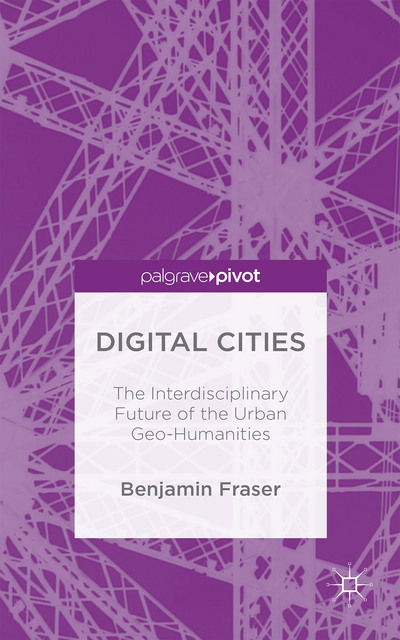
A mid-length Palgrave Pivot book being released here.
‘Making a strong case for interdisciplinary layering as a way to represent the many layers – physical, social, aesthetic – of the city, Fraser’s visionary book is as much a meditation on the future of the digital humanities itself as it is on the city as an object of humanistic inquiry. He cogently charts a course for how humanists will employ thick mapping as a way to practice the digital humanities.’ [–David J. Staley, Associate Professor of History and Adjunct Associate Professor of Design, Director of the Goldberg Center at The Ohio State University, USA]
Digital Cities stakes claim to an interdisciplinary terrain where the humanities and social sciences combine with digital methods. Part I: Layers of the Interdisciplinary City converts a century of urban thinking into concise insights destined for digital application. Part II: Disciplinary/Digital Debates and the Urban Phenomenon delves into…
The audio of lectures given by John Rawls to students in his course “Philosophy 171: Modern Political Philosophy” are being made available on YouTube by the Harvard Philosophy Department. The lectures were delivered at Harvard in the spring semester of 1984. There were eleven lectures. The first three are already up—one, two, and three. What was the first day of class with Rawls like? Listen:
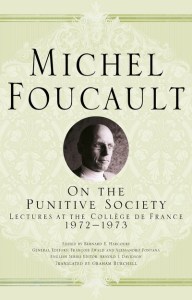
Michel Foucault, On the Punitive Society, translated by Graham Burchell, forthcoming from Palgrave – date unclear: Palgrave say June; Amazon August. Thanks to Chatham Vemuri for the link to the updated Palgrave page.
These thirteen lectures on the ‘punitive society,’ delivered at the Collège de France in the first three months of 1973, examine the way in which the relations between justice and truth that govern modern penal law were forged, and question what links them to the emergence of a new punitive regime that still dominates contemporary society.
Presumed to be preparation for Discipline and Punish, published in 1975, in fact the lectures unfold quite differently, going beyond the carceral system and encompassing the whole of capitalist society, at the heart of which is the invention of a particular management of the multiplicity of interweaving illegalisms.
The lectures, which stand as an essay in its own right, bring together hitherto unpublished historical material concerning classical political economy, the Quakers, English ‘Dissenters,’ and their philanthropy – the discourse of those who introduce the penitentiary into the penal – and the moralization of the worker’s time. Through his criticism of Thomas Hobbes, Michel Foucault offers an analysis of civil war that is not the war of all against all, but a ‘general matrix’ that makes it possible to understand the functioning of the penal strategy, the target of which is less the criminal than the social enemy within. On the Punitive Society is one of the great texts recounting the history of capitalism. Our human sciences prove to be, in the Nietzschean sense, ‘moral sciences.’
My review of this course was published at Berfrois early last year; a longer review essay is forthcoming from Historical Materialism, and a preprint is available here. These lectures will be extensively discussed in Foucault: The Birth of Power.
Last night I went to see the rarely performed King John at the Globe theatre in London. The production – the last of the canonical plays to be performed at the Globe – was timed to coincide with the 800th anniversary of the sealing of the Magna Carta by King John. The production was previously performed at Salisbury Cathedral and Temple Church, and though I like the Globe, I wish I’d seen it in one of those settings. Some of the ceremonial parts would surely have been very powerful in those buildings. (I’m going to see different productions of Richard II at the Globe later this summer, and at St Bartholomew the Great later this week. It will be interesting to compare the two.)
I was very interested to see King John, which I’d never seen before, partly because of its general interest, but also because it is one of only a handful of Shakespeare’s plays in which the word ‘territories’ appears. There is one mention in the opening scene, and one in the final act.
In the opening scene, it is used in a passage about the claim the French King is making to the English crown, on behalf of Arthur Plantagenet.
Philip of France, in right and true behalf
Of thy deceased brother Geoffrey’s son,
Arthur Plantagenet, lays most lawful claim
To this fair island, and the territories:
To Ireland, Poictiers, Anjou, Touraine, Mainei,
Desiring thee to lay aside the sword
Which sways usurpingly these several titles,
And put thy same into young Arthur’s hand,
Thy nephew and right royal sovereign.
What’s interesting about this passage is that editors frequently amend the text. The phrase ‘the territories’ is sometimes corrected to ‘her territories’ or ‘the territories of Ireland’, with the claim sometimes made that there are no other uses of the phrase in this way by Shakespeare. But given the paucity of references to ‘territory’ and ‘territories’ by Shakespeare I think we need to be careful in extrapolating anything from linguistic absence. It seems clearly a reference to a list of territories beyond ‘this fair island’, which are currently in the possession of the English crown.
The Arden Third Series of this text isn’t due for publication until 2016, so I’ve been working so far with the Second Series edition. (I really should get hold of the editions by Oxford or Cambridge and the new one from Penguin.) In the Arden the editor, E.A.J. Honigman, glosses “territories” as “i.e. dependencies”, and refers to a previous editor’s note (in the 1936 Cambridge edition) on this “rather odd use of the word”.
Yet as Honigmann notes, the term is used in the anonymous play, The Troublesome Reign of King John, which most people think was one of Shakespeare’s key sources for his play. It has even been suggested that Shakespeare was the author of that play too, and that the play in the Folio is his own revision of an earlier version. Honigmann in contrast argues that Shakespeare’s play precedes The Troublesome Reign, and is its major source. But whichever account is believed, the plays are within a few years of each other, and The Troublesome Reign shows that the use of the term ‘the territories’ to describe places, perhaps belonging to other places, as opposed to lands, belonging to someone, is not without precedent. The instance Honigmann selects is “King to England, Cornwall, and Wales, and to their territories”. But there are four instances of the term ‘territories’ in that earlier play, and one other in Shakespeare’s King John. In The Troublesome Reign the uses are all possessive: “Albion territories”; “our territories”; “your territories”; “their territories”. It is the same in the other King John reference, where towards the end of the play we are told by the Bastard that the King is “well prepar’d/To whip this dwarfish war, these pigmy arms,/From out the circle of his territories”. This sense of ‘territories’, as the lands under the possession of a ruler, is more common in Shakespeare’s use, and doesn’t receive an editor’s gloss in Arden. But ‘Albion territories’ and ‘the territories’ hint at something more.
Equally, the specific territories mentioned recur at several points in the play. King John, like the near-contemporary play Richard II, is very much a play about land, with the word recurring multiple times in the text. (Both plays, incidentally, are entirely in verse, and the only two of Shakespeare’s plays without at least some prose.) But while Richard II is a play that is frequently about the economic uses of land, its use, abuse and yield, King John is much more about conquest and inheritence. John, of course, was nicknamed sans terre, ‘lackland’, either because as a youngest child he was not expected to inherit (or perhaps later because of what he had lost).Both plays, of course, as many of Shakespeare’s histories, concern the question of lineage and succession.There are also some interesting passages which relate to King Lear‘s “interest of territory, cares of state”; and the relation between Robert and the Bastard has some similarities to and differences from the Edgar/Edmund subplot of Lear.
Interestingly, this production took some lines from The Troublesome Reign, and invented some of its own,notably the phrase about the ‘magna carta’, which is not mentioned or even alluded to in Shakespeare’s play. But it worked here, and the audience appreciated it. For most it sounded like a laugh of recognition; for me it was a jolt of surprise: where did that come from?
I was uncertain if or how King John would figure in my planned book on Shakespeare and territory, although I’d been thinking about it because of Fionnuala O’Neill’s piece “Toward Tyranny: Geopolitics and Genre, A Response to Stuart Elden” (requires subscription) which she wrote as a reply to my “The Geopolitics of King Lear: Territory, Land, Earth” (free download). I now definitely think there is enough to at least warrant a discussion of it in relation to some of the other history plays. Seeing this remarkable production, and going back over my notes on the play has reinvigorated my interest in it.
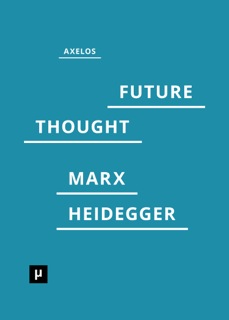
The book was translated by Kenneth Mills, and edited and introduced by me.
“Technologists only change the world in various ways in generalized indifference; the point is to think the world and interpret the changes in its unfathomability, to perceive and experience the difference binding being to the nothing.”
Anticipating the age of planetary technology Kostas Axelos, a Greek-French philosopher, approaches the technological question in this book, first published in 1966, by connecting the thought of Karl Marx and Martin Heidegger. Marx famously declared that philosophers had only interpreted the world, but the point was to change it. Heidegger on his part stressed that our modern malaise was due to the forgetting of being, for which he thought technological questions were central. Following from his study of Marx as a thinker of technology, and foreseeing debates about globalization, Axelos recognizes that technology now determines the world. Providing an introduction to some of his major themes, including the play of the world, Axelos asks if planetary technology requires a new, a future way of thought which in itself is planetary.


 Foucault Studies