New Series – Cultural Geographies: Rewriting the Earth

A new book series with Ashgate – Cultural Geographies: Rewriting the Earth

ashgatepublishing's avatarAshgate Publishing Blog

Posted by Katy Crossan, Senior Commissioning Editor

Ashgate is delighted to announce the launch of a new series, Cultural Geographies: Rewriting the Earth, with series editors Paul Kingsbury (Simon Fraser University, Canada) and Arun Saldanha (University of Minnesota, USA).

Social and Cultural Geography series postcard

Cultural geography has witnessed profound changes in recent years on three interrelated levels: theoretical, methodological, and socio-political. In terms of theory, new conceptions of culture have emerged which examine social and geographical differentiation as involving objects, affect, nonhumans, mobility, emotion, queerness, assemblage, materiality, the unconscious, biopolitics, relationality, and intersectionality. At the level of methodology, experiments with fieldwork and writing practices demonstrate the extent to which cultural geography has learnt from and contributes to many areas of policy, science, therapy, ethics, aesthetics, and activism. Finally, in terms of the socio-political and engagements with the world outside of academia, cultural geographers are exploring the multiple crises of energy, climate change, nationalism…

View original post 107 more words

Posted in Uncategorized | 1 Comment

Discards, Diverse Economies, and Degrowth Forum By Josh Lepawsky and Max Liboiron

A new forum of short open access pieces at the Society and Space open site.

Posted in Uncategorized | Leave a comment

Michel Foucault à Münsterlingen: À l’origine de l’Histoire de la folie – forthcoming in November 2015

1e14da743cMichel Foucault à Münsterlingen: À l’origine de l’Histoire de la folie – an intriguing collection of texts, photographs, correspondence and commentaries on Foucault in 1954 is forthcoming in November 2015. It revolves around a visit Foucault made to a Swiss clinic in Münsterlingen in 1954 for a ‘feast of fools’. This was also the year in which Foucault’s first book Maladie mental et personalité appeared, as well as his translation of Ludwig Binswanger’s Dream and Existence.

This book is in the same series as Le beau danger and La grande étrangère, which are translated with University of Minnesota Press as Speech Begins After Death and  Language, Madness and Desire, so perhaps an English translation will follow, though the Foucault in here seems only to be his correspondence with Binswanger and some notes on the history of psychiatry and Binswanger.

En 1954, Michel Foucault participe à une fête des fous à l’asile psychiatrique suisse de Münsterlingen, dont il reste des photos, inédites. Étrange cérémonie, survivance d’un rituel hérité directement du Moyen Âge, qui marqua le jeune philosophe en train d’élaborer une nouvelle manière de parler de la folie et de son histoire.

Cette visite de Michel Foucault en mars 1954 à l’asile psychiatrique suisse de Münsterlingen le jour d’un carnaval des fous nous apprend beaucoup à la fois sur le jeune philosophe – l’année 1954 est riche en événements pour lui –, mais aussi sur ce rituel qui a perduré jusqu’au milieu du xxe siècle.

Photos, archives, textes éclairent ce moment trop souvent négligé par les spécialistes de Michel Foucault. Ce début des années 1950 est pourtant marqué par l’entrée de Foucault dans les asiles et par sa passion pour les innovations qui touchent la psychologie clinique.
C’est la germaniste Jacqueline Verdeaux, munie d’un Leika, qui photographie. Ces images laissent entrevoir l’étrange sensation qu’a pu ressentir Foucault lors de ce jour improbable où les fous « jouent » aux fous. Une sensation d’autant plus étrange que l’asile cantonal est, avec la clinique universitaire du Burghölzli de Zürich, l’une des plaques tournantes de la psychiatrie suisse.
Ce livre, qui aborde une période inexplorée, et non abordée dans La Pléiade à paraître, nous pousse à renverser les perspectives familières concernant Michel Foucault.

Table of contents here.

Posted in Uncategorized | Leave a comment

Foucault’s posthumous publications – review in Inside Higher Education, and some corrections

image_miniTwo volumes of Foucault’s posthumous publications are reviewed in Inside Higher Education by Scott McLemee. The review looks at Speech Begins After Death and  Language, Madness and Desire, both published by University of Minnesota Press.

The review doesn’t say very much at all about the books themselves, and there are unfortunately some inaccuracies here. Dits et écrits was a posthumous collection, not a posthumous publication in a strict sense. All the texts within it had been published in Foucault’s lifetime, or were authorised by him and appeared after his death – i.e. the texts in the Technologies of the Self volume. The key addition of these volumes, other than convenience, was the translation of works published in Foucault’s lifetime in languages other than French. Lots of texts were excluded because they violated Foucault’s wish (which wasn’t in a formal will). Some were missed due to simple omission. But Defert was planning this collection from at least 1986, possibly earlier and maybe even during Foucault’s lifetime, so it’s not justified to make the inference about his mind being changed.

I think the key break with the ‘no posthumous publications’ request was in the lecture courses – not in the transcriptions themselves, but in the editorial notes, which frequently, and increasingly as the series went on, quote from the course manuscripts. By the time of Lectures on the Will to Know (2011), an entire article-length piece on Oedipus was in an appendix, and by then it was clear that more and more material was likely to be published. (The French original of Speech Begins After Death  was published the same year.)

It is also worth noting that On the Punitive Society is not the last of the Foucault courses to be translated; because there are two more to come, both of which are out in French. Finally, though this is a difference of view, not of accuracy, to my mind, Language, Madness and Desire contains quite a lot of new material which wasn’t clear from previous publications, notably on Sade. (My review of this volume is forthcoming in Cultural Geographies.)

Posted in Foucault's Last Decade, Foucault: The Birth of Power, Michel Foucault | Leave a comment

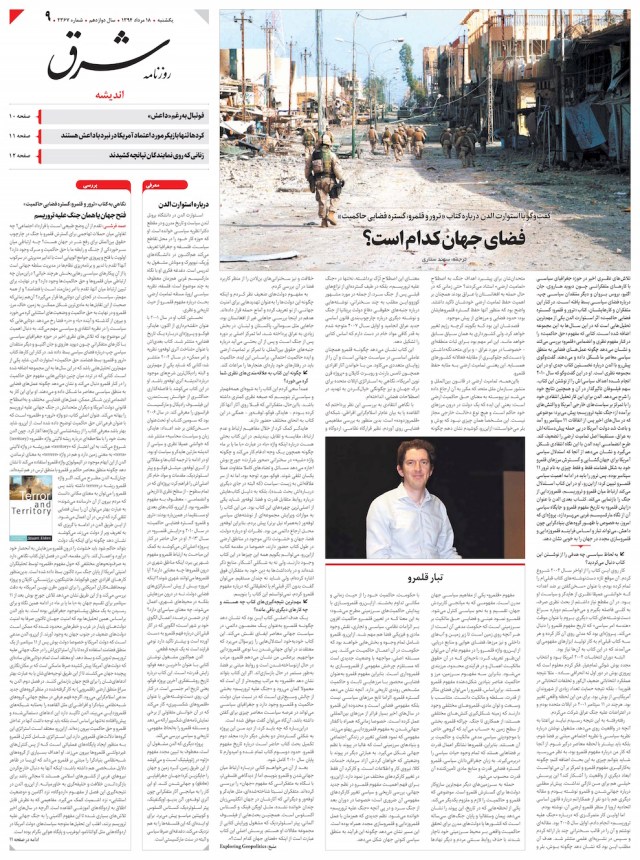
Feature on Terror and Territory (interview, review and profile) in Iran’s Shargh Daily

There is a full-page feature on my 2009 book Terror and Territory in Iran’s Shargh Daily newspaper. It was put together by Sahand Sattari, and includes a translation of an interview with Exploring Geopolitics, a review of the book, and a short profile of my background, publications and current projects. Many thanks to Sahand for his work.

Iran feature copy

Posted in My Publications, Territory, Terror and Territory | 2 Comments

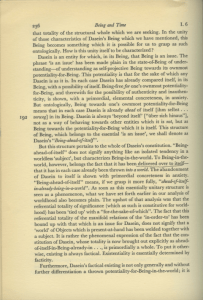
Hannah Arendt’s marginalia to Heidegger’s Being and Time

Screen Shot 2015-08-17 at 08.38.09Enowning shares the news from Bard College:

The marginalia in Hannah Arendt copy of Being and Time. Just a few underlinings. More here.

The disappointment, apart from the very few traces, is that this is of Being and Time in the Macquarrie and Robinson translation, not Sein und Zeit. That would be worth seeing.


Posted in Hannah Arendt, Martin Heidegger | 1 Comment

Travelling through words

Derek Gregory shares the text of his contribution to the ‘How We Write’ collection. Great stories and fascinating insights into the creative process.

Derek Gregory's avatargeographical imaginations

How-We-Write-cover-EAt Stuart Elden‘s suggestion, I’ve been invited to join a collaborative project initiated and edited by Suzanne Akbaricalled ‘How we write‘: it’s an interdisciplinary collection of short essays each of which describes how we write (and emphatically not how you ought to write…).

It will be published in remarkably short order by Punctum Books as a free downloadable volume; the contributors are Suzanne Conklin Akbari, Michael Collins, Alexandra Gillespie, Alice Hutton Sharp, Asa Simon Mittman, Jeffrey Jerome Cohen, Maura Nolan, Rick Godden, Bruce Holsinger, Stuart Elden and Steve Mentz.

There’s certainly not one way of writing, and as I roughed out my contribution I realised through talking with friends that even in my own field(s) the variety of writing practices is enormous and seemingly endless.  Trevor Barnes told me over lunch yesterday that he had once thought everyone wrote like him.  It turns out that we have much in common – we both find…

View original post 3,652 more words

Posted in Uncategorized | 1 Comment

Arctic seabed claims and the politics of mapping

Phil Steinberg on Arctic seabed claims and the politics of mapping.

philsteinberg's avatar

Following up on my recent blogpost on Russia’s Arctic seabed mapping, The Conversation has published a companion piece on some of the politics surrounding the map, its drawing, and its reception. The Conversation article integrates analysis of some of the recent (manufactured) controversy surrounding the Russian claim with reflections that I made earlier this year on the map’s seven-year history. Screen Shot 2015-08-14 at 11.42.29

For more on Russia’s recent claim and what it means (and doesn’t mean), see also this recent article in the New Scientist by the map’s designer, Martin Pratt.

View original post

Posted in Uncategorized | 1 Comment

13 new papers and a video abstract – “The Necessity of Dialectical Naturalism: Marcuse, Bookchin, and Dialectics in the Midst of Ecological Crises”

Several new Antipode papers online, including Christian Parenti’s ‘The Environment Making State’.

Antipode Editorial Office's avatarAntipodeFoundation.org

It’s not quite the middle of August and the September issue of Antipode is out now! Antipode 47(4) really showcases critical geography at its very best: timely topics, engaged research, engaging writing…

We open with Christian Parenti’s 2013 Antipode AAG Lecture, The Environment Making State: Territory, Nature, and Value (which is open access; there’s a video of the lecture itself here); for more on the state’s “natures”, see the next paper, Infrastructure Nation: State Space, Hegemony, and Hydraulic Regionalism in Pakistan by Majed Akhter.

We’re pleased to present here a video abstract featuring Shannon Brincat and Damian Gerber talking about their paper, The Necessity of Dialectical Naturalism: Marcuse, Bookchin, and Dialectics in the Midst of Ecological Crises. Whilst primarily a theoretical analysis focused on the work of Marcuse and Bookchin, their paper, they contend, has important implications for ecological praxis. It exposes the ontological hole at the heart of the dominant (mis)conceptualisation…

View original post 375 more words

Posted in Uncategorized | Leave a comment

Top posts on Progressive Geographies this week

Posted in Uncategorized | Leave a comment