Louis Althusser’s seminars at the École Normale Supérieure (ENS) are of course best known for the famous Reading Capitalvolume, which developed from his 1964-65 seminar. He ran seminars on the young Marx in 1961-62 and Lacan and psychoanalysis in 1963-64. I’ve written about his 1962-63 seminar before in The Archaeology of Foucault (pp. 14-15). This seminar was on structuralism, and Althusser spoke about Foucault and Lévi-Strauss. Among other contributions, Pierre Macherey spoke about Canguilhem – a piece which was published with an introduction by Althusser in 1964. Balibar’s notes from that seminar and some other materials are at IMEC, and I was able to use them back in 2020.
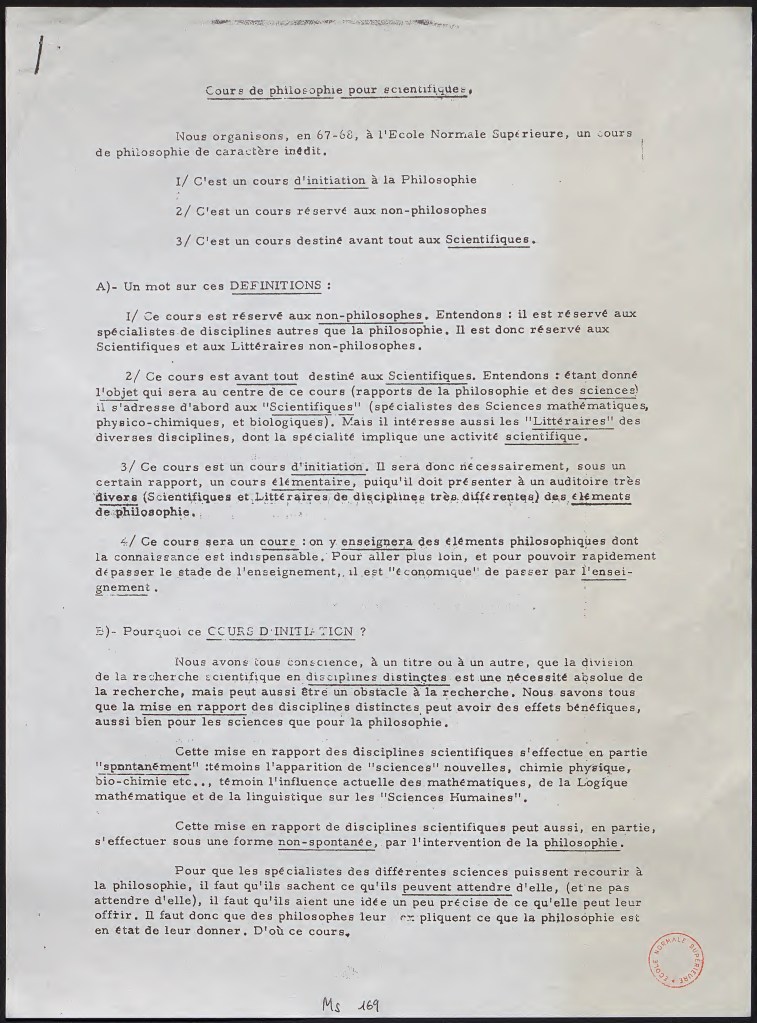
Between 1967 and 1968 Louis Althusser and some of his students delivered a course at the ENS pitched as ‘philosophy for scientists’ or non-philosophers. Some parts of the course have been published, including Alain Badiou’s Le concept du modèlein 1969 and Michel Fichant and Michel Pécheux, Sur L’histoire des sciencesshortly afterwards. Badiou’s text was reissued by Fayard in 2007 and translated as The Concept of Modelby re:press that same year.
These early volumes indicate others to follow. In Badiou’s book the list reads:
Introduction (Louis Althusser)
Expérience et Expérimentation (Pierre Macherey and Etienne Balibar)
La «coupure épistémologique» (François Regnault, Michel Péchaux)
Le Concept de Modéle (Alain Badiou)
L’idée d’une histoire des sciences (Michel Fichant)
Conclusion provisoire
Between Badiou’s book and the Fichant and Pécheux one the structure of the series changed, with François Regnault withdrawing his contribution, and the third and fifth volumes being merged. Althusser’s Introduction was eventually published in 1974, as Philosophie et philosophie spontanée des savants (1967), and was translated in Philosophy and the Spontaneous Philosophy of the Scientists. The French text is, I think, out of print, but available on Gallica. More recently, G.M. Goshgarian has edited Althusser’s text Initiation à la philosophie pour les non-philosophes, andtranslated it as Philosophy for Non-Philosophers,but that is a later text which seems distinct from this project, although clearly linked to it in its approach.
The series as listed in the Badiou and Fichant/Pécheux volumes
Pierre Macherey is very good on the history of the course and the series, in a piece translated in Parrhesia in 2009. He indicates that a fifth lecture which Althusser planned for the concluding volume was published posthumously in Althusser’s Écrits philosophiques et politiques, under the title “Du coté de la philosophie”.
In that piece, Macherey mentions that the original roneotypes of the course materials are available at the ENS archives, donated by Balibar. They have also been made available online to read or download at archive.org
The first page of the lecture typescripts
The ENS description reads:
Louis Althusser. Cours de philosophie pour scientifiques organisés à l’Ecole normale supérieure
Papier. Documents ronéotypés. 175 f. 325 x 240 mm.
Cours organisés par Louis Althusser : 5 cours de Louis Althusser, 3 cours de Pierre Macherey, 3 cours d’Etienne Balibar, et 1 cours de François Regnault.
Some of the Althusser texts mentioned above, and the Badiou one, are reasonably well known. The Fichant and Pëcheux volume is interesting for some of the debates about epistemology and science with which Foucault and Canguilhem were involved. The availability of the archive material of the course means that there is more material for people to work with…
Louis Althusser, Jacques Rancière, Pierre Macherey, Étienne Balibar, Roger Establet, Lire le Capital, Paris: François Maspero, two volumes, 1965; Reading Capital: The Complete Edition, trans. Ben Brewster and David Fernbach, London: Verso, 2016.
Louis Althusser, Philosophie et philosophie spontanée des savants (1967), Paris: François Maspero,1974; “Philosophy and the Spontaneous Philosophy of the Scientists”, trans. Warren Montag, in Gregory Elliott ed. Philosophy and the Spontaneous Philosophy of the Scientists, London: Verso, 1990, 69–165.
Louis Althusser, Initiation à la philosophie pour les non-philosophes, ed. G.M. Goshgarian, Paris: Presses Universitaires de France, 2014; Philosophy for Non-Philosophers, ed. and trans. G.M. Goshgarian, London: Bloomsbury, 2017.
Louis Althusser, “Du coté de la philosophie (cinquième Cours de philosophie pour scientifiques”, Écrits philosophiques et politiques, ed. François Matheron, Paris, Stock/IMEC, 2 volumes, 1994, Vol II, 265-310.
Alain Badiou, Le concept du modèle, Paris: François Maspero, 1969, reissue Paris: Fayard, 2007; trans. The Concept of Model: An Introduction to the Materialist Epistemology of Mathematics, trans. Zachary Luke Fraser and Tzuchien Tho, Melbourne: re:press, 2007.
Louis Althusser et. al. “Séminaire 1962-1963”, Fonds Louis Althusser, IMEC, 813ALT/40/4, 813ALT/40/5 and 813ALT/40/6
This piece develops an earlier post about this course from January 2022. I’ve revised the text and expanded the references, in a similar style to what I’ve been doing with the ‘Sunday histories‘ posts.
Presenting a new historical narrative on European integration and identity this title examines how the concept of Europe has been entangled in a dynamic and dramatic tension between calls for unity and arguments for borders and division. Through an in-depth intellectual history of the idea of Europe, Mats Andren interrogates the concept of integration and more recent debates surrounding European identity across the nineteenth and early twentieth centuries and the post-war period. Applying a broad range of original sources this unique work will be key reading for students and researchers studying European History, European Studies, Political History and related fields.
Towards the end of her life, Virginia Woolf defined her “philosophy”-the “constant idea” that “makes her a writer.” She wrote that this idea had given her “the strongest pleasure known to [her].” She called these “exceptional moments,” or “moments of being.” Thomas Nail contends that Woolf is a philosopher of being. And these “moments of being” as forming a unique process philosophy of motion. In her description of these moments Woolf gives us access to a world in motion and process; where all of nature and matter flows, ripples, and quivers. In these moments the anthropocentric division between humans and nature dissolves into metastable patterns-without essences or vital forces. Matter becomes dynamic, and what originally appeared solid is perceived as woven, porous, and fluid.
The Philosophy of Virginia Woolf beginsby defining the basic idea of the moment of being, why it is important and how to understand it and its philosophical implications. It recounts a series of 14 ‘moments’ each of which explores an aspect of Woolf’s philosophy. They show how the moments evolve and articulate Woolf’s process philosophy of movement. Each moment reveals unique aspects of how moments work and the kind of philosophical vision Woolf held. Nail concludes by addressing some of the ethical and political consequences of these moments in Woolf ‘s thinking. In the end, the book contends that Woolf offers us an absolutely unique philosophical and aesthetic understanding of phenomena, including nature, culture, desire, gender, writing/reading, consciousness, art, ecology, and sensation. Itshows that Woolf is a philosopher in her own right, and held a unique philosophical position that makes a unique contribution to how to think in the world.
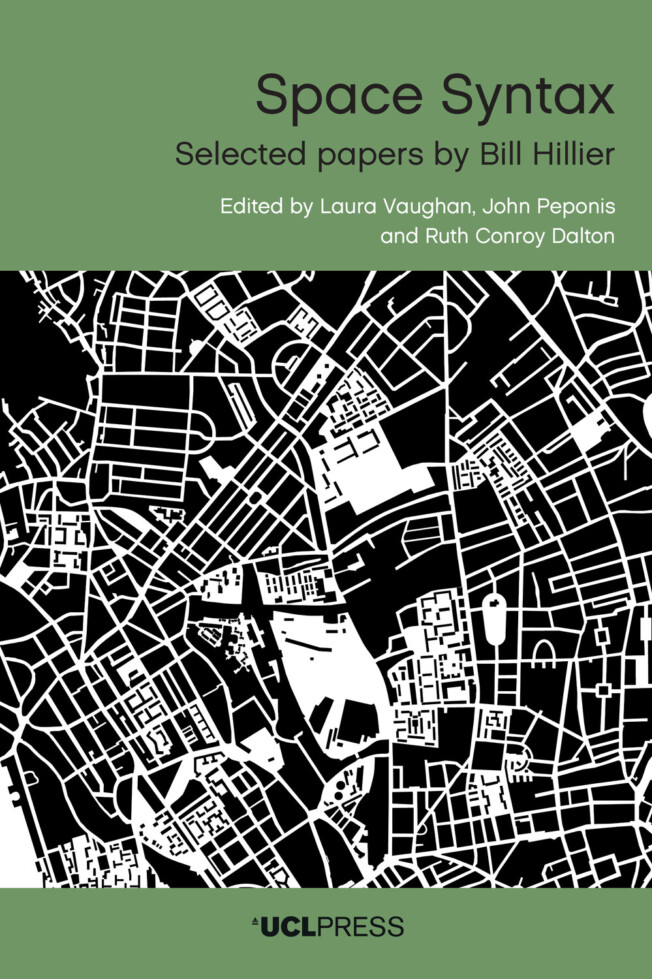
Professor Bill Hillier spent most of his career at The Bartlett, University College London, where he founded and developed, with a team of colleagues, an original research programme that set the study of architecture on a firm scientific basis. His transformational way of thinking about buildings and cities influenced generations of scholars, researchers and practitioners within the built environment disciplines and way beyond – in fields ranging from archaeology and biology to physics and zoology.
Space Syntax: Selected papers by Bill Hillier provides a canon of works that reflects the progression of Hillier’s ideas from the early publications of the 1970s to his most recent work, published before his death in 2019. This selection of influential works ranges from his papers on architecture as a professional and research discipline, through to his later papers that present a theory of the spatial structure of the city and its social functions. By bringing together writing from across his career-span of half a century, with specially commissioned introductions by a wide range of international experts in the field, we are able to contextualise and show the range and evolution of Hillier’s key ideas.
The support for refugee scholars to come to the United States of America in the 1930s and 1940s is well known. Varian Fry famously helped several hundred European artists and intellectuals to flee Vichy France between 1940 and 1941. The Rockefeller Foundation also supported various academics, as did the Society for Protection of Science and Learning in the United Kingdom. I’ve done some work with these archives before. The records of the Emergency Committee in Aid of Displaced Foreign Scholars are at the New York Public Library, and there are some interesting stories to be told about their support.
The Emergency Committee operated between 1933 and 1945, initially focused on Jewish scholars in Germany, and then extending to other parts of Europe. It was originally called the Emergency Committee in Aid of Displaced German Scholars and changed its name in 1938. The funds were not given directly to the academics, but to universities or other places that would appoint them to positions, often as matching funds. In this way, universities could provide support to a displaced person, but have the benefit of appointing someone for a fraction of the usual cost, often in a temporary or entry-level post. The Emergency Committee supported Claude Lévi-Strauss, Ernst Kantorowicz, Alexandre Koyré, Jean Wahl and many others.
The Russian-born linguist Roman Jakobson had moved to Czechoslovakia in 1920, and taught mainly at the University of Brno, while also being a founding member of the Prague Linguistic Circle. He fled Czechoslovakia in March 1939, just as Germany invaded. He initially went to Denmark, then to Norway, and finally into Sweden. Stephen Rudy tells the story of crossing the Norwegian-Swedish border in a cart, with Jakobson in a coffin and his wife acting as the grieving widow (“Introduction”, x). Jakobson taught in all these Scandinavian countries, including general linguistics and Paleo-Siberian languages at the University of Oslo, and Russian at the University of Uppsala. He felt that the Nazis were following him from one refuge to another. In 1941 he boarded a ship to the United States, along with Ernst Cassirer and both of their wives. Jakobson taught at the École Libre des Hautes Études from 1942, at Columbia University from 1943, and later at Harvard University and MIT.
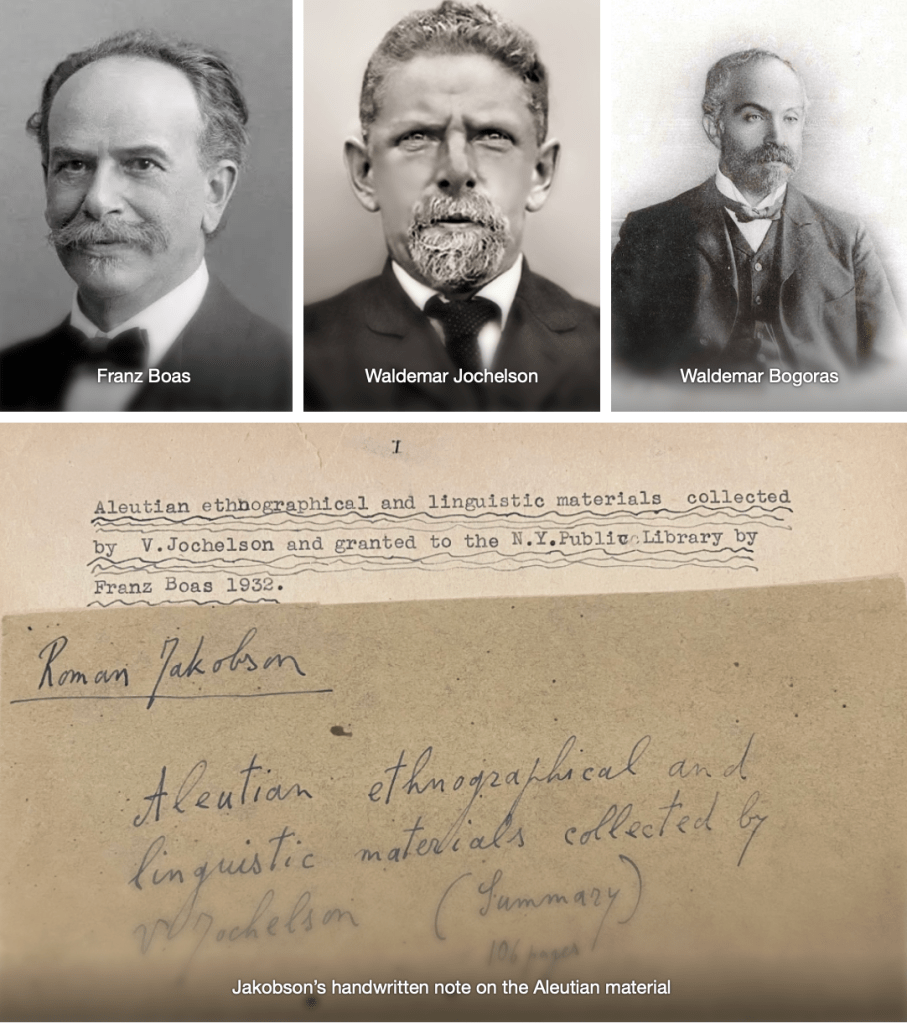
But his first work in the United States was a bit different than going straight into teaching. He worked for the New York Public Library (NYPL) on some Aleutian material collected by the anthropologist Franz Boas, and later on other languages spoken across eastern Siberia and Alaska. The work concerned collections originally made by Waldemar Jochelson in the Aleutian Islands and Kamchatka in 1909-10 for the Russian Geographical Society, and Waldemar Bogoras’s ethnographic papers from time in the northeast of Siberia in 1901. In June 1941 the NYPL asked the Emergency Committee if they could supplement the $50 per month they could afford to pay Jakobson in order for him to catalogue and organise the material. They said Jakobson’s specialism in East Siberian languages would make him well placed to work on these papers.
A composite image of Franz Boas, Waldemar Jochelson and Waldemar Bogoras, and the typed and handwritten title pages of the Aleutian material in the New York Public Library
Although the initial reaction of the Emergency Committee was that support was unlikely, given the short-term nature of the contract, the committee members consulted were in favour. A note about Jakobson found in the Emergency Committee files shows that he was interviewed by a representative of the Committee. The report notes that he was “an earnest, consecrated, unworldly man – very absorbed in his work”. Matching funding was given, and Jakobson was employed for five months at $100 a month, although the decision was not approved until October 1941. He did not actually begin the work until 1 April 1942, and Boas was already concerned that these five months would be insufficient to complete the study. From correspondence quoted by his biographer Rosemary Lévy Zuwalt, it is clear that Boas was trying to find ways to support Jakobson: “He is a man of unusual knowledge and of great scientific attainment. I am seeing him often, and I have great respect for his knowledge and methods” (Boas to Alfred Louis Kroeber, 19 February 1942, cited in Franz Boas: Shaping Anthropology and Fostering Social Justice, 394; see also the letters in Swiggers, “Roman Jakobson’s Struggle in War-Time America”).
One letter from Jakobson indicates that he stayed at Boas’s home, and was doing some work for him on the links between Aleut and Gilyak before he was formally employed by the NYPL. Gilyak, also known as Nivkh, was spoken in Russia’s far east, in the area sometimes known as Russian Manchuria. In the letter, Jakobson says he was also doing research on the relatively unknown Yiddish-Czech language spoken by medieval Czech Jews, for the Yiddish Scientific Institute (YIVO), also in New York (Jakobson to Boas, 11 September 1941). He had met YIVO co-founder Max Weinrich in Copenhagen at the Fourth Congress of Linguistics in August 1936 (Jakobson to YIVO, 27 February 1969, Rachel Erlich papers, box 5). Some of Jakobson’s work for YIVO was published in “The City of Learning: The Flourishing Period of Jewish Culture in Medieval Prague” in The American Hebrew in December 1941. Jakobson there says he is “preparing a special detailed study about the ‘Canaan language’ in Jewish medieval culture” (p. 373). In a later piece he describes this as a book entitled Czech in Medieval Hebrew Sources (Selected Writings, Vol VI.2, 886). That study was never completed, though Jakobson did work on Canaanic (see Dittmann, “Roman Jakobson’s Research into Judeo-Czech”; Bláha et. al. “Roman Jakobson’s Unpublished Study on the Language of Canaanite Glosses”). He would also occasionally publish on Yiddish, writing a preface to Uriel Weinreich’s College Yiddish in 1949 (pp. 9-10). Uriel was the son of Max, with whom Jakobson would occasionally work. Jakobson and Morris Halle contributed to Max Weinreich’s Festschrift on “The Term ‘Canaan’ in Medieval Hebrew”. Although not published until 1964, this text was drafted in New York in 1942-44, before being completed in 1962 (see Selected Writings, Vol VI.2, 886).
Jakobson assimilated the material he was tasked with working on at the NYPL quickly into his previous knowledge. An earlier project with Nicolai Trubetzkoy, begun in the late 1920s, on the “Languages of the USSR” had been abandoned (see Nikolai Vakhtin, “Indigenous Minorities of Siberia and Russian Sociolinguistics of the 1920s”, especially 182-83; and Brandist, “Marxism and the Philosophy of Language in Russia in the 1920s and 1930s”). Jakobson published a survey on “The Paleosiberian Languages” in the American Anthropologist, which was published in the final issue of 1942. (This and “The City of Learning” were two of Jakobson’s very first publications in English; after previous publications in Russia, Czech, German and French.) Jakobson also began teaching at the École Libre in the 1942-43 academic year, in rooms provided by the New School. One of the first courses he led was a collaborative seminar on The Song of Igor, which led to the project I’ve discussed before – here and here.
This École Libre teaching was also supported by the Emergency Committee, who part-funded many of the French and Belgian academics who were teaching there. An application was also made to the Rockefeller Foundation to support Jakobson, but this was turned down. Noting this in his correspondence to the Emergency Committee, New School director Alvin Johnson said that his “own opinion of Jakobson is more favorable, perhaps because I have no bias against the Prague School of Philology. Jakobson seems to me an exceptionally brilliant scholar, and a most inspiring teacher” (5 October 1942). Writing in support of this application, the NYPL said that Jakobson “has just completed a study of Aleutian manuscript material from the point of view of language and folklore” (9 October 1942). The Emergency Committee supported his École Libre post with a grant of $1200, matched by the École Libre from other sources. The funding was renewed in subsequent years.
Boas died on 21 December 1942, and so did not live to see the results of the cataloguing work. Jakobson approached the NYPL and the Emergency Committee again in 1944 to ask if they would support him doing similar work on Kamchadal and ‘Asiatic Eskimo’ collections which Boas had given to him. (I am using ‘Eskimo’ as the historical term used to describe this material, as it appears in the letters and reports.) The Kamchadal materials were in the Jochelson papers; the Eskimo in the Bogoras papers. Jakobson told the NYPL and the Committee that Boas had wanted this material deposited in a library only after Jakobson had arranged and catalogued it. This support was given in June 1944, on the same terms as before – $250 from the Committee, with matching funds from the NYPL, for five months work, which began in the autumn.
Some parts of Jakobson’s cataloguing work were reported in two articles by Avrahm Yarmolinsky in the Bulletin of the New York Public Library in 1944 and 1947, both of which include material by Jakobson. Yarmolinksky was head of the Slavonic division of the NYPL from 1918-55. For the most part the two articles present folktales in English translations. The 1944 article has “A Note on Aleut Speech Sounds” by Jakobson and a bibliography he had prepared on Aleutian; the 1947 article a bibliography of work on Kamchadal and Eskimo. Jakobson’s work was described by Yarmolinksky as follows:
He corrected the summaries [of the folktales] and supplied them where they were lacking, and also classified the tales according to their dialect, literary style and subject-matter. Further, he added a note intended to clarify the phonology of the Eastern dialect of Aleut and simplify its transcription (“Aleutian Manuscript Collection”, pp. 671-72).
In 1944, Jakobson published an article on “Franz Boas’ Approach to Language”, written in tribute in summer 1943. He would write another tribute for the centenary of Boas’s birth in 1959.
Although Jakobson worked on many other topics, he did complete, or enable, some of these linguistic projects began during the War. In 1957, together with Gerta Hüttl-Folter and John Fred Beebe, Jakobson produced a two-hundred-page bibliographical guide to Paleosiberian Peoples and Languages. That year he also finally completed a study of the Gilyak language group, “Notes on Gilyak”, which he says he first began in Norway in 1939-40, worked on in Sweden in 1941, and discussed with Cassirer on the boat from Sweden to New York (see Selected Writings, Vol II, p. 97). Dean Stoddard Worth published the Kamchadal Texts Collected by Waldemar Jochelson in 1961. In his Introduction he thanks Jakobson: “at whose suggestion this work was begun, and thanks to whose constant help and advice it was finished” (p. 11).
In 1977 Robert Austerlitz surveyed Jakobson’s works on Paleosiberian languages, indicating the published materials, including the two notes in the Bulletin of the New York Public Library articles, and some unpublished conference papers, but not the manuscript material. He makes this point concerning the importance of Jakobson’s work in this area: “In sum, then, the Paleosiberian field has benefited from Jakobson the theoretician and general linguistics from Jakobson the Paleosiberianist” (p. 18).
Finally, in 2023, Nikolai B. Vakhtin published most of Jakobson’s report on the Jochelson material. The article discussing the work is in Russian, but the report is reproduced in English. Vakhtin includes the introduction, the notes on dialectic and motifs, and the grammar, but only a few of the notes on the individual folktales. The part which Yarmolinsky published on the phonology of the languages is shown to have been edited by him, and Vakhtin publishes Jakobson’s original text. As far as I know, the briefer reports Jakobson made on the Kamchadal and Eskimo material have not been published. Reading them gives a clear sense of how Jakobson was able to engage with so many different researchers, from linguistics to literature, to anthropology and mythology. All these reports, and the material they are cataloguing, are in the New York Public Library archives.
References
Robert Austerlitz, “The Study of Paleosiberian Languages” in Daniel Armstrong and C. H. van Schooneveld (eds.). Roman Jakobson: Echoes of his Scholarship, Lisse: Peter de Ridder, 1977, 13–20.
Ondřej Bláha, Robert Dittmann, Karel Komárek, Daniel Polakovič and Lenka Uličná, “Roman Jakobson’s Unpublished Study on the Language of Canaanite Glosses”, Jews and Slavs 24, 2012, 282-318.
Craig Brandist, “Marxism and the Philosophy of Language in Russia in the 1920s and 1930s”, Historical Materialism 13 (1), 2005, 63-84.
Robert Dittmann, “Roman Jakobson’s Research into Judeo-Czech”, in Tomáš Kubíček and Andrew Lass eds. Roman O. Jakobson: A Work in Progress, Olomouc: Palacký University, 2014, 145-53.
Murray B. Emeneau, “Franz Boas as a Linguist”, American Anthropologist 45 (3) part 2,1943, 35-38 (No 61 of Memoir Series of the American Anthropological Association, “Franz Boas, 1858-1942”).
Roman Jakobson, “The City of Learning: The Flourishing Period of Jewish Culture in Medieval Prague” [1941], reprinted in Selected Writings, Vol IX.2, 371-79.
Roman Jakobson, “The Paleosiberian Languages”, American Anthropologist 44 (4), 1942, 602-20, reprinted in Selected Writings, Vol IX.2, 385-407.
Roman Jakobson, “Franz Boas’ Approach to Language”, International Journal of American Linguistics 10 (4), 1944, 188-95, reprinted in Selected Writings, Vol II, 477-88.
Roman Jakobson, “Notes on Gilyak” [1957], reprinted in Selected Writings, Vol II, 72-97.
Roman Jakobson, “Boas’ View of Grammatical Meaning” [1959], reprinted in Selected Writings,Vol II, 489-96.
Roman Jakobson, Selected Writings, The Hague: Mouton & Co, nine volumes, 1962-
Roman Jakobson and Morris Halle, “The Term ‘Canaan’ in Medieval Hebrew” [1964], reprinted in Selected Writings, Vol VI.2, 858-86.
Roman Jakobson, Gerta Hüttl-Folter and John Fred Beebe, Paleosiberian Peoples and Languages: A Bibliographical Guide, New Haven: HRAF Press, 1957.
Rosemary Lévy Zumwalt, Franz Boas: The Emergence of the Anthropologist, Lincoln: University of Nebraska Press, 2019.
Rosemary Lévy Zumwalt, Franz Boas: Shaping Anthropology and Fostering Social Justice, Lincoln: University of Nebraska Press, 2022.
Stephen Rudy, “Introduction”, in Roman Jakobson, My Futurist Years, ed. Bengt Jangfeldt and Stephen Rudy, New York: Marsilio, 1997, ix-xxvi.
Dean Stoddard Worth, Kamchadal Texts Collected by Waldemar Jochelson, The Hague: Mouton, 1961.
Pierre Swiggers, “Roman Jakobson’s Struggle in War-Time America: More Epistolary Testimonies”, Orbis 36, 1993, 281-85.
Nikolai Vakhtin, “Indigenous Minorities of Siberia and Russian Sociolinguistics of the 1920s: A Life Apart?”, Acta Borealia 32 (2), 2015, 171-89.
Nikolai B. Vakhtin, “Roman Jakobson and the Aleut Materials Collected by Waldemar Jochelson”, Voprosy Jazykoznanija 4, 2023, pp. 117-28, doi: 10.31857/0373-658X.2023.4.117-128
Uriel Weinreich, College Yiddish, New York: YIVO Institute for Jewish Research, 1974 [1949].
Avrahm Yarmolinsky, “Aleutian Manuscript Collection”, Bulletin of the New York Public Library, 48 (8), 1944, 671-80.
Avrahm Yarmolinsky, “Kamchadal and Asiatic Eskimo Manuscript Collections: A Recent Accession”, Bulletin of the New York Public Library 51(11), 1947, 659-69.
Thank you to Ondřej Bláha and Pierre Swiggers for sharing hard-to-find publications; and the archives listed above for access to materials.
This is the twenty-second post of a weekly series, where I post short essays with some indications of further reading and sources, but which are not as formal as something I’d try to publish more conventionally. They are usually tangential to my main writing focus, a home for spare ideas, asides, dead-ends and possible futures. I hope there is some interest in them. They are provisional and suggestions are welcome.
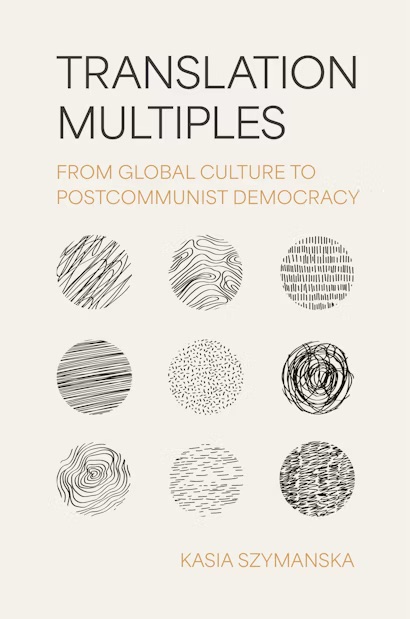
In Translation Multiples, Kasia Szymanska examines what happens when translators, poets, and artists expose the act of translation by placing parallel translation variants next to one another in a standalone work of art, presenting each as a legitimate version of the original. Analyzing such “translation multiples” as a new genre of writing, Szymanska explores how an original text can diverge into variants, how such multiplicity can be displayed and embraced, and how the resulting work can still be read as a coherent text. To do so, she focuses on contemporary projects in two different contexts—Anglophone experimental practices and post–1989 Poland’s emergence into democracy—while viewing them against the backdrop of twentieth-century cultural and political developments.
Szymanska first takes a broad look at Anglophone global culture, debunking the myth of translation as a transparent medium and an unoriginal, secondary form of writing. She then turns to postcommunist Poland, where projects introducing multiple translation variants with different ideological readings offered an essential platform for pluralist political discussion. She examines in particular an elaborate metatranslation of “La Marseillaise”; a triple rendering of Anthony Burgess’s novel A Clockwork Orange; and a quadruple book of Bertolt Brecht’s poetry with distinct readings by four translators. She argues that the creators of such multiples want to tell their own stories—personal, critical, visual, or political. Showing why multiple translations matter, Szymanska calls for a redefined practice of reading translations that follows the ethics of the multiple.
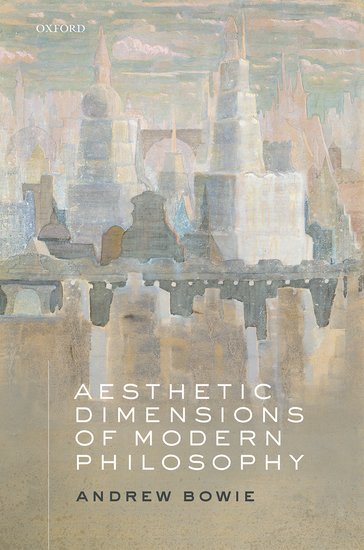
Cover of book shows Mikalojus Konstantinas Ciurlionis, The City (1908)
Much of contemporary philosophy, especially in the analytical tradition, regards aesthetics as of lesser significance than epistemology, ethics, metaphysics, and the philosophy of language. Yet, in Aesthetic Dimensions of Modern Philosophy, Andrew Bowie explores the idea that art and aesthetics have crucial implications for those areas of philosophy.
In the modern period, the growth of warranted scientific knowledge is accompanied both by heightened concern with epistemological scepticism and a new philosophical attention to art and the beauty of nature. This suggests that modernity involves problems concerning how human beings make sense of the world that go beyond questions of knowledge, and are reflected in the arts. The relationship of art to philosophy is explored in Montaigne, Descartes, Hume, Kant, Schelling, the early German Romantics, and Hegel. This book also considers Cassirer’s and the hermeneutic tradition’s exploration of close links between meaning in language and in art. The work of Karl Polanyi, Marx, Nietzsche, Heidegger, Adorno, Dewey, and others is used to investigate how the modern sciences and the development of capitalism change both humankind’s relations to nature and the nature of value, and so affect the role of art in human self-understanding. The aesthetic dimensions of modern philosophy can help to uncover often neglected historical shifts in how ‘subjective’ and ‘objective’ are conceived. Seeing art as a kind of philosophy, and philosophy as a kind of art, reveals unresolved tensions between the different cultural domains of the modern world and questions some of the orientation of contemporary philosophy.
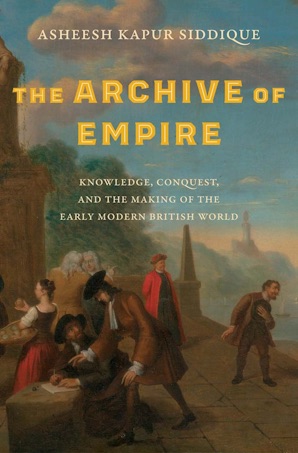
How modern data-driven government originated in the creation and use of administrative archives in the British Empire
Over the span of two hundred years, Great Britain established, governed, lost, and reconstructed an empire that embraced three continents and two oceanic worlds. The British ruled this empire by correlating incoming information about the conduct of subjects and aliens in imperial spaces with norms of good governance developed in London. Officials derived these norms by studying the histories of government contained in the official records of both the state and corporations and located in repositories known as archives.
As the empire expanded in both the Americas and India, however, this system of political knowledge came to be regarded as inadequate in governing the non-English people who inhabited the lands over which the British asserted sovereignty. This posed a key problem for imperial officials: What kind of knowledge was required to govern an empire populated by a growing number of culturally different people? Using files, pens, and paper, the British defined the information order of the modern state as they debated answers to this question. In tracing the rise and deployment of archives in early modern British imperial rule, Asheesh Kapur Siddique uncovers the origins of our data-driven present.
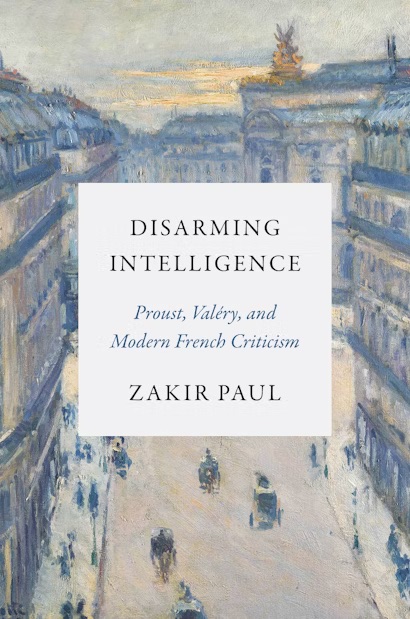
In the late nineteenth century, psychologists and philosophers became intensely interested in the possibility of quantifying, measuring, and evaluating “intelligence,” and using it to separate and compare individuals. Disarming Intelligence analyzes how this polyvalent term was consolidated and contested in competing discourses, from fin de siècle psychology and philosophy to literature, criticism, and cultural polemics around the First World War.
Zakir Paul examines how Marcel Proust, Henri Bergson, Paul Valéry, and the critics of the influential Nouvelle revue française registered, negotiated, and subtly countered the ways intelligence was invoked across the political and aesthetic spectrum. For these writers, intelligence fluctuates between an individual, sovereign faculty for analyzing the world and something collective, accidental, and contingent. Disarming Intelligence shows how literary and critical styles questioned, suspended, and reimagined what intelligence could be by bringing elements of uncertainty and potentiality into its horizon. The book also explores interwar political tensions—from the extreme right to Walter Benjamin’s engaged essays on contemporary French writers. Finally, a brief coda recasts current debates about artificial intelligence by comparing them to these earlier crises of intelligence.
By drawing together and untangling competing conceptions of intelligence, Disarming Intelligence exposes its mercurial but influential and urgent role in literary and cultural politics.