Charlotte Epstein on The Birth of Territory at Progress in Political Economy

Progress in Political Economy have posted one of the papers on my book The Birth of Territory from a workshop in Sydney. My thanks to Charlotte Epstein for the thoughtful engagement, and Adam David Morton at PPE for posting this.

Last month the University of New South Wales hosted a one-day workshop entitled ‘Geopolitics, Geopower, Geometrics’, with Stuart Elden (University of Warwick) including a focus on his award-winning book The Birth of Territory (11 March 2015). The roundtable included Scott Sharpe (ADFA)Brett Neilson (UWS), and Charlotte Epstein (University of Sydney). This is the text of Charlotte Epstein’s presentation.

territoryI’m very pleased to have this opportunity to engage with this rich and heady book. The Birth of Territory takes the reader on a genealogical journey upstream into the making of that ever pertinent political object, territory, whose emergence Elden traces by crossing together the two lenses of power, on one hand, with that of place, on the other hand. Territory and the genealogical mode of enquiry happen to be very much on my mind as well, for reasons I’ll hint at later, and so I readily embarked on this journey as fellow traveller-cum-genealogist, recognising the moves, the interrogations the text raises, and the answers. But also as someone who was genuinely curious to see what Elden had come up with, I am interested in regard to his nailing the origins of this key political concept, territory. [more]
Posted in Books, Conferences, Politics, Territory, The Birth of Territory | Leave a comment

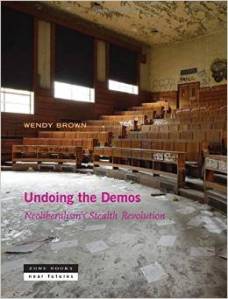
Wendy Brown, Undoing the Demos: Neoliberalism’s Stealth Revolution

downloadWendy Brown, Undoing the Demos: Neoliberalism’s Stealth Revolution – recently published by Zone Books.

Neoliberal rationality — ubiquitous today in statecraft and the workplace, in jurisprudence, education, and culture — remakes everything and everyone in the image of homo oeconomicus. What happens when this rationality transposes the constituent elements of democracy into an economic register? In vivid detail, Wendy Brown explains how democracy itself is imperiled. The demos disintegrates into bits of human capital; concerns with justice cede to the mandates of growth rates, credit ratings, and investment climates; liberty submits to the imperative of human capital appreciation; equality dissolves into market competition; and popular sovereignty grows incoherent. Liberal democratic practices may not survive these transformations. Radical democratic dreams may not either.

In an original and compelling theoretical argument, Brown explains how and why neoliberal reason undoes the political form and political imaginary it falsely promises to secure and reinvigorate. Through meticulous analyses of neoliberalized law, political practices, governance, and education, she charts the new common sense. Undoing the Demos makes clear that, far from being the lodestar of the twenty-first century, a future for democracy depends upon it becoming an object of struggle and rethinking.

Posted in Wendy Brown | 2 Comments

Foucault and ancient polizei: a genealogy of the military pastorate (2015)

This looks interesting, with link to the full piece.

Clare O'Farrell's avatarFoucault News

Kevin Scott Jobe, Foucault and ancient polizei: a genealogy of the military pastorate, Journal of Political Power, Vol. 8, No. 1, 21, 2015
http://dx.doi.org/10.1080/2158379X.2015.1011378

Full PDF here

Abstract

While Foucault claimed that biopower, as a form of political pastorate, did not exist in ancient Greece, he did take the view, following Hegel, that the ancient ‘ethical community’ [sittlichkeit] constituted a kind of ‘political technology of the individual’, an ancient form of ‘police’. In this paper, I trace Foucault’s conception of ‘police’ in his Tanner Lectures to Hegel’s analysis of politeia as the origin of the modern polizei. Through an examination of politeia in ancient political and military literature, I uncover a military–pastoral technology, founded on the relation not between shepherd–flock, but between leader [hegemon] and follower [epistatae]. I suggest two forms that a military–pastoral technology has taken shape, both in the

View original post 46 more words

Posted in Uncategorized | Leave a comment

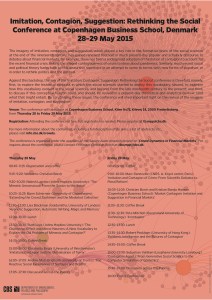
Imitation, Contagion, Suggestion: Rethinking the Social – conference at Copenhagen Business School, Denmark, 28–29 May 2015

Imitation-Contagion-Suggestion Conference ProgramImitation, Contagion, Suggestion: Rethinking the Social – conference at Copenhagen Business School, Denmark, 28–29 May 2015. Full details here.

Posted in Conferences | Leave a comment

Volume 33, Issue 2 now out

New issue of Society and Space now out

Posted in Uncategorized | Leave a comment

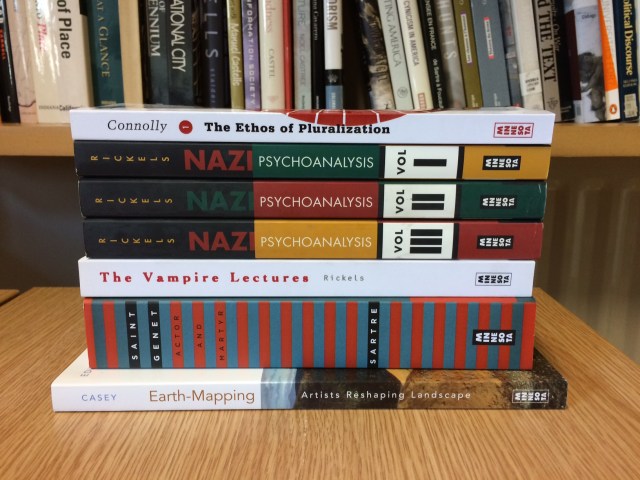
Books received – Connolly, Rickels, Sartre, Casey

IMG_0631

Some more books from UMP – older books by Connolly, Rickels, Sartre and Casey.

Posted in Books, Edward Casey, Jean-Paul Sartre, William E Connolly | Leave a comment

Books received – GIA, Derrida, Vora, Lorimer, le Doeuff, Braver, Transactions


IMG_0630

Publications by the Groupe Information Asiles and Groupe Information Santé; Derrida’s Cinders, Vora’s Life Support, Lorimer’s Wildlife in the Anthropocene, le Doeuff’s Hipparchia’s Choice; Braver’s Heidegger; and the new issue of Transactions. The UMP books and the Braver are recompense for review work.


Posted in Books, Jacques Derrida, Martin Heidegger, Michel Foucault | Leave a comment

Amanda Rogers reviews Carolyn Pedwell’s Affective Relations at the Society and Space open site

9781137275257Amanda Rogers reviews Carolyn Pedwell’s book Affective Relations: The Transnational Politics of Empathy (Palgrave Macmillan 2014) at the Society and Space open site.

Pedwell’s rich study examines the diverse ways in which empathy is mobilised – from political speeches that uphold neoliberalism, to postcolonial literatures that refuse certain forms of empathic connection. Empathy is an affective relation often conceptualized in liberal and neoliberal thought as the imaginative and felt ability to “put oneself in the other’s shoes”. In challenging the appropriative dynamics of this mode of perspective taking, alongside its assumptions of universality, Affective Relations underscores the multiple configurations of empathy across different contexts.

Continue reading the review here.

Posted in Uncategorized | Leave a comment

Heidegger, National Socialism and the editing of the Gesamtausgabe

Davis on H and NSThe Daily Nous reported a story about the editing of the Heidegger Gesamtausgabe a few days ago. The initial story was that some things – politically highly charged – had been deleted or changed in the editing of the texts. The Gesamtausgabe has long been known to be unreliable, but this was a new set of revelations.

The story has now been updated, which shows that the initial reporting was somewhat flawed. The comments below the story are well worth reading – Peter Trawny (editor of the ‘Black Notebooks’) contributes, as does Julia Ireland, whose reconstruction of a manuscript page from the 1934-35 Hölderlin course is part of the story. The manuscript page – the illustration here, but is available in full in Ireland’s recent article in Research in Phenomenology – shows the formidable challenges for editors. The article is well worth a look.

Update: Julia Ireland’s article is available here open access.

Posted in Martin Heidegger, Politics, Publishing | 2 Comments

Alix Cohen (ed.), Kant’s Lectures on Anthropology – reviewed at NDPR

9781107024915Alix Cohen (ed.), Kant’s Lectures on Anthropology: A Critical Guide is reviewed at NDPR. Here’s the publisher description.

Kant’s lectures on anthropology, which formed the basis of his Anthropology from a Pragmatic Point of View (1798), contain many observations on human nature, culture and psychology and illuminate his distinctive approach to the human sciences. The essays in the present volume, written by an international team of leading Kant scholars, offer the first comprehensive scholarly assessment of these lectures, their philosophical importance, their evolution and their relation to Kant’s critical philosophy. They explore a wide range of topics, including Kant’s account of cognition, the senses, self-knowledge, freedom, passion, desire, morality, culture, education and cosmopolitanism.

Posted in Immanuel Kant | Leave a comment