My Loss is Your Learning Gain

Thanks to Derek Sayer’s Coasts of Bohemia blog for the alert to this depressing piece about a very real possibility in UK higher education.

lizmorrish's avatarAcademic Irregularities

Liz Morrish discusses some new ways the Conservative government will seek to assess and rank universities. ‘Learning gain’ is about to be ‘a thing’.

acronyms

It is just over two weeks after the General Election, and our thoughts turn to the prospect of more cuts in public spending, a new leader for the Labour Party, some uncertainty over Brexit and the referendum on EU membership, and, post UKIP, a somewhat muted dialogue over immigration. But what lies in the future for higher education? Have you been paying selective attention over the months leading up to the election? A tuition fee cut may have lodged in your memory, but that was Labour Party policy, and we can forget that now. What does a Conservative government have planned for universities? We know that abolition of the cap on student numbers was already in the offing, as was a national postgraduate loan system for…

View original post 793 more words
Posted in Uncategorized | Leave a comment

Interesting piece on academia and bureaucracy in The Times Higher

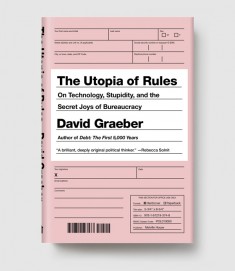
The-Utopia-of-Rulesgray-235x271Interesting piece on academia and bureaucracy in The Times Higher Education, partly drawing on David Graeber’s new book The Utopia of Rules: On Technology, Stupidity, and the Secret Joys of Bureaucracy.

.


Posted in Politics, Universities | 1 Comment

Political Geography seeks two new associate editors

Political Geography looking for new associate editors – please spread the word.

philsteinberg's avatar

polgeog

Political Geography is seeking two new associate editors, to start in January 2016.

Political Geography operates in a decentralized manner with each member of the editorial team having full responsibility for her or his queue. Therefore, after being assigned an article, associate editors are responsible for all aspects of manuscript processing, including selecting and recruiting referees, managing the revision process, making acceptance decisions, and, when necessary, facilitating communication between authors and Elsevier production and publishing staff. Typically, each associate editor will process between 40 and 50 articles per year, with about half of these going to publication. As a member of the editorial team, each associate editor will also be expected to work with other team members to chart the journal’s future direction as well as the conceptualization and organization of special issues, conference-based plenary lectures, and other activities that advance the journal’s standing and facilitate the publication and promotion…

View original post 286 more words

Posted in Uncategorized | Leave a comment

“Foucault and Shakespeare: Ceremony, Theatre and Politics”, abstract for workshop at Theatre, Performance, Foucault!, King’s College London, 4 July 2015

I previously shared the call for papers for the Theatre, Performance, Foucault! workshop at King’s College London on 4 July 2015.

I’ll be presenting on the topic of “Foucault and Shakespeare: Ceremony, Theatre and Politics”. This is the intersection of my two main current projects. Here’s the abstract.

Foucault only refers to Shakespeare in a few places in his work. He is intrigued by the figures of madness that appear in King Lear, Hamlet and Macbeth. He occasionally notes the overthrow of one monarch by another, such as in Richard II or Richard III, arguing that “a part of Shakespeare’s historical drama really is the drama of the coup d’État”. For Foucault, the first are illustrations of the conflict between the individual and the mechanisms of discipline. The second are, however, less interesting than moments when the sovereign is replaced, not with another sovereign, but with a different, more anonymous, form of power. Yet, in 1976, where he treats the theme at most length, he intriguingly suggests that “Shakespearean tragedy is, at least in terms of one of its axes, a sort of ceremony, or a rememorialization of the problems of public right”. Foucault was long fascinated by the theatre, and especially its relation to political ceremony. Drawing especially on his 1972 lectures in Paris and a related presentation in Minnesota, I will begin to sketch how we might understand the relation between ceremony, theatre and politics in Foucault and Shakespeare.

Posted in Conferences, Foucault's Last Decade, Foucault: The Birth of Power, Michel Foucault, Shakespearean Territories, William Shakespeare | 3 Comments

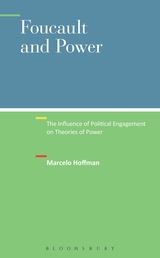
Marcelo Hoffman, Foucault and Power: The Influence of Political Engagement on Theories of Power – now available in paperback

Marcelo Hoffman, Foucault and Power: The Influence of Political Engagement on Theories of Power – is now available in paperback.

9781441187635

Michel Foucault is one of the most preeminent theorists of power, yet the relationship between his militant activities and his analysis of power remains unclear. The book explores this relationship to explain the development of Foucault’s thinking about power.

Using newly translated and unpublished materials, it examines what led Foucault to take on the question of power in the early 1970s and subsequently refine his thinking, working through different models (war and government) and modalities (disciplinary, biopolitical and governmental). Looking at Foucault’s political trajectory, from his immersion in the prisoner support movement to his engagements with the Iranian revolution and Solidarity in Poland, the book shows the militant underpinning of his interest in the question of power and its various shifts and mutations.

This thorough account, which includes the first translation of a report edited by Foucault on prison conditions, will provide students in contemporary political theory with a better understanding of Foucault’s thinking about power and of the interplay between political activities and theoretical productions.

Posted in Michel Foucault, Politics | Leave a comment

Historical Materialism 2015 London – call for papers

Historical Materialism 2015 London – call for papers.

Posted in Uncategorized | Leave a comment

Michel Serres Today: new paper uploaded to academia.edu

Chris Watkins follows his Serres bibliographic work with an introduction to his writing.

Christopher Watkin's avatarChristopher Watkin

I have just uploaded a paper on Michel Serres to academia.edu. Here is the abstract:

This is an expanded version of a paper originally given at the English and Theatre Studies research seminar at Melbourne University in May 2015, and it retains its oral tone. My intention both for the original paper and for this expanded version is to provide a first introduction to the work and thought of Michel Serres. I discuss how Serres’s work has been received in the French-speaking and English-speaking worlds to date, briefly highlight the different areas in which his thought is making a decisive contribution today, and then offer reflections on what it is that characterises his writing as a whole. I finish by examining some of his recent thought in more detail, specifically his recent elaboration of an econarratology around the idea of the “Great Story” of the universe, opening the way, for…

View original post 11 more words

Posted in Uncategorized | 2 Comments

Reconfiguring global space

Derek Gregory with details of a very interesting event coming up in Indiana.

Derek Gregory's avatargeographical imaginations

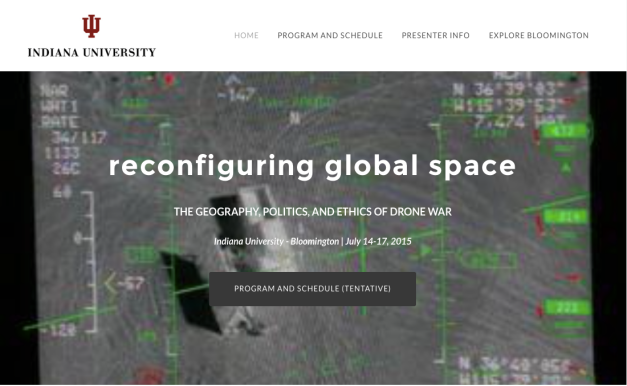
In July I’m thrilled to be speaking at Reconfiguring Global Space: the geography, politics and ethics of drone war, to be held at Indiana University – Bloomington, 14-17 July.

Reconfiguring Global Space PNG

The other speakers – which explains why I’m thrilled to be going – include Medea Benjamin, Mark Neocleous, Priya Satia and Madiha Tahir: people I know only through print, video or e-mail (sometimes all three!) and it will be good to meet them in non-digital form.  Which, given the subject of the conference, is an all too appropriate wish….

There are lots of other interesting participants too: the outline program is here, and the organizers hope to have full details available at the end of this month.

View original post

Posted in Uncategorized | 1 Comment

Future of Surrey’s Department of Politics Secured

I’ve just received an update on University of Surrey’s politics department, which was under serious threat in March this year – I shared the story and a couple of updates.

We are delighted to report that the Department of Politics at the University of Surrey will continue to exist as a self-standing autonomous unit and there will be no compulsory redundancies.

Following threat of closure and major job losses back in March, the Department, led by Dr Roberta Guerrina and backed by the PSA, put together a proposal for the future of the Department that has now been accepted by the University. Under terms that have been agreed by the Vice-Chancellor, the Department will continue to exist, a total of ten people will remain within the Department, all undergraduate, masters and post-graduate programmes will continue to run and the Department will maintain its research intensity.

Congratulations to all involved.

Please do feel free to share this information with colleagues.  The PSA has also published the news on our website and via Twitter here.

Yours faithfully,

James Ludley

Programme Development Officer

Political Studies Association

Posted in Politics, Universities | Leave a comment

Representations of space through colours – a request for help

An inquiry from a colleague:

How can we think about representations of space through colours? Can people refer recommended sources that examine the use of colours as metaphors for and representations of space? This is not about race – i.e. white, black or colour. Uses of colour crop up in relation to terms such as ‘red zone’, places such as ‘red square’, the ‘Pink Tide’ in Latin America, ‘black ops’, and, especially, ‘whiteness’ as a metaphor for weather (snow as the obvious referent), but also counterrevolution (thinking of El Lissitsky ‘Beat the Whites with the Red Wedge’), or whiteness (as light, as emptiness, as silence). Any thoughts or pointers on space and colour, specifically in relation to literary geographies and the representations of space?

Please add any thoughts as comments to this post. Thanks for any suggestions.

Posted in Uncategorized | 11 Comments