Global Discourse book award review symposium on The Birth of Territory – first review by Jordan Branch

branchGlobal Discourse are hosting a review symposium on The Birth of Territory, which was joint winner of their inaugural book award. The first review by Jordan Branch is available online – requires subscription, or email me.

Update: the second review, by Jeppe Strandsbjerg, is available here.

Posted in Books, Politics, Territory, The Birth of Territory | Leave a comment

AAG Subconference Call For Black Lives Matter ‘T-shirt Book Bloc’

A call for involvement at the forthcoming AAG conference.

Angela's avatarMutable Matter

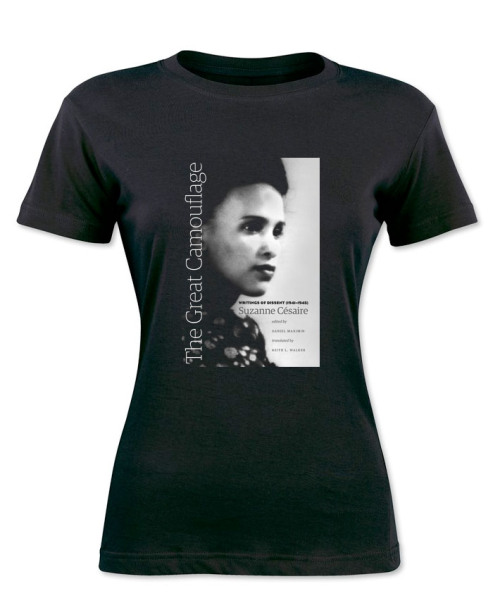
s_césaire_tshirt

Calling all AAG (Association of American Geographers Annual Meeting) attendees!

Some of us UK Subconference folks thought it would be nice to show our solidarity with the Black Lives Matter campaign through making and wearing t-shirts to the AAG  in Chicago. These will have books on them by black authors, and authors of colour, whose writings engage with institutional racism and/or who have been absent from the mainstream geographical canon despite their contributions to geography (kind of like a t-shirt book bloc).

With this, we not only want to highlight systemic racism, but also want to highlight geography’s (and also academia’s and education’s) implication in this system through citational practices, teaching, recruitment, admissions et cetera.

You can bring and make your own, and we will also be making them in Chicago with iron-on patches. If you have any ideas for books, designs generally or want a tshirt, get in touch!…

View original post 11 more words

Posted in Uncategorized | Leave a comment

Simon Springer, Violent Neoliberalism – now published

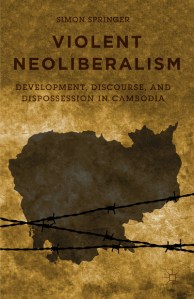
Simon Springer, Violent Neoliberalism: Development, Discourse, and Dispossession in Cambodia, is now published.

9781137485328

Violent Neoliberalism explores the relationship between neoliberalism and violence through a critical poststructuralist perspective. Springer exposes the supposed humanitarianism of what has become the world’s most dominant political economic model as a process of transformation that is shot through with a significant degree of cruelty. Employing a series of theoretical dialogues informed by the empirical experiences of development, discourse, and dispossession in contemporary Cambodia,Violent Neoliberalism engages as a diagnostic rupturing of commonsense to reveal the manifold ways in which ongoing patterns of neoliberalization have become engrossed with violence.


Posted in Politics | Leave a comment

Council for the Defence of British Universities on Surrey Politics

Council for the Defence of British Universities – Restructuring Politics at the University of Surrey: An Unexpected and Questionable Decision

Posted in Politics, Universities | 1 Comment

The Uncollected Foucault – updates to texts needed; and to texts available

papers copyI’ve been doing further work on ‘The Uncollected Foucault’ – which will hopefully become a short article as well as a resource here.

I’ve made some updates to texts needed; and to texts available. The ones I still need are proving a real challenge. Please help if you can!

At the general Foucault Resources page there are some other things which will hopefully be useful – a list of audio and video recordings; Foucault’s collaborative projects; a few short translations…

Posted in Foucault's Last Decade, Michel Foucault, Publishing | Leave a comment

Two posts at Centre for Interdisciplinary Methodologies, University of Warwick

The Centre for Interdisciplinary Methodologies at University of Warwick has two new academic posts. For more information, and to apply, please see:

Associate Professor – (75498-035)

Assistant Professor – (75540-035)

Both are related to Masters level teaching, especially the MSc in Urban Informatics and Analytics, but also the MSc in Big Data and Digital Futures and MA in Digital Media and Culture.

Applications from those with research expertise in one or more of the following fields are welcome: spatial-temporal analysis, complexity, network analysis, spatial modeling, urban simulation, locative media, web scraping and social media analysis, urban studies, science and technology studies, big data, software studies, digital mapping, critical cartography, computational culture, and environmental- and bio-sensing. We are especially interested in receiving applications from those whose research sits broadly within one or more of the Centre’s three main clusters: change and continuity; the moving image; methods and methodologies.

You will have a critical, innovative approach to methodology, whatever your substantive domain of expertise. You will have a detailed knowledge of the tools, media, and software that constitute your research practice, and a critical awareness of the limits of different types of data analysis and work creatively to generate bespoke methods suited to new research challenges.

Posted in Uncategorized | 1 Comment

Forthcoming papers in Society and Space

Forthcoming papers in Society and Space – Natalie Oswin outlines some of the papers available online. Some of these will be in the next issue; some are from a forthcoming theme issue on ‘War, law and space’.

Posted in Society and Space | Leave a comment

Marina Warner, ‘Learning my Lesson’ – on Universities in the LRB

Marina Warner, ‘Learning my Lesson’ – on Universities in the LRB. It takes her own story, and broadens it to apply far beyond the University of Essex. Here’s one key paragraph, but the whole thing is well worth reading.

I was forced out of my professorship at Essex after being told, first, that I couldn’t retire because I was needed (for the next round of research assessment in 2020);​1second, that I should accept the job of chairing the Man Booker International Prize in 2015; and finally, that I was to be congratulated on gaining a fellowship at All Souls, Oxford – non-stipendiary and part-time, but a chance to do some research – only subsequently to be informed that policy had now changed, and I would be required to teach full-time. There was more to what happened, to others as well as to me, but I won’t go over the details here. After I wrote a piece about the experience in the LRB, letters and emails poured in to me – and to the paper. The correspondence reveals a deeper and more bitter scene in higher education than I had ever imagined. I had been naive, culpably unobservant as I went about my activities at Essex. Students, lecturers, professors from one institution after another were howling in sympathy and rage; not one of them dissented or tried to justify the situation. I had thought that Essex was a monstrous manifestation, but it turns out that its rulers’ ideas are ‘the new normal’, as the Chinese government calls its present economic plan. Cries also reached me from other countries, where the new methods have been taken even further: from New Zealand and Australia, above all; from Europe, especially the Netherlands, and from certain institutions in the US.

Posted in Politics, Universities | Leave a comment

“A Period of Intense Debate about Marxist Philosophy”: An Interview with Étienne Balibar

Translation of an interview with Étienne Balibar in Viewpoint.

This text was first pub­lished in L’Human­ité on March 13, 2015.

Jérome Skalski: Fifty years ago Louis Althusser’s For Marx, and, under his direc­tion, Read­ing Cap­i­tal, were pub­lished. What was the con­text of the debate at that period?

Étienne Bal­ibar: To put it very briefly, I would say that the ques­tion speaks to an intel­lec­tual and even aca­d­e­mic dimen­sion, and a polit­i­cal and ide­o­log­i­cal one. I belong to a gen­er­a­tion that entered the École Nor­male Supérieure in 1960. That’s not irrel­e­vant from an his­tor­i­cal point of view. In our group, which was formed lit­tle by lit­tle around Althusser, there were stu­dents, of course, but also dis­ci­ples. Peo­ple who were a bit older, like Pierre Macherey, and later those a bit younger who came just after, the future Maoists, like Dominique Lecourt. That is, over the span of five or six years. On the one hand, then, the year 1960 was two years before the end of the Alger­ian War, and the year that Jean-Paul Sartre’s Cri­tique of Dialec­ti­cal Rea­sonwas pub­lished. We had been politi­cized by the Alger­ian War. We were all UNEF mil­i­tants, which was the first French union to meet with the Alger­ian unions linked to the FLN in order to coor­di­nate actions against the war. This con­text was one of intense politi­ciza­tion and mobi­liza­tion, but also very sharp inter­nal con­flicts. The basis of our politi­ciza­tion was mostly that of the anti-colonial and, con­se­quently, anti-imperialist mobi­liza­tion. The social dimen­sion existed, but it came as a kind of an add-on.

continue reading here.

Posted in Etienne Balibar, Karl Marx, Politics | Leave a comment

Governing Emergencies – Theory, Culture and Society theme edited by Peter Adey, Ben Anderson and Stephen Graham

F1.mediumGoverning EmergenciesTheory, Culture and Society theme edited by Peter Adey, Ben Anderson and Stephen Graham.

Includes essays by Claudia Aradau, Stephanie Simon and Marieke de Goede, Stephen J Collier and Andrew Lakoff, among others.

Papers require subscription.

Posted in Politics, Stephen Graham | Leave a comment