
Reassessing Power: Foucault’s Legacy in Historical and Contemporary Research – Gdansk, 17-19 July 2025

Reassessing Power: Foucault’s Legacy in Historical and Contemporary Research – Gdansk, 17-19 July 2025
Vanessa Grossman, A Concrete Alliance: Communism and Modern Architecture in Postwar France – Yale University Press, November 2024
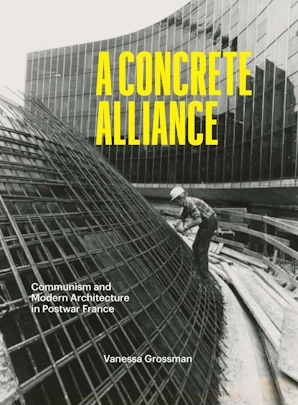
The compelling story of the significant relationship between communism and modern architecture in postwar France
The massive reshaping of French cities that took place between 1958 and 1981 is commonly regarded as a unique episode in which modernist ideals were tested on an unprecedented scale. Yet the history of postwar French modernism has never fully accounted for the influence of one of architecture’s most important institutional patrons, the French Communist Party (PCF). Drawing political theory and architectural history into conversation, Vanessa Grossman probes the shifting but enduring alliance between modern architecture and the PCF in the aftermath of the political crisis of 1958, prompted by the Algerian War of Independence and Charles de Gaulle’s rise to power.
Focusing on key episodes, Grossman discusses the work of Renée Gailhoustet (a rare female architect of her generation), Jean Renaudie, and members of the Atelier d’urbanisme et d’architecture (AUA), in collaboration with architectural elders such as Jean Prouvé and Oscar Niemeyer, who self-exiled to France, and in relation to contemporary Marxist thinkers such as philosophers Louis Althusser and Henri Lefebvre. Grossman exposes how communist politics and architectural modernism were mutually reinforcing ideologies that circulated in France across national and international networks of architects, urban planners, civil servants, intellectuals, activists, and politicians. Offering a new understanding of the postwar realization that architecture, particularly housing, could be employed as a political tool, this highly original book reveals the meaningful dialogue between French communism and architectural modernism.
Thanks to John Raimo for the link
Keith Michael Baker, Jean-Paul Marat: Prophet of Terror – University of Chicago Press, November 2025
952 pages!
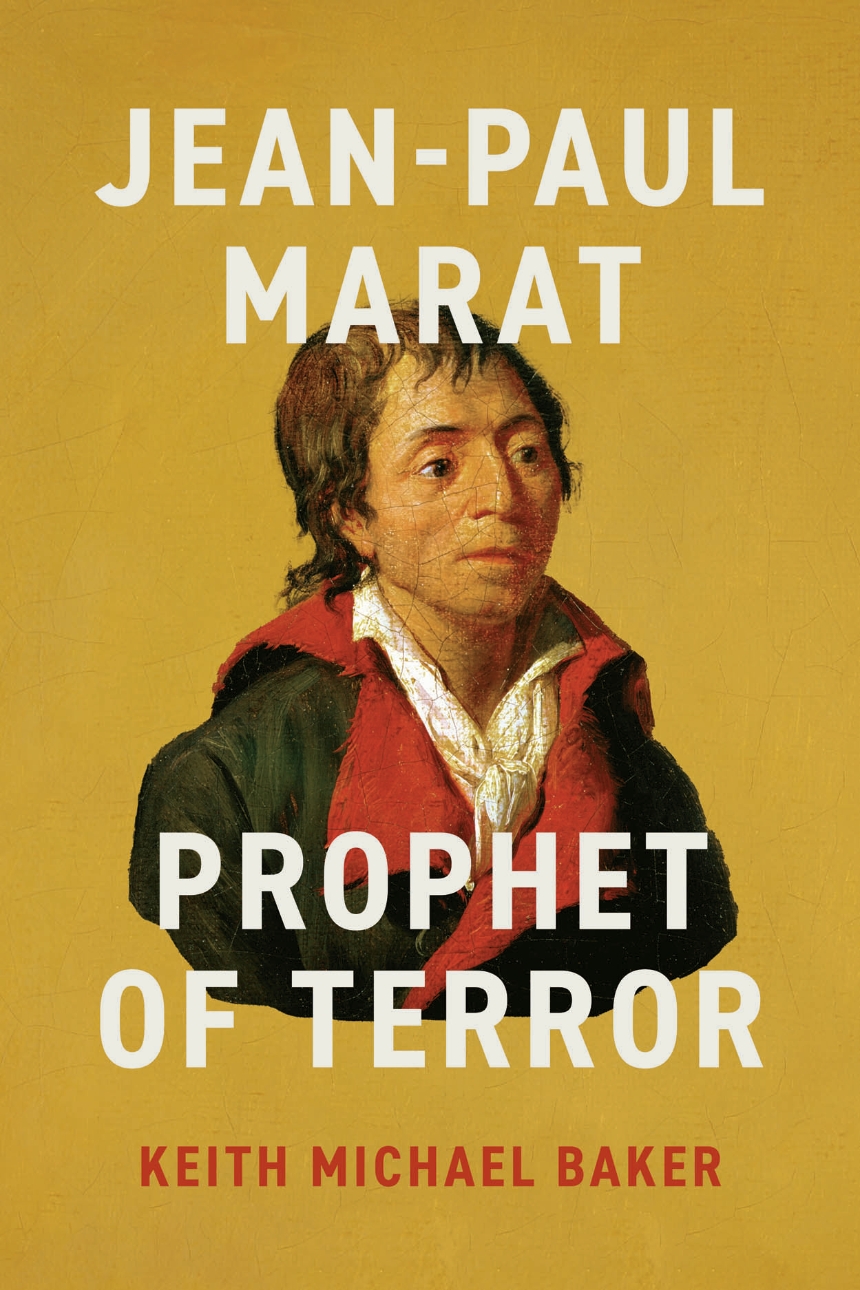
A landmark biography of one of the most notorious and controversial protagonists of the French Revolution—Jean-Paul Marat.
Who better to pen an authoritative biography of Jean-Paul Marat (1743–93) than preeminent historian of France, Keith Michael Baker? Decades in the making, this monumental work takes readers on a journey through the intriguing, sometimes shocking life of this writer and thinker.
Starting with his Swiss family and upbringing, Baker then sheds light on Marat’s early years in England, his career as an aspiring scientist in Paris, his gradual transformation from impassioned pamphleteer to revolutionary newspaperman, and, finally, his murder and martyrdom. Throughout, Baker offers readers the unique opportunity to reconsider the outbreak and development of the French Revolution through Marat’s eyes and in his own words. To help make sense of Marat’s trajectory, he shows how his violent and incendiary public calls to render unseen forces visible, to inject immediacy into an increasingly abstract modern world, would transform classical republicanism into the language of the Terror.
Far beyond a standard rendering of Marat’s life and its milestones, this biography offers readers an opportunity to see the French Revolution as never before, through the perspective of one of its major figures. Baker’s book reveals how someone like Marat could go from translating Newton and engaging Franklin to calling for an ever-growing number of heads to roll—a transformation as chillingly relevant as ever.
The Complete Correspondence of Friedrich Hölderlin, ed. Charlie Louth – SUNY Press, October 2025
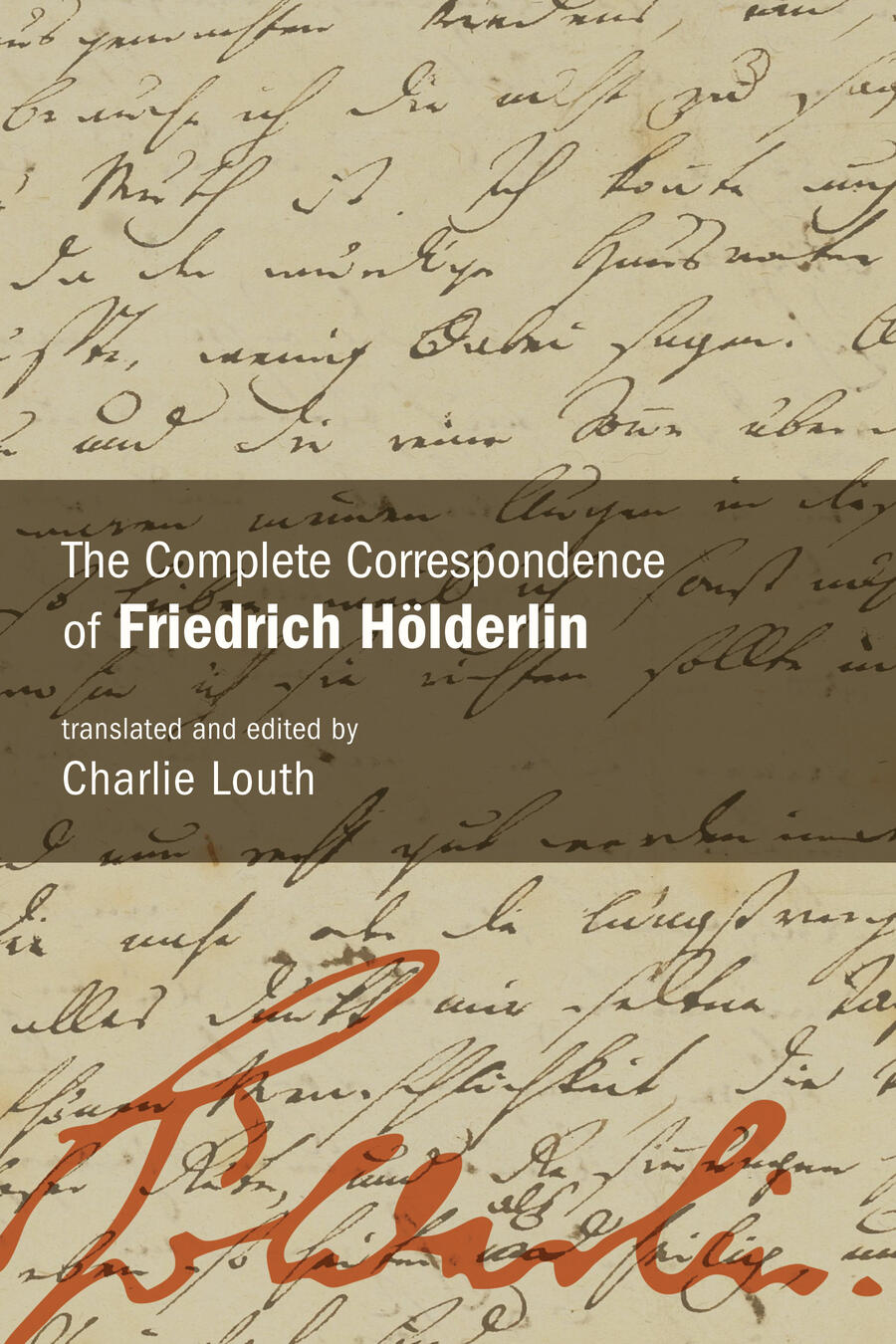
The first English translation of Hölderlin’s complete correspondence, with a full introduction and notes.
Friedrich Hölderlin (1770–1843) is widely acknowledged to be one of the most significant European poets and thinkers. His poems continue to fascinate and compel; his role in the development of German Idealism is well-known; and his writings continue to shape philosophical reflections on subjectivity and the place of poetry in the world. Hölderlin’s correspondence is indispensable for anyone hoping to come to terms with his work, yet until now only selections have been available in English. This new and complete edition includes all the letters Hölderlin received and ranges from early letters written while he was still at school to letters pondering the French Revolution and its consequences in Germany, relaying to Hegel his arguments with Fichte’s lectures, setting out his poetic theory, to his final letters written in half-concealed madness to his mother. The chief source of what we know of Hölderlin’s biography, the letters vitally illuminate his poetry and thought at every point, German Romanticism.
I missed this when published a couple of years ago – a previously unpublished lecture by Henri Lefebvre, taken from his archives, which have been deposited at IMEC and are being catalogued – see the initial notice.
Henri Lefebvre, “Socialisme industriel et socialisme paysan” / “Industrial Socialism and Peasant Socialism“, Actuel Marx, 2023, eds. Claire Revol and Armelle Lefebvre (requires subscription)
Cet inédit issu du fonds d’archives Henri Lefebvre est la retranscription d’une conférence prononcée en 1959 qui porte sur l’évaluation des enjeux des luttes paysannes, mal saisis selon l’auteur. Il est augmenté d’une présentation qui insiste sur l’inscription de ce thème dans un programme précoce qui, attaché à la question de la rente foncière dans la perspective des textes de jeunesse de Marx, alimentera la réflexion lefebvrienne sur les formes sociales comme fondements de la sociologie historique de Marx. Selon Lefebvre, les travaux incessants de Marx sur la dissolution de la propriété collective au cours de l’histoire et hors du contexte européen sont à la fois inaboutis et insuffisamment compris, alors qu’ils faisaient une place plus importante au socialisme paysan.
This unpublished work from the Henri Lefebvre archives is a transcript of a lecture given in 1959 on the evaluation of the issues involved in peasant struggles, which, according to the author, were poorly understood. It is supplemented by an introduction emphasizing the inclusion of this theme in an early program which, dedicated to the question of ground rent from the perspective of Marx’s early texts, would feed into Lefebvre’s thinking on social forms as the foundation of Marx’s XV historical sociology. According to Lefebvre, Marx’s incessant work on the dissolution of collective _ property in the course of history and outside the European context was both unfinished and insufficiently understood, even though it gave greater prominence to peasant socialism.
A useful supplement to Henri Lefebvre, On the Rural: Economy, Sociology, Geography, eds. Stuart Elden and Adam David Morton, trans. Robert Bononno et. al., Minneapolis: University of Minnesota Press, 2022.
The Gillian Rose Memorial Lecture Conference 2025 – Swedenborg Hall, London, 18-19 June 2025
‘Keep your mind in hell, and despair not’ – Rose’s discovery of Silouan the Athonite’s maxim provided the occasion for Love’s Work and guided its weaving journey along the quotidian verges of hell and despair. Whether passing through the three cities of death or across the thresholds of stormed paradises, Rose’s work refuses any alleviation of the state of perdition. For her, trying to keep the mind out of hell is the real council of despair. And yet the promise that sustains her season in hell is not the humility of Christian hope taught by the Athonite nor the pride of Stephen Daedalus evoked throughout Love’s Work, but one of divine comedy or fidelity to the movements of the bacchanalian revel and repose in its sin. The Gillian Rose Memorial Lecture conference this year departs from Love’s Work in an exploration of the play of promise and perdition throughout the full range of Rose’s philosophical writing.
Nicholas D. Anderson, Inadvertent Expansion: How Peripheral Agents Shape World Politics – Cornell University Press, January 2025
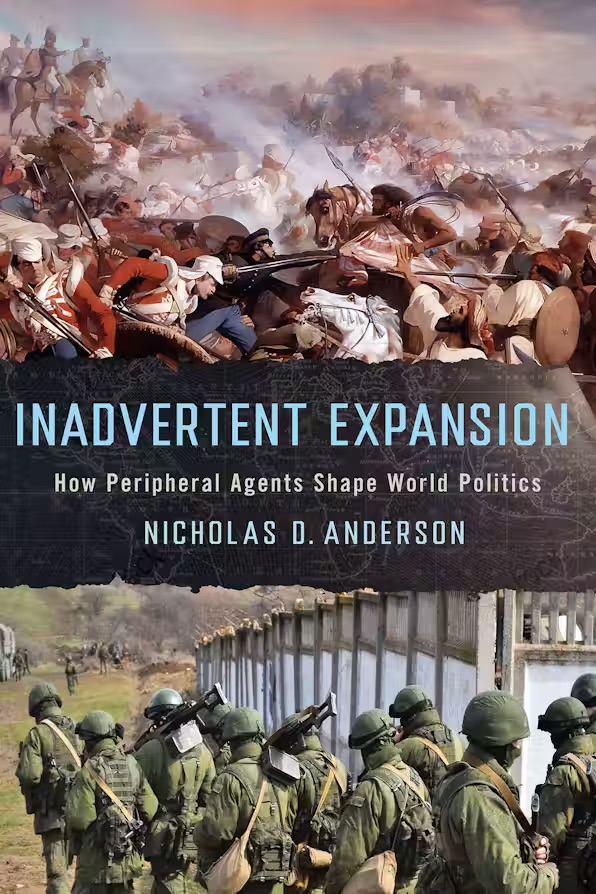
In Inadvertent Expansion, Nicholas D. Anderson investigates a surprisingly common yet overlooked phenomenon in the history of great power politics: territorial expansion that was neither intended nor initially authorized by state leaders.
Territorial expansion is typically understood as a centrally driven and often strategic activity. But as Anderson shows, nearly a quarter of great power coercive territorial acquisitions since the nineteenth century have in fact been instances of what he calls “inadvertent expansion.” A two-step process, inadvertent expansion first involves agents on the periphery of a state or empire acquiring territory without the authorization or knowledge of higher-ups. Leaders in the capital must then decide whether to accept or reject the already-acquired territory.
Through cases ranging from those of the United States in Florida and Texas to Japan in Manchuria and Germany in East Africa, Anderson shows that inadvertent expansion is rooted in a principal-agent problem. When leaders in the capital fail to exert or have limited control over their agents on the periphery, unauthorized efforts to take territory are more likely to occur. Yet it is only when the geopolitical risks associated with keeping the acquired territory are perceived to be low that leaders are more likely to accept such expansion.
Accentuating the influence of small, seemingly insignificant actors over the foreign policy behavior of powerful states, Inadvertent Expansion offers new insights into how the boundaries of states and empires came to be and captures timeless dynamics between state leaders and their peripheral agents.
Interview at New Books Network with Eleanora Mattiacci. Thanks to dmf for the link
A reminder of this event on 27 May 2025, 5.30pm, online – a discussion of Chris Philo’s important new book Adorno and the Antifascist Geographical Imagination (Edinburgh University Press, 2025).
Reminder: London Group of Historical Geographers – registration (free, but required 24 hours in advance)
speakers: Chris Philo, Stuart Elden, Felicitas Kübler
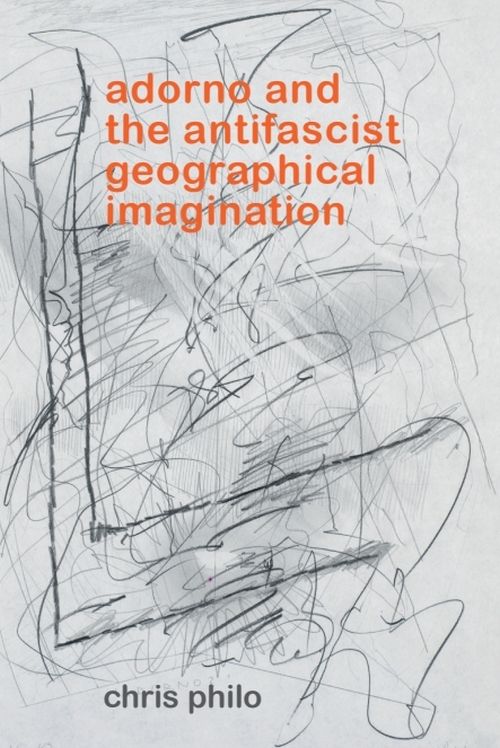
To think antifascistically is necessarily to think geographically; to think geographically ought to be to think antifascistically. This aphorism sets the compass for this book’s ambitious attempt to fold questions of fascism and antifascism into the remit of Geotheory (the focus of the host book series). Alert to fascism’s pernicious haunting of our contemporary moment, it reaches for intellectual resources through which to fashion constellations of antifascist thought hinging on attentiveness to space, place, landscape and nature.
Specifically, the book offers the first attempt to systematically explore the ‘geographies’ integral to the thinking of Theodor W. Adorno, premier exponent of the Frankfurt School of critical theory whose writings – on philosophy and sociology, politics and culture, literature and music – were often framed precisely against the threat of fascistic regression. By disclosing Adorno’s geographies, the shape of a geographical antifascism comes into view as a transformational restatement of critical geography’s spirit and purpose.
I’ve continued my work with archives in the USA over the past several weeks. Some of this has been in relation to the Indo-European Thought project, but I’ve managed to work on some peripheral things too.
I had two days in Princeton, one at the Derrida book collection in the Firestone Library of Princeton University, and one at the special collections of the Institute of Advanced Study. I had everything set up for a visit to the Derrida library in March 2020 – flight, hotel, book orders – but it had to be cancelled due to the pandemic restrictions. An archivist there was willing to help with the work on Foucault via a virtual consultation – a Teams call with a document camera, where I could watch her turning the pages of Derrida’s copy of Foucault’s Folie et déraison. This was invaluable at the time, and it enabled me to finish The Early Foucault. But it was good to see the actual book itself, albeit five years later than planned. There are some other books by Foucault in Derrida’s collection, some dedicated by Foucault and some marked up. I also looked at a few things by Benveniste, Dumézil, Eliade and Koyré in the collection.
At the IAS, I asked to see the files on Jean de Menasce and Jean Gottmann. So many people central or peripheral to this project spent time there. I’d already been given scans of material relating to other people I had an interest in – Georges Dumézil, Ernst Kantorowicz, Alexandre Koyré, and Walter Bruno Henning. I discuss what the Henning files reveal about his Khwarezmian dictionary project here. But though I’m really grateful for the remote access, I wanted to visit at least once – I’d never been to Princeton before. I did walk around the lake (famously used in the Oppenheimer film) and went to the Einstein statue in the lunch break.
In New York, I went to the Berg collection of the New York Public Library, to look at two things in the Vladimir Nabokov collection – his correspondence with Roman Jakobson, and the marked-up typescript of his translation of The Song of Igor. I had to get permission from the Nabokov estate to access the letters, which took a little while. I had previously written a short piece on this site about the failed collaboration on a critical edition of the Igor text by Jakobson and English translation by Nabokov. I’ve since found some new sources for this story – some published and some not, and wrote an update on this story.
One of the reasons for the falling out was that Nabokov was convinced that Jakobson was a Soviet agent. Exploring the basis for this accusation has become a very deep rabbit-hole. It’s led me through the Columbia and MIT archives, and to some unexpected places. One of those was the Gottesman libraries of Teachers College of Columbia University, which has some interesting documents relating to the climate at Columbia in the late 1940s and early 1950s. There is a lot more in the main Columbia archives relating to the story. I am not sure what I will do with this, but I have more than a draft of something. At the very least it’s been interesting and opens up a whole range of questions.
I also had a few days in Chicago, mainly working with the Mircea Eliade papers and a few things relating to Eliade in the Ioan Culianu collection at the Regenstein library. This was one of the US archives I’d initially planned to visit for the Indo-European project, but it ended up being almost the last I got to visit. I hope to have a chapter on the decade Eliade spent in Paris after the Second World War. There isn’t much realting to that period in Chicago, but there is an extensive correspondence with Dumézil, which is important for the story of his career. Some of what I looked at in Chicago got me thinking about a notorious story relating to Eliade – the murder of Ioan Culianu. I wrote a piece about that, partly in relation to Bruce Lincoln’s recent book on the story, for this site.


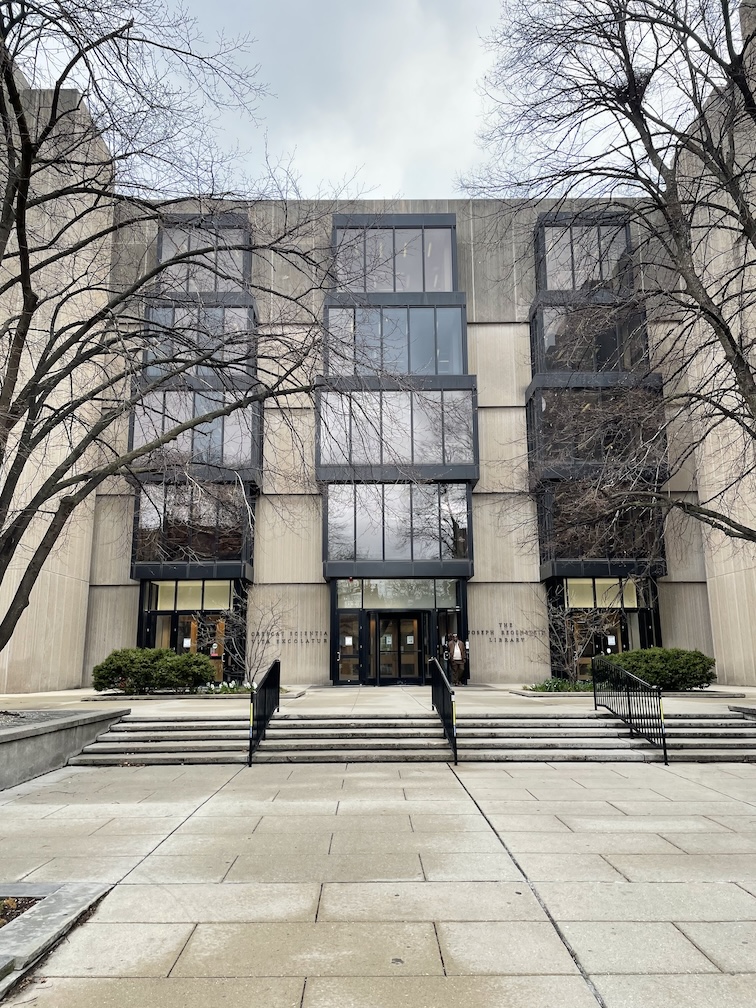
Clockwise from left: Firestone Library, Princeton University; Institute for Advanced Study; Regenstein Library, University of Chicago; Teachers College
I made some additional visits to Columbia University archives, some relating to the Jakobson story and some things from the Edward Said papers, and had one day back at the Rockefeller Archives Center to go over things I hadn’t had time with on the previous visit. Some of the initial work Jakobson did in the United States in 1941 and 1942 related to North American and Siberian languages, from material given by Franz Boas to the New York Public Library, so I took a look at that. He also did some work on the medieval Yiddish spoke by Czech Jews for YIVO, the Yiddish Scientific Institute which is just a few minutes’ walk from the Remarque Institute. They don’t have much in the archives relating to Jakobson, as far as I can tell, but I did look at some correspondence they have. I will write about Jakobson’s library work in the next ‘Sunday History’ [update: now available here].
I also presented on Benveniste again at an event at Remarque, on the theme of ‘Troubling Classical Bodies’, with Brooke Holmes and Anurima Banerji. There is a video of the event here, and the text of my piece on “Émile Benveniste and the Sogdian Word for ‘Knee’” is here.
Some more of the things I’ve discovered have been shared in the ‘Sunday Histories’ series of posts. Some of these pieces would never have been written had I not found things in the archives – not always things I was looking for, which is often the most interesting part of this work. Two pieces on Foucault, for example, on the question of who translated The Order of Things, and the confusion over an English king mentioned in the History of Madness, both came out of chance discoveries. Some of the work relating to Benveniste, and in particular his Vocabulaire project, led to another couple of short pieces – one on territory and one on animal names and the different approach of Elisabeth Raucq.
My time in New York ended last week and I’m now back in the UK. I’m not sure when I’ll next be back in the US. I spent most of the time there doing archival work or – as important – writing up the notes on the things I’ve seen or photographed there. I really didn’t want to head back with too many files of things unprocessed. That is definitely the less glamorous part of archival work.
I really appreciate that so many archives are willing to digitise things, and I made a lot of requests. Sometimes those are of things I realised were more important than I’d initially thought in an archive I’d been to already; others were more speculative requests for any correspondence with someone that is in an archive. I did a few side trips, but wasn’t able to get everywhere. Archives in Baltimore, Wisconsin, Cincinnati and Philadelphia were all really helpful at a distance. But I also stumbled across things that happened to be in the next folder to one I was initially looking at; or some other chance discovery. With archives nearby in New York it wasn’t difficult to go back. I’ll miss that, and much more, about my time there. I can thoroughly recommend the Remarque Institute as a place to spend time – I feel very fortunate to have had a semester there.
Previous updates on this project can be found here, along with links to some research resources and forthcoming publications. The re-edition of Georges Dumézil’s Mitra-Varuna is now available open access. There is a lot more about the earlier Foucault work here. The final volume of the series is The Archaeology of Foucault, and the special issue of Theory, Culture & Society I co-edited on “Foucault before the Collège de France” has some important contributions on the earlier parts of Foucault’s career, and is currently available free to access. Recent articles include “Foucault, Dynastics and Power Relations” in Philosophy, Politics and Critique and “Foucault and Dumézil on Antiquity” in Journal of the History of Ideas (both require subscription, so ask if you’d like a copy); and “Alexandre Koyré and the Collège de France” in History of European Ideas (open access).
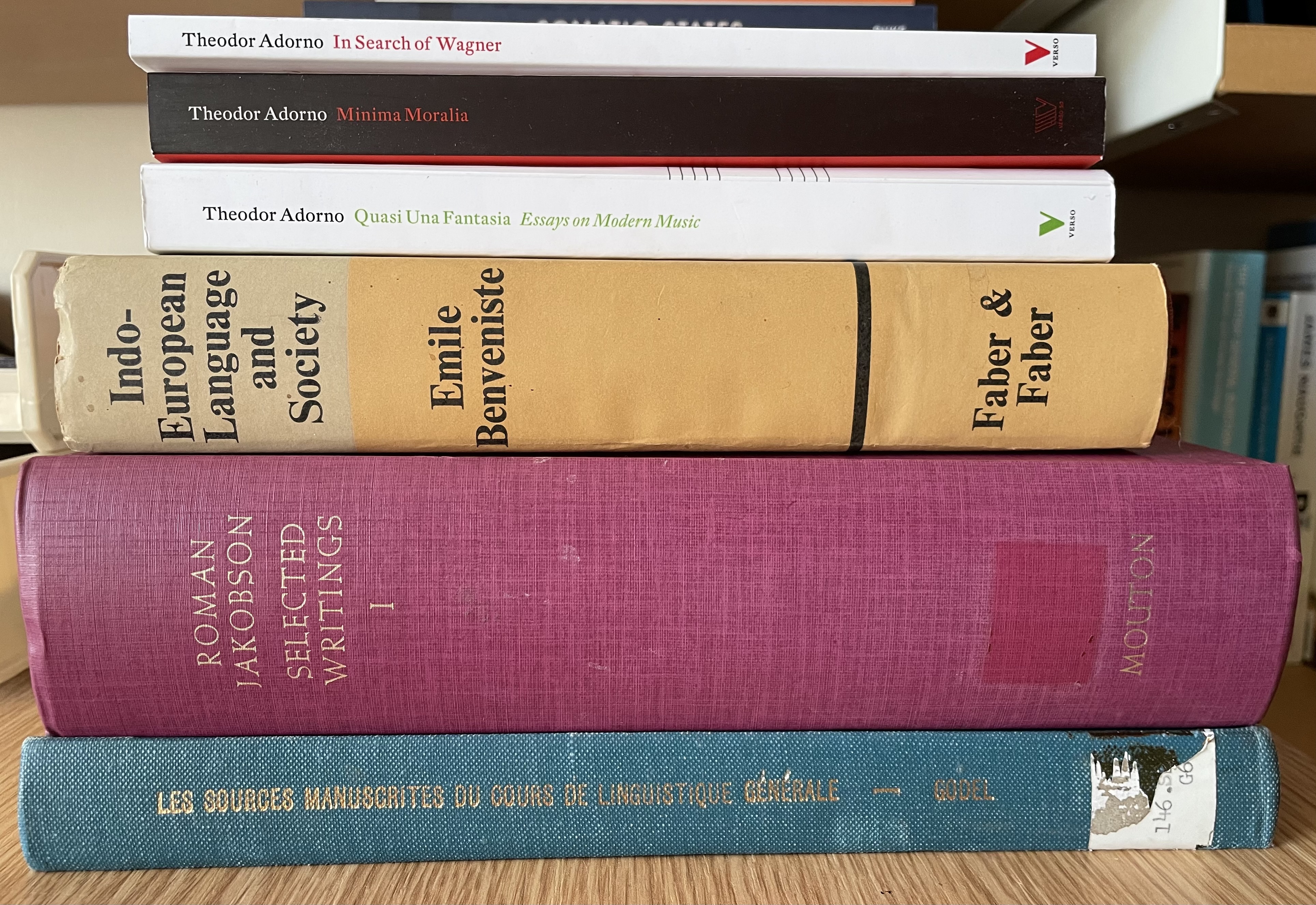
Three books by Adorno from Verso, and second-hand copies of Émile Benveniste’s Indo-European Language and Society, the first volume of Roman Jakobson’s Selected Writings, and Robert Godel, Les Sources Manuscrites du cours de linguistique générale de F. de Saussure.

