Günter Figal resigns as Heidegger Society Chair over the content of the Black Notebooks

Günter Figal resigns as Heidegger Society Chair over the content of the Black Notebooks. Daily Nous has the story – thanks to Graham Harman for the link.

I admit to being puzzled by this – Figal took up the chair in 2003, when a lot of material was already widely-known. Yes, there is a lot of unpleasant material in the notebooks, and it would cause me to amend, supplement and add nuance to claims I’ve previously made about Heidegger, politics and calculation – such as in Speaking Against Number. That said, much is familiar and there were public remarks available before. Figal’s willingness to be associated with this name and society until now seems to indicate a fairly uncritical – or perhaps just incurious – attitude before.

Posted in Martin Heidegger | 1 Comment

Étienne Balibar: Three words for the dead and the living

The Verso blog has the English translation of Étienne Balibar’s “Three words for the dead and the living“, originally published in Libération.

Posted in Etienne Balibar, Politics | 1 Comment

Mary Beard on ‘How to Write’

in her TLS column, classicist Mary Beard discusses ‘How to write‘. Other than the updates on the Foucault book, I’ve not written much about writing recently on this site. But I have done in the past – there is a piece here with some comments about words-per-day (beginning from a previous column from Mary Beard), daily routines by authors, and links to some other pieces.

Posted in Publishing, Writing | 1 Comment

Kathleen E. Kennedy, Medieval Hackers – open access from Punctum books

Cover_Medieval_Hackers_Front_WEB

Medieval Hackers calls attention to the use of certain vocabulary terms in the Middle Ages and today: commonness, openness, and freedom. Today we associate this language with computer hackers, some of whom believe that information, from literature to the code that makes up computer programs, should be much more accessible to the general public than it is. In the medieval past these same terms were used by translators of censored texts, including the bible. Only at times in history when texts of enormous cultural importance were kept out of circulation, including our own time, does this vocabulary emerge. Using sources from Anonymous’s Fawkes mask to William Tyndale’s bible prefaces,Medieval Hackers demonstrates why we should watch for this language when it turns up in our media today. This is important work in media archaeology, for as Kennedy writes in this book, the “effluorescence of intellectual piracy” in our current moment of political and technological revolutions “cannot help but draw us to look back and see that the enforcement of intellectual property in the face of traditional information culture has occurred before. … We have seen that despite the radically different stakes involved, in the late Middle Ages, law texts traced the same trajectory as religious texts. In the end, perhaps religious texts serve as cultural bellwethers for the health of the information commons in all areas. As unlikely as it might seem, we might consider seriously the import of an animatronic [John] Wyclif, gesturing us to follow him on a (potentially doomed) quest to preserve the information commons.”


Posted in Uncategorized | 1 Comment

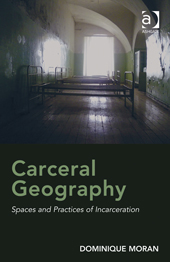
New book: “Carceral Geography: Spaces and Practices of Incarceration”

Dominique Moran with details of her new book, Carceral Geography.

carceralgeography's avatarProf Dominique Moran

9781409452348.PPC_PPC TemplateMy new book ‘Carceral Geography: Spaces and Practices of Incarceration’ is now out with Ashgate.

The ‘punitive turn’ has brought about new ways of thinking about geography and the state, and has highlighted spaces of incarceration as a new terrain for exploration by geographers. In this book I try to offer a geographical perspective on incarceration, track the ideas, practices and engagements that have shaped the development of this new and vibrant subdiscipline, and scope out future research directions. By conveying a sense of the debates, directions, and threads within the field of carceral geography, the book traces the inner workings of this dynamic field, its synergies with criminology and prison sociology, and its likely future trajectories. Synthesizing existing work in carceral geography, and exploring the future directions it might take, it develops a notion of the ‘carceral’ as spatial, emplaced, mobile, embodied and affective.

Contents: Introduction; Origins and dialogues. Part I Carceral Space:…

View original post 67 more words

Posted in Uncategorized | 1 Comment

Mustafa Dikeç – Hate

A new commentary at Society & Space – the first of a few on recent events.

Posted in Uncategorized | 1 Comment

Top posts on Progressive Geographies this week

Posted in Uncategorized | Leave a comment

Neoliberal Dogma? Revisiting Foucault on Social Security, Healthcare, and Autonomy (Pt. II of II)

The second part of a discussion of Foucault and social security, this time on health.

Posted in Uncategorized | Leave a comment

A request for help – some difficult-to-find texts by Michel Foucault

I wonder if anyone reading can help locate copies of these texts by, or about, Foucault. Texts crossed out are ones that I have been sent copies of already.

Michel Foucault, “Photogenic painting”, translated by Pierre A. Walker, Critical texts, Vol 6 No 3, 1989, pp. 1-12; also in Gilles Deleuze and Michel Foucault, Gérald Fromanger: Photogenic Painting/La peinture photogénique, French-English edition, London: Black Dog, 1999, pp. 81-104. Michel Foucault, “Dialogue on power” in Simeon Wade, Chez Foucault, 1978, pp. 4-22. Michel Foucault, “Response to Susan Sontag”, Soho News, 2 March 1982, p. 13. “The power and politics of Michel Foucault”, Inside (Daily Californian), 22 April 1983, pp. 7, 20-22. “A last interview with French philosopher Michel Foucault”, City Paper, 8:3, Jul 27-Aug 2 1984, p. 18. Phillip Horwitz, “Don’t cry for me academia”, Jimmy & Lucy’s House of K, 2 August 1984, pp. 78-80. Michel Foucault, “Le gai savoir”, Mec magazine, 5, June 1988, pp. 32-36 and “Le gai savoir II”, Mec magazine, 6-7, July-Aug 1988, pp. 30-33. (There is an English translation of a revised version of the two parts together in Critical Inquiry, and the French of that version is in Jean Bitoux’s Entretiens sur la question gay. But ideally I would like to see the two original parts.)

I’ve tried multiple ways to get hold of copies, so far with no luck. I am sure there are copies of some of these in the IMEC archive, but at the moment I’m hoping not to have to make another trip there. I know some (but not all) are in Dits et écrits, but they are often translations back into French and I’d like to see the original. The references are correct to the best of my knowledge, but obviously I’ve been unable to check and am reliant on other sources. Any help gratefully received – email me or comment below. At the Foucault Resources page on this site, and especially at the page on Uncollected Notes, Lectures and Interviews, there are some other difficult-to-find pieces that I was able to locate.

Posted in Foucault's Last Decade, Michel Foucault, Publishing | 5 Comments

Antipode’s 5th Institute for the Geographies of Justice – application deadline 31st January

Details of the forthcoming Antipode institute in Johannesburg.

Antipode Editorial Office's avatarAntipodeFoundation.org

Antipode’s 5th Institute for the Geographies of Justice
21st-27th June 2015, Johannesburg, South Africa

‘Occupying Radical Geography’

Antipode’s 5th Institute for the Geographies of Justice (IGJ) will take place in Johannesburg, South Africa from 21st to 27th June 2015.

The 2015 IGJ poses the question ‘how do we occupy radical geography today?’. We pose ‘occupation’ as a meta-theme or framework for praxis as we organize engagements across a wide array of debates and concerns inside/outside radical geography. We pose the question to ask how we might occupy and transform radical geography as an occupation, vocation or critical stance.

As radical-geographic practitioners in various ways, the organizing group in Johannesburg will present a platform for transformations with participants, to enable and renew a set of debates pertinent to ‘occupying radical geography’. In doing so, we pose a number of related questions: How do we define radical/critical geographies? How should we…

View original post 804 more words

Posted in Uncategorized | 1 Comment