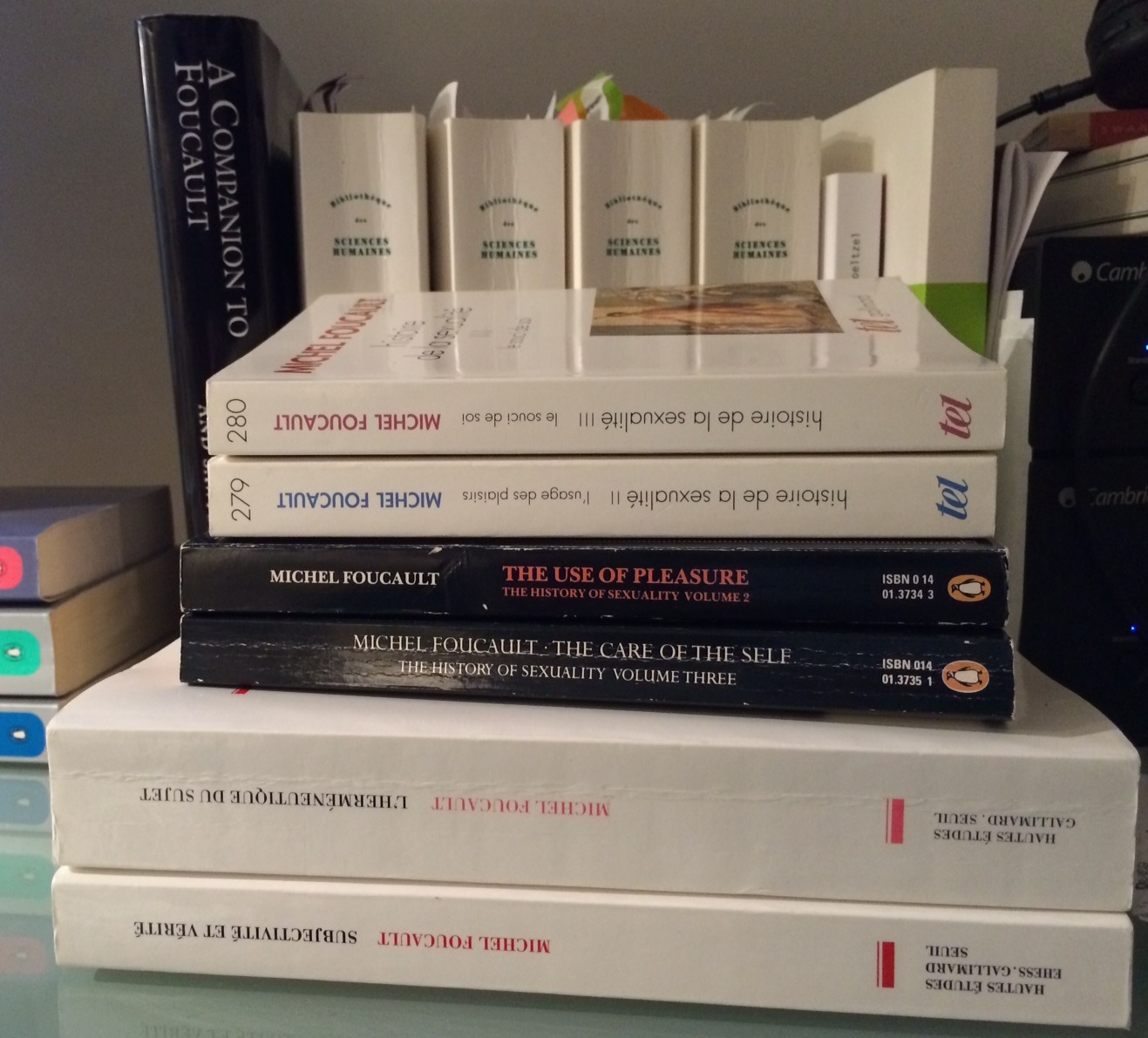
 I’ve made good progress on Chapter 9 around Christmas and the New Year. A productive day in the British Library today filled in some missing references to primary or secondary material Foucault utilised, as well as tracking down two little-known pieces by Foucault himself. I have also updated the list of Foucault’s uncollected notes, lectures and interviews on this site.
The chapter begins with a section on the two different historical plans (as opposed to the 1976 thematic plan) of the History of Sexuality: the one that culminates with a draft of a large manuscript on antiquity in March 1983; and the one that takes that draft and rearranges its contents into the actually published volumes two and three. In the first plan a volume on Christianity will follow as volume III; in the second it is shifted down to be the projected volume IV. I talk a bit about the different arrangements of the material on antiquity, drawing on insights from Daniel Defert and the editors of his courses, as well as all the available materials. It is clear that Foucault did not simply split the March 1983 manuscript in two at the middle. It also has implications for his work on ‘The Care of the Self’, because in early 1983 Le souci de soi is the title for a book separate from the History of Sexuality series; whereas in later 1983 that title is used for a new arrangement of the sexuality material. The original plan for the book of that title comprised quite different material, which Frédéric Gros discusses in some detail in his ‘Course Context’ in The Hermeneutic of the Subject.
I spent quite a bit of time with the Dreyfus and Rabinow interview ‘On the Genealogy of Ethics: An Overview of Work in Progress’. This is a really interesting and important piece, but especially in English the version we are reading is only part of the story. The interview first appeared as a second appendix to the second edition of Dreyfus and Rabinow‘s book on Foucault in late 1983. The interview was heavily edited from transcripts of discussions over three days in April 1983. I read the transcripts at IMEC back when it was based in Paris – the papers are now in Caen. What is interesting about the interview is that by the time it appeared in print in late 1983 Foucault had already changed his mind on some things, not least the arrangement of material across the second and third volumes. So when the Dreyfus and Rabinow book was translated into French in 1984, Foucault took the opportunity to amend the interview. I’d long known this – a translation of the 1983 English version and the 1984 French one appear as separate texts in Dit et écrits (texts 326 and 344). What I hadn’t appreciated was how dramatically different they were. I had initially intended to do the kind of line by line comparison I did of the “Rêver de ses plaisirs” article and the different introductions to the History of Sexuality, but the changes are far too large. What English readers need, really, is a translation of the 1984 version – Foucault doesn’t just fiddle with formulations, or update descriptions of future work, but for several questions he basically deletes the original answer and writes a new one. Of course, such a translation could use the 1983 version as a basis, but that would be most useful for the questions. It’s disappointing that the 1984 version – which is obviously Foucault’s preferred version, and one which accords better with the books he published late in his life – has not been translated, while the 1983 one is continually reprinted (aside from the original book and an abridged version in Vanity Fair, it’s also in The Foucault Reader, Essential Works: Ethics and The Essential Foucault).
As a minor point, I reread the Dits et écrits note to the ‘Maurice Florence’ article on Foucault for the Dictionnaire des philosophes – a note that is only partly reproduced in the English translations. It’s long been known that this text was largely written by Foucault, with small additions by François Ewald. The French note says that this text too was initially an early draft of a version of the introduction to the History of Sexuality – a detail missing from the English translation. I’ve updated the page on the introductions accordingly. However there is a brief introductory paragraph in the Dictionnaire that does not appear in Dits et écrits. While likely the work of Ewald, so too is the first sentence of what does appear there (marked by brackets and a note).
I then go onto a reading of volumes II and III as actually published. I read these first twenty years ago, in the first year of my PhD, and have returned to them periodically since. I confess I previously found them Foucault’s least interesting books, but reading them again, having worked through all the lecture courses and other materials in chronological order, was something of a revelation. They are so dense, deceptively so given the very different writing style to some of Foucault’s earlier books. It’s not so far away from reading Heidegger’s Being and Time in the light of his lecture courses on Aristotle in the 1920s –sections, paragraphs and even lines in the books are the distillation of extensive lecture material. But I’m struck again at how Foucault’s lectures, while preparatory to the books, never map onto them straight-forwardly. Themes are reconfigured, new material is introduced that was never trialled in lectures, and crucial topics in lectures disappear. Volume II especially seems to have had very little exposure to a public audience. Volume III is much more reliant on lectures, especially the Subjectivité et vérité course. Perhaps the chapter I enjoyed the most was ‘The Political Game’ from Part III of Volume III, which despite my interest in politics I’d never really given much thought before. But the account there is very intriguing, especially in terms of Foucault’s account of power.
The last part of this chapter (though I may yet reorganise or split) will be on the final two Paris lecture courses, The Government of Self and Others and The Courage of Truth, along with related materials such as the Fearless Speech lectures. While these begin in early 1983 and so predate the publication of volumes II and III, most of the material for those two books was in place by late 1982/early 1983, and the decisions after that date were largely to do with the rearrangement of material. These two lecture courses open up new and planned projects, never to be realized. Once the discussion of those courses is in place – and I’m hoping to do that over the next two weeks – I will have a just-about-full draft of the book.
You can read more about the Foucault’s Last Decade project, along with links to previous updates, here.