Giorgio Agamben, Pilate and Jesus – forthcoming in February 2015

Giorgio Agamben, Pilate and Jesus, translated by Adam Kotsko – forthcoming in February 2015.

pid_24947

Pontius Pilate is one of the most enigmatic figures in Christian theology. The only non-Christian to be named in the Nicene Creed, he is presented as a cruel colonial overseer in secular accounts, as a conflicted judge convinced of Jesus’s innocence in the Gospels, and as either a pious Christian or a virtual demon in later Christian writings. This book takes Pilate’s role in the trial of Jesus as a starting point for investigating the function of legal judgment in Western society and the ways that such judgment requires us to adjudicate the competing claims of the eternal and the historical. Coming just as Agamben is bringing his decades-long Homo Sacer project to an end, Pilate and Jesussheds considerable light on what is at stake in that series as a whole. At the same time, it stands on its own, perhaps more than any of the author’s recent works. It thus serves as a perfect starting place for readers who are curious about Agamben’s approach but do not know where to begin.


Posted in Giorgio Agamben | Leave a comment

Jennifer Bates and Richard Wilson (eds.), Shakespeare and Continental Philosophy

This looks an interesting collection – Jennifer Bates and Richard Wilson (eds.), Shakespeare and Continental Philosophy.

9780748694945

This collection of 15 essays by celebrated authors in Shakespeare studies and in continental philosophy develops different aspects of the interface between continental thinking and Shakespeare’s plays. The authors draw from current continental philosophy (e.g. Lacan, Foucault, Derrida) as well as from the 19th century continental tradition (e.g. Hegel, Kierkegaard) and from the early roots of continental tradition (e.g. Aristotle, Ibn Sina). The chapters address the span of the tragedies, comedies and history plays in the light of thinkers as diverse as Aristotle, Ibn Sina and Jean-Luc Marion, Hegel, Kierkegaard, Schopenhauer, Schmitt, Arendt, Lacan, Levinas, Foucault and Derrida.


Posted in Books, Carl Schmitt, Hannah Arendt, Jacques Derrida, Michel Foucault, William Shakespeare | Leave a comment

Last lecture of the semester: Foucault and Derrida on Madness

Peter Gratton shares the text of his final lecture, discussing the Foucault-Derrida debate. He has very fortunate students.

Peter Gratton's avatarPHILOSOPHY IN A TIME OF ERROR

Tonight. Below I go over the debate between Foucault and Derrida after a whole semester in which I taught their texts on crime and punishment, but not this particular debate. It’s been a great class. And obviously, anything below is a trying out of certain ideas.

Final Lecture: Differences of Method

This will have been an act of madness: to wait until the last class, in its final hours, to redescribe the relation between Foucault and Derrida in terms of their quite critical debates across 30 years of a limited number of writings. To have read them thus far, side by side, not even concerning the very issues confronting them in those debates (most particularly a few short passages in the opening paragraphs of Descartes Meditations), but instead spending a semester on crime and punishment and the abyssal relation between the two. All then to pass it off to…

View original post 5,873 more words

Posted in Uncategorized | 2 Comments

The Politics of the UK HE Marking Boycott, Part III

Another excellent update on the UK higher education pension situation, and the shameful position of the union.

Lee Jones's avatarThe Disorder Of Things

A brief update. As anticipated in Part II, UCU’s higher education committee voted to suspend the industrial action over pensions until 15 January and enter into negotiations with employers, despite opposition from UCU Left members. Having voted down UCU Left amendments to their negotiating position, the HEC has authorised its representatives to pursue an outcome that implicitly accepts much of the employers’ agenda and envisages sacrificing the 75% of USS members on a final salary pension for a weakly improved career-average scheme for all. It now appears that these proposals were initially discussed at a USS conference with branch delegates in October, but no mandate was given then to pursue the far-reaching changes envisaged, and attendees were actively instructed not to discuss the proposals within their branches. This only confirms my earlier impression that the individuals running UCU have no respect for internal union democracy. They wanted to keep…

View original post 435 more words

Posted in Uncategorized | Leave a comment

Eyal Weizman interview, film screening, Society and Space lecture and review of Forensis forthcoming

A new interview with Eyal Weizman ahead of a film screening in London.

Posted in Uncategorized | Leave a comment

Terry Eagleton reviews Trouble in Paradise and Absolute Recoil by Slavoj Žižek

Terry Eagleton reviews Trouble in Paradise and Absolute Recoil by Slavoj Žižek in The Guardian.

9781781686829-c7d2eddc016118e4fe340d5756263aa6

Here’s the great final paragraph (spoiler alert):

Trouble in Paradise, with its unerring ear for political cant, is a book that everyone, not least the Masters of the Universe, would profit from reading.Absolute Recoil, with its intricate reflections on materialism and dialectics, is likely to have fewer takers. There is less on cant and more on Kant. Even so, it contains some fascinating stuff on Kabbala, slave narratives, espionage, atonal music and God as the supreme criminal. No doubt we shall have a chance to read some of this again in his next few books.

Posted in Slavoj Zizek, Terry Eagleton | 1 Comment

Gastón Gordillo on Forensis: The Architecture of Public Truth

forensis_dustjacket_cover_364Gastón Gordillo has posted the introduction of his review of the Forensis collection, directed by Eyal Weizman. The full review essay will appear in Environment and Planning D: Society and Space in early 2015.

Posted in Eyal Weizman, Gaston Gordillo, Society and Space | Leave a comment

Graham Scambler on Roy Bhaskar (1944-2014)

Graham Scambler has a good discussion of the work of Roy Bhaskar, who died recently.

Posted in Uncategorized | Tagged , | Leave a comment

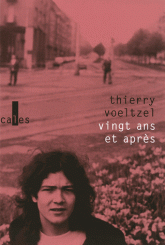
Vingt ans et après. Suivi de Letzlove, l’anagramme d’une rencontre (2014)

This is interesting – a book of interviews with Foucault, who was originally anonymous. The original edition was hard to find. There are some parts in the Jeremy Carrette collection, Foucault and Religion, but as far as I know the rest is not in English.

Clare O'Farrell's avatarFoucault News

voelTh. Voeltzel, M. Foucault, Vingt ans et après. Suivi de Letzlove, l’anagramme d’une rencontre
DATE DE PARUTION : 09/10/14 EDITEUR : Verticales ISBN : 978-2-07-014665-9 EAN : 9782070146659 PRÉSENTATION : Broché NB. DE PAGES : 213 p.

En 1978 paraît aux éditions Grasset, dans la collection ” Enjeux ” de Claude Mauriac, Vingt ans et après, un livre d’entretiens – enregistrés sur cassettes et retranscrits par Mireille Davidovici – entre un parfait inconnu d’un peu plus de vingt ans, Thierry Voeltzel, et un grand philosophe qui avait alors tenu à garder l’anonymat : Michel Foucault – passer son nom sous silence était alors un geste éditorial audacieux.

Le dialogue, organisé de façon thématique, est une conversation informée et vivante. Il révèle la richesse de paroles et de vie des années 70, dix ans après Mai 68, moment intense de mutation de la jeunesse, notamment concernant la sexualité, les drogues, la…

View original post 211 more words

Posted in Uncategorized | Leave a comment

Foucault’s Last Decade – Update 15

Update 15

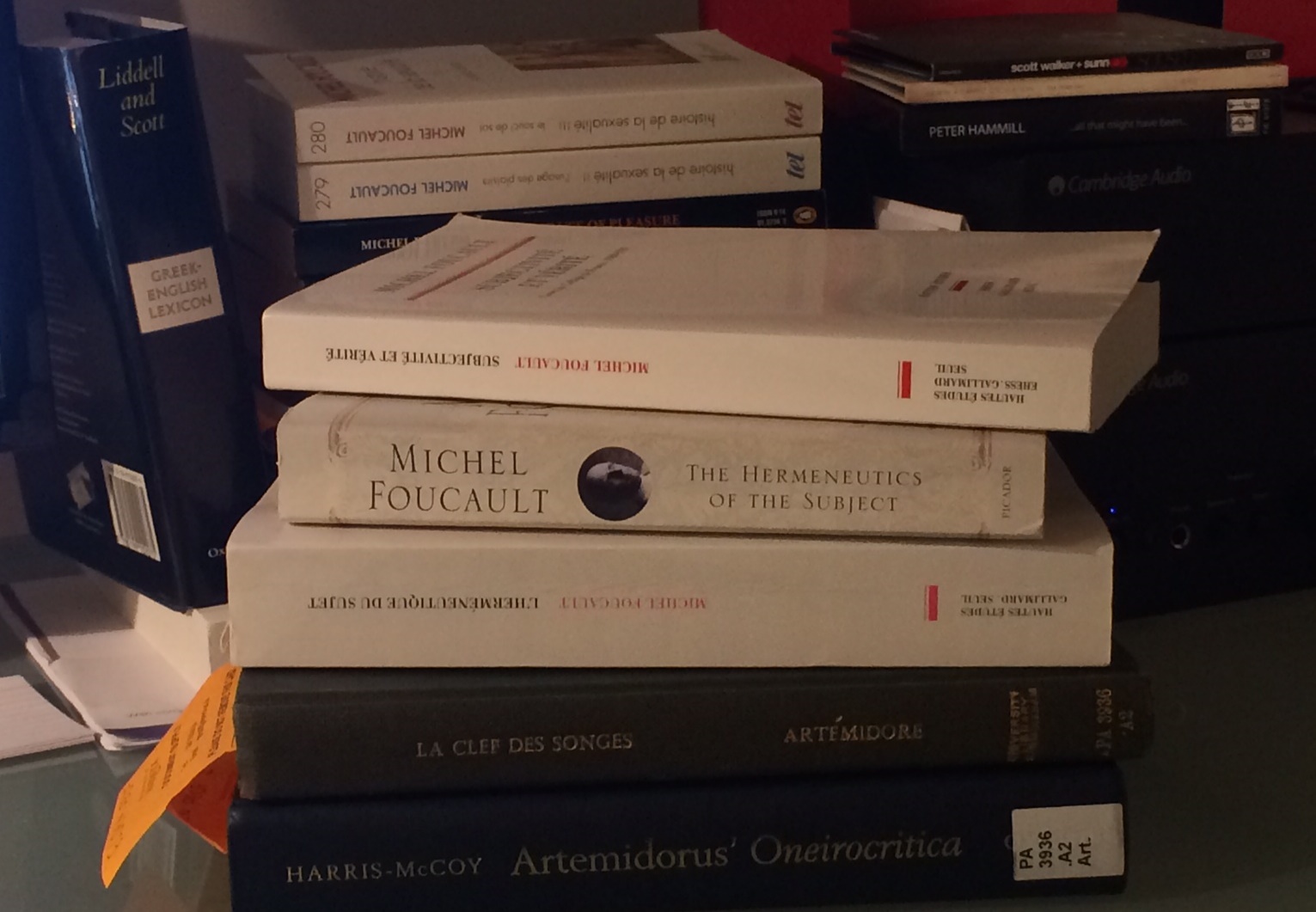
In the past few weeks I have continued working on Subjectivité et vérité and took a very full set of notes, far more than can be contained in this chapter. I gave a talk on this lecture course at Nottingham Contemporary gallery earlier this month, which seemed to go well. As well as discussing some key themes from the course, I also outlined this book project in some detail. The event was filmed, and can be seen here.

I spent a bit of time tracking some of Foucault’s references, especially to Artemidorus’ Onirocritica, and his use of a phrase from Peter Brown, which I thought was interesting enough to discuss in a post on this site.

I then moved onto The Hermeneutic of the Subject. I reviewed the French edition of this text back in 2003 (available here), and used it for a 2005 article on the various forms and detours the History of Sexuality project took – a kind of preview of the work I am now doing in considerably more detail (available here). But this recent reading was the first time I’d worked with the English translation as well as the French, and the discussion of this course will be new. Like the two final courses on parrhesia, this course anticipates a lot of projects Foucault did not live to complete.

While I had worked on the second and third volumes of the History of Sexuality some time ago, I’d deliberately refrained from reading them again before working through these two courses. I wanted to focus on how Foucault introduced the material to his audience in Paris initially, and only then to see how he reworked it for the books themselves. So the next stage will be to reread the books, now I have taken notes on both courses.

Foucault presented material that went into volumes two and three in 1981 and 1982, though much of the 1982 course was never published in book form. If we consider On the Government of the Living, from 1980, as presenting some work from the unpublished volume 4, his lecture courses work backwards while the volumes from 2 onward are presented forwards. This is not uncommon in how historians work, but is revealing in multiple ways. One thing that is noticeable is how in, for example, Subjectivité et vérité, which predominantly deals with Hellenistic and Roman periods, the comparisons forward to early Christianity are more sure-footed than the distinctions suggested from classical (Hellenic) Greece. The classical period is then treated in The Hermeneutic of the Subject in a way that addresses many of the limitations of Subjectivité et vérité. This is only to be expected: while there are discussions of antiquity in Lectures on the Will to Know, Subjectivité et vérité is the first time in his Collège de France lectures Foucault has worked on these specific themes. His lectures were to report on his ongoing research, and it is remarkable how confidently he addresses these texts and their complexities when he has clearly only been engaging with these themes, and these questions, for a limited time. That said, as Frédéric Gros notes in his editorial matter to Subjectivité et vérité, some of the claims of the lectures are toned down or left out of the books.

In addition, there is a lot of material, especially in Hermeneutic of the Subject which does not find its way into these books. The Hermeneutic of the Subject is closer to an elaboration of the originally planned material for a book under the title of The Care of the Self, back when The Use of Pleasure contained the material that eventually was distributed between volumes 2 and 3. In that version, which Daniel Defert says was drafted in May 1983, The Care of the Self was the title of a separate volume, not part of the series. But Foucault used the title for the second half of a new arrangement of the sexuality material. It is also striking that a lot of material in The Use of Pleasure as published was not tried out to his Paris audiences.

All this means is that in almost no instances do we have exact replication of material between lectures and books. Given this is the case for books he published in his lifetime and during his time at the Collège de France – Discipline and Punish, and the three volumes of the History of Sexuality – it cautions against any simple suggestion that the material for promised and unpublished books can be gleaned from the lectures. La société punitive has thematic overlaps with Discipline and Punish, but not a straight-forward equivalence and there are crucial differences of inflection. Much material in The History of Sexuality was not presented in Paris; much that was ended up not being used – the long discussion of Plato’s Alcibiades, for example. The lectures are revealing for the process of his thinking, not the end product.

From all this material I’ve shaped a draft of the first part of Chapter Eight. I now need to work up the notes on The Hermeneutic of the Subject and work through volumes two and three, including the various variant texts of the introduction and related materials. The final Chapter Nine will largely focus on the final two Paris lecture courses and some related materials, including Fearless Speech.

You can read more about the Foucault’s Last Decade project, along with links to previous updates, here.



Posted in Conferences, Foucault's Last Decade, Michel Foucault | 1 Comment