Statements by UCU, VC and concerned Warwick staff about yesterday’s events

Update: there is an Alumni petition here

Update 2: Student Union statement and Amnesty International press release

Update 3: Warwick for Free Education site

Original links:

Statement by Vice-Chancellor, Nigel Thrift

Letter to Registrar from Warwick staff (Update: another version appears here, with more signatories)

Statement by Warwick UCU (below):

Warwick WUCU branch committee are concerned at the incidents which occurred on Wednesday 3rd December in Senate House when a group of Warwick University students, staging a sit-in to protest against university tuition fees, were subject to what appears to be excessive police action.

A video, which was subsequently posted on YouTube, showed students being grabbed and pushed and having their hair pulled, followed by CS spray being used at very close range. Also in the footage, a taser gun can be seen and heard, and there have been subsequent reports that it may have been discharged against one student. At the time of writing, three students are being held at Coventry police station.​

According to reporting in the Coventry Telegraph, the police were called by university officials to attend the protest after a claim that a protester had attacked a member of staff. There is nothing in the video or other reporting to suggest that there was an imminent threat at the time of the police action, and their behaviour appears disproportionate and unacceptable. ACPO guidelines, for example, state that CS spray ‘should not be used at a distance of less than one metre unless the nature of the risk to the officer is such that this cannot be avoided’ – it is not at all clear from the video footage and reporting that there was such a risk. The students state that they had been sitting in a circle discussing free education and the university community and that they had not been informed that the police had been called and nor did the police, on arrival, tell them why they were there.

We call on the university to publicly affirm its commitment to democratic values and the rights of students and staff to protest peacefully against policies and practices with which there is disagreement. The university is our common space and we protest in the strongest terms against the violations that were allowed to take place here today.

Warwick UCU
Posted in Politics, Universities | 2 Comments

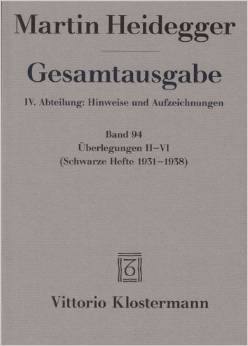
Bibliography of texts discussing Heidegger’s Black Notebooks

UnknownI wouldn’t usually link to Wikipedia, but this is a very useful list of text and recordings that discuss Heidegger’s Schwarze Hefte, the ‘Black Notebooks’.

Thanks to Andrzej Serafin for the work, and for sending me the link.

Posted in Martin Heidegger | 1 Comment

Bal Sokhi-​Bulley on Governmentality at Critical Legal Thinking

Bal Sokhi-Bulley, ‘Governmentality: Notes on the Thought of Michel Foucault‘ at Critical Legal Thinking.


Posted in Michel Foucault | Leave a comment

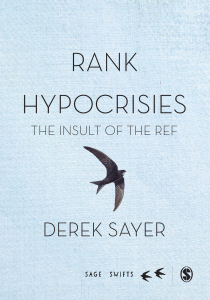
Rank Hypocrisies: The Insult of the REF (when I’m 64)

Derek Sayer’s book on the REF now published – for a short book this is very expensive, but a cheaper e-book is forthcoming.

dereksayer's avatarcoasts of bohemia

Sayer_Rank_SWIFTS copy

UPDATE.  There is a (much cheaper) Kindle edition of this book to come soon, but it is not currently listed on amazon or other sites.

Seems oddly appropriate that I should be celebrating my 64th birthday with a new book that attacks a centerpiece of the unholy alliance of neoliberalism and Old Corruption that has been running and ruining British universities for the last thirty years.  Published December 3, 2015.  Lets hope it has “impact”! For more details see here.

View original post

Posted in Uncategorized | Leave a comment

The Guardian on events at Warwick University yesterday

I was away from Warwick yesterday, examining a PhD at Aberystwyth. Story and video in The Guardian.

Three people have been arrested and police officers accused of using excessive force after a Taser was pulled on students amid violent scenes at a sit-in for a free education on Wednesday.

Students at the University of Warwick say they were sitting down discussing tuition fees after a national student protest when the police arrived…


Posted in Universities | Leave a comment

Tareq A. Ramadan on ‘ISIL, Coins, and the Caliphate’

A fascinating guest post at Juan Cole’s ever-interesting Informed Comment on “ISIL, Coins, and the Caliphate”.

It has been recently reported by Daesh (what most Arabs call the self-styled “Islamic State Group” or IS) that it will be producing and circulating its own coinage in an attempt to purportedly offset the popularity and usage of secular, Western currencies which they dub the “oppressor’s money” [1]. For Daesh, the issuing of its own coins will, allegedly, be an extension of a policy also aimed at preventing usury (i.e. charging interest) which is a practice forbidden under Islamic law…

Posted in Uncategorized | Leave a comment

George Monbiot on land ownership in Britain

Illustration by Sébastien ThibaultInteresting piece by George Monbiot on land ownership in The Guardian, but fully referenced on his website.

Posted in Uncategorized | 1 Comment

Giorgio Agamben, Pilate and Jesus – forthcoming in February 2015

Giorgio Agamben, Pilate and Jesus, translated by Adam Kotsko – forthcoming in February 2015.

pid_24947

Pontius Pilate is one of the most enigmatic figures in Christian theology. The only non-Christian to be named in the Nicene Creed, he is presented as a cruel colonial overseer in secular accounts, as a conflicted judge convinced of Jesus’s innocence in the Gospels, and as either a pious Christian or a virtual demon in later Christian writings. This book takes Pilate’s role in the trial of Jesus as a starting point for investigating the function of legal judgment in Western society and the ways that such judgment requires us to adjudicate the competing claims of the eternal and the historical. Coming just as Agamben is bringing his decades-long Homo Sacer project to an end, Pilate and Jesussheds considerable light on what is at stake in that series as a whole. At the same time, it stands on its own, perhaps more than any of the author’s recent works. It thus serves as a perfect starting place for readers who are curious about Agamben’s approach but do not know where to begin.


Posted in Giorgio Agamben | Leave a comment

Jennifer Bates and Richard Wilson (eds.), Shakespeare and Continental Philosophy

This looks an interesting collection – Jennifer Bates and Richard Wilson (eds.), Shakespeare and Continental Philosophy.

9780748694945

This collection of 15 essays by celebrated authors in Shakespeare studies and in continental philosophy develops different aspects of the interface between continental thinking and Shakespeare’s plays. The authors draw from current continental philosophy (e.g. Lacan, Foucault, Derrida) as well as from the 19th century continental tradition (e.g. Hegel, Kierkegaard) and from the early roots of continental tradition (e.g. Aristotle, Ibn Sina). The chapters address the span of the tragedies, comedies and history plays in the light of thinkers as diverse as Aristotle, Ibn Sina and Jean-Luc Marion, Hegel, Kierkegaard, Schopenhauer, Schmitt, Arendt, Lacan, Levinas, Foucault and Derrida.


Posted in Books, Carl Schmitt, Hannah Arendt, Jacques Derrida, Michel Foucault, William Shakespeare | Leave a comment

Last lecture of the semester: Foucault and Derrida on Madness

Peter Gratton shares the text of his final lecture, discussing the Foucault-Derrida debate. He has very fortunate students.

Peter Gratton's avatarPHILOSOPHY IN A TIME OF ERROR

Tonight. Below I go over the debate between Foucault and Derrida after a whole semester in which I taught their texts on crime and punishment, but not this particular debate. It’s been a great class. And obviously, anything below is a trying out of certain ideas.

Final Lecture: Differences of Method

This will have been an act of madness: to wait until the last class, in its final hours, to redescribe the relation between Foucault and Derrida in terms of their quite critical debates across 30 years of a limited number of writings. To have read them thus far, side by side, not even concerning the very issues confronting them in those debates (most particularly a few short passages in the opening paragraphs of Descartes Meditations), but instead spending a semester on crime and punishment and the abyssal relation between the two. All then to pass it off to…

View original post 5,873 more words

Posted in Uncategorized | 2 Comments