‘Maurice Florence’ on Michel Foucault – the missing opening paragraph

One of the things I’ve been doing with the Foucault’s Last Decade project is checking the original publication of texts in several instances, rather than relying on the reprints in Dits et écrits. Sometimes this is because the company Foucault is in can be revealing, or where there were notes or introductions which are removed when it was reprinted. The editors of Dits et écrits sometimes include notes beyond those of Foucault’s, and these are not always marked. So it can be useful to check.

One interesting text which is different in the original to the version in Dits et écrits is the text written by ‘Maurice Florence’, i.e. ‘MF’, which is a thinly-disguised autobiographical work. Foucault co-wrote the text with François Ewald, who was one of the editors of Dits et écrits, along with Daniel Defert. Foucault’s text came from an early version of the introduction to Volume II of the History of Sexuality (for a discussion, see here). In the Dits et écrits version, the opening line is enclosed in brackets, with the note explaining that this was written by Ewald – presumably this alone then, and the rest by Foucault. The version in Essential Works Vol II replicates this format, in a translation by Robert Hurley. There are, though two earlier translations – one by Jackie Urla in History of the Present No 4, and one by Catherine Porter in 1994 for The Cambridge Companion to Michel Foucault. The second edition of The Cambridge Companion does not include this text, with the editor Gary Gutting suggesting that it would be redundant given it is available in Essential Works.

The original publication, in the Dictionnaire des philosophes, begins with this paragraph:

9782130455240FSIl est sans doute encore trop tôt pour apprécier la rupture introduite par Michel Foucault, professeur au Collège de France (chaire d’histoire des systèmes de pensée) depuis 1970, dans un paysage philosophique jusqu’alors dominée par Sartre, et ce que ce dernier désignait comme la philosophie indépassable de notre temps: le marxisme. D’emblée, dès l’Histoire de la folie (1961), Michel Foucault est ailleurs. Il ne s’agit plus de fonder la philosophie sur un nouveau cogito, ni de developer en système des choses jusqu’alors caches aux yeux du monde, mais plutôt d’interroger ce geste énigmatique, peut-être caractéristique des societies occidentales par lequel se trouvent constitutes des discours vrais (donc aussi de la philosophie) avec le pouvoir que l’on sait.

Dictionnaire des philosophes, edited by Denis Huisman, Paris: PUF, Two Volumes, 1984, Vol I, p. 941.

This paragraph is translated in The Cambridge Companion (first edition), but not in Essential Works.

case6.000x9.000.inddIt is doubtless too early to assess the break introduced by Michel Foucault, who has been Professor at the Collège de France (he holds the Chair of the History of Systems of Thought) since 1970, in a philosophic landscape previously dominated by Sartre and by what Sartre called the unsurpassable philosophy of our time, Marxism. From the outset, starting with The History of Madness (1961), Michel Foucault situates himself elsewhere. It is no longer a question of basing philosophy on a new cogito, or of developing a system of things previously hidden from the eyes of the world, but rather of interrogating the enigmatic gesture – a gesture that may be characteristic of Western society – through which true discourses (thus also those of philosophy) are constituted, with their familiar power.

Maurice Florence, “Foucault, Michel, 1926 – “, in Gary Gutting (ed.), The Cambridge Companion to Foucault, Cambridge: Cambridge University Press, 1994, p. 314.

As a paragraph by Ewald, there is clearly a reason for its excision, though it could have been marked in the same way as the sentence by him that was included. Yet equally, Foucault approved the text for the Dictionnaire; it is part of an integral work; and this is an interesting way of positioning his work. Other texts included – such as discussions following lectures, or roundtables – have words from others alongside Foucault’s.

The Cambridge Companion first edition is, of course, out of print, as it has been replaced by the second edition. The Dictionnaire des philosophes is in print, and there is a 2009 edition – I’m not sure if the Foucault text in that is still the one by ‘Maurice Florence’. [Update: The full French text is available here.] Given the historical interest of this presentation, it seemed worthwhile to make this paragraph, in French and English, available again.

(This post is part of the Foucault Resources part of this site, which also includes bibliographies, links to audio and video recordings, some textual comparisons, a few brief translations, and some other pieces.)
Posted in Foucault's Last Decade, Michel Foucault, Publishing | 2 Comments

CFP Contested Spaces of Citizenship – Durham, 29 April 2015

Postgraduate Conference: CONTESTED SPACES OF CITIZENSHIP

Durham University, Department of Geography, 29 April 2015

Keynote speaker: Professor Engin F. Isin

Space is at the core of political struggles and contestations. Brown (2010) highlights how borders and territory are, almost paradoxically, increasingly important in a globalised world. In this neoliberal era borders are apparently more detached from their geographical location (Sassen 2005; Bigo and Guild 2005), yet an increase in international migration has highlighted the violence at the borderzone (Bigo 2007). Along with the idea of a borderless world a new form of spatial management became relevant, the space of camp (Agamben 1998; Minca 2005) that is proliferating as a way of managing those who trouble the territorial order, such as the Roma (Sigona 2005), refugees and asylum-seekers (Hyndman 2000), and undocumented migrants (De Genova and Peutz 2010). At the same time, these camps also produce new forms of resistance and everyday practices (Ramadan 2013; Sigona 2014).

In this postgraduate conference the notion of political space will be investigated in relation to the concept of citizenship. Citizenship is more than membership, it is a way of being political (Isin 2002) that emerges through struggles. Citizenship is also fundamentally spatial: space “is a fundamental strategic property by which groups […] are constituted in the real world” (Isin 2002, p. 49). Space is crucial to the creation, embodiment and lived experiences of political subjects. It is in spaces of encounter and struggles that new and old political subjectivities are contested and resisted. Space is not only the neutral background of political struggles. It is actively and strategically used, as tool to disempower abject subjects (Isin and Rygiel 2007), but also as a resource for enacting new scripts of activist citizens, not only through contestation but also through solidarity (Isin and Nielsen 2008). At the same time, space is constituted by political struggles and forms of citizenship, affecting the ways in which new political subjects come to emerge, for instance traversing and interstitial spaces can generate opportunities to rethink political subjectivities (Isin 2012).

This one-day conference aims to bring together postgraduate students working on issues of politics and space, territory and borders as sites of struggles, control, contestation, resistance and solidarity among political subjects. We also encourage papers based upon collaborative and participatory research.

More details here. 

Posted in Conferences, Politics | 1 Comment

Ebola in Sierra Leone: News from the Frontline – Peter Penfold at African Arguments

I’ve not been updating the Ebola reading list much recently, but this is an interesting piece on ‘Ebola in Sierra Leone‘ by Peter Penfold, former British High Commissioner to the country.

Posted in Ebola, Politics | Leave a comment

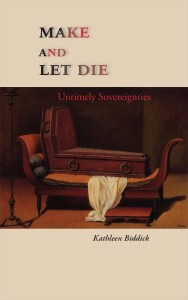
Kathleen Biddick, Make and Let Die: Untimely Sovereignties – forthcoming from Punctum Books

Biddick_Cover_Front_Gaines_WEBKathleen Biddick’s Make and Let Die: Untimely Sovereignties is forthcoming from Punctum Books.

This collection of essays by one of medieval studies’ most brilliant and prescient historians argues that the analysis and critique of biopower, as conventionally defined by Michel Foucault and then widely assumed in much contemporary theory of sovereignty, is a sovereign mode of temporalization caught up in the very time-machine it ostensibly seeks to expose and dismantle… (more here)


Posted in Michel Foucault, Politics, Publishing | Leave a comment

Little plastic bodies

A nice post which discusses the animated films made by Juliet Fall, one of which was about The Birth of Territory.

benjaminthomaswhite's avatarSingular Things

Stuart Elden is a professor of geography and political theory at Warwick University (UK) and Monash University (Australia). His fearsome appetite for hard books is charted at his blog Progressive Geographies*, which also includes all sorts of useful resources, from bibliographies on Boko Haram and the Ebola crisis to compilations of material by and about Foucault and Lefebvre.

9780226202570He’s also recently published a Big Book: The Birth of Territory, a history of a key concept in political geography from the classical to the early modern period. I’ve just bought a copy: some of my current research on refugee camps involves thinking about them in the Foucauldian terms of population and territory that Elden explores. (I’ll be reading a lot more work in geography over the next few years, I suspect.) It’ll be interesting to see what impact it has in history departments, but it’s already made a splash…

View original post 265 more words

Posted in The Birth of Territory | Leave a comment

Neoliberal Dogma? Revisiting Foucault on Social Security, Healthcare, and Autonomy (Pt. I of II)

Another contribution to the ‘Foucault and neoliberalism’ debate.

Posted in Uncategorized | 1 Comment

Media Practices and Urban Politics: A Conversation about Slow Theory

A conversation at the Society and Space open site, with the relevant paper in the journal open access for a month.

Posted in Uncategorized | 1 Comment

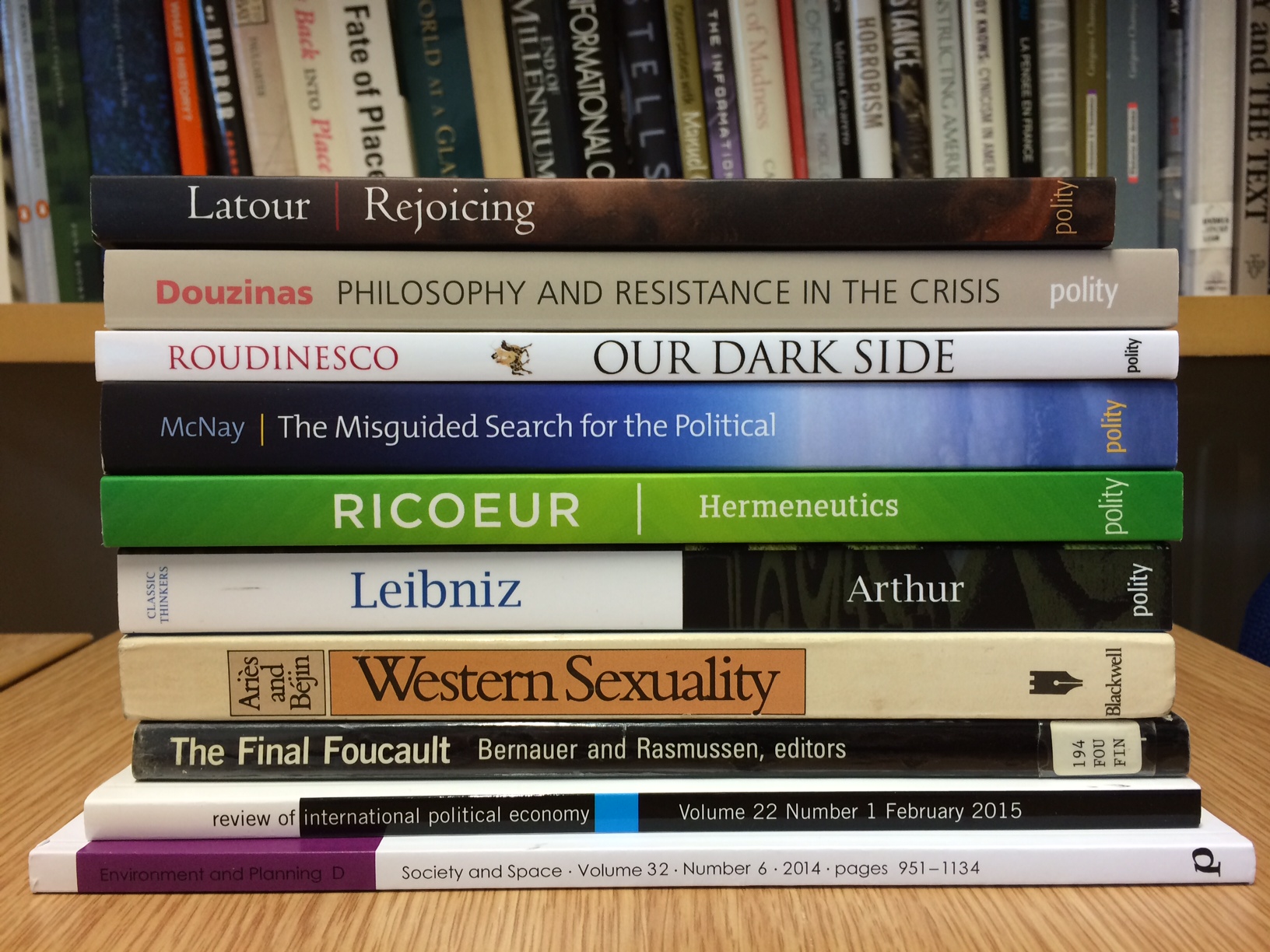
Books received – Latour, Douzinas, Roudinesco, McNay, Ricoeur, Leibniz, Western Sexuality and The Final Foucault

photo

Six books from Polity in recompense for review work; second-hand copies of Western Sexuality and The Final Foucault; and the new issues of Society and Space and RIPE.

Posted in Uncategorized | 1 Comment

Top posts on Progressive Geographies this week

Posted in Uncategorized | Leave a comment

Foucault on Parrēsia – translation of a 1982 lecture in Critical Inquiry (now available)

winter2015largeimageA lecture by Foucault in 1982 at Université de Grenoble, on “Parrēsia” was first published in French in 2012 in the journal Anabases; it is now published in English in Critical Inquiry, translated by Graham Burchell (requires subscription). It is followed by a discussion.

Here are the first two paragraphs:

Thank you very much for inviting me. I am here, as you know, as a supplicant. What I mean is that, until four or five years ago, my field, at any rate the domain of my work, had scarcely anything to do with ancient philosophy; and then, following a number of zigzags, detours, or steps back in time, I began to say to myself that, after all, it was very interesting.  So I come to ancient philosophy as part of the work I am doing.  One day, when I was asking him some questions, telling him about my problems, Henri Joly was kind enough to say that you might agree to discuss my work with me, in its present imperfect state.  It is some material, some references to texts, some indications; what I am going to sketch out to you is therefore incomplete, and, if you were willing, it would be very good of you, first, to call out if you can’t hear me, stop me if you do not understand or if it’s not clear, and then anyway, at the end, tell me what you think.

So, to start with, this is how I came to be asking myself this set of questions.  What I had been studying for really quite a long time was the question of the obligation to tell the truth:  what is this ethical structure internal to truth-telling, this bond that, beyond necessities having to do with the structure or reference of discourse, means that at a given moment someone is obliged to tell the truth?  And I tried to pose this question, or rather I encountered this question of the obligation to tell the truth, of, if you like, the ethical foundation of truth-telling, with regard to truth-telling about oneself.  In actual fact it seems to me that I encountered it several times.  First of all in medical and psychiatric practice since, from a given moment, which is moreover quite precise and can be pinpointed at the beginning of the nineteenth century, we see the obligation to tell the truth about oneself becoming part of the great ritual of psychiatry.  Obviously we come across this problem of truth-telling about oneself in judicial practice and more especially in penal practice.  And, finally, I came across it for the third time with regard to, let’s say, problems of sexuality and more precisely of concupiscence and the flesh in Christianity.


Posted in Conferences, Foucault's Last Decade, Michel Foucault, Publishing | 1 Comment